Best Vanna AI Alternatives for Text-to-SQL in 2026
By the InfiniSynapse Data Team · Published: 2026-06-23 · Last updated: 2026-07-28 · Next review: 2026-10-28 · About / Team: https://infinisynapse.com/en/editorial-standards (#about)
Named authors & credentials (Authority): William Zhu — InfiniSynapse cofounder; public professional background: GitHub @allwefantasy (InfiniSQL / open-source data systems). Desk contact: zhuhl@infinisynapse.com. Page reviewers with published industry resumes / qualification frames: data platform, analytics engineering, LLM security (OWASP LLM Top 10 + NIST AI RMF), editor. Traceable org + individual authority: About / team page · who reviews · InfiniSynapse org on GitHub.
Disclosure: we build InfiniSynapse, an AI-native Data Agent platform and sell in this space; InfiniSynapse appears only where a governed text-to-SQL / Data Agent path is genuinely relevant, and every external link points to the source it names.
External validation status. Third-party frameworks / peer signals (not InfiniSynapse product claims): BIRD, Spider, NIST AI RMF, OWASP LLM Top 10, ISO/IEC 27001, ISO/IEC 42001, Stanford HAI AI Index, Gartner Peer Insights — Analytics & BI, G2 Analytics Platforms. External peer-review / audit archive (empty until first submission): peer-review archive. This page is vendor-affiliated; it is not a commissioned independent audit.
Table of Contents
- TL;DR
- Why This Matters in 2026
- Definition
- RAG Text-to-SQL vs Governed Alternatives
- Core Capabilities
- NL2SQL Benchmarks: Spider and BIRD
- Buyer Scorecard
- Vendor Landscape
- Implementation Patterns
- Governance and Trust
- InfiniSynapse Production Pattern
- Common Failure Modes
- Operational checkpoints
- Glossary
- FAQ
- Who wrote this
- References
- Conclusion
TL;DR
Direct answer: vanna ai alternatives matter when RAG-on-DDL pilots stall in production—teams need semantic grounding, validation loops, and audit beyond training examples on raw schema.
Who this is for: analytics leaders, data engineers, and procurement teams evaluating vanna ai alternatives in 2026.
What you'll learn:
- A citable definition and production trade-offs for vanna ai alternatives
- How Spider and BIRD inform—but do not replace—warehouse evaluation [1][2]
- A six-dimension buyer scorecard with pass/fail signals for vanna ai alternatives
- Vendor archetypes and rollout patterns that survive compliance review
Start with the cluster hub Best AI Tools for Data Analysis in 2026 when scoping platform-wide analytics strategy. Adjacent depth: NL2SQL Benchmark Spider BIRD.
Why This Matters in 2026
Three forces pushed vanna ai alternatives from pilot curiosity to procurement priority:
- Production accuracy — RAG on DDL breaks with schema drift
- Governance gaps — Training examples do not enforce row-level access
- Agent expectations — Multi-step analysis exceeds single-shot SQL
Independent adoption context from the Stanford HAI AI Index [3] tracks the same shift from demo workflows to governed analytics loops that drive demand for vanna ai alternatives. Category buyer signals (not our product claims) include Gartner Peer Insights — Analytics & BI and G2 Analytics Platforms [4][5].
| Symptom without governance | What breaks |
|---|---|
| Same question, different SQL | Trust collapses after one wrong number |
| No audit trail on AI outputs | Compliance blocks production access |
| Analysts re-explain definitions | Pilots stall in review |
| Ungoverned self-serve | Metric sprawl amplifies across teams |
For adjacent depth on the same cluster, see InfiniSynapse vs Hex: AI Data Analysis Compared (2026) and Best Hex Alternatives for AI Data Analysis in 2026.
Definition
Citable definition: vanna ai alternatives are text-to-SQL platforms that improve on RAG-only patterns with semantic layers, agent orchestration, validation, and enterprise governance.
The definition has four non-negotiable properties:
| Property | Meaning |
|---|---|
| Grounding | Answers compile against approved metrics or schema context |
| Explainability | Reviewers see SQL, steps, and assumptions |
| Governance | Access rules apply at compile time |
| Repeatability | Tenth-run quality matches week-one baselines |
vanna ai alternatives are not a one-shot prompt demo. Production systems optimize for correct, reviewable outputs—not fluent paragraphs alone. The NIST AI Risk Management Framework [6] is a useful map for reviewers validating generated logic and residual risk.
RAG Text-to-SQL vs Governed Alternatives
| Dimension | Traditional approach | vanna ai alternatives approach |
|---|---|---|
| Grounding | Documentation RAG | Semantic metric compilation |
| Validation | Optional execute | Baseline compare plus review |
| Memory | Retrain examples | Workflow memory for fixes |
| Audit | Limited | Full replay logs |
Choose legacy patterns when metrics are fixed and audiences consume the same views weekly. Choose vanna ai alternatives when stakeholders ask unpredictable questions, definitions span domains, or analysts spend hours rewriting the same logic. Separating display layers from analysis execution still benefits from the Wikipedia business intelligence overview [7].
Core Capabilities
Production evaluations of vanna ai alternatives should verify four capability areas:
Training/RAG
Vanna trains on DDL and examples; alternatives add semantic contracts. Open-source RAG remains a strong pilot path when marts are curated and reviewers stay in the loop.
Semantic layer
dbt MetricFlow and Snowflake semantic views / Cortex Analyst [8][9] reduce join errors by compiling natural language against governed metrics rather than raw table dumps.
Agent orchestration
Multi-step plans for diagnostic questions. Agent safety expectations should reference Anthropic research on reliable tool use [10].
Eval scorecard
Use Evaluate Text to SQL Accuracy on real workloads—not only vendor demo schemas.
NL2SQL Benchmarks: Spider and BIRD
Public benchmarks help buyers interpret claims about vanna ai alternatives without treating leaderboard ranks as deployment guarantees.
Spider (yale-lily.github.io/spider) is the long-standing cross-domain text-to-SQL suite focused on schema generalization across databases [1]. Its main signal is whether a model maps a question to correct SQL given a known schema—not whether that SQL encodes your organization's metric contracts.
BIRD (bird-bench.github.io) raises the bar with larger, dirtier databases (12,751 text-to-SQL pairs across 95 databases / ~33.4 GB in the published paper), value grounding, external knowledge, and efficiency [2]. In the NeurIPS 2023 paper, GPT-4 reached 54.89% execution accuracy versus a human ceiling of 92.96%—evidence that even strong models still lag expert humans on realistic schemas.
| Benchmark | What it stresses | Production caveat |
|---|---|---|
| Spider | Cross-domain schema / SQL structure | Does not encode your metric definitions |
| BIRD | Dirty values, knowledge, efficiency | Still not your warehouse contracts |
Use leaderboard execution accuracy as a directional filter, then validate any candidate against analyst-reviewed tickets on your own marts. Deeper framing: NL2SQL Benchmark Spider BIRD.
Buyer Scorecard
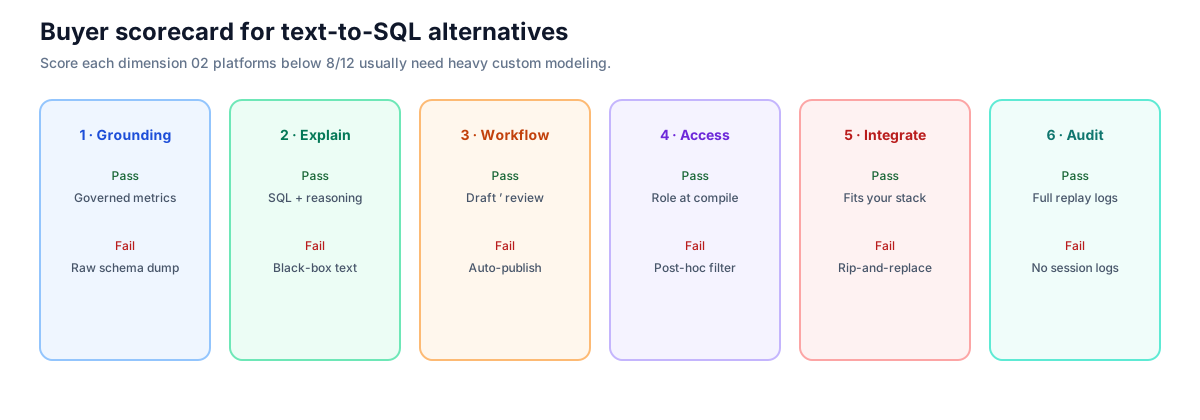
Score each dimension 0–2 when evaluating vanna ai alternatives:
| Dimension | Pass signal | Fail signal |
|---|---|---|
| Metric grounding | Compiles against governed definitions | Raw schema dump only |
| Explainability | Shows SQL + reasoning | Black-box paragraph |
| Human workflow | Draft → review → publish | Auto-send to executives |
| Access control | Role rules at query time | Post-hoc filtering |
| Integration | Works with existing stack | Rip-and-replace required |
| Audit trail | Replay any generated query | No logs after session |
Platforms scoring below 8/12 usually require heavy custom modeling before vanna ai alternatives reach production trust. Multi-source design should keep domain boundaries explicit as scope grows (Microsoft data architecture guidance [11]).
Vendor Landscape
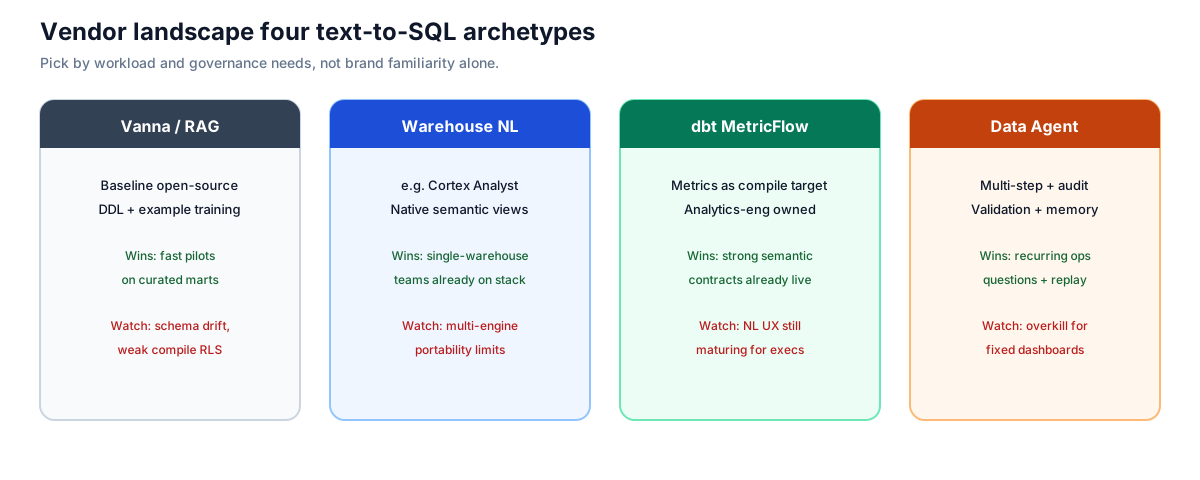
The market for vanna ai alternatives spans multiple archetypes in 2026:
Vanna (baseline)
Open-source RAG SQL popular for pilots—and the baseline many vanna ai alternatives shortlists start from. Strong when you own ops and can constrain schemas; weak when executive metrics need compile-time contracts.
Warehouse NL
Snowflake Cortex Analyst [9] for Snowflake-centric teams that want warehouse-native semantic grounding.
dbt MetricFlow
Governed metrics as the NL compile target via MetricFlow [8]—best when analytics engineering already owns the semantic layer.
Governed Data Agent platforms
Multi-step analysis with validation, memory, and replay. Pick this archetype when recurring operational questions outgrow single-shot SQL.
| Archetype | Wins when | Watch-outs |
|---|---|---|
| Vanna / RAG | Fast pilot on curated marts | Schema drift, weak RLS |
| Warehouse NL | Single-warehouse stack | Portability across engines |
| MetricFlow | Strong dbt ownership | NL UX still maturing |
| Data Agent | Multi-step + audit needs | Overkill for fixed dashboards |
Implementation Patterns
Use these patterns when rolling out vanna ai alternatives beyond a weekend prototype.
Pattern A — RAG pilot
Start Vanna on curated marts—not raw schema.
Pattern B — Add semantic layer
Promote successful queries to governed metrics.
Pattern C — Agent upgrade
Move recurring questions to SQL agents.
Week-one checkpoint
Confirm executive sponsors named a metric council chair, reviewers know the approval UI, and the pilot question set matches last quarter's analyst tickets—not vendor demo prompts.
LLM-backed analytics should account for risks in the OWASP Top 10 for LLM Applications [12], especially when connectors expose production schemas.
Governance and Trust
vanna ai alternatives fail in production when controls are an afterthought:
| Risk | Mitigation |
|---|---|
| Wrong metric compiled | Bind NL to semantic layer |
| Prompt injection | Sandboxed execution, allow-listed tables |
| Data exfiltration | Row-level security at compile time |
| Unreviewed AI narratives | Mandatory analyst approval gate |
| Model drift | Version prompts and track accuracy weekly |
Regulated rollouts often anchor access reviews to ISO/IEC 27001 [13] when credentials and audit logs are in scope. Public-sector buyers should also review ISO/IEC 42001 [14] when procuring analytics agents.
InfiniSynapse Production Pattern
Disclosure: this is our product—use it only where a governed Data Agent matches your need; RAG pilots or warehouse-native NL may be enough for simpler estates.
InfiniSynapse competes with Vanna on production text-to-SQL: semantic grounding instead of DDL-only RAG, validation against analyst baselines, durable memory when fixes land, and audit trails for compliance—not just training-loop convenience.
Customers often start with analyst-reviewed workflows, then graduate to agentic mode once metric councils stabilize. vanna ai alternatives remain the right entry framing for risk-averse teams; autonomy compounds value on recurring operational questions.
ClickHouse connector paths should align with ClickHouse documentation [15] for table engines, sampling, and query guardrails.
Common Failure Modes
Most vanna ai alternatives programs fail in predictable ways.
Failure 1 — Training on raw production DDL: Guarantees wrong joins.
Failure 2 — No eval scorecard: Accuracy guesses until executive review fails.
Failure 3 — Skipping semantic layer: See failure modes in Why Text-to-SQL Fails.
Failure 4 — Open-source without ops: Self-host burden underestimated.
Analytics uptime improves when teams borrow Google SRE practices [16]—error budgets and blameless postmortems for failed query chains.
Operational checkpoints
Four production checkpoints for vanna ai alternatives (not a repeating template):
- Baseline disagreement log — Capture reviewer disagreements when published outputs differ from finance baselines; small deltas erode executive trust quickly.
- Schema-drift coupling — Log drift events alongside accuracy reviews so engineers know whether to fix prompts or semantic models.
- Persona return rate — Measure return usage by persona after week four; drop-off usually means latency, wrong metrics, or missing approval clarity.
- Signed metric ownership — Record which metric council member signed each published answer so audit can replay responsibility chains.
Glossary
| Term | Meaning in this guide |
|---|---|
| vanna ai alternatives | Text-to-SQL platforms that add semantic grounding, validation, orchestration, and governance beyond RAG-on-DDL |
| RAG NL2SQL | Retrieving DDL/docs/examples to prompt an LLM that emits SQL |
| Semantic layer | Contract layer for metric IDs, joins, grain, and filters shared by BI and agents |
| Execution accuracy (EX) | Share of questions whose predicted SQL returns the correct result set |
| Compile-time governance | Enforcing access and metric bindings before SQL executes |
Frequently Asked Questions
What is it in simple terms?
It is a governed approach to vanna ai alternatives: reviewable SQL, metric grounding, and audit—not chatbot fluency alone.
How is it different from a generic AI chatbot?
Generic chatbots optimize for fluent text without guaranteed correctness. Governed analytics systems compile against your metrics with lineage and access controls.
Do I need a semantic layer?
For demos, no. For production access touching recurring executive metrics, yes—otherwise logic compiles against raw schema names and joins drift.
Can it replace my existing BI stack?
Usually no—it complements BI and notebooks by handling ad-hoc and recurring questions outside pre-built dashboards.
How long does rollout take?
A focused pilot of vanna ai alternatives with five governed metrics and one review workflow often takes 4–6 weeks. Enterprise-wide adoption takes quarters.
Who wrote this
Named author. William Zhu — InfiniSynapse cofounder. Professional background (public): GitHub @allwefantasy. Org profile: github.com/InfiniSynapse.
Team byline & About page. Published by the InfiniSynapse Data Team. Public About / Team page: https://infinisynapse.com/en/editorial-standards · About InfiniSynapse · Named accountability & team.
Reviewer credentials (published resumes). Analytics engineering · Data platform · LLM security · Editor.
Corrections & external peer review. zhuhl@infinisynapse.com · corrections policy · peer-review archive.
Suggested citation
APA (7th): InfiniSynapse Data Team. (2026, July 28). Best Vanna AI alternatives for text-to-SQL in 2026. InfiniSynapse. https://infinisynapse.com/en/blog/vanna-ai-alternatives
References
- [Benchmark] Yale LILY Lab. Spider: A Large-Scale Human-Labeled Dataset for Complex and Cross-Domain Semantic Parsing and Text-to-SQL Task. yale-lily.github.io/spider
- [Benchmark] Li et al. Can LLM Already Serve as A Database Interface? A BIg Bench for Large-Scale Database Grounded Text-to-SQLs (BIRD). NeurIPS 2023. bird-bench.github.io · paper
- [Independent] Stanford HAI. AI Index. hai.stanford.edu/ai-index
- [Independent] Gartner Peer Insights. Analytics and Business Intelligence Platforms. gartner.com
- [Independent] G2. Analytics Platforms category. g2.com
- [Standard] NIST. AI Risk Management Framework (AI RMF 1.0). nist.gov
- [Reference] Wikipedia. Business intelligence. en.wikipedia.org
- [Docs] dbt Labs. MetricFlow. docs.getdbt.com
- [Docs] Snowflake. Cortex Analyst. docs.snowflake.com
- [Research] Anthropic. Research. anthropic.com/research
- [Docs] Microsoft. Azure Architecture — Data guide. learn.microsoft.com
- [Standard] OWASP. Top 10 for LLM Applications. owasp.org
- [Standard] ISO/IEC. 27001 — Information security management. iso.org
- [Standard] ISO/IEC. 42001:2023 — AI management systems. iso.org
- [Docs] ClickHouse. Documentation. clickhouse.com/docs
- [Reference] Google. Site Reliability Engineering. sre.google
- [Policy / About] InfiniSynapse. About the research desk & editorial standards. infinisynapse.com/en/editorial-standards
- [Person] William Zhu. Cofounder, InfiniSynapse — public engineering profile. github.com/allwefantasy
Conflict-of-interest note: InfiniSynapse is our product and competes with several archetypes referenced here; recommendations are framed as a rubric you can apply to any vendor.
Conclusion
Buyers who shortlist vanna ai alternatives on grounding, explainability, and review workflow—before chasing leaderboard sparkle—are the ones whose pilots survive the first executive review. Prefer shared metric contracts, tenth-run accuracy on your own tickets, and replayable audit trails over demo-day fluency when shortlisting vanna ai alternatives.
Next steps:
- Read Why Text-to-SQL Fails before scaling.
- Compare InfiniSynapse vs Hex for notebook-class tools.
- See Evaluate Text to SQL Accuracy for eval scorecards.
- Cross-check public NL2SQL claims against Spider and BIRD, then re-run on your marts.
When recurring questions outgrow pilot scope, evaluate AI-native Data Agents that compile, execute, and audit in one loop—with the same governed metrics your vanna ai alternatives evaluation established. Cap pilot scope to one department until reviewer agreement stays high for two consecutive weeks.