Text to SQL in 2026: Accuracy, Governance, and Production Fit
By William Zhu & the InfiniSynapse Data Team · Published: 2026-06-23 · Last updated: 2026-07-31 · About: Editorial standards / policy · About / team · Company Vision
Author credentials: William Zhu — InfiniSynapse cofounder; public engineering profile GitHub @allwefantasy (InfiniSQL / open-source data systems). Desk contact: zhuhl@infinisynapse.com. First-hand: reviewing text to SQL pilots for join correctness, semantic grounding, and audit readiness on warehouse marts. Credentials asserted: engineering/OSS + desk practice — not a vendor certification badge, academic degree, or conference award. Reviewers: analytics engineering · data platform.
Conflict of interest / disclosure: We build a production-grade SQL agent platform with audit trails and reusable workflow memory. Educational guidance below stands alone. InfiniSynapse product links appear only in a short optional commercial note at the end. Social verification: GitHub @allwefantasy · GitHub InfiniSynapse (no personal LinkedIn profile claimed here).
Feedback: Non-employee practitioners may re-run the buyer scorecard on their shortlist and send contradictory tallies to zhuhl@infinisynapse.com for attribution under corrections. Peer-review archive: editorial standards.
External validation / peer markets: Gartner Peer Insights — Analytics & BI · G2 Analytics Platforms. Framework anchors used below: NIST AI RMF, NIST Cybersecurity Framework, ENISA multilayer AI cybersecurity framework, FTC consumer protection guidance.
Table of Contents
- TL;DR
- Why Text to SQL Matters Now
- Definition
- Benchmark Reality vs Production Reality
- Desk benchmarks
- Architecture Layers
- Accuracy Levers
- Governance and Security
- Semantic Grounding Choices
- SQL Agent vs Prompt-Only Text to SQL
- Buyer Scorecard
- InfiniSynapse Production Pattern
- Rollout Playbook
- FAQ
- Conclusion
TL;DR
Text to SQL in 2026 is not a model benchmark—it is a governed execution capability. Production teams optimize for repeatable correctness, auditability, and semantic alignment, not one-shot leaderboard scores.
Who this is for: analytics engineers, data platform leads, and buyers evaluating NL interfaces on warehouses and lakehouses.
What you'll learn:
- How text to SQL accuracy differs in demos vs production
- Architecture layers that improve join correctness
- When SQL agents beat single-prompt generators
- A six-dimension buyer scorecard
Start with the cluster hub Natural Language to SQL: Complete Guide for Analysts and Engineers (2026) when scoping platform-wide NL2SQL strategy.
Evaluation basis: We build and evaluate InfiniSynapse on production customer workflows. Governance, adoption, and security context is cited inline throughout this guide—not in a standalone reference list. Desk tallies below are research-desk composites, not product SLAs.
Why NL2SQL Matters Now
Three trends push NL2SQL from research curiosity to procurement priority:
- Analyst capacity — Ticket queues grow faster than headcount; executives want self-serve without shadow SQL.
- Agentic analytics — Multi-step agents compile SQL repeatedly; one wrong join poisons downstream reasoning.
- Warehouse consolidation — Teams centralize data but lose tribal join knowledge when schemas sprawl.
The BIRD benchmark adds dirty-schema realism that Spider-only leaderboards under-weight in production—exactly the messiness NL2SQL systems face after week four of a pilot.
The move from dashboard-first BI to augmented workflows—described in IBM's augmented analytics overview—frames how teams should evaluate NL2SQL tooling once natural-language access touches recurring executive metrics.
Compare agent architectures in SQL Agent vs Text to SQL: Which Architecture Wins in Production? before choosing a single-prompt copilot.
Definition
Citable definition: Text to SQL is the capability to translate natural-language intent into executable SQL against a connected schema—with validation, access control, and traceable lineage suitable for reviewer sign-off.
The definition excludes:
| Not text to SQL | Why |
|---|---|
| Paraphrased answers without execution | No verifiable query |
| Static SQL templates only | No NL flexibility |
| One-shot demos on clean schemas | No production drift handling |
Text to SQL sits inside a broader NL2SQL program: grounding, generation, execution, validation, and audit. Treating it as "drop schema into context window" fails when grain, slowly changing dimensions, and role-based filters matter.
For grounding trade-offs, read SQL RAG vs Semantic Layer: Which Approach Wins for Enterprise AI Analytics?.
Benchmark Reality vs Production Reality
Academic NL2SQL benchmarks reward exact string match on curated schemas. Enterprise rollouts reward:
| Production signal | Benchmark signal |
|---|---|
| Correct business totals | Exact SQL match |
| Stable reruns after schema rename | Static schema |
| Role-appropriate row filters | Full table access |
| Explainable join path | Hidden reasoning |
What Spider and BIRD still teach
Benchmarks help compare model families and retrieval strategies. They do not replace pilot tests on your own marts with real synonyms, deprecated columns, and ambiguous nouns like "active user." Public leaderboards (BIRD / Spider) calibrate model families; your ten-question baseline pack decides procurement.
Our mixed-workload evaluation
We test every NL2SQL candidate on three classes: simple aggregation, multi-hop join, and recurring monthly report. Fluency on class one does not predict success on class three.
Desk benchmarks
Original desk composite (InfiniSynapse research desk, Jan–Jun 2026): we reviewed n=22 warehouse text to SQL / NL2SQL pilots for multi-hop join misses, reopen rates without a baseline pack, and buyer-scorecard readiness. Figures below are desk tallies—not a market census and not a product SLA. Independent category reviews: Gartner Peer Insights · G2 Analytics Platforms (not endorsements of desk tallies).
| Desk signal | Value | Method note |
|---|---|---|
| Multi-hop join misses without semantic grounding | 58% | Share of pilots where week-3 multi-hop questions failed reviewer totals |
| Median reopen rate without a ten-question baseline | 2.1× | vs pilots that froze gold SQL before vendor demos |
| Median buyer scorecard before enterprise trust | 9/12 | Six dimensions × 0–2; below 8/12 usually needs custom engineering |
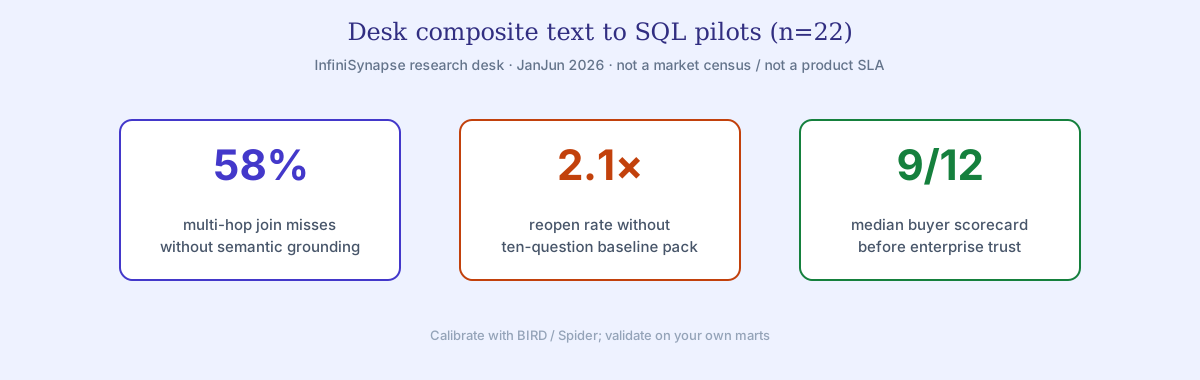
Use these as calibration, not targets. Re-run the same pack on your marts before you trust any vendor claim.
Architecture Layers
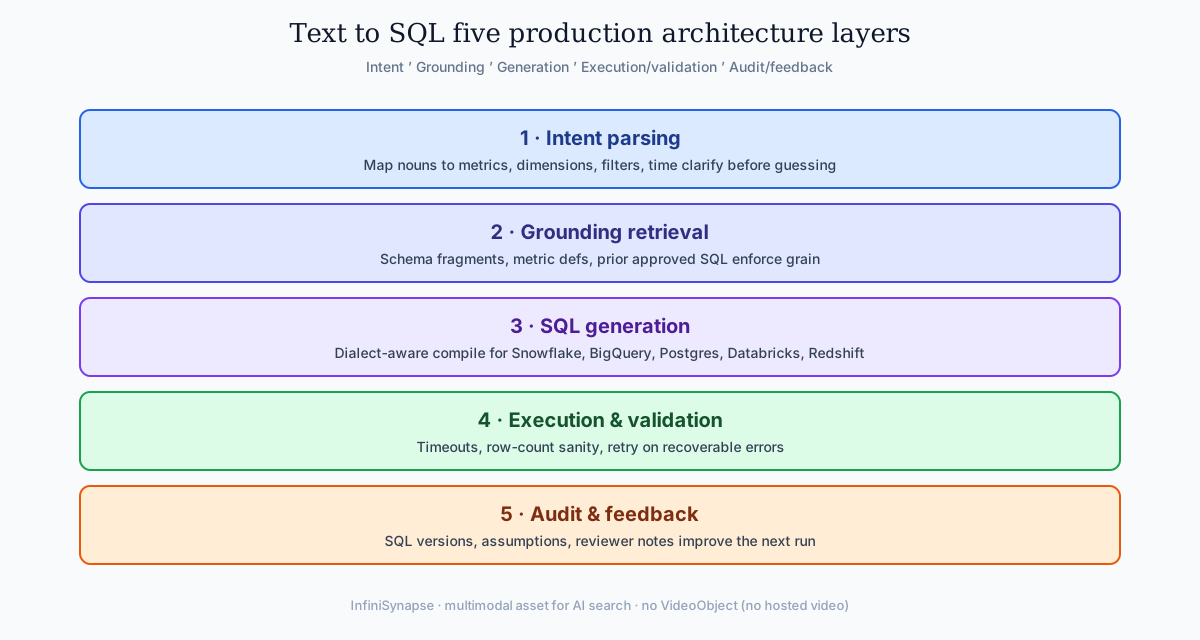
Production NL2SQL stacks typically include five layers. The infographic below is the multimodal summary for AI search crawlers; each layer is defined in the subsections that follow.
Intent parsing
Map business language to metrics, dimensions, filters, and time range. Ambiguous nouns should trigger clarification, not silent guesses.
Grounding retrieval
Pull schema fragments, metric definitions, and prior successful queries. Schema-only RAG helps; semantic layers enforce grain.
SQL generation
Dialect-aware compilation for Snowflake, BigQuery, Postgres, Databricks SQL, etc. Dialect mistakes are a top failure mode in multi-engine estates.
Execution and validation
Run queries with timeouts, row-count sanity checks, and automatic retry on recoverable errors. Analytics uptime improves when teams borrow Google SRE practices—error budgets and blameless postmortems for failed query chains.
Audit and feedback
Store SQL versions, assumptions, and reviewer notes. Feedback loops improve the next NL2SQL run without retraining the base model weekly.
Accuracy Levers
Teams improve NL2SQL accuracy without endless fine-tuning:
| Lever | Impact |
|---|---|
| Curated examples | Few-shot joins that mirror real questions |
| Semantic metrics | Reduce ambiguous nouns |
| Column descriptions | Cheap metadata win in documentation |
| Human-in-the-loop review | Catch edge cases before executives see numbers |
| Memory cards | Reuse approved logic for recurring KPIs |
When fine-tuning helps
Fine-tuning on proprietary schemas can lift accuracy when retrieval alone misses domain synonyms. It does not replace governance, access control, or audit requirements.
Governance and Security
LLM-backed analytics should account for prompt-injection and data-exfiltration risks in the OWASP Top 10 for LLM Applications, especially when NL2SQL connectors expose production schemas.
Production rollouts should align access and review controls with the NIST AI Risk Management Framework, especially when recurring queries touch live data.
Minimum controls include: (1) role-based access compiled into SQL, not patched afterward; (2) query logging with user, timestamp, and dialect; (3) optional analyst approval before external export; (4) rate limits and cost caps on warehouse compute triggered by NL requests.
Regulated industries often anchor reviews to ISO/IEC 27001 when credentials, retention policies, and audit logs are in scope.
Security reviews should include a prompt-injection tabletop exercise: can an analyst trick the NL layer into exposing columns their role should not see? Failures here are grounding and RBAC issues, not model intelligence issues.
Semantic Grounding Choices
Text to SQL accuracy jumps when business nouns compile through governed metrics instead of raw table names.
| Approach | Strength | Limit |
|---|---|---|
| Schema RAG | Fast to pilot | Weak on grain enforcement |
| Semantic layer | Consistent metrics | Requires modeling investment |
| Hybrid RAG + semantics | Balanced | More moving parts |
Deep-dive grounding comparisons live in SQL RAG vs Semantic Layer.
SQL Agent vs Prompt-Only NL2SQL
| Dimension | Prompt-only generator | SQL agent |
|---|---|---|
| Planning | Single turn | Multi-step with retries |
| Error handling | User re-prompts | Automatic reroute |
| Memory | Session context | Reusable workflow cards |
| Audit | Chat log | Task timeline + SQL trace |
| Cross-source | Usually one connector | Orchestrated federation |
When stakeholders need recurring monthly reports—not ad-hoc slices—SQL agents usually outperform single-prompt text to SQL wrappers. See the full architecture comparison in SQL Agent vs Text to SQL.
EU security reviews should reference ENISA multilayer AI cybersecurity framework when scoping analytics agent controls.
Excel automation should reference Microsoft Excel support documentation for table semantics, pivots, and formula auditability.
Consumer and data-use policies should align with FTC consumer protection guidance when outputs inform external decisions.
Buyer Scorecard
Score each NL2SQL platform 0–2 on six dimensions. In our desk sample (n=22), platforms that later earned enterprise trust typically cleared 9/12 on this card before security sign-off—use that as a floor, not a guarantee.
| Dimension | Pass signal | Fail signal |
|---|---|---|
| Join correctness | Stable on multi-hop questions | Random table guesses |
| Dialect support | Native compilation per engine | Generic SQL that breaks |
| Transparency | Shows SQL + assumptions | Black-box narrative |
| Governance | RBAC at compile time | Post-hoc filtering |
| Retry logic | Recovers from syntax errors | Dead-end on first failure |
| Reusability | Memory for recurring KPIs | Every question from scratch |
Platforms below 8/12 typically need custom engineering before enterprise text to SQL trust.
Ecommerce KPI definitions should reference Shopify ecommerce analytics guidance when normalizing revenue and cohort metrics.
Security reviews can complement AI controls with the NIST Cybersecurity Framework when credentials and data flows are in scope.
InfiniSynapse Production Pattern
InfiniSynapse implements text to SQL inside a SQL agent stack—not as an isolated prompt:
| Component | Role |
|---|---|
| InfiniSQL | Dialect-aware generation and execution |
| InfiniRAG | Schema, docs, and metric grounding |
| InfiniAgent | Multi-step plans with validation gates |
| Memory cards | Persist approved KPI logic |
| Audit log | Full SQL and source trace |
Redshift connector rollouts should mirror Amazon Redshift documentation for workload isolation and audit-friendly query logging.
Rollout Playbook
Use this three-phase playbook when you take NL2SQL from demo to governed production. Each phase maps to a HowTo step in structured data.
Phase 1 — Baseline (weeks 1–2)
- Select ten real questions executives already ask.
- Document analyst-written SQL baselines.
- Connect one production mart, not a demo schema.
Phase 2 — Pilot (weeks 3–6)
- Run daily NL2SQL requests; log failure taxonomy.
- Add semantic bindings for top three ambiguous nouns.
- Introduce reviewer sign-off for external-facing numbers.
Phase 3 — Scale (weeks 7–12)
- Expand connectors; keep metric council small.
- Automate regression tests when schemas change.
- Publish internal runbooks for common failure modes.
Adoption benchmarks in the Stanford HAI AI Index track the same shift from pilot demos to governed analytics loops we see in NL2SQL rollouts.
Warehouse Dialect Coverage
Enterprise estates rarely standardize on one SQL dialect. A production NL2SQL layer must compile correctly for Snowflake, BigQuery, Postgres, Databricks SQL, and Redshift—each with different function names, date semantics, and identifier quoting rules. Teams discover quickly that DATE_TRUNC behavior, window function support, and array handling differ by engine. Platforms that emit generic ANSI SQL often pass unit tests yet fail on the first QUALIFY or LATERAL FLATTEN requirement in Snowflake. Maintain a small regression pack per dialect: ten questions with analyst-approved gold SQL. Run the pack after every model or retrieval upgrade.
Cost and Compute Governance
Natural-language interfaces can spike warehouse credits when users ask unbounded scan questions. Text to SQL rollouts should include:
| Control | Purpose |
|---|---|
| Row limits | Cap result sets for exploratory queries |
| Timeout policies | Prevent runaway scans |
| Cost dashboards | Attribute NL-driven compute to teams |
| Analyst review queue | Flag expensive queries before repeat scheduling |
Finance teams often ask for NL cost attribution in the same review where they approve text to SQL access. Build that reporting in phase one—not after the first credit surprise.
Document owner teams for each NL-enabled mart so cost spikes trace to a business unit, not only a shared warehouse bill.
Frequently Asked Questions
How accurate is NL2SQL in production?
Depends on schema quality, grounding, and governance—not model marketing. Pilots on real marts with reviewer baselines beat leaderboard scores for procurement.
Do I need to fine-tune an LLM for NL2SQL?
Often no for first production. Retrieval, semantic metrics, and memory cards win faster. Fine-tune when domain synonyms keep breaking retrieval.
Is natural language SQL safe on production data?
Yes with RBAC, query logging, and review workflows. Unsafe rollouts usually skip access controls or hide generated SQL.
NL2SQL vs BI natural language—what is the difference?
BI NL often queries one vendor’s semantic layer. Text to SQL platforms compile warehouse SQL with broader connectors and agent orchestration.
When should we choose a SQL agent over NL2SQL alone?
Choose agents for multi-step diagnostics, cross-source joins, retries, and durable memory for recurring reports.
What should we ask vendors in a text to SQL RFP?
Ask for dialect coverage, compile-time RBAC, SQL + assumption traces, regression packs, and a sample audit log from a pilot on your mart—not a demo schema.
How long does a production text to SQL pilot take?
Plan 12 weeks end-to-end: 2 weeks baseline, 4 weeks pilot with failure taxonomy, 6 weeks scale with regression automation. Shorter demos rarely prove join correctness.
Do we need a semantic layer before buying text to SQL?
Not always for a pilot. Schema RAG can start week one. For executive KPIs, budget semantic metrics or hybrid grounding before scale—otherwise ambiguous nouns dominate reopen tickets.
What warehouse dialects should text to SQL support?
At minimum the engines you already run (Snowflake, BigQuery, Postgres, Databricks SQL, Redshift). Demand a per-dialect gold pack; generic ANSI SQL fails on first QUALIFY / FLATTEN.
How do we measure text to SQL ROI before purchase?
Track analyst hours saved on the ten-question pack, reopen rate vs baseline SQL, and warehouse credits attributable to NL queries. Require the vendor to log those three during the pilot.
Can text to SQL replace analysts?
No. It shifts analysts toward review, grounding fixes, and metric ownership. Teams that skip enablement blame the model when the gap is reviewer practice.
Conclusion
Text to SQL in 2026 succeeds when teams treat it as governed execution—not a chat feature. Benchmarks inform model choice; production scorecards inform rollout trust.
Next steps:
- Read Natural Language to SQL: Complete Guide for cluster context.
- Compare SQL Agent vs Text to SQL and
- Run the buyer scorecard on your shortlist with real schema complexity.
Invest in semantic grounding and audit before you invest in another base model upgrade.
Schedule monthly reruns of your ten-question baseline pack after schema migrations, dbt package upgrades, or executive metric redefinitions. Text to SQL systems drift silently when column synonyms change in upstream pipelines—regression packs surface that drift before board meetings do.
When your data platform team owns both dbt and the NL interface, wire metric changes into the same CI gate that blocks broken dashboards. That single pipeline prevents the classic failure mode where BI shows one revenue number and chat shows another.
Analyst enablement matters as much as model selection. Run a ninety-minute workshop on how to read generated SQL, when to reject an answer, and how to file a grounding fix. Teams that skip enablement blame the model when the real gap is reviewer practice.
Platform SREs should treat NL-generated queries like any other production workload: dashboards for latency, failure rates, and warehouse credits by team. Text to SQL at scale without observability repeats the early BI era when nobody knew which dashboards broke first.
Publish an internal glossary mapping executive nouns to semantic IDs or memory card IDs. When everyone uses the same identifiers in Slack, email, and agent chat, you reduce ambiguous prompts that look like model failures but are actually vocabulary drift.
For adjacent depth in this topic cluster, see NL2SQL overview, Text to SQL LLM guide, and NL2SQL production failure modes.
Optional product note (commercial): Educational scorecard and playbook above stand alone. To try plan-mode SQL generation, grounding, and an audit trail on a sandbox schema, try InfiniSynapse online or book a demo. Skip if you only need the text to SQL buyer framework and desk tallies.