Data Analyst Jobs Remote: The Complete 2026 Guide
By the InfiniSynapse Data Team · Last updated: 2026-07-08 · We build an AI-native data analysis platform and work with distributed analytics teams; this guide reflects the real state of remote analytics hiring in 2026.
Table of Contents
- TL;DR
- The State of Remote Analytics Hiring
- Where to Find Remote Roles
- How Remote Hiring Differs
- How to Stand Out for Remote Roles
- Succeeding as a Distributed Analyst
- Tools That Make Remote Work Possible
- Negotiating Remote Arrangements
- The Future of Remote Analytics
- Remote Readiness Scorecard
- Failure Modes
- Frequently Asked Questions
- Conclusion
TL;DR
Direct answer: searching for data analyst jobs remote roles has become far more productive since analytics work suits distributed teams well. Most of the job is querying, analyzing, and communicating, all of which travel over the internet. You qualify the same way as for on-site roles, with a portfolio, but you must also demonstrate strong asynchronous communication.
Who this is for: anyone searching for data analyst jobs remote options, whether entry-level or experienced.
What you'll learn: the state of remote hiring, where to find roles, how remote hiring differs, how to stand out, and how to succeed as a distributed analyst.
This guide sits under the data analyst career hub; for the broader market, see data analyst jobs.
The State of Remote Analytics Hiring
The market for data analyst jobs remote arrangements has matured significantly, and analytics is among the most remote-friendly of all technical roles. The reason is structural: the core work of pulling data, analyzing it, and communicating findings happens through software and does not require physical presence. Organizations discovered during the shift to distributed work that analysts could be just as productive from anywhere, and many kept remote options permanently.
This maturity means that searching for data analyst jobs remote listings now returns a genuinely wide field rather than a handful of exceptions. Some employers offer fully remote roles open to candidates anywhere, others offer hybrid arrangements, and a growing number pay closer to a national band regardless of location. The practical consequence is that a strong candidate is no longer limited to local employers, which widens opportunity dramatically, though it also means competing in a larger pool. Understanding this landscape, grounded in the same analytical work described in the Wikipedia data analysis overview, is the first step to a productive remote search.
Where to Find Remote Roles
Finding data analyst jobs remote listings works best across several channels rather than one. General job boards now filter by remote, and dedicated remote-work platforms specialize in distributed roles. Company career pages increasingly label remote eligibility explicitly, and analytics communities frequently share openings that never hit the big boards. Casting a wide net across these sources surfaces far more options than relying on a single site.
When searching for data analyst jobs remote positions, use varied search terms, because roles are labeled inconsistently. Some list "remote analyst," others "distributed," others simply note location as "anywhere." Searching by the responsibilities of the role, as with any analyst search, rather than a single title, surfaces more genuine matches. Entry-level candidates should note that remote options have widened access considerably, a theme we cover in entry level data analyst jobs, so a first analytics role no longer requires living in a major hub. Persistence and breadth in the search consistently pay off. Enterprise adoption patterns in Google Cloud's AI overview mirror the shift from pilots to governed analytics.
How Remote Hiring Differs
Applying for data analyst jobs remote roles differs from on-site hiring in several ways worth preparing for. The evaluation weighs written communication more heavily, because remote teams run on asynchronous writing, so a clear, well-structured application and thoughtful written responses matter more than they might in person. Interviews are conducted over video and often include a practical exercise you complete independently, testing whether you can work without someone looking over your shoulder.
Employers filling data analyst jobs remote positions also probe for self-direction and communication discipline. They want evidence that you can manage your own time, proactively surface blockers, and communicate findings clearly in writing to people you rarely see face to face. Demonstrating these traits, through your application and interview conduct, is as important as technical skill. A candidate who is technically strong but communicates vaguely or unreliably is a poor fit for distributed work, so remote hiring places unusual weight on the human skills that some on-site processes underemphasize.
How to Stand Out for Remote Roles
Standing out for data analyst jobs remote positions builds on the usual portfolio advice with a distributed twist. A strong portfolio remains the foundation, but for remote roles, the written explanations accompanying your analyses carry extra weight, because they preview exactly the asynchronous communication the job requires. Analyses documented with clear, well-organized writing signal remote-readiness directly.
A second way to stand out for data analyst jobs remote roles is to demonstrate the self-management and tooling fluency distributed work demands. Showing that you can direct modern analysis tools, communicate results in writing, and work independently reassures an employer that you will thrive without in-person supervision. Adding fluency with AI-native tools further strengthens the case, since these tools let a remote analyst work efficiently and transparently. Combined with a polished data analyst resume and thorough interview preparation, these moves make a remote candidate memorable rather than one applicant among many in a global pool.
Succeeding as a Distributed Analyst
Landing one of the data analyst jobs remote roles is the start; succeeding in it requires deliberate habits. The most important is proactive communication: in a distributed team, no one sees you working, so you must make your progress, findings, and blockers visible through clear, regular written updates. Analysts who master this asynchronous visibility thrive, while those who go quiet, however hard they are working, struggle to build trust.
Succeeding in data analyst jobs remote arrangements also depends on disciplined self-management and documentation. Without the ambient structure of an office, remote analysts must manage their own time and keep their work well-documented so colleagues in other time zones can pick it up. The analysts who excel remotely treat documentation not as overhead but as the medium through which a distributed team collaborates. These habits, once built, make remote work genuinely more productive than the office for focused analytical tasks, which is why so many analysts, once remote, prefer to stay that way. Warehouse-grounded analytics should align with Databricks documentation on SQL warehouses and data governance.
Tools That Make Remote Work Possible
The right tools are what make data analyst jobs remote work practical, and modern analytics platforms are built for distributed teams. Cloud-based data tools mean an analyst can connect to company data from anywhere securely, and collaborative documentation keeps distributed teams aligned. Among these, AI-native platforms are particularly well-suited to remote work.
InfiniSynapse is an example. It is not an NLP2SQL box or a ChatBI widget but a system that behaves like a professional data analyst, connecting to sources with one-click authorization and running multi-step analysis through InfiniSQL, all accessible from anywhere with an inspectable audit trail that keeps distributed teams aligned on how a number was produced. For someone in data analyst jobs remote arrangements, such transparency is invaluable, because it lets colleagues verify work asynchronously without a meeting. We explore the paradigm in what AI-native data analysis means, and the Stanford HAI AI Index documents how these tools matured alongside the shift to distributed work.
Negotiating Remote Arrangements
Even when a role is not advertised as remote, the market for data analyst jobs remote flexibility has shifted enough that negotiation is often possible. Many on-site or hybrid roles can be made partly or fully remote for a strong candidate, especially after an offer is on the table and the employer is invested in you. The key is to raise the topic at the right moment, usually once they have decided they want you, and to frame remote work around your productivity rather than personal preference.
When negotiating for data analyst jobs remote arrangements, come prepared with evidence that you work effectively without supervision, such as a portfolio documented with clear written explanations and examples of independent projects you have driven to completion. Employers grant flexibility to candidates they trust, and demonstrated self-direction builds that trust. It also helps to propose concrete structures, such as regular written updates and defined overlap hours with the team, that address an employer's natural concerns about coordination. Approaching the conversation collaboratively, as a shared problem to solve rather than a demand, makes a remote arrangement far more likely, and it signals exactly the maturity that distributed teams value in their analysts.
The Future of Remote Analytics
The trajectory for data analyst jobs remote arrangements points toward continued normalization rather than retreat. The structural fit between analytics and distributed work is durable: the tools are cloud-based, the output is digital, and the collaboration is increasingly asynchronous by design. As more organizations build the management practices that make distributed teams effective, remote and hybrid options are becoming a standard part of the analytics landscape rather than a perk.
For analysts, this means the skills that support data analyst jobs remote success, especially written communication and self-management, are worth investing in regardless of where you currently work, because they are becoming baseline expectations across the field. The analysts who cultivate these habits early position themselves well for a job market where location matters less each year and demonstrated remote-readiness matters more. Pairing these human skills with fluency in modern, cloud-native, and AI-native tools creates a profile that thrives whether the next role is across the street or across the world, which is an increasingly valuable form of career resilience. The move toward augmented workflows, outlined in IBM's augmented analytics overview, frames how teams evaluate modern tooling.
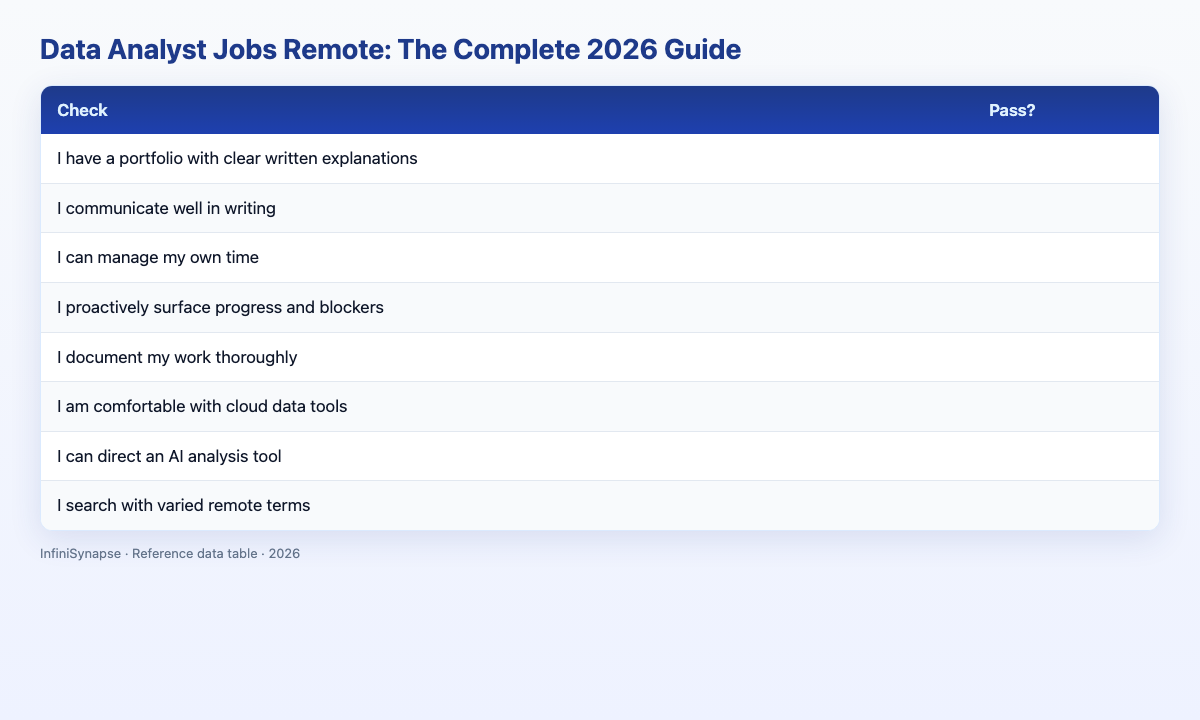
Remote Readiness Scorecard
Assess your readiness for remote roles (1 point each):
| Check | Pass? |
|---|---|
| I have a portfolio with clear written explanations | |
| I communicate well in writing | |
| I can manage my own time | |
| I proactively surface progress and blockers | |
| I document my work thoroughly | |
| I am comfortable with cloud data tools | |
| I can direct an AI analysis tool | |
| I search with varied remote terms |
6–8: strong remote candidate. 3–5: build the communication habits. Below 3: practice async work first.
Failure Modes
Failure 1: Going quiet. In data analyst jobs remote roles, invisible work erodes trust regardless of effort.
Failure 2: Weak written communication. Remote hiring weighs writing heavily; vague writing loses offers.
Failure 3: Searching one term only. Inconsistent labels mean varied search terms surface more roles.
Failure 4: Poor documentation. Undocumented work strands distributed colleagues in other time zones.
Frequently Asked Questions
Are there many remote data analyst jobs in 2026?
Yes, searching for data analyst jobs remote options returns a wide field in 2026, because analytics work suits distributed teams well. The core tasks of querying, analyzing, and communicating happen through software, so many employers offer fully remote or hybrid roles, some paying near a national band regardless of location.
How do I find remote data analyst jobs?
Find data analyst jobs remote listings across general job boards filtered by remote, dedicated remote-work platforms, company career pages, and analytics communities. Use varied search terms since labels differ, and search by responsibility rather than exact title to surface more genuine matches across the distributed job market.
Do remote data analyst jobs pay less?
Not necessarily. Many employers offering data analyst jobs remote arrangements pay close to a national band regardless of where an analyst lives, which can benefit those in lower-cost regions. Policies vary, so confirm each employer's remote pay approach, but remote no longer reliably means a pay cut.
What skills do remote data analyst jobs require?
Beyond the usual SQL, spreadsheets, and visualization, data analyst jobs remote roles require strong written communication, self-management, and thorough documentation, because distributed teams run asynchronously. Fluency with cloud and AI-native tools also helps, since remote analysts must connect to data and collaborate entirely through software.
How do I stand out for remote data analyst jobs?
Stand out for data analyst jobs remote roles with a portfolio whose written explanations preview strong asynchronous communication, plus demonstrated self-management and tooling fluency. Showing you can direct modern analysis tools and work independently reassures employers you will thrive without in-person supervision in a distributed team.
Conclusion
Searching for data analyst jobs remote roles is more productive than ever in 2026, because analytics suits distributed work and many employers now offer it permanently. Qualify with a portfolio as usual, but emphasize written communication, self-management, and documentation, the habits that make remote analysts thrive.
Modern tools make distributed analytics practical; see what AI-native data analysis means and try the InfiniSynapse web app free on registration, no credit card required.