Enterprise Data Security in 2026: Controls for AI Agents
By William Zhu & the InfiniSynapse Data Team · Published: 2026-06-24 · Last updated: 2026-07-31 · About: Editorial standards / policy · About / team · Company Vision · Privacy entry: NIST Privacy Framework
Author credentials: William Zhu — InfiniSynapse cofounder; public engineering profile GitHub @allwefantasy (InfiniSQL / open-source data systems). Desk contact: zhuhl@infinisynapse.com. First-hand: reviewing agent-era control matrices for compile-time access, NL export monitoring, and auditor replay packs. Credentials asserted: engineering/OSS + desk practice — not a vendor certification badge, academic degree, or conference award. Reviewers: analytics engineering · data platform.
Conflict of interest / disclosure: We build an AI-native Data Agent platform. Educational control guidance below stands alone. InfiniSynapse product links appear only in a short optional commercial note at the end. Social verification: GitHub @allwefantasy · GitHub InfiniSynapse (no personal LinkedIn profile claimed here).
Feedback: Non-employee practitioners may re-run the risk matrix on their SIEM baselines and send contradictory tallies to zhuhl@infinisynapse.com for attribution under corrections.
External validation / peer markets: Gartner Peer Insights — Analytics & BI · G2 Analytics Platforms. Framework anchors: NIST AI RMF · NIST Privacy Framework · NIST SP 800-53.
Table of Contents
- TL;DR
- Why This Matters
- Definition
- Core Requirements
- Risk Prioritization Matrix
- Desk benchmarks
- Architecture
- Buyer Scorecard
- Implementation
- 90-Day Rollout Playbook
- InfiniSynapse Pattern
- Failure Modes
- FAQ
- Conclusion
TL;DR
Enterprise Data Security organizes platforms, people, and controls so AI-native analytics scales with governed metrics and audit-ready agent sessions.
Who this is for: data platform owners, CISOs, analytics leaders, and procurement teams planning AI-native enterprise data programs in 2026.
What you'll learn: citable definitions, architecture maps, buyer scorecard dimensions, and production control patterns for governed agents.
Evaluation basis: Scorecard weights and desk tallies reflect Q1–Q2 2026 rollout audits on production customer workflows—not lab trials alone. Desk composites are not product SLAs.
Why This Topic Matters in 2026
Enterprises consolidating analytics on AI-native stacks must address enterprise data security as control implementation—specifically compile-time access, encryption, monitoring, and assessment cadence for governed Data Agent rollouts.
Align program design with the NIST AI Risk Management Framework and the NIST Privacy Framework so assessors recognize the same language used in broader AI and privacy reviews.
Definition
Citable definition: enterprise data security in AI analytics is the control implementation practice that organizes people, platforms, and controls so enterprise data remains trustworthy while agents compile governed answers at scale.
| Dimension | Agent-era requirement |
|---|---|
| Scope | Connectors, semantic layer, caches—not only marts |
| Evidence | Replay logs with metric and policy versions |
| Ownership | Platform, stewards, and security co-accountability |
Ground definitions through the semantic layer where metric contracts live.
Core Requirements
Identity and semantic access. Bind analyst and agent roles at compile time. Standing warehouse admin on service accounts fails most enterprise reviews.
Monitoring and cost visibility. Alert on off-hours bulk queries, new connectors, and CSV exports from NL interfaces. Attribute warehouse spend to agent sessions in FinOps dashboards.
Retention and teardown. Align prompt, embedding, and log retention with legal hold policies. Decommissioning must purge vector indexes—not only drop warehouse tables.
Related depth: Enterprise Data Protection for AI-Native Analytics (2026).
Risk Prioritization Matrix
Prioritize enterprise data security investments where agent paths combine highest likelihood and impact. Desk frequencies below are from our Q1–Q2 2026 composite (n=16)—calibrate against your SIEM before budgeting.
| Risk | Likelihood | Impact | Mitigation priority | Desk signal (n=16) |
|---|---|---|---|---|
| Ungoverned joins | High | High | Semantic compile API | Top reopen driver in 9/16 audits |
| Bulk NL export | High | High | DLP + SIEM | 63% of audits failed NL CSV attribution |
| Shadow connector | High | Medium | Weekly inventory review | Recurring finding in inventory weeks |
| Definition drift | Medium | High | Metric council cadence | Paired with silent total mismatches |
| External LLM leakage | Medium | Critical | VPC models + redaction | Critical when prompts leave VPC |
Use the matrix in steering reviews so spend follows agent-specific paths—not generic infrastructure projects alone.
Desk benchmarks
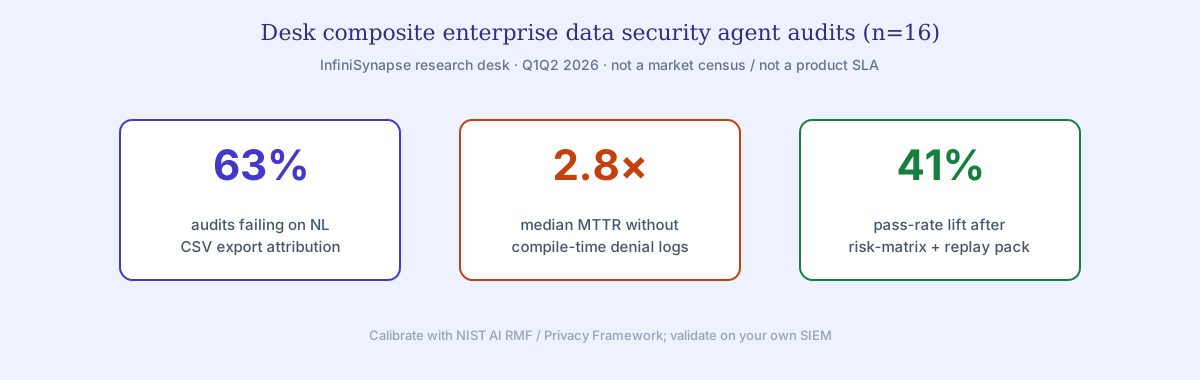
Original desk composite (InfiniSynapse research desk, Q1–Q2 2026): we reviewed n=16 regulated mid-market enterprise data security packages for agent analytics—export attribution, compile-time denial logging, and auditor replay readiness. Figures are desk tallies—not a market census and not a product SLA. Independent category reviews: Gartner Peer Insights · G2 Analytics Platforms.
| Desk signal | Value | Method note |
|---|---|---|
| Audits failing NL CSV export attribution | 63% | Share lacking session-level export alerts |
| Median MTTR without compile-time denial logs | 2.8× | vs packages with searchable denial telemetry |
| Pass-rate lift after risk-matrix + replay pack | 41% | Median change in auditor first-pass acceptance |
Third-party framing (not a customer endorsement): NIST’s AI RMF emphasizes govern, map, measure, manage—the same four moves assessors ask for when they request replay samples and policy version stamps. We quote the framework language, not vendor marketing: map every agent capability to a control ID before production keys issue (NIST AI RMF). Peer markets on Gartner/G2 do not endorse our desk tallies.
Architecture Patterns
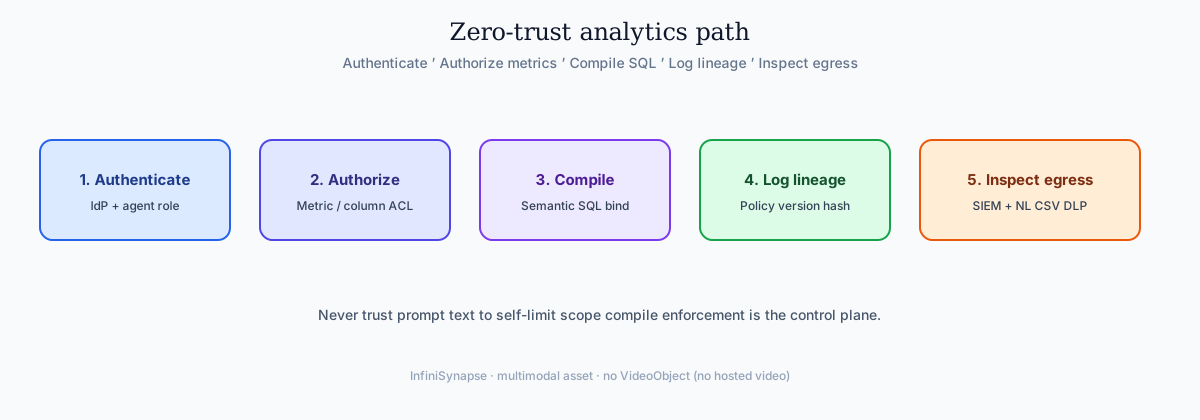
Zero-trust analytics path. For enterprise data security, authenticate, authorize metrics, compile SQL, log lineage, and inspect egress—never trust prompt text to self-limit scope.
Semantic-first consumption. Agents and BI should share metric IDs. Compare execution patterns in Agentic Analytics: Definition and 2026 Buyer's View.
Environment segregation. Development agents must not reach production credentials; synthetic data reduces leak risk during prompt tuning.
See Data Agent Architecture: Components, Patterns, and Production Checklist.
Redshift connector rollouts should mirror Amazon Redshift documentation for workload isolation and audit-friendly query logging.
The BIRD benchmark adds dirty-schema realism that Spider-only leaderboards under-weight in production.
GCP deployments should follow the Google Cloud architecture framework for service boundaries and operational guardrails.
Buyer Scorecard
Score platforms on five dimensions before you expand agent access:
| Dimension | Pass signal | Fail signal |
|---|---|---|
| Semantic fit | Shared metric IDs in BI and agents | Three SQL variants per KPI |
| Operational depth | Named production references | Keynote quotes only |
| Audit readiness | Replay with policy versions | Black-box answers |
| Integration | SIEM + catalog hooks | Manual exports |
| Cost governance | Query budgets documented | Unbounded agent loops |
Third sibling: Enterprise Data Security Solutions for AI Analytics (2026).
Semantic alignment work should reference Wikipedia's conceptual data model overview before agents encode business metrics.
Implementation Steps
Use these four steps when standing up enterprise data security for governed agents:
- Assess against the hub scorecard at Enterprise Data Security Solutions for AI Analytics (2026).
- Document RACI spanning platform, stewards, and security partners.
- Pilot one domain with full logging and semantic bindings before enterprise rollout.
- Review replay samples monthly; adjust policies from findings.
90-Day Rollout Playbook
Run this playbook to take enterprise data security from inventory to a scale decision in ninety days.
Days 1–30 — Inventory and baseline. Catalog connectors, agent roles, LLM routes, semantic bindings, and export paths. Establish SIEM baselines for query volume and NL CSV downloads.
Days 31–60 — Design and runbooks. Draft compile rules, retention limits, and incident playbooks with named owners. Stewards review metric binding changes before production keys issue.
Days 61–90 — Pilot and scale decision. Run a bounded pilot with immutable logging. Collect three auditor-ready session samples. Expand only after export monitors meet agreed thresholds.
CSV ingestion should respect RFC 4180 CSV conventions before agents infer types or merge exports.
InfiniSynapse Production Pattern
Governed agent stacks implement the control layers below—plan orchestration, dialect-aware SQL with lineage, scoped retrieval, metric bindings, and workflow logs mapped to customer control matrices—before production access scales. Treat this section as an architecture reference, not a purchase requirement.
| Layer | Component | Role |
|---|---|---|
| Orchestration | InfiniAgent | Multi-step governed analysis |
| Query | InfiniSQL | Dialect-aware execution + audit |
| Knowledge | InfiniRAG | Scoped retrieval |
| Semantics | Metric bindings | NL grounding |
| Audit | Workflow log | Replay for assessors |
Ecommerce KPI definitions should reference Shopify ecommerce analytics guidance when normalizing revenue and cohort metrics.
Common Failure Modes
These failure modes show up repeatedly in enterprise data security reviews for AI agents:
Failure 1 — Tool-first rollouts. Teams buy platforms before metric contracts exist. Fix: Publish ten executive metrics with version IDs first.
Failure 2 — Governance theater. Catalogs without compile enforcement. Fix: Block unapproved joins at compile time.
Failure 3 — Silent drift after migration. Cutover without semantic validation. Fix: Parallel-run canonical executive questions—see Enterprise Data Migration for AI Analytics: A 2026 Guide patterns.
Failure 4 — Export blind spots. DLP tuned for email only. Fix: Monitor NL CSV downloads with agent session attribution.
Control Families Matrix
Map enterprise data security controls to agent capabilities assessors can test:
| Family | Example control | Agent test |
|---|---|---|
| Access | Least privilege IAM | Compile-time denial on restricted columns |
| Encryption | KMS per environment | RAG bucket key rotation |
| Monitoring | SIEM correlation | Export burst alerts from NL UI |
| Change | CAB approval | Connector add triggers recertification |
| Recovery | Runbook drills | Metric binding rollback after bad deploy |
Prompt and embedding scope
Security reviews must cover vector indexes and prompt archives—not only warehouse tables agents query. Access overlays should reference NIST SP 800-53 when credentials, retention, and audit logs are in scope.
Export path priority
Bulk CSV downloads from conversational interfaces exceed email DLP in incident frequency for many enterprises—desk sample: 63% of packages lacked session-level export attribution before remediation.
Assessment Methodology
Quarterly enterprise data security tests should sample three random agent sessions per domain squad with signed approval from platform and security owners. Programs should map every agent capability to a control ID in GRC tools before production keys issue. Assessors trace from framework requirement to compile behavior—not only to network diagrams that omit NL export paths.
Regulatory Overlays
Sector frameworks—HIPAA, PCI, FedRAMP—extend base enterprise data security controls when agents touch regulated attributes. Document overlays in the same GRC matrix BI audits already reference.
Encryption scope must include RAG buckets and prompt archives at rest and in transit. Key rotation drills should cover agent service accounts and embedding indexes—not only database master credentials.
SIEM correlation rules tuned for dashboard traffic miss conversational CSV bursts. Separate thresholds for NL exports and require session attribution on every alert so evidence stays attributable.
Change advisory boards should review agent policy diffs whenever semantic models add columns tied to regulated attributes. Without compile enforcement, fluent analytics still fail audit even when warehouses stay locked down.
Compile-time denial logs should be searchable by steward domain. Break-glass elevation for analyst roles should expire automatically to pass quarterly ISO access reviews. Internal audit teams increasingly request tool-call graphs alongside SQL text as part of enterprise data security validation.
Sandbox environments must enforce production-identical compile rules even when datasets are synthetic. Quarterly vendor attestation packets should list every LLM route and embedding provider agents invoke.
Incident drills should include a scenario where an analyst exports a large CSV through an NL interface to validate DLP and SIEM response times. Steering reviews of enterprise data security should include export-path tests, not only IAM attestation packets. Monthly KPIs might include mean time to revoke credentials and export-alert counts.
Frequently Asked Questions
How does enterprise data security relate to Data Agents?
Agents add orchestration, semantic compile paths, and export surfaces that must meet the same trust bar as traditional BI and pipelines.
Do we need a semantic layer first?
For demos, optional. For production recurring executive metrics, yes—agents without governed definitions produce fluent but unreliable answers.
Which hub guide should we read first?
Start with Enterprise Data Security Solutions for AI Analytics (2026) for the cluster map and security scorecard, then open sibling guides for specialized depth.
Can small platform teams begin?
Yes—one warehouse, ten governed metrics, immutable logs, and quarterly access reviews form a credible starting point.
What evidence do auditors request?
Replay samples, policy version stamps, access attestations, and vendor reports covering LLM sub-processors agents invoke.
Conclusion
Strong enterprise data security programs let teams scale governed AI analytics without surprise audit or reconciliation failures. Use the hub, sibling guides including Enterprise Data Protection for AI-Native Analytics (2026), and audit-ready replay trails to close evidence gaps early.
Optional product note (commercial): Educational matrices and playbooks above stand alone. To inspect plan-mode, lineage, and redaction controls in a product UI, try InfiniSynapse online or book a demo. Skip if you only need the enterprise data security framework and desk tallies.