Enterprise Data Management (EDM): The 2026 Program Guide
By the InfiniSynapse Data Team · Last updated: 2026-07-15 · We build an AI-native data analysis platform and work with organizations standing up data programs; this guide reflects how enterprise data management actually takes hold in 2026, not an org chart.
Table of Contents
- TL;DR
- How We Approach It
- What It Is
- The Program Pillars
- How to Build It
- Operating Model and Roles
- Common Failures
- EDM in the Age of AI
- Maturity Scorecard
- Common Misconceptions
- Frequently Asked Questions
- Conclusion
TL;DR
Direct answer: enterprise data management is the organization-wide program that treats data as a strategic asset — governing, integrating, securing, and improving it across every domain. In 2026, enterprise data management matters because scattered, ungoverned data becomes confidently wrong AI answers, and only an organization-wide program can fix data problems at their root.
Who this is for: data leaders, CDOs, and architects building enterprise data management in 2026.
What you'll learn: what the program is, its pillars, how to build it, why programs fail, and how it underpins trustworthy AI.
This guide sits under the master data management hub.
For the underlying discipline, see data management.
Also see cloud data management.
How We Approach It
Governance and risk expectations are framed by FTC consumer protection guidance when programs need an external control reference.
We treat enterprise data management as a program, not a project: an ongoing organizational capability rather than a one-time build. Every recommendation reflects what we see when organizations succeed or stall at making data a trusted asset. We anchor definitions to the Azure architecture center and align program risk practices with the OECD AI policy observatory, which treats organization-wide accountability for data as foundational to any trustworthy system.
The table below maps the pillars of enterprise data management.
| Pillar | What it ensures |
|---|---|
| Governance | Ownership, policy, accountability |
| Integration | Data connects across the organization |
| Quality | Data is trustworthy |
| Security | Data is protected |
| Master data | Core entities have golden records |
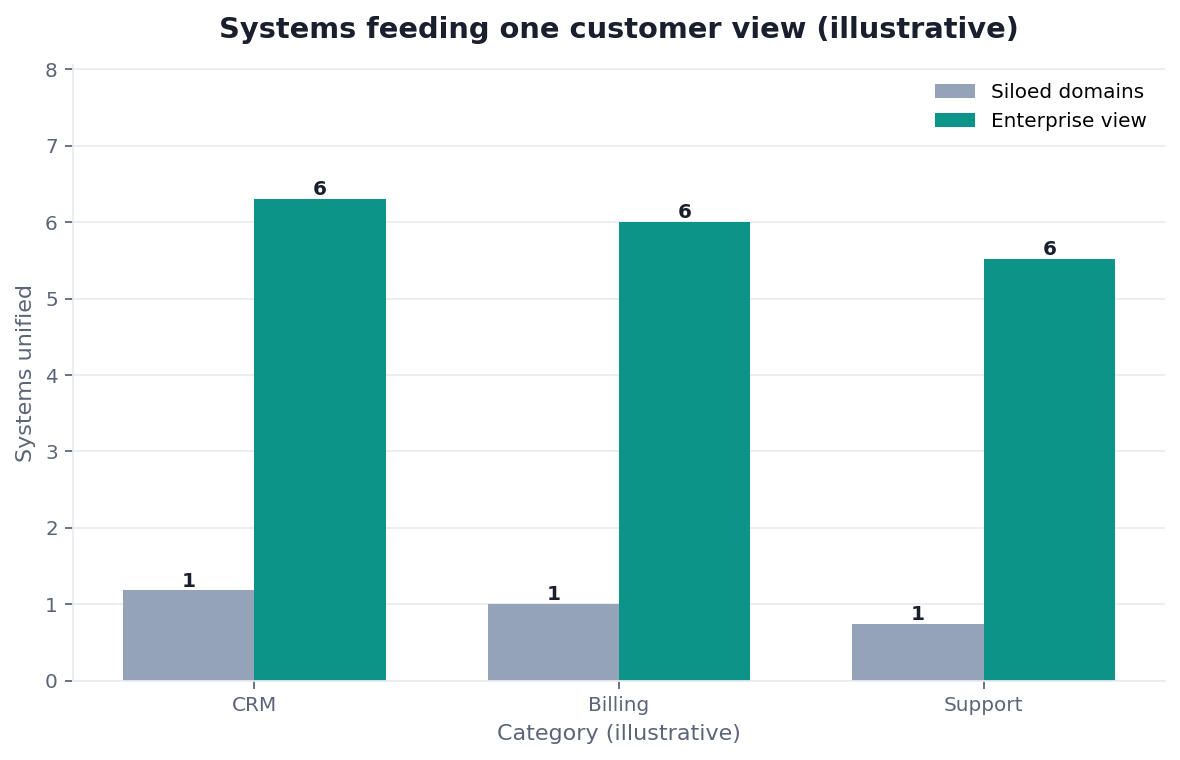
Practical example: a company with domain-by-domain data silos launched enterprise data management with a single governance council and one integrated customer view; within a year, reporting disputes across departments dropped sharply. The organization-wide framing from Databricks documentation helped structure that council. A program, not a tool, unified the data.
Scope note: This guide reflects patterns we see when mid-market and enterprise teams work with enterprise data management in 2026. It is not a substitute for legal counsel, vendor runbooks, or a formal survey of every industry — and when a smaller toolset or lighter process would serve, a full program is overkill.
What It Is
At its core, enterprise data management is the organization-wide practice of treating data as a shared strategic asset — with common governance, integration, quality, and security — rather than a collection of departmental silos each managed its own way.
Key Definition: enterprise data management is the organization-wide program that establishes governance, integration, quality, security, and master data practices across all domains, so an organization's data is consistently trusted, connected, and usable as a strategic asset.
The distinction that matters is scope. Ordinary data management can be done team by team; enterprise data management deliberately spans the whole organization, precisely because the most damaging data problems — inconsistent definitions, conflicting numbers, orphaned data — occur at the seams between departments where no single team is accountable.
The Program Pillars
Core definitions remain usefully summarized in Wikipedia statistics overview for shared vocabulary across stakeholders.
Effective enterprise data management rests on interlocking pillars, each of which fails visibly across the organization when neglected.
Governance and integration
Governance establishes who owns data and what the rules are across every domain; integration ensures data connects rather than fragmenting into silos. These two pillars are the backbone of enterprise data management, because organization-wide accountability and connected data are what distinguish a program from a pile of departmental efforts.
Quality, security, and master data
Quality ensures data is trustworthy, security protects it, and master data maintains authoritative records for core entities like customers and products. The reliability framing in EU AI Act overview shows how these pillars reinforce each other, so enterprise data management delivers data that is simultaneously trusted, protected, and consistent.
How to Build It
Building enterprise data management succeeds when it starts with a clear mandate and one high-value domain rather than a big-bang rollout. Establish organization-wide governance, then prove the program on the data whose problems are most visible — usually the customer or product domain — before expanding.
This connects enterprise data management to the underlying discipline of data management: the program formalizes and scales those disciplines organization-wide. The lakehouse governance patterns documented at Wikipedia machine learning overview illustrate how a single set of standards can be applied consistently across many domains rather than reinvented per team. Rather than attempting to govern everything at once, deliver a visible win in one domain, build organizational trust in the program, and expand. A program that shows value early earns the executive sponsorship it needs to survive; one that promises value "after two years of platform work" rarely does.
Operating Model and Roles
Core definitions remain usefully summarized in Wikipedia natural language processing overview for shared vocabulary across stakeholders.
Enterprise data management lives or dies by its operating model — the roles and forums that keep it running. A durable program names data owners for each domain, appoints stewards who maintain quality day to day, and convenes a governance body that resolves cross-domain disputes.
The critical design choice is where accountability sits. Centralizing everything creates a bottleneck; decentralizing everything recreates the silos the program exists to fix. Most successful enterprise data management programs adopt a federated model: central standards and a governance council, with domain teams accountable for executing within them. That balance keeps the program organization-wide without making it a chokepoint, and it gives domain experts ownership of the data they understand best.
Common Failures
The failures we see in enterprise data management are consistent. Launching without executive sponsorship leaves the program powerless at the department seams where it matters most. Attempting to govern everything at once overwhelms the organization before value is proven. And treating it as an IT project rather than a business program leaves it without the authority to change how departments work.
A subtler failure is confusing documentation with the program. Enterprise data management that produces policies nobody enforces is theater; the program only matters when its governance has teeth — when a data owner is genuinely accountable and a failed quality rule genuinely gets fixed. We judge a program by behavior change across the organization, not by the thickness of its policy binder.
Culture, Not Just Process
Implementation details are commonly grounded in Google Cloud AI overview when teams translate concepts into production practice.
The organizations that succeed at enterprise data management treat it as a cultural change as much as a procedural one. Processes and councils are necessary, but they only work when people across the business actually value trustworthy data and see stewardship as part of their job rather than an imposition from a central team.
Making stewardship attractive
Stewardship succeeds when it is recognized and resourced rather than dumped on already-busy people as unpaid overhead. Programs that give stewards real authority, visible recognition, and time to do the work see engagement; programs that treat stewardship as a box to tick see quiet neglect. Culture, in this sense, is downstream of incentives, and leaders who want a data culture must build the incentives that produce one.
Trust compounds
The payoff of cultural buy-in compounds over time. Each domain that becomes reliably trustworthy makes the next one easier, because teams see the benefit and want it for their own data. A program that earns cultural momentum eventually needs less central enforcement, because trustworthy data becomes the default expectation rather than a rule people resent.
Measuring Program Value
A durable enterprise data management program measures its own value, because a program that cannot show impact eventually loses funding. The useful metrics are outcome-oriented: fewer reporting disputes, faster onboarding of new analysts, less time reconciling numbers, and quicker, more confident decisions.
Vanity metrics — the number of policies written, datasets catalogued, or meetings held — measure activity, not value, and leaning on them is a common way for a program to look busy while delivering little. Tie the program's reported success to business outcomes that executives already care about, and the sponsorship that keeps it alive becomes far easier to sustain year after year.
EDM in the Age of AI
Core definitions remain usefully summarized in Wikipedia conceptual data model overview for shared vocabulary across stakeholders.
AI raises the stakes for enterprise data management sharply. When autonomous agents read data across the organization to produce answers, every seam — inconsistent definitions, conflicting numbers, ungoverned sources — becomes a confidently wrong conclusion at scale. Only an organization-wide program can ensure the data an agent reads is consistent and trustworthy everywhere it looks.
An AI-native platform helps by binding governed business definitions to sources so an agent's answers respect the same standards the program encodes, an approach we describe in what AI-native data analysis means. In the InfiniSynapse web app, zero-config federation lets an agent read consistently across domains, so a mature enterprise data management program directly improves the reliability of automated analysis organization-wide.
Maturity Scorecard
Assess your enterprise data management maturity (1 point each):
| Check | Pass? |
|---|---|
| The program has executive sponsorship | |
| Data owners are named per domain | |
| Governance resolves cross-domain disputes | |
| Data integrates across the organization | |
| Quality is measured everywhere it matters | |
| Core entities have golden records | |
| Governance has real enforcement | |
| Data is consistent enough for AI |
6–8: strong program. 3–5: strengthen the operating model. Below 3: secure sponsorship and pick one domain.
Common Misconceptions
Misconception 1: It is an IT project. Enterprise data management is a business program with organization-wide authority.
Misconception 2: Govern everything at once. Start with one high-value domain and expand.
Misconception 3: Policies are the program. Enforcement and behavior change are the program.
Misconception 4: Centralize all control. A federated model avoids both silos and bottlenecks.
Frequently Asked Questions
What is enterprise data management?
Enterprise data management is the organization-wide program that establishes governance, integration, quality, security, and master data practices across all domains, so an organization's data is consistently trusted, connected, and usable as a strategic asset. Its defining feature is scope: it applies one consistent set of practices everywhere, rather than letting each department manage data in its own incompatible way.
What are the program pillars?
The pillars are governance (ownership, policy, accountability), integration (data connects across the organization), quality (data is trustworthy), security (data is protected), and master data (core entities have golden records). Governance and integration form the backbone, while quality, security, and master data reinforce each other to deliver data that is simultaneously trusted, protected, and consistent.
How do you build the program?
Start with a clear mandate and executive sponsorship, establish organization-wide governance, and prove the program on one high-value domain — usually customer or product — before expanding. Early, visible results are what sustain the executive backing a program needs; an initiative that asks for years of investment before showing anything concrete tends to lose support long before it delivers.
What operating model works best?
A federated model works best: central standards and a governance council, with domain teams accountable for executing within them. Pure centralization turns the program into a chokepoint that slows every request, while pure decentralization lets the old departmental silos quietly reassemble. The federated middle path preserves organization-wide consistency while leaving day-to-day ownership with the domain experts who understand their data.
Why does it matter for AI?
An agent that reads across departments inherits whatever inconsistencies exist between them, and it presents the result with unwarranted confidence. Because those inconsistencies live at the boundaries no single team owns, only an organization-wide program can eliminate them. That makes a mature program a practical prerequisite for reliable automated analysis that spans more than one department's data.
Conclusion
Enterprise data management is the organization-wide program that turns scattered data into a trusted strategic asset through governance, integration, quality, security, and master data. In 2026 it is the foundation trustworthy AI depends on across every domain. Secure sponsorship, start with one high-value domain, adopt a federated model, and give governance real teeth.
Treat it as a business program with real authority and measurable outcomes, and scattered data becomes an asset the whole organization — and its AI agents — can rely on. To see how governed, federated data becomes trustworthy automated analysis across the organization, read what AI-native data analysis means and try the InfiniSynapse web app free on registration.