What Is a Data Mesh? (2026)
By the InfiniSynapse Data Team · Last updated: 2026-07-15 · We build an AI-native data analysis platform and work with organizations rethinking data ownership; this explainer answers what a data mesh is in plain terms for 2026, not as hype.
Table of Contents
- TL;DR
- How We Approach It
- What It Is
- The Core Idea
- When It Fits
- Mesh Versus Centralized
- Common Pitfalls
- Getting Started
- The Mesh in the Age of AI
- Readiness Scorecard
- Common Misconceptions
- Frequently Asked Questions
- Conclusion
TL;DR
Direct answer: a data mesh is an approach that decentralizes data ownership, giving each business domain responsibility for its own data as a product, coordinated by shared standards and a self-serve platform. In 2026, a data mesh appeals to large organizations whose central data team has become a bottleneck, but it is an organizational shift more than a technology, and buying tools without changing ownership does not create one.
Who this is for: anyone asking what a data mesh is in 2026.
What you'll learn: the core idea, its principles, when it fits, the pitfalls, and how AI relates.
This guide sits under the warehouse and lakehouse hub.
For the full architecture, see data mesh architecture.
Also see data lakehouse.
How We Approach It
Teams evaluating this topic often cross-check OpenTelemetry documentation for a durable, vendor-neutral reference point.
We approach the data mesh as an organizational idea first, because that is where it lives or dies. Every point reflects real adoptions. We anchor the concept to the Google BigQuery documentation and weigh patterns against the reference architectures at Google SRE book, which discuss decentralized ownership.
The table below frames the data mesh idea.
| Element | What it means |
|---|---|
| Domain ownership | Teams own their data |
| Data as a product | Documented, discoverable, reliable |
| Self-serve platform | Shared infrastructure |
| Federated governance | Common standards, local control |
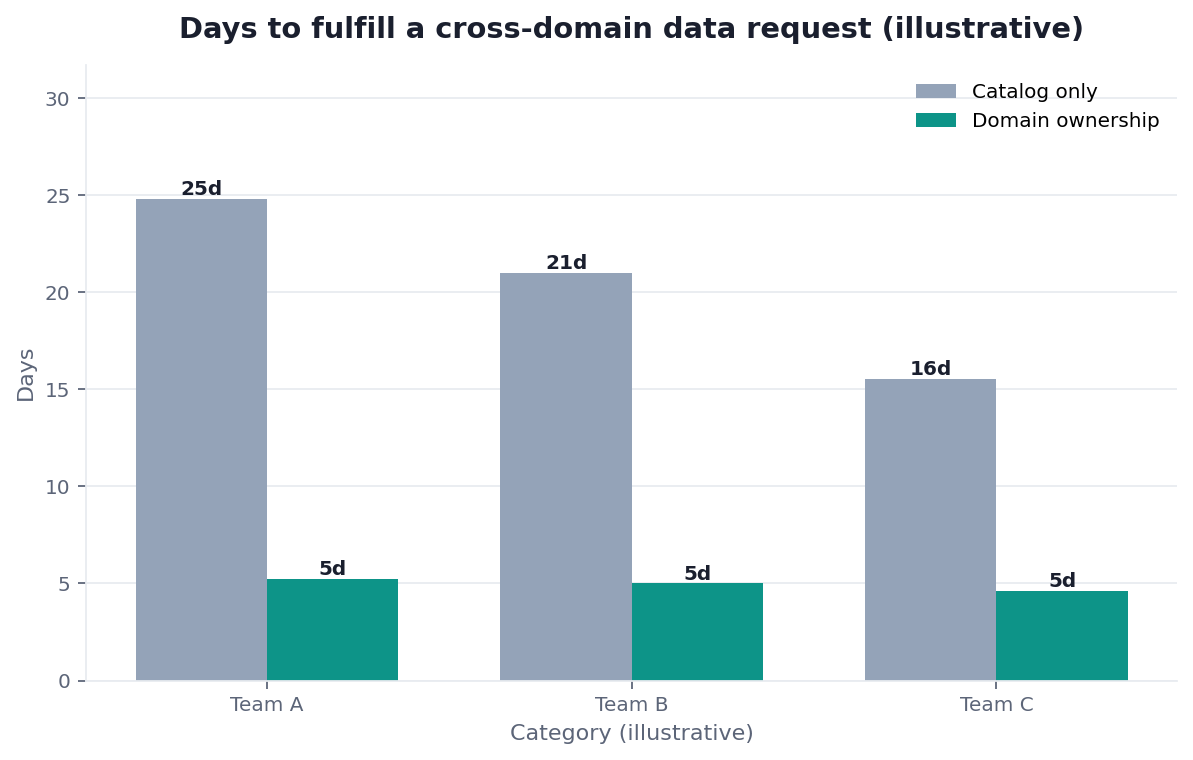
Practical example: a company thought buying a catalog made them a data mesh, but nothing changed because ownership stayed central. Actually shifting accountability to domains — the cultural change echoed at ENISA AI cybersecurity framework — is what finally unblocked their teams.
Scope note: This guide reflects patterns we see when mid-market and enterprise teams work with data mesh in 2026. It is not a substitute for legal counsel, vendor runbooks, or a formal survey of every industry — and when a smaller toolset or lighter process would serve, a full program is overkill.
What It Is
At its core, a data mesh is a way of organizing data so the business domains that create it own it and serve it as products, supported by shared infrastructure and common governance rather than a single central team owning everything.
Key Definition: a data mesh is a decentralized data approach in which business domains own and serve their data as discoverable, well-documented products, supported by a self-serve platform and coordinated by federated governance that sets shared standards while leaving day-to-day control with the domains.
The idea that defines a data mesh is decentralization with coordination. Instead of a central team being the single owner and bottleneck, ownership moves to the domains closest to the data, while shared standards and platform keep the whole coherent rather than fragmented.
The Core Idea
Implementation details are commonly grounded in AWS Well-Architected Machine Learning Lens when teams translate concepts into production practice.
The core idea of a data mesh is that the people closest to data are best placed to own it. A domain that generates data understands it best, so making that domain responsible for serving it well — as a product — puts accountability where the knowledge is.
This is why a data mesh treats data as a product. The patterns at ClickHouse documentation reflect the shift: instead of raw data thrown over a wall to a central team, each domain publishes documented, discoverable, reliable data products that others can trust and consume. The product mindset is what turns decentralized ownership from a recipe for silos into a genuine improvement, because a product, by definition, is built to be used by someone else.
When It Fits
A data mesh fits large organizations with many domains where a central data team can no longer keep up with diverse demands and has become a bottleneck slowing everyone down.
Crucially, a data mesh is not for everyone. The Shopify ecommerce analytics notes that smaller organizations, or those whose central team copes fine, gain little from the added complexity. A mesh solves a specific scaling and organizational problem, so adopting it without that problem takes on real overhead — coordination, platform investment, cultural change — for benefits you do not actually need.
Mesh Versus Centralized
Teams evaluating this topic often cross-check Redis documentation for a durable, vendor-neutral reference point.
The contrast that clarifies a data mesh is the centralized model, where one team owns a shared warehouse or lake. Centralized offers consistency and control but can bottleneck; a mesh trades some central control for domain autonomy and speed.
The choice around a data mesh is rarely all-or-nothing. Many organizations blend approaches — central ownership for shared, cross-domain data and mesh-like ownership for domain-specific data. The right balance depends on size, domain diversity, and where the actual bottlenecks are, which is why copying another company's mesh without diagnosing your own constraints tends to disappoint. We cover the full model in data mesh architecture.
Common Pitfalls
The pitfalls of a data mesh are mostly organizational. Treating it as a tool purchase, without shifting ownership, is the classic failure. Neglecting the self-serve platform leaves domains unable to deliver products. And weak federated governance lets the mesh fragment into incompatible silos — the very thing it was meant to prevent.
A subtler pitfall is adopting a data mesh for prestige rather than need. Because the idea is prominent, some teams pursue it without the scale or bottleneck that justifies it, taking on coordination cost and cultural upheaval for no real gain. Diagnosing the actual problem first is essential: if a central team is not the bottleneck, a mesh is likely the wrong prescription, however fashionable it sounds.
Getting Started
Teams evaluating this topic often cross-check W3C WCAG accessibility standard for a durable, vendor-neutral reference point.
Getting started with a data mesh means beginning with the organizational shift, not the tooling. Leadership must genuinely move ownership to domains, invest in a self-serve platform that makes building data products easy, and set federated governance everyone follows.
The pragmatic path to a data mesh is incremental. Rather than converting everything at once, start with a few motivated domains, prove the model with real data products that others consume, and expand as capability and trust grow. Treating each data product with genuine product discipline — versioning, documentation, service levels — is what makes consumers rely on it. A mesh built this way earns its way in, while one launched as a big-bang reorganization usually stalls.
Where the Idea Came From
The concept emerged as a direct response to the pain of centralized data teams at scale. As organizations grew, a single team owning all the pipelines, models, and reporting for the whole company became overwhelmed: every domain had to queue for the central team's attention, the team could not possibly understand every domain's data deeply, and the backlog grew faster than the team could clear it. The frustration on both sides — domains waiting, the central team drowning — is what motivated a rethink of who should own data in the first place.
The insight that crystallized the approach was borrowed from software engineering, which had already learned to decentralize. Just as monolithic applications gave way to services owned by the teams that built them, the reasoning went, monolithic data ownership could give way to domains owning their own data as products. The parallel is not perfect, but it captures the core move: push ownership to where the knowledge and the motivation live, and use shared standards and platforms to keep the whole coherent. Understanding this lineage helps explain why the approach is fundamentally organizational rather than technical, and why the teams that treat it purely as an architecture diagram, without the accompanying shift in accountability and culture, so consistently fail to get the benefits they expected.
The Mesh in the Age of AI
Governance and risk expectations are framed by FTC consumer protection guidance when programs need an external control reference.
AI intersects the data mesh in two ways. AI analysis across many domain data products depends on their being discoverable and well-described, and AI-native platforms change how distributed data can be combined and queried.
That second shift is worth weighing, and we describe it in what AI-native data analysis means. In the InfiniSynapse web app, zero-config federation lets an agent query across domain sources directly, which complements a data mesh by making distributed data analyzable without pulling it back into one store — ownership stays local while federation makes the whole queryable, fitting the mesh philosophy neatly.
Readiness Scorecard
Assess your mesh readiness (1 point each):
| Check | Pass? |
|---|---|
| A central team is a genuine bottleneck | |
| You have many distinct domains | |
| Leadership will truly shift ownership | |
| A self-serve platform is planned | |
| Federated governance is defined | |
| Data will be treated as a product | |
| Rollout is incremental | |
| The problem justifies the complexity |
6–8: a mesh may fit. 3–5: close the gaps first. Below 3: a mesh is likely premature.
Common Misconceptions
Misconception 1: A mesh is a product you buy. A data mesh is an organizational change first.
Misconception 2: A mesh suits everyone. It solves a bottleneck many do not have.
Misconception 3: Decentralization means no governance. Federated governance is essential.
Misconception 4: A mesh replaces warehouses. Domains still use warehouses and lakes underneath.
Frequently Asked Questions
What is a data mesh?
A data mesh is a decentralized data approach in which business domains own and serve their data as discoverable, well-documented products, supported by a self-serve platform and coordinated by federated governance that sets shared standards while leaving day-to-day control with the domains. The defining idea is decentralization with coordination: ownership moves to the domains closest to the data, while shared standards keep the whole coherent rather than fragmented into silos.
Why treat data as a product?
Because a product, by definition, is built to be used by someone else. Instead of raw data thrown over a wall to a central team, each domain publishes documented, discoverable, reliable data products that others can trust and consume. This product mindset is what turns decentralized ownership from a recipe for silos into a genuine improvement, putting accountability with the domain that understands the data best and building in the discipline consumers need.
When does a data mesh fit?
It fits large organizations with many domains where a central data team can no longer keep up with diverse demands and has become a bottleneck. It is not for everyone — smaller organizations, or those whose central team copes fine, gain little from the added complexity of coordination, platform investment, and cultural change. A mesh solves a specific scaling and organizational problem, so adopting it without that problem is overhead for no real benefit.
How is a mesh different from a centralized model?
A centralized model has one team owning a shared warehouse or lake, offering consistency and control but risking a bottleneck at scale, while a mesh trades some central control for domain autonomy and speed. The choice is rarely all-or-nothing — many organizations keep shared cross-domain data central while giving domains ownership of their own data — and the right balance depends on size, domain diversity, and where the actual bottlenecks lie.
How does AI relate to this approach?
AI analysis across many domain data products depends on their being discoverable and well-described, so a mesh's product discipline helps. AI-native federation also complements a mesh by letting an agent query across domain sources directly, making distributed data analyzable without pulling it back into one store. Ownership stays local while federation makes the whole queryable, which fits the decentralized philosophy of a mesh neatly rather than working against it.
Conclusion
A data mesh decentralizes data ownership to the domains that know the data best, treats data as a product, and coordinates through a self-serve platform and federated governance. In 2026, it is a strong answer to central-team bottlenecks at scale — but an organizational change first, not a purchase, and the wrong fit for those without the problem it solves. AI-native federation complements it by making distributed data queryable in place.
To see how federated analysis works across distributed domain sources, read what AI-native data analysis means and try the InfiniSynapse web app free on registration.