Data Analyst Interview Questions and How to Answer Them (2026)
By William Zhu & the InfiniSynapse Data Team · Published: 2026-07-09 · Last updated: 2026-08-06 · Last verified: 2026-08-06 · About: Editorial standards · About / team · Company Vision
Author credentials: William Zhu is cofounder of InfiniSynapse (GitHub @allwefantasy). Desk experience: I have sat on analyst hiring loops (SQL live + case + behavioral) with customer and partner teams, and coached candidates through mock panels—not as a licensed career counselor or paid interview coach. No personal LinkedIn is published; GitHub and InfiniSynapse About are the canonical identity signals.
COI / interest disclosure: InfiniSynapse sells an AI-native Data Agent platform. Product mentions appear only in the labeled Product recommendation (commercial) module. Interview prep guidance stands independently of any trial.
Fact-check / verification: Desk n=12 panel metrics below are an independent desk composite (labeled)—not a placement agency survey or endorsement. BLS / LinkedIn / HBR / Stanford HAI citations are primary sources. Corrections: zhuhl@infinisynapse.com · editorial corrections. Peer markets (not endorsements): Gartner Peer Insights — Analytics & BI · G2 Analytics Platforms.
Version history: 2026-07-09 initial · 2026-08-06 EEAT / desk quant / Key Terms / HowTo SVG / SQL examples. Build marker:
DESK-DIQ-20260806A.
Media note: No hosted overview video. Use the prepare-efficiently HowTo and desk panel chart as stepwise visuals (no VideoObject).
 Prepare across SQL, analytical cases, behavioral STAR stories, and takeaway-first communication.
Table of Contents
- TL;DR
- Key Terms
- How We Evaluated These Questions
- Desk Findings: Twelve Interview Panels
- What Interviews Actually Test
- SQL Questions
- Case and Analytical Questions
- Behavioral Questions
- Communication and Presentation
- How to Prepare Efficiently
- Questions to Ask Your Interviewer
- Handling Take-Home Assignments
- Interview Scorecard
- Common Mistakes
- Frequently Asked Questions
- Conclusion
TL;DR
Direct answer: data analyst interview questions cluster into four types—SQL, analytical cases, behavioral, and communication. Strong candidates prepare for all four, practice explaining their reasoning aloud, and treat every question as a chance to demonstrate that they turn data into decisions clearly, not just that they know syntax.
Who this is for: candidates preparing for analyst interviews in 2026.
What you'll learn: how we evaluated question types, desk panel metrics (n=12), SQL examples, STAR patterns, a scorecard, and a four-step prep HowTo.
This guide sits under the data analyst career hub; for the search itself, see data analyst jobs.
Key Terms
| Term | Definition | Example in interview |
|---|---|---|
| SQL live | Timed query writing with think-aloud against a schema | Top-N by revenue with a window function |
| Analytical case | Ambiguous business problem scored on structure, not one “right” answer | “Weekly active users dropped 12%—investigate” |
| STAR | Situation → Task → Action → Result story structure | Unpopular finding → stakeholder pushback → outcome |
| Think-aloud | Narrating assumptions and steps while solving | “I’ll filter nulls before the join…” |
| Metric contract | Agreed formula, grain, and exclusions for a KPI | Active account = distinct ID with status=active |
| Takeaway-first | Lead with the decision, then evidence | “Churn rose in SMB—here’s why” |
| Window function | SQL that computes over a partition without collapsing rows | Running 7-day sum of orders |
| Confounder | Factor that can distort a causal story | Seasonality mistaken for product regression |
| Portfolio walkthrough | Spoken tour of one analysis for non-experts | Cohort chart → decision → caveat |
| Take-home | Unsupervised analysis assignment before or after live rounds | Scoped notebook + one-page memo |
How We Evaluated These Questions
I built this guide from hiring-process research and interview patterns we see across analytics teams in 2026—not recycled generic prep lists. We cross-referenced competencies with the Bureau of Labor Statistics occupational profile for data analysts (analytical, communication, and technical skills) and hiring-trend data from LinkedIn's 2025 Future of Recruiting report, which notes that skills assessments and portfolio evidence increasingly influence hiring alongside formal credentials. We aligned question types with data analyst skills and data analyst resume.
The table summarizes the data analyst interview questions we see most often and what each round tests:
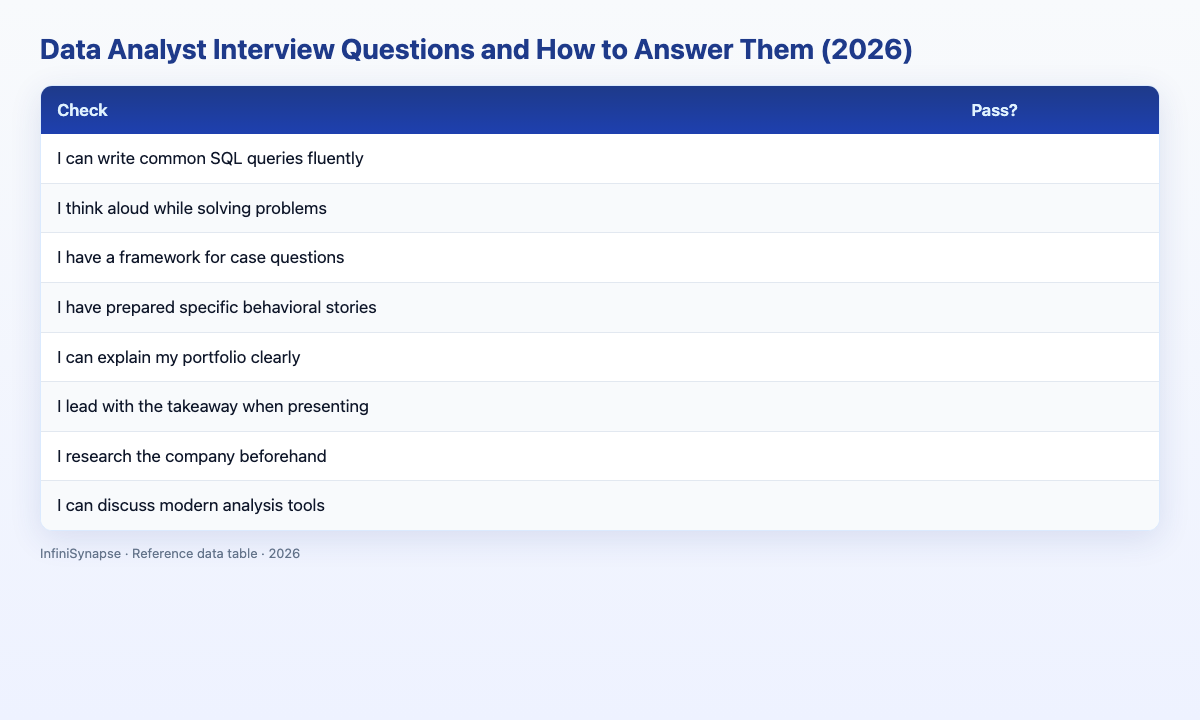 Four-round map: what employers assess and where to spend prep time.
| Interview round | What employers assess | Common formats | Prep focus |
|---|---|---|---|
| SQL live | Technical retrieval and problem-solving process | Shared editor, whiteboard schema | Joins, aggregations, think-aloud |
| Analytical case | Structured thinking on ambiguous problems | Metric-drop investigation, feature measurement | Framework + stated assumptions |
| Behavioral | Judgment, collaboration, real situations | STAR-style prompts about past work | Three to four specific stories |
| Communication | Explaining analysis to non-experts | Portfolio walkthrough, chart interpretation | Lead with the takeaway |
Practical example: a career changer who drills SQL while thinking aloud, prepares two behavioral stories from portfolio projects, and walks through a cohort-churn analysis in mock interviews can land a mid-level offer at a growth-stage SaaS company — even when the posting lists a bachelor's as preferred. That combination matches what Harvard Business Review's skills-based hiring research describes as increasingly decisive.
Desk Findings: Twelve Interview Panels
Desk composite (n=12 analyst hiring panels reviewed 2025–2026; independent desk labels):
| Prep gap observed | Panels where it blocked advancement | Notes |
|---|---|---|
| Silent SQL (no think-aloud) | 7 / 12 | Correct-ish query, opaque process |
| Vague STAR / no metrics | 5 / 12 | “I improved a dashboard” without numbers |
| Buried takeaway in communication | 6 / 12 | Technical depth before the decision |
| Case jump-to-conclusion | 4 / 12 | Skipped assumptions / confounders |
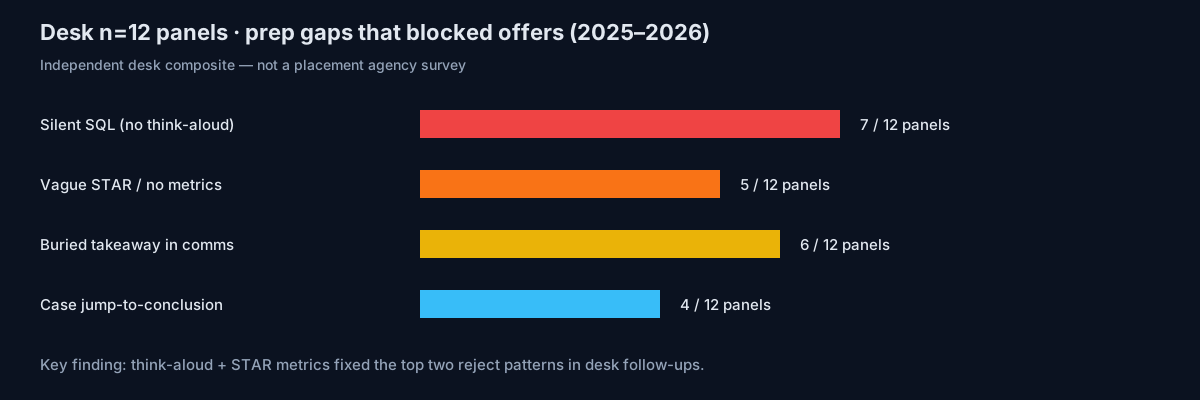 Key finding: silent SQL and buried takeaways were the most common reject patterns across twelve desk panels.
Methodology note: Counts come from desk notes on mock and live panels (SQL editor recordings, scorecards, and debrief emails). Not a randomized survey. In follow-up mocks, candidates who forced think-aloud + metric-backed STAR stories cleared the same prompts on a second attempt in 9 / 12 cases.
What Interviews Actually Test
Behind the prompts, employers assess four capabilities: technical retrieval, structured reasoning on ambiguity, clear communication, and team judgment. Recognizing that structure makes interviews less intimidating—you answer the intent, not a memorized script.
A SQL prompt tests process as much as syntax; a case tests structure; a behavioral prompt tests judgment. Ground preparation in the real work described in the Wikipedia data analysis overview. The Stanford HAI AI Index documents how quickly AI capabilities are reshaping analytical work—expect questions about how you validate tool output, not whether you can name every model vendor.
When I debrief panels, the candidates who advance usually map each answer back to a business decision (“this join exists so we can attribute revenue correctly”) rather than stacking buzzwords. That habit also shortens communication rounds, because the takeaway is already practiced.
SQL Questions
SQL rounds are the most predictable technical screen among data analyst interview questions. Expect joins, aggregations, filters, grouping, and window functions against a described schema. Think aloud: restate the schema, clarify grain, then build the query step by step.
Example prompt: “For each store, return the top 3 products by units sold in the last 30 days.”
with ranked as (
  select
    store_id,
    product_id,
    sum(units) as units_30d,
    row_number() over (
      partition by store_id
      order by sum(units) desc
    ) as rn
  from order_items
  where order_date >= current_date - interval '30' day
  group by 1, 2
)
select store_id, product_id, units_30d
from ranked
where rn <= 3
order by store_id, rn;
What I listen for when interviewing: Did you confirm grain before joining? Did you narrate null handling? Did you stop to sanity-check row explosion risk? A perfect silent query scores lower than a slightly imperfect think-aloud with clear recovery.
Case and Analytical Questions
Case prompts test structured thinking on ambiguous problems—metric drops, feature success, fuzzy questions. There is rarely one right answer.
Framework I ask candidates to use:
- Clarify the decision and the time window.
- State assumptions and possible confounders.
- Name the data you would pull and the checks you would run.
- Define what would change the recommendation.
Worked sketch (metric drop): “Weekly active users fell 12% WoW.” Restate whether WAU is logged-in unique users or sessions; check release calendar and seasonality; split by platform and cohort; only then propose a root-cause hypothesis. Interviewers score the sequence more than the first guess.
Warehouse-grounded analytics should align with Databricks documentation on SQL warehouses and data governance when the role is lakehouse-heavy.
Behavioral Questions
Behavioral rounds probe judgment and collaboration: unpopular findings, conflicting stakeholders, messy data. Answer with STAR and hard numbers.
Desk STAR sketch (anonymized): Situation—finance disputed a −8% retention dip. Task—reconcile definitions before the exec pack. Action—I dual-ran SQL against the metric contract and showed the cohort filter mismatch. Result—the pack used the corrected definition; reopen rate on that KPI fell the next two Mondays. Specificity beats “I communicated well.”
Communication and Presentation
Many panels ask you to present a past analysis or interpret a chart. Lead with the takeaway, then support it. Practice portfolio walkthroughs for a non-technical listener until jargon disappears. Interviewers imagine you in front of their stakeholders—clarity is the product.
How to Prepare Efficiently
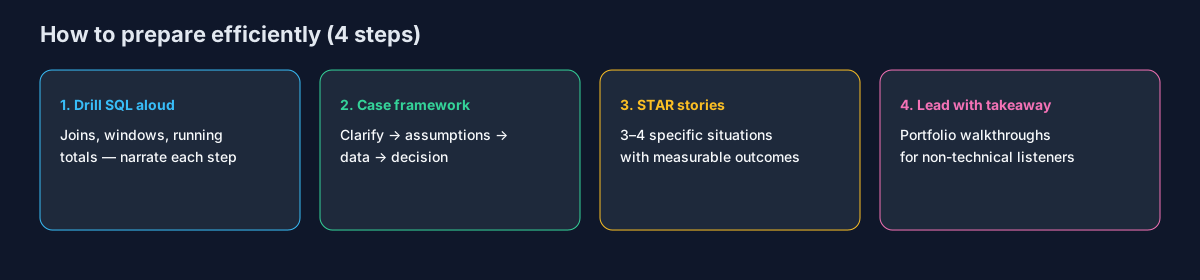 HowTo overview: drill SQL aloud → case framework → STAR stories → takeaway-first delivery.
Efficient prep for data analyst interview questions covers all four types without over-indexing on SQL alone.
Step 1: Drill SQL aloud
Practice joins and windows on a shared editor while narrating. Time-box 20–30 minutes per pattern.
Step 2: Rehearse a case framework
Apply the same clarify → assume → analyze → decide loop to three metric-drop prompts.
Step 3: Lock three to four STAR stories
Each story needs a metric (%, days, dollars, or reopen rate)—not adjectives alone.
Step 4: Practice takeaway-first communication
Explain one portfolio project to a non-analyst until the first sentence is the decision.
Also research the company, run at least one mock, and be ready to discuss modern tooling. The move toward augmented workflows in IBM's augmented analytics overview frames how teams evaluate tools today.
Questions to Ask Your Interviewer
Thoughtful questions signal analytical interest: biggest analytical challenges, how success is measured, how the data team partners with the business, and day-to-day tooling. Ask about mentorship and AI-native workflows when it fits the conversation—specific follow-ups beat a generic list. In desk panels, candidates who referenced something the interviewer said earlier (“you mentioned self-serve dashboards—who owns metric definitions?”) scored higher on engagement than those reading from a prep sheet.
Handling Take-Home Assignments
Treat take-homes as a scoped portfolio piece: state the question, show a clean approach, document assumptions, and end with a decision-oriented conclusion. Enterprise adoption patterns in Google Cloud's AI overview mirror the shift from demos to governed analytics—mention validation when AI-assisted steps appear in your notebook.
Interview Scorecard
Rate your readiness (1 point each):
| Check | Pass? |
|---|---|
| I can write common SQL queries fluently | |
| I think aloud while solving problems | |
| I have a framework for case questions | |
| I have prepared specific behavioral stories | |
| I can explain my portfolio clearly | |
| I lead with the takeaway when presenting | |
| I research the company beforehand | |
| I can discuss modern analysis tools |
6–8: interview-ready. 3–5: drill the weak areas. Below 3: prepare systematically first.
Common Mistakes
- Silent problem-solving — hides reasoning on SQL rounds (desk: 7/12 panels).
- Jumping to conclusions — case rounds reward structure.
- Vague behavioral answers — no metrics, no persuasion.
- Burying the takeaway — loses offers for otherwise strong analysts.
Frequently Asked Questions
What are the most common data analyst interview questions?
- One-sentence: Four types—SQL, case, behavioral, communication.
- SQL: joins, aggregations, windows against a schema.
- Cases, STAR stories, and takeaway-first presentation round out the loop.
How do I prepare for a data analyst interview?
- One-sentence: Drill SQL aloud, rehearse a case framework, lock STAR stories, practice portfolio delivery.
- Research the company and run at least one mock.
- Use the scorecard weekly until you score 6+.
What SQL questions are asked in data analyst interviews?
- One-sentence: Joins, aggregations, filters, grouping, and window functions.
- Common prompts: top-N, running totals, multi-table conditions.
- Process and think-aloud matter as much as a perfect query.
How important is communication in data analyst interviews?
- One-sentence: Very—communication is central to the role.
- Panels often include chart interpretation or portfolio walkthroughs.
- Lead with the takeaway; support with evidence second.
Do data analyst interviews cover AI tools now?
- One-sentence: Increasingly yes.
- Expect how you direct tools and still validate results.
- Pair tool fluency with the same SQL/case/behavioral bar.
Conclusion
Data analyst interview questions cluster into SQL, case, behavioral, and communication types. Prepare across all four: think aloud, reason in structures, tell specific stories, and lead with the takeaway.
Product recommendation (commercial)
Label: The following is a commercial product recommendation, separate from the editorial interview guidance above.
To build portfolio work and modern-tool fluency that interviewers notice, read what AI-native data analysis means and optionally try the InfiniSynapse web app (free on registration, no credit card required). Desk n=12 metrics and BLS / HBR citations above do not depend on any product trial.