Do You Need a Data Analyst Degree? Honest 2026 Guidance
By the InfiniSynapse Data Team · Last updated: 2026-07-08 · We build an AI-native data analysis platform and work with analysts from every background; this guide reflects what employers actually ask for in 2026, not outdated gatekeeping.
Table of Contents
- TL;DR
- What a Data Analyst Degree Actually Teaches
- Do Employers Require a Degree?
- Degree vs Certification vs Bootcamp
- The No-Degree Path That Works
- When a Degree Is Worth It
- Building Skills Alongside Any Path
- AI-Era Skills Beyond the Classroom
- Decision Scorecard
- Frequently Asked Questions
- Conclusion
TL;DR
Direct answer: you do not strictly need a data analyst degree to land a role in 2026. Employers hire on demonstrated ability, and a strong portfolio plus certifications or bootcamp training can substitute for a degree in most entry-level positions. A data analyst degree still offers depth, credibility, and broader career options, but it is one path among several, not a hard requirement.
Who this is for: students, career changers, and self-taught learners deciding whether a data analyst degree is necessary.
What you'll learn: what degrees teach, what employers actually require, how no-degree paths work, and when investing in a data analyst degree makes sense.
This guide sits under the data analyst certification hub; for structured alternatives, see data analyst course and data analyst training.
What a Data Analyst Degree Actually Teaches
A data analyst degree, typically in statistics, mathematics, economics, computer science, or a dedicated analytics program, provides structured grounding in quantitative methods. Coursework covers probability, regression, data visualization, database concepts, and often programming in Python or R. The breadth is the main advantage: a data analyst degree exposes you to theory, methodology, and communication skills over several years rather than compressing them into weeks.
What a data analyst degree does less well is teach job-ready tooling at the pace the market demands. University curricula often lag behind industry practice, and many programs still underemphasize SQL depth, modern BI platforms, and AI-native analysis tools. Graduates with a data analyst degree frequently need supplemental learning to bridge the gap between academic foundations and what hiring managers list in job postings. Understanding this gap helps you evaluate whether a data analyst degree alone prepares you or whether you will need additional training regardless, as described in the Wikipedia overview of data analysis.
The value of a data analyst degree also depends on the specific program. A rigorous statistics or computer science track builds analytical thinking that lasts a career, while a loosely defined analytics major may offer little beyond what a good certification provides faster and cheaper. Researching the curriculum, alumni outcomes, and internship placement rates matters more than the label on the diploma when assessing whether a particular data analyst degree is worth the investment.
Do Employers Require a Degree?
In 2026, most employers list a bachelor's degree as preferred rather than strictly required for data analyst roles. Job postings often say "bachelor's degree or equivalent experience," and hiring managers routinely interview candidates without a data analyst degree when the portfolio and skills are strong. The trend toward skills-based hiring, accelerated by remote work and portfolio-first recruiting, has weakened the degree as a gatekeeper. Warehouse-grounded analytics should align with Databricks documentation on SQL warehouses and data governance.
That said, a data analyst degree still functions as a screening signal at some organizations, particularly large enterprises, government agencies, and companies with formal HR pipelines. These employers may filter applications automatically on education before a human reviewer sees your work. For candidates without a data analyst degree, the practical response is to target companies that emphasize demonstrated ability, build a visible portfolio, and network into referrals that bypass automated filters. We cover the job-search side in how to become a data analyst and entry-level data analyst jobs.
The honest summary is that a data analyst degree helps but does not guarantee entry, while lacking one does not bar entry if you compensate with skills and proof. The market rewards people who can analyze data and communicate findings, regardless of whether they arrived through a data analyst degree, a bootcamp, or self-study. What matters is evidence, not pedigree.
Degree vs Certification vs Bootcamp
A data analyst degree, a certification, and a bootcamp represent three different trade-offs in time, cost, and depth. A data analyst degree takes two to four years and costs the most, but it provides the broadest foundation and the strongest credential for roles requiring academic grounding. A certification, covered in the data analyst certification guide, takes weeks to months and focuses on job-relevant skills with a credential that signals commitment. A bootcamp compresses training into an intensive program, often with career support, at a middle price point.
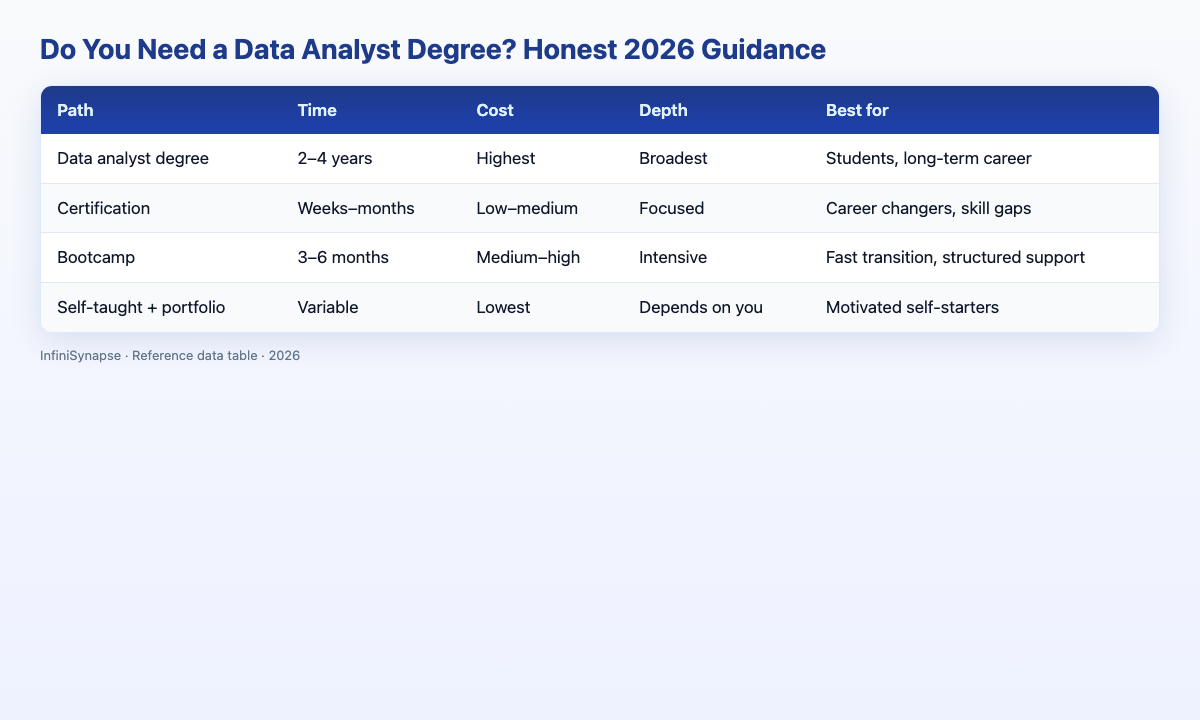
| Path | Time | Cost | Depth | Best for |
|---|---|---|---|---|
| Data analyst degree | 2–4 years | Highest | Broadest | Students, long-term career |
| Certification | Weeks–months | Low–medium | Focused | Career changers, skill gaps |
| Bootcamp | 3–6 months | Medium–high | Intensive | Fast transition, structured support |
| Self-taught + portfolio | Variable | Lowest | Depends on you | Motivated self-starters |
None of these paths is universally superior. A data analyst degree suits someone early in their education who wants maximum optionality, while a certification or bootcamp suits a career changer who needs efficient, targeted skill-building. Many successful analysts combine paths: a data analyst degree plus certifications, or a bootcamp plus a self-built portfolio. The strongest profiles layer credentials with demonstrated ability rather than relying on any single path.
The No-Degree Path That Works
Breaking in without a data analyst degree is achievable and increasingly common. The no-degree path that works follows a clear sequence: learn core skills (SQL, spreadsheets, visualization), build a portfolio of two or three real analyses, earn a certification for structure and credibility, and run a targeted job search emphasizing demonstrated ability. Each step produces evidence employers can evaluate, which matters more than whether you hold a data analyst degree.
The portfolio is the centerpiece of the no-degree path. Employers want to see that you can take a messy dataset, frame a question, clean and query the data, analyze it, and present a clear recommendation. Two or three well-documented projects, published where recruiters can find them, outweigh a data analyst degree listed on a resume with no supporting work. Supplement the portfolio with a certification from a recognized provider to show structured learning, and consider a bootcamp if you benefit from accountability and career coaching.
Candidates without a data analyst degree should also target the right employers. Startups, mid-size tech companies, and agencies often hire on skills and portfolio rather than credentials. Use data analyst course and data analyst training) resources to fill knowledge gaps efficiently. Network actively, because referrals frequently bypass degree filters that automated screening applies. The no-degree path requires more deliberate effort in portfolio-building and networking, but it is a proven route into analytics for motivated learners.
When a Degree Is Worth It
A data analyst degree is worth the investment when your situation benefits from its specific advantages. If you are a traditional student with time and access to affordable education, a data analyst degree provides the deepest foundation and keeps the widest range of career options open, including data science, research, and management tracks that may prefer or require advanced degrees later. If you aim for roles in government, healthcare, or academia, a data analyst degree often remains expected regardless of skills-based hiring trends elsewhere. The move toward augmented workflows, outlined in IBM's augmented analytics overview, frames how teams evaluate modern tooling.
A data analyst degree also makes sense when employer tuition reimbursement or scholarships reduce the cost substantially, or when the program includes strong internship placement that converts directly into job offers. In these cases, the data analyst degree functions as both education and a hiring pipeline, which changes the ROI calculation significantly. Research specific programs' outcomes rather than assuming all degrees deliver equal value.
Conversely, a data analyst degree is harder to justify for experienced career changers who need efficient entry. Spending two to four years and significant tuition when a bootcamp or certification plus portfolio can open the same doors in months is a poor trade for many people. Be honest about your timeline, financial situation, and target roles before committing to a degree route. The right path is the one that gets you employable fastest at a cost you can bear, not the path that sounds most prestigious.
Building Skills Alongside Any Path
Whether you pursue a academic pathway or an alternative route, active skill-building determines employability. Passive completion of any program, degree included, produces a credential without ability if you do not practice on real data. The analysts who get hired apply what they learn immediately, building analyses that demonstrate SQL fluency, visualization skill, and clear communication.
Alongside formal education, practice on public datasets and real business questions. If you are in a degree track program, treat coursework projects as portfolio pieces: document your process, publish your findings, and annotate your reasoning. If you are on a no-degree path, treat every certification exercise as a chance to produce portfolio work rather than checking boxes. The habit of turning learning into demonstrable output matters more than which path you chose.
InfiniSynapse supports this practice model. It is an AI-native data analysis agent that connects to your data sources and runs analysis through InfiniSQL, behaving like a professional analyst rather than a simple query widget. Practicing with such tools alongside your formal education path coursework or certification program builds the AI-era fluency employers increasingly expect. We explore the paradigm in what AI-native data analysis means), and the Stanford HAI AI Index documents how central these skills have become across knowledge work.
AI-Era Skills Beyond the Classroom
A crucial 2026 consideration for anyone evaluating a the degree option is whether the program covers AI-native tools. Many university curricula still focus on traditional statistics and spreadsheet work while underemphasizing the agents and platforms reshaping how analysts operate daily. Graduates may enter the job market with solid foundations but without the AI fluency that modern teams expect, requiring supplemental learning after the degree-based entry is complete.
The skills employers now want extend beyond what most academic qualification programs teach on their own. Directing AI-native analysis agents, validating automated outputs, and integrating AI-assisted workflows into standard analytical practice are increasingly part of the job. A degree qualification that incorporates these tools, or that you supplement with hands-on practice using platforms like InfiniSynapse, positions you ahead of graduates who learned only classical methods. Enterprise adoption patterns in Google Cloud's AI overview mirror the shift from pilots to governed analytics.
This does not diminish the value of a university training path's theoretical grounding. Understanding why a regression works, how to spot confounding variables, and when a visualization misleads remains essential. The point is that a degree credential is most valuable when paired with current tooling practice, not when treated as a complete preparation for the modern analytics workplace. Plan for ongoing learning regardless of which educational path you choose.
Decision Scorecard
Use this scorecard to decide whether a the academic route fits your situation (1 point each):
| Check | Applies to me? |
|---|---|
| I have 2–4 years and affordable access to education | |
| My target employers prefer or require degrees | |
| I want maximum long-term career optionality | |
| The program has strong internship placement | |
| I am early in my career, not a mid-career changer | |
| Tuition reimbursement or scholarships reduce cost | |
| I learn best in structured academic environments | |
| I can supplement the degree with portfolio work |
6–8: a degree program is likely worth pursuing. 3–5: weigh it against certifications and bootcamps. Below 3: the no-degree path may serve you better.
Frequently Asked Questions
Do you need a degree-based training to get hired?
No. Most employers in 2026 hire on demonstrated ability, and a strong portfolio with certifications can substitute for a academic degree option in entry-level roles. Some large enterprises still prefer degrees, but the trend toward skills-based hiring has weakened the requirement. Focus on building proof of ability regardless of your educational path.
What degree is best for a data analyst?
Statistics, mathematics, economics, computer science, and dedicated analytics programs are the most common university degree path paths. The best choice depends on whether you want depth in theory (statistics, math) or breadth in tooling (computer science). Research specific program curricula and alumni outcomes rather than relying on the major name alone.
Can you be a data analyst without a degree?
Yes. Many working analysts entered through certifications, bootcamps, or self-study paired with a strong portfolio. The no-degree path requires deliberate portfolio-building, targeted skill development, and networking to bypass automated degree filters, but it is a proven and increasingly accepted route into the field.
Is a formal degree training worth it in 2026?
A the degree route is worth it when you have time, affordable access, and target roles or employers that value academic credentials. It is harder to justify for career changers who need fast entry, since certifications and bootcamps can open the same doors in less time. Evaluate ROI based on your specific situation, not general prestige.
How does a degree compare to a certification?
A a degree in analytics offers greater depth and breadth over years, while a certification offers focused, job-relevant skills in weeks to months at lower cost. A degree suits students seeking maximum optionality; a certification suits career changers seeking efficient entry. Many analysts combine both for the strongest profile.
Conclusion
A this degree path is a valuable path into analytics, but it is not the only path and not a strict requirement in 2026. Employers hire on demonstrated ability, so whether you hold a analytics degree or arrive through certifications, bootcamps, and a self-built portfolio, the decisive factor is proof that you can turn data into decisions. Choose the path that fits your timeline, budget, and target roles, then invest in building real skills and a visible portfolio regardless of which credential you pursue.
To practice the AI-era skills employers want, read what AI-native data analysis means) and try the InfiniSynapse web app free on registration, no credit card required.