What Is a Data Analysis Platform? A 2026 Guide
By the InfiniSynapse Data Team · Last updated: 2026-07-08 · We build an AI-native data analysis platform and evaluate competing systems on real workloads; this guide reflects hands-on architecture experience, not marketing copy.
Table of Contents
- TL;DR
- Platform vs Point Tool
- The Layers a Data Analysis Platform Spans
- When You Need a Platform, Not a Tool
- Types of Data Analysis Platform
- The AI-Native
- How Platforms Handle Data Preparation
- Governance and Access in an Integrated System
- Migration: The Hidden Cost of Adoption
- Selection Scorecard
- From Point Tools to a Platform: A Migration Path
- Failure Modes
- Frequently Asked Questions
- Conclusion
TL;DR
Direct answer: a data analysis platform is integrated software that spans the whole workflow—connecting to sources, preparing data, running analysis, and sharing results—rather than solving a single step. You need one when analysis becomes a team activity across many sources, not a solo task in one file.
Who this is for: teams deciding whether a point tool is enough or whether they need a full data analysis platform.
What you'll learn: how a platform differs from a tool, the layers it covers, when the upgrade is justified, the platform types, and how the AI-native model reshapes the category.
This zooms in on the platform concept within our data analysis tools hub; to compare specific options, read top data analysis platforms compared.
For related depth in this pillar, see Best Data Analysis Software in 2026: Free and Paid.
Platform vs Point Tool
A point tool solves one step well—a spreadsheet for math, a chart library for visuals. A data analysis platform integrates several steps so data flows from source to insight without manual handoffs between disconnected apps.
Key Definition: a data analysis platform is an integrated system that connects to data sources, prepares and transforms data, performs analysis, and shares results within one governed environment, as opposed to a single-purpose tool that handles only one stage.
The distinction matters because the friction in real work often lives between tools—exporting from one app, cleaning in another, charting in a third. The Wikipedia data analysis overview describes these stages as a continuous process, and a data analysis platform exists precisely to keep that process continuous instead of stitched together by hand.
The Layers a Data Analysis Platform Spans
A complete data analysis platform typically covers four layers:
- Connection — read from databases, warehouses, and files without a migration project.
- Preparation — clean, join, and transform data into an analyzable shape.
- Analysis — query, compute metrics, model, and detect patterns.
- Sharing and governance — distribute results with access control and an audit trail.
A point tool covers one layer. The value of a platform is that the layers connect, so a change in the source propagates through preparation and analysis without re-exporting files. IBM's augmented analytics overview frames this integration as the defining feature of modern analytics platforms.
When You Need a Platform, Not a Tool
You have outgrown point tools and need a data analysis platform when: Scripted analysis should follow Python documentation conventions for reproducibility and testable pipelines.
- Multiple people must work from the same governed numbers.
- Data lives across several sources that must be joined.
- The same analysis repeats on a schedule.
- "Who has the latest version?" has become a recurring question.
If none of these apply, a point tool is cheaper and simpler. If most apply, the integration a platform provides pays for itself by eliminating the manual handoffs that cause errors and delay.
Types of Data Analysis Platform
- BI platforms (Tableau, Power BI, Looker): strong on the analysis-and-sharing layers, lighter on preparation.
- Data science platforms (notebooks-as-a-service): strong on analysis and modeling, require code.
- Warehouse-centric platforms: strong on scale, governed by tools like those in Databricks' documentation.
- AI-native platforms: span all four layers and add autonomy and memory.
Each type of data analysis platform emphasizes different layers, so the right one depends on which layer is your bottleneck.
The AI-Native
The newest category is the AI-native data analysis platform, which spans all four layers and adds something older platforms lack: autonomy. InfiniSynapse is built this way. It is not an NLP2SQL box or a ChatBI widget but a system that behaves like a professional data analyst.
It connects to Snowflake, Supabase, PostgreSQL, MySQL, MongoDB, and more with one-click authorization; through fourth-generation LLM-native RAG it recalls the right schema and business definitions; and through InfiniSQL it runs joint analysis across structured databases, documents, audio, and video. A user submits a goal; the platform plans the steps, self-corrects when a source times out, and distills the finished task into a reusable memory card. We explain the paradigm in what AI-native data analysis means, and the Stanford HAI AI Index documents how quickly this autonomy became production-grade.
How Platforms Handle Data Preparation
Preparation is the layer where integrated systems separate most sharply from point tools. A spreadsheet or a chart library assumes the data arriving is already clean; in reality, raw sources carry missing values, inconsistent formats, duplicate keys, and columns that mean different things in different systems. An integrated system addresses this by profiling sources on arrival, flagging anomalies, and standardizing definitions before analysis begins.
The practical payoff is trust. When preparation is a first-class stage rather than an afterthought handled in a separate app, the numbers that reach a dashboard are defensible. Teams that skip this stage—presenting raw or lightly cleaned data—eventually ship a wrong figure into a decision, and the cost of that single error often exceeds a year of subscription fees. This is why buyers should weigh preparation power as heavily as visualization polish, even though the demos rarely dwell on it.
Governance and Access in an Integrated System
Once analysis becomes a team activity, governance stops being optional. Who can see which data, who can change a metric definition, and who approved a number before it reached leadership all become questions with real consequences. An integrated system answers them with project-level access control, audit trails at the query level, and an approval step before a definition becomes canonical.
Point tools rarely provide this, because a single spreadsheet on one laptop has no concept of shared truth. As soon as two people work from the same numbers, the absence of governance produces the familiar problem of dueling figures in competing decks. Governance is not bureaucracy; it is the mechanism that lets a team scale analysis without scaling confusion, and it is one of the strongest reasons to graduate from tools to an integrated system.
Migration: The Hidden Cost of Adoption
The most underestimated cost of adopting an integrated system is migration. Some systems require you to move data into their proprietary store before you can analyze anything. That migration is measured in weeks, adds ongoing sync overhead, and creates a second copy of the truth that can drift from the original.
The alternative is a system that reads existing sources in place with one-click authorization, analyzing data where it already lives. This design eliminates the migration tax entirely and keeps a single source of truth. When evaluating options, ask bluntly whether adoption requires moving data, because the answer often decides whether a rollout takes an afternoon or a quarter.
Selection Scorecard
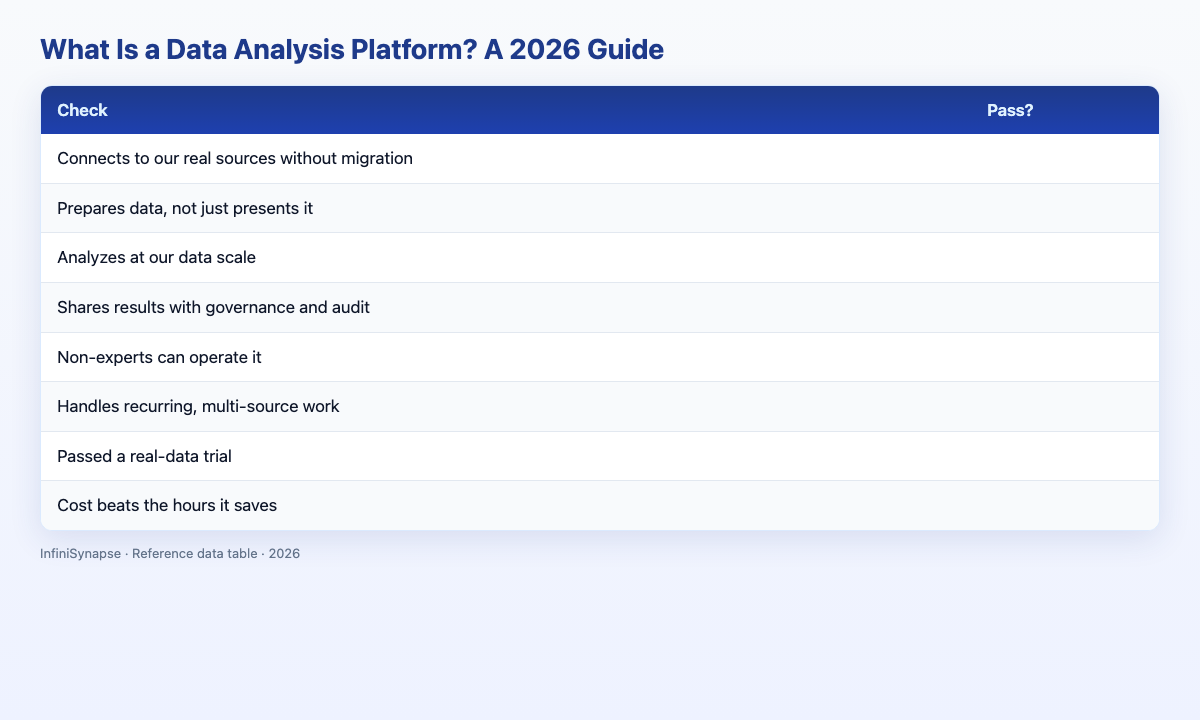
Score any data analysis platform (1 point each):
| Check | Pass? |
|---|---|
| Connects to our real sources without migration | |
| Prepares data, not just presents it | |
| Analyzes at our data scale | |
| Shares results with governance and audit | |
| Non-experts can operate it | |
| Handles recurring, multi-source work | |
| Passed a real-data trial | |
| Cost beats the hours it saves |
6–8: adopt. 3–5: scope it. Below 3: a point tool may be enough.
From Point Tools to a Platform: A Migration Path
Teams rarely adopt an integrated system overnight. The healthier route is a staged migration that proves value before it demands commitment. Start by connecting the system to a single high-value source and reproducing one analysis your team already trusts. This validates the connection and preparation layers on real data without betting the whole workflow on an unproven choice.
Next, move one recurring report onto the system and run it for a month. Recurring work is where integration pays off, so this stage reveals whether the promised time savings are real. Measure the second and third runs, not just the first, because the value of memory and reuse only appears on repetition. If the report that took an afternoon now takes minutes, the case for broader adoption makes itself.
Finally, expand to additional sources and users once the core workflow is proven. Bring the people who will rely on the system into the trial early, since adoption succeeds or fails on whether non-specialists can operate it. A staged path like this de-risks the decision: each step is reversible, the evidence accumulates on your own data, and the team grows comfortable before the integrated system becomes load-bearing. Rushing straight to full rollout, by contrast, is how expensive adoptions stall in month two when a surprise limitation surfaces.
A staged path also builds the internal knowledge that any integrated system needs to succeed. Each stage teaches the team how the system connects, prepares, and governs data, so by the time it becomes load-bearing, several people understand it rather than one. That distributed understanding is what prevents the common failure where an adoption depends entirely on a single champion who later leaves. Treat the migration as much as a learning exercise as a technical rollout, and record the decisions made at each stage so future teammates inherit the reasoning rather than just the result.
Failure Modes
Failure 1: Buying a platform for a point problem. If your only need is quick charts, a data analysis platform is overkill.
Failure 2: Ignoring the preparation layer. A platform strong on dashboards but weak on cleaning leaves the hardest work manual.
Failure 3: Migration lock-in. Platforms that force you to move data before analyzing it impose a heavy tax.
Failure 4: No governance. An ungoverned platform eventually ships a wrong number into a decision.
Frequently Asked Questions
What is a ?
A data analysis platform is integrated software that spans connecting to data sources, preparing and transforming data, running analysis, and sharing results within one governed environment. It differs from a point tool, which handles only a single step such as charting or math.
How is \1the role changing\2?
A tool solves one step well; a data analysis platform integrates several steps so data flows from source to insight without manual handoffs. The platform's value is continuity and governance across the whole workflow, not depth in a single feature.
Do \1employers require proof\2?
You need a data analysis platform when multiple people work from shared numbers, data spans several sources, or the same analysis repeats on a schedule. If your work is solo, single-source, and one-off, a point tool is cheaper and simpler.
What are examples of s?
Examples of data analysis platforms include BI platforms like Tableau and Power BI, warehouse-centric platforms, data science platforms, and AI-native platforms such as InfiniSynapse that span connection, preparation, analysis, and sharing with autonomy and memory.
What makes \1a strong fit\2?
An AI-native data analysis platform adds autonomy and memory: it plans and runs multi-step analysis from a plain-language goal, self-corrects on failure, and remembers finished tasks so recurring work speeds up. Older platforms require the analyst to drive each step manually.
Conclusion
A data analysis platform earns its place when analysis becomes a team activity spanning many sources and repeating over time. Match the platform type to your bottleneck layer—preparation, analysis, or sharing—and weight integration and governance heavily. Above all, insist on a real trial before committing, because the difference between a point tool and an integrated system only becomes obvious once your own messy data flows through every layer end to end.
If your bottleneck is recurring, multi-source work, an AI-native platform is the most direct answer. See how AI-native data analysis works and try the InfiniSynapse web app free on registration, no credit card required.