Data Analysis Methods: A Practical Map for 2026
By the InfiniSynapse Data Team · Last updated: 2026-07-08 · We build an AI-native data analysis platform; this map of methods reflects how they are actually chosen and applied in practice.

Table of Contents
- TL;DR
- How to Think About Methods
- Quantitative Methods
- Qualitative Methods
- Descriptive vs Inferential
- Choosing the Right Method
- Methods vs Techniques
- How AI Applies Methods
- Combining Multiple Methods
- Avoiding Method Misuse
- Methods Scorecard
- Frequently Asked Questions
- Conclusion
TL;DR
Direct answer: data analysis methods are the systematic approaches used to examine data, divided broadly into quantitative methods for numerical data and qualitative methods for non-numerical data. The right method depends on your question and data type, and matching them correctly matters more than choosing the most sophisticated option.
Who this is for: anyone mapping the landscape of data analysis methods to choose the right approach.
What you'll learn: how to think about methods, the quantitative and qualitative families, the descriptive-versus-inferential split, and how to choose.
This guide sits within the data analysis fundamentals hub; for specific techniques, see data analysis techniques.
For related depth in this pillar, see The 4 Types of Data Analysis (2026 Guide).
How to Think About Methods
The landscape of data analysis methods is easier to navigate when you organize it by the question a method answers and the data it suits, rather than memorizing a long list. A method is simply a systematic approach to examining data, and the many named methods cluster into a few families defined by their purpose and their data type. Seeing these families makes the whole landscape approachable.
The most useful first cut among data analysis methods is between quantitative methods, which work with numerical data, and qualitative methods, which work with non-numerical data like text or observations. A second cut distinguishes descriptive methods, which summarize, from inferential methods, which generalize. Holding these organizing distinctions in mind, consistent with the disciplined process described in the Wikipedia overview of data analysis, turns the intimidating variety of data analysis methods into a manageable map you can reason about.
Quantitative Methods
Quantitative data analysis methods work with numerical data and are the most familiar family. They include descriptive statistics that summarize data through means, medians, and distributions; inferential statistics that test whether patterns generalize beyond a sample; and regression methods that quantify relationships between variables. These form the backbone of most business and scientific analysis.
More advanced quantitative data analysis methods include time-series analysis for data over time, clustering for finding natural groupings, and predictive modeling for forecasting. Each suits particular questions: regression for understanding drivers, clustering for segmentation, time-series for trends. The power of quantitative data analysis methods is their rigor and the ability to quantify uncertainty, but that power depends on matching the method to the data's characteristics and checking the assumptions each method makes, since a misapplied quantitative method produces precise but false results.
Qualitative Methods
Qualitative data analysis methods work with non-numerical data such as interviews, open-ended survey responses, texts, and observations. Rather than counting and calculating, they systematically identify themes, patterns, and meanings in the data. Common qualitative data analysis methods include thematic analysis, which draws out recurring themes, and content analysis, which systematically categorizes text.
Qualitative data analysis methods are essential when the question concerns meaning, experience, or reasons that numbers cannot capture. Why customers feel loyal, how users experience a product, or what themes recur in feedback are questions for qualitative methods. We explore this family in depth in our advanced coverage of qualitative data analysis. Though sometimes seen as less rigorous than quantitative approaches, well-executed qualitative data analysis methods follow systematic procedures that make their findings defensible, and they answer questions that quantitative methods simply cannot.
Descriptive vs Inferential
A crucial distinction among data analysis methods separates descriptive from inferential approaches. Descriptive methods summarize what the data shows, such as the average order value or the distribution of customer ages. They make no claims beyond the data at hand and are the workhorses of everyday analysis, answering what happened clearly and reliably. The move toward augmented workflows, outlined in IBM's augmented analytics overview, frames how teams evaluate modern tooling.
Inferential data analysis methods, by contrast, use a sample to draw conclusions about a larger population, quantifying the uncertainty involved. Hypothesis tests and confidence intervals are inferential tools that judge whether an observed pattern is likely real or merely chance. Confusing these two families of data analysis methods, treating a descriptive summary as if it proved a general claim, is a common and serious error. Knowing whether your question calls for description or inference is essential to choosing the right method and interpreting its results honestly.
Choosing the Right Method
Choosing among data analysis methods starts with the question, not the method. First, determine whether your data is numerical or non-numerical, which points you toward quantitative or qualitative methods. Second, determine whether you need to describe what happened or infer something about a broader population, which points toward descriptive or inferential methods.
Within those cuts, the specific choice among data analysis methods depends on the exact question and the data's characteristics, such as its size, distribution, and the assumptions a method requires. A guiding principle is to prefer the simplest method that genuinely answers the question, since sophistication for its own sake adds risk without value. Matching data analysis methods to questions is itself the core analytical skill, more important than mastery of any single technique, because the wrong method applied expertly still yields a misleading answer.
Methods vs Techniques
It helps to distinguish data analysis methods from techniques, terms often used loosely. A method is a broad systematic approach, such as regression analysis or thematic analysis, defined by its logic and purpose. A technique is a more specific procedure or tool used within a method, such as a particular chart type or a specific statistical test.
This distinction clarifies how data analysis methods relate to the practical toolkit covered in data analysis techniques. You choose a method based on your question and data, then apply specific techniques to execute it. In practice the terms blur, and little hinges on policing the boundary, but understanding that data analysis methods are the higher-level approaches while techniques are the concrete procedures helps organize both your learning and your practice, so you select an approach first and reach for specific tools second.
How AI Applies Methods
In 2026, AI-native tools increasingly apply data analysis methods on the analyst's behalf, selecting and executing appropriate approaches from a plain-language goal. Rather than manually coding a regression or building a thematic coding scheme, an analyst can now describe the question and have an agent apply suitable data analysis methods, presenting results with an inspectable trail for verification. Dashboard-centric workflows sit within the broader Wikipedia business intelligence overview.
InfiniSynapse reflects this. It is not an NLP2SQL box or a ChatBI widget but a system that behaves like a professional data analyst, connecting to sources with one-click authorization and applying data analysis methods through InfiniSQL. The human still frames the question and judges whether the chosen method and result make sense, which remains essential, but the mechanical application of data analysis methods is accelerated. We explore the paradigm in what AI-native data analysis means, and the Stanford HAI AI Index documents how these tools handle standard methods reliably while leaving method-appropriateness judgment to people.
Combining Multiple Methods
Real analysis often combines several approaches rather than relying on one, and knowing how to sequence them is a valuable skill. A common pattern begins with descriptive summaries to understand the data, moves to visual exploration to spot patterns, and then applies an inferential or modeling approach to test or quantify what exploration suggested. Each approach informs the next, building a progressively deeper understanding than any single one could provide.
Combining quantitative and qualitative approaches is especially powerful for questions that have both a measurable and a human dimension. Numbers might reveal that a metric dropped, while interviews explain why customers behaved as they did, and together they tell a fuller story than either alone. This mixed approach requires judgment about which to lead with and how to integrate the findings, but when the question genuinely spans both dimensions, combining them yields insight that a single-track analysis would miss. The art lies in choosing a sequence where each approach answers the question the previous one raised, so the combination compounds rather than merely accumulates.
Avoiding Method Misuse
The most common failure is not choosing a weak approach but misusing a sound one, so guarding against misuse is essential. Every quantitative approach carries assumptions, about the data's distribution, independence, or scale, and applying one whose assumptions the data violates produces precise but false results. A regression on data that breaks its assumptions, or a significance test on a biased sample, yields numbers that look authoritative but mislead.
Avoiding misuse requires understanding not just how to run an approach but when it is valid. This means checking assumptions before trusting results, being honest about the limits of the data, and resisting the temptation to apply a sophisticated approach simply because it is available. Qualitative approaches have their own discipline, requiring systematic procedures rather than cherry-picked quotes that confirm a preconception. Across the board, the safeguard against misuse is the same: match the approach to the data and question honestly, verify its conditions are met, and interpret its output with appropriate humility about what it can and cannot establish.
Methods Scorecard
Assess your method selection (1 point each): Enterprise adoption patterns in Google Cloud's AI overview mirror the shift from pilots to governed analytics.
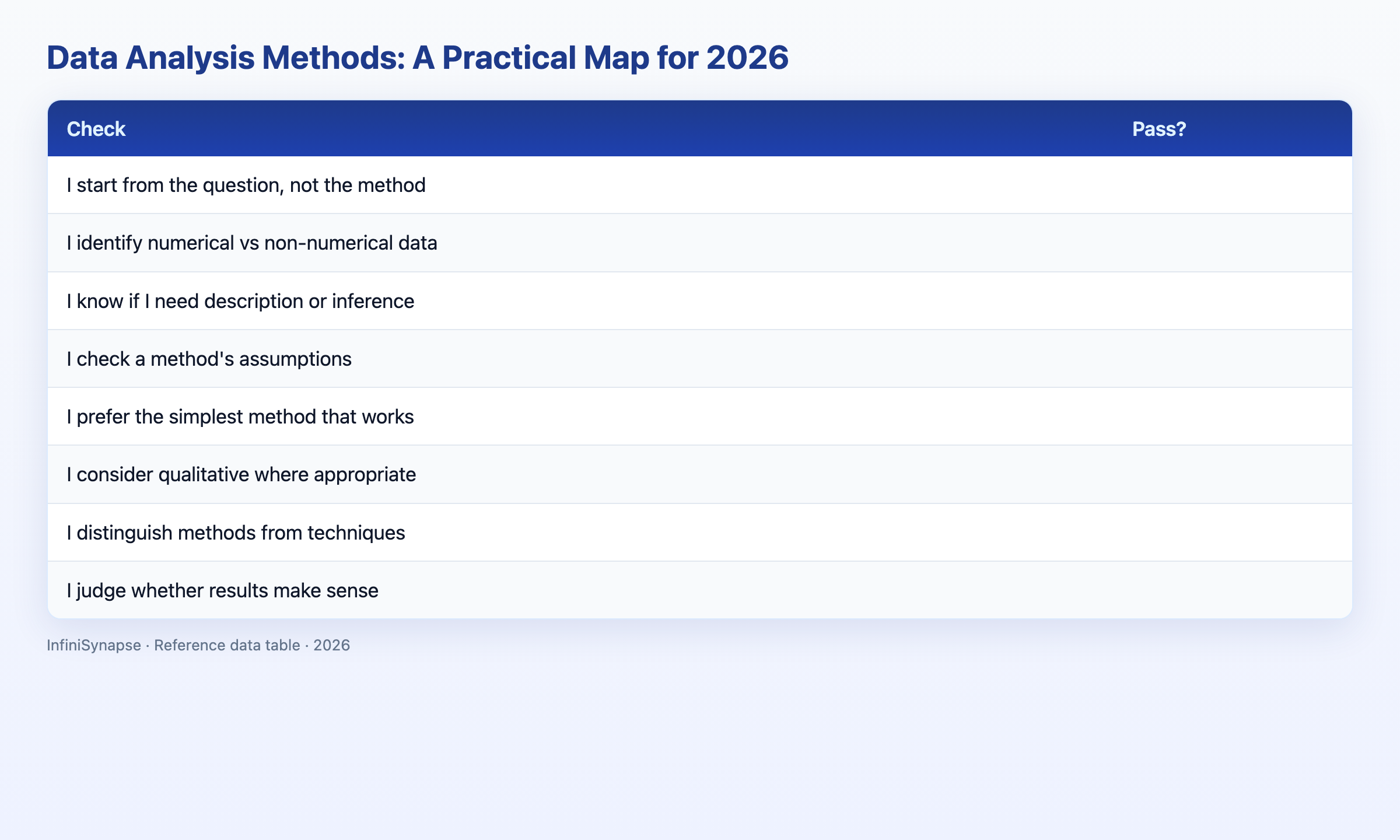
| Check | Pass? |
|---|---|
| I start from the question, not the method | |
| I identify numerical vs non-numerical data | |
| I know if I need description or inference | |
| I check a method's assumptions | |
| I prefer the simplest method that works | |
| I consider qualitative where appropriate | |
| I distinguish methods from techniques | |
| I judge whether results make sense |
6–8: sound method selection. 3–5: reinforce a distinction. Below 3: revisit the map.
Frequently Asked Questions
What are data analysis methods?
Data analysis methods are the systematic approaches used to examine data, divided broadly into quantitative methods for numerical data and qualitative methods for non-numerical data like text. They further split into descriptive methods that summarize and inferential methods that generalize from a sample. The right method depends on your question and data type.
What is the difference between quantitative and qualitative methods?
Quantitative data analysis methods work with numerical data, using statistics to summarize, test, and model, while qualitative methods work with non-numerical data like interviews and texts, systematically identifying themes and meanings. Quantitative methods quantify and generalize; qualitative methods explain meaning and experience that numbers cannot capture.
How do I choose the right data analysis method?
Choose a data analysis method by starting from the question: determine whether your data is numerical or non-numerical, and whether you need to describe what happened or infer about a broader population. Then pick the simplest method that genuinely answers the question, checking its assumptions. Matching method to question matters more than sophistication.
What is the difference between descriptive and inferential methods?
Descriptive data analysis methods summarize what the data shows, like averages and distributions, making no claims beyond the data at hand. Inferential methods use a sample to draw conclusions about a larger population, quantifying uncertainty through tools like hypothesis tests. Confusing the two, treating a summary as proof of a general claim, is a serious error.
How do AI tools apply data analysis methods?
AI-native tools apply data analysis methods by selecting and executing appropriate approaches from a plain-language goal, such as running a regression or summarizing themes, and presenting results with an inspectable trail. The human still frames the question and judges whether the method and result make sense, while the mechanical application is accelerated.
Conclusion
Data analysis methods divide into quantitative and qualitative families, and into descriptive and inferential approaches, and the core skill is matching the method to your question and data rather than chasing sophistication. In 2026, AI-native tools apply standard methods from a plain-language goal while humans supply the framing and judgment.
To see methods applied automatically, read the complete data analysis guide and what AI-native data analysis means), then try the InfiniSynapse web app free on registration.