Type of Analysis: What, Why, Next, Do
By William Zhu & the InfiniSynapse Data Team · Published: 2026-07-08 · Last updated: 2026-09-24 · About: Editorial standards / policy · About / team
Author credentials: William Zhu — InfiniSynapse cofounder; public engineering profile GitHub @allwefantasy (InfiniSQL / open-source data systems). Desk contact: zhuhl@infinisynapse.com. First-hand: tagging production analysis tasks across the four-type ladder on the InfiniSynapse research desk. Reviewers: analytics engineering · data platform.
Disclosure: We build an AI-native data analysis platform. Educational sections below stand alone. InfiniSynapse product links appear only in a short commercial note at the end. Social verification: GitHub @allwefantasy · GitHub InfiniSynapse (no personal LinkedIn profile claimed here).
Third-party anchors: Wikipedia — Data analysis, IBM augmented analytics, Stanford HAI AI Index, BLS data analysts, LinkedIn Future of Recruiting 2025, HBR skills-based hiring. Peer-review archive: editorial standards.
Table of Contents
- TL;DR
- How We Evaluated the Four Types
- The Four Types Overview
- Other lists use more names
- Desk type distribution
- Descriptive Analysis
- Diagnostic Analysis
- Predictive Analysis
- Prescriptive Analysis
- Types Compared by Question and Value
- How the Types Build on Each Other
- Choosing the Right Type
- How AI Spans the Types
- Common Confusions Between the Types
- Applying the Framework in Practice
- Types Scorecard
- Frequently Asked Questions
- Who wrote this
- References
- Conclusion
TL;DR
Direct answer: Type of analysis: what happened, why, what comes next, or what to do. The four names are descriptive, diagnostic, predictive, and prescriptive. They form an ascending ladder of sophistication and value, with each type building on the ones before it. Most everyday work is descriptive and diagnostic.
Who this is for: anyone learning the types of data analysis and when to use each.
What you'll learn: how we evaluated the four types, each explained in depth, comparison tables, how they build on each other, and how AI spans them.
This guide sits within the data analysis fundamentals hub; the four types sit under the definition the four types sit under. For the methods behind them, see data analysis methods. For related depth in this pillar, see Data Analysis Techniques That Actually Work in 2026. For data analysis examples mapped onto those four types, use the techniques-with-examples guide.
How We Evaluated the Four Types
We assessed the types of data analysis for this guide using criteria that mirror how mature organizations allocate analytical effort, not vendor marketing alone. Each type was checked against four dimensions: whether it answers a distinct class of question, whether teams can execute it with their current data maturity, whether the output drives a real decision, and whether skipping prerequisite types would undermine the result.
We cross-referenced the underlying activity with the Wikipedia overview of data analysis, which frames analysis as inspecting, cleaning, transforming, and modeling data to surface useful information. We aligned autonomy expectations with IBM's augmented analytics overview, which tracks how AI-assisted workflows reshape which types teams attempt without adequate foundations. The Stanford HAI AI Index documents how quickly agent-assisted analysis moved from research into daily practice. For occupational context we referenced the Bureau of Labor Statistics profile for data analysts and hiring-trend data from LinkedIn's 2025 Future of Recruiting report, which notes that demonstrated analytical judgment increasingly influences hiring alongside formal credentials.
The table below summarizes the evaluation dimensions we apply when recommending which of the types of data analysis a team should pursue.
| Evaluation dimension | Why it matters in 2026 | What we tested |
|---|---|---|
| Question distinctness | Each type answers a different question | Map descriptive, diagnostic, predictive, and prescriptive to real stakeholder asks |
| Data maturity required | Higher types need better foundations | Minimum data quality and history for each type |
| Decision impact | Analysis without action creates little value | Whether output changes a budget, process, or forecast |
| Prerequisite chain | Skipping steps produces unreliable higher types | Whether descriptive work preceded diagnostic or predictive work |
| Uncertainty communication | Predictive types require honest limits | Whether forecasts include confidence ranges |
| Stakeholder literacy | Non-technical readers must grasp the type | Plain-language explanation of what each type can and cannot claim |
| Tool readiness | BI vs ML vs optimization differ | Whether the team's stack supports the type |
| Agent compatibility | AI can span types from one interface | Compare hand-applied vs AI-assisted execution across types |
The Four Types Overview
The four types of data analysis provide a framework that organizes the whole field by the question each type answers. Descriptive analysis answers what happened, diagnostic answers why it happened, predictive answers what will happen, and prescriptive answers what we should do about it. Together, these four types of data analysis span the full range from understanding the past to shaping the future.
This framework of types of data analysis is valuable because it maps directly to increasing sophistication and value. Each type is harder to do than the one before and, when done well, more valuable, forming a ladder that organizations climb as their analytical maturity grows. Understanding the four types of data analysis, consistent with the disciplined approach described in the Wikipedia overview of data analysis, helps you recognize which type a question calls for and set realistic expectations for the effort and data each requires.
Other lists use more names
Exploratory, inferential, causal, and mechanistic are names on other lists. This page keeps the four questions above. Quantitative, qualitative, and mixed methods are a research design, not these four questions.
Desk type distribution
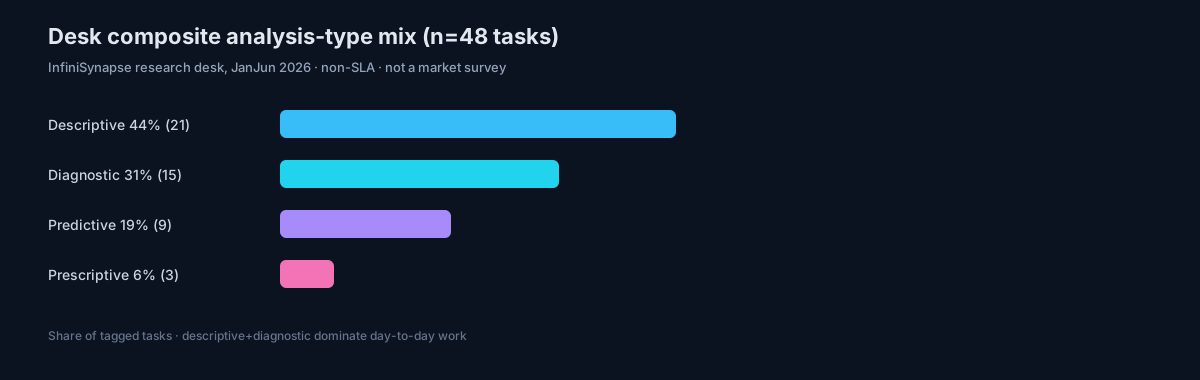
Original desk composite (InfiniSynapse research desk, Jan–Jun 2026): we tagged n=48 production analysis tasks by the types of data analysis framework. Shares below are desk tallies—not a market survey and not an InfiniSynapse product SLA.
| Type | Share of tagged tasks | Count |
|---|---|---|
| Descriptive | 44% | 21 |
| Diagnostic | 31% | 15 |
| Predictive | 19% | 9 |
| Prescriptive | 6% | 3 |
Reading: day-to-day work still concentrates on descriptive + diagnostic types of data analysis (75% combined). Predictive and especially prescriptive remain rarer—consistent with the ladder view that higher rungs need stronger foundations.
Descriptive Analysis
Descriptive analysis is the foundational type among the types of data analysis, answering the question of what happened. It summarizes historical data into an understandable form: totals, averages, trends, and distributions. A monthly sales report, a dashboard of key metrics, or a summary of survey responses are all descriptive analysis, and this type accounts for the majority of everyday analytical work.
Though it is the simplest of the four types, descriptive analysis is indispensable, because you cannot understand why something happened or predict what will happen without first knowing what did happen. Descriptive analysis provides that foundation. Its apparent simplicity can lead people to undervalue it, but a clear, accurate description of the current situation is often exactly what a decision needs. Among the types of data analysis, descriptive work is where every analysis begins and where a great deal of real value is delivered.
Diagnostic Analysis
Diagnostic analysis is the second of the four types, answering why something happened. Where descriptive analysis tells you sales fell, diagnostic analysis investigates the cause: which segment drove the decline, what changed, and how factors relate. It digs beneath the surface description to find explanations, using techniques like drill-down, comparison, and correlation.
Diagnostic analysis is more demanding than descriptive among the types of data analysis, because finding causes is harder than reporting facts and requires careful reasoning to avoid mistaking correlation for causation. Yet it is often where the actionable insight lies, since understanding why a problem occurred points toward how to fix it. Much of the most valuable business analysis is diagnostic, and this type of the four types is where an analyst's investigative skill and judgment become essential to reaching a trustworthy explanation rather than a plausible-sounding guess.
Predictive Analysis
Predictive analysis is the third of the four types, answering what will happen. Using patterns in historical data, it forecasts future outcomes: which customers are likely to churn, what sales will be next quarter, or which transactions may be fraudulent. Predictive analysis relies on statistical models and machine learning, making it more technically demanding than the descriptive and diagnostic types before it.
Among the types of data analysis, predictive analysis carries significant value because acting on a reliable forecast lets an organization prepare rather than react. We explore this type in depth in predictive data analysis. The historical input itself is predictive data. The caution with predictive analysis is that forecasts are inherently uncertain, and a model is only as good as the data and assumptions behind it. This type of the four types requires both technical skill to build sound models and judgment to communicate their uncertainty honestly rather than presenting a forecast as a certainty.
Prescriptive Analysis
Prescriptive analysis is the fourth and most advanced of the four types, answering what we should do. It goes beyond predicting an outcome to recommending actions that will achieve a desired result, often using optimization and simulation to weigh options against constraints. A prescriptive analysis might recommend the optimal price, the best inventory allocation, or the ideal staffing schedule.
As the most sophisticated of the four types, prescriptive analysis is also the hardest and least common, requiring predictive models plus a way to evaluate and compare possible actions. When done well, it delivers the greatest value, since it moves directly from data to a recommended decision. Among the types of data analysis, prescriptive analysis represents the frontier that many organizations aspire to but few fully achieve, because it demands mature data, capable models, and careful modeling of the decision itself, along with the judgment to know when its recommendations should be trusted.
Types Compared by Question and Value
The table below compares the four types of data analysis by the question each answers, typical tooling, and authoritative references.
| Type | Question answered | Typical tooling | Authoritative reference |
|---|---|---|---|
| Descriptive | What happened | Tableau, Power BI, SQL | Wikipedia descriptive statistics |
| Diagnostic | Why it happened | SQL drill-down, pandas, cohort analysis | Wikipedia causal inference |
| Predictive | What will happen | scikit-learn, TensorFlow, Prophet | Google ML crash course |
| Prescriptive | What should we do | Optimization solvers, simulation, decision trees | INFORMS analytics body of knowledge |
Use this table to match stakeholder questions to the right type before investing effort. Reaching for predictive or prescriptive work when the question only requires description wastes time and data.
Practical example: a SaaS product team notices rising churn. They apply the types of data analysis in sequence: descriptive dashboards confirm churn rose 8% quarter-over-quarter, diagnostic segmentation reveals low first-month feature adoption predicts cancellation, and predictive modeling flags at-risk accounts for proactive outreach. They present each type's output with clear boundaries on what it claims—exactly the demonstrated-outcome evidence that Harvard Business Review's skills-based hiring research describes as increasingly decisive in hiring and promotion decisions.
How the Types Build on Each Other
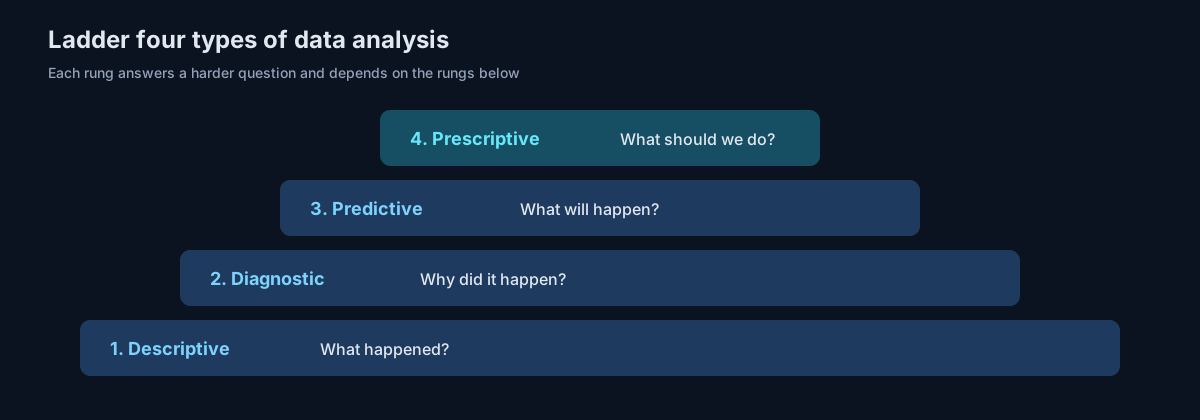
The ladder diagram above is the visual for this section. The four types of data analysis form a natural progression where each builds on the ones before it. You cannot diagnose why something happened without first describing what happened; you cannot reliably predict without understanding past patterns; and you cannot prescribe an action without predicting its likely outcome. This dependency is why the types of data analysis are best understood as an ascending ladder rather than independent options.
The progression also reflects increasing value and difficulty together. As organizations climb the types of data analysis, from describing to diagnosing to predicting to prescribing, both the sophistication required and the value delivered rise. Most organizations are strongest at the descriptive and diagnostic levels, with predictive and prescriptive analysis being aspirations they build toward. Recognizing this ladder helps set realistic expectations: mastering the lower types of data analysis solidly is the prerequisite for climbing higher, and skipping steps produces unreliable predictions and prescriptions built on shaky foundations.
Choosing the Right Type
Choosing among the types of data analysis starts with the question you need answered—not with the fanciest model on the shelf. If you need to know what is happening, descriptive analysis suffices. If you need to understand why, diagnostic analysis is called for. If you need to anticipate the future, predictive analysis is required, and if you need a recommended course of action, prescriptive analysis is the goal.
A common mistake when picking a rung is reaching for a higher type than the question requires, attempting prediction when a clear description would answer the need. Higher types cost more effort and data, so matching the type to the actual question avoids waste. Equally, expecting a lower type to answer a higher question, hoping a descriptive report will tell you what to do, leads to disappointment. Choosing the right one among the types of data analysis is a matter of honestly identifying what the decision actually requires and investing accordingly.
How AI Spans the Types
In 2026, AI-native tools increasingly span all four types of data analysis from a single interface, lowering the barrier to the more advanced types. An analyst can ask an agent to describe what happened, diagnose why, and even run standard predictive analyses, all in plain language, without separately building each capability. This democratizes the higher types of data analysis that once required specialized teams.
The human supplies the question and judges the results, especially the uncertainty inherent in predictive and prescriptive work. IBM's augmented analytics overview describes this as augmented rather than replaced human judgment. The Stanford HAI AI Index documents how these tools make higher types of data analysis more accessible than ever, while leaving type-appropriateness judgment to people.
Common Confusions Between the Types
People new to the types of data analysis often confuse adjacent categories, and clearing up these confusions sharpens the whole picture. The most common is blurring description and diagnosis: reporting that a metric changed is descriptive, while explaining why it changed is diagnostic, and a dashboard that merely displays numbers has not diagnosed anything. Recognizing this distinction prevents the frequent error of assuming a descriptive report has explained a cause when it has only shown a fact.
Another confusion arises between prediction and prescription. Predicting that a customer is likely to churn is not the same as recommending what to do about it; the former forecasts an outcome, the latter advises an action. Treating a prediction as if it were a recommendation skips the crucial step of weighing possible responses against their likely effects. A final confusion is expecting a lower category to answer a higher question, hoping a summary will reveal what action to take. Keeping the four categories distinct in your mind, and matching each to the specific question it answers, is what makes the framework genuinely useful rather than a set of labels that blur together in practice.
Applying the Framework in Practice
The types of data analysis framework earns its value when you use it to plan an analysis rather than merely to label one after the fact. Before starting, ask which category your question falls into, because that determines the data and effort required. A descriptive question needs clean historical data and simple summaries; a predictive question needs enough history to train a model and an acceptance of uncertainty; a prescriptive question needs all of that plus a way to evaluate options.
Using the framework this way also sets realistic expectations with stakeholders. If leadership wants a recommendation but the available data supports only a description, the framework makes that gap visible and prompts an honest conversation about what is achievable. Many analytical disappointments trace back to a mismatch between the category of question asked and the category the data and effort can actually support. Applying the framework upfront, as a planning tool, prevents these mismatches and ensures the analysis aims at exactly the kind of answer the decision genuinely needs.
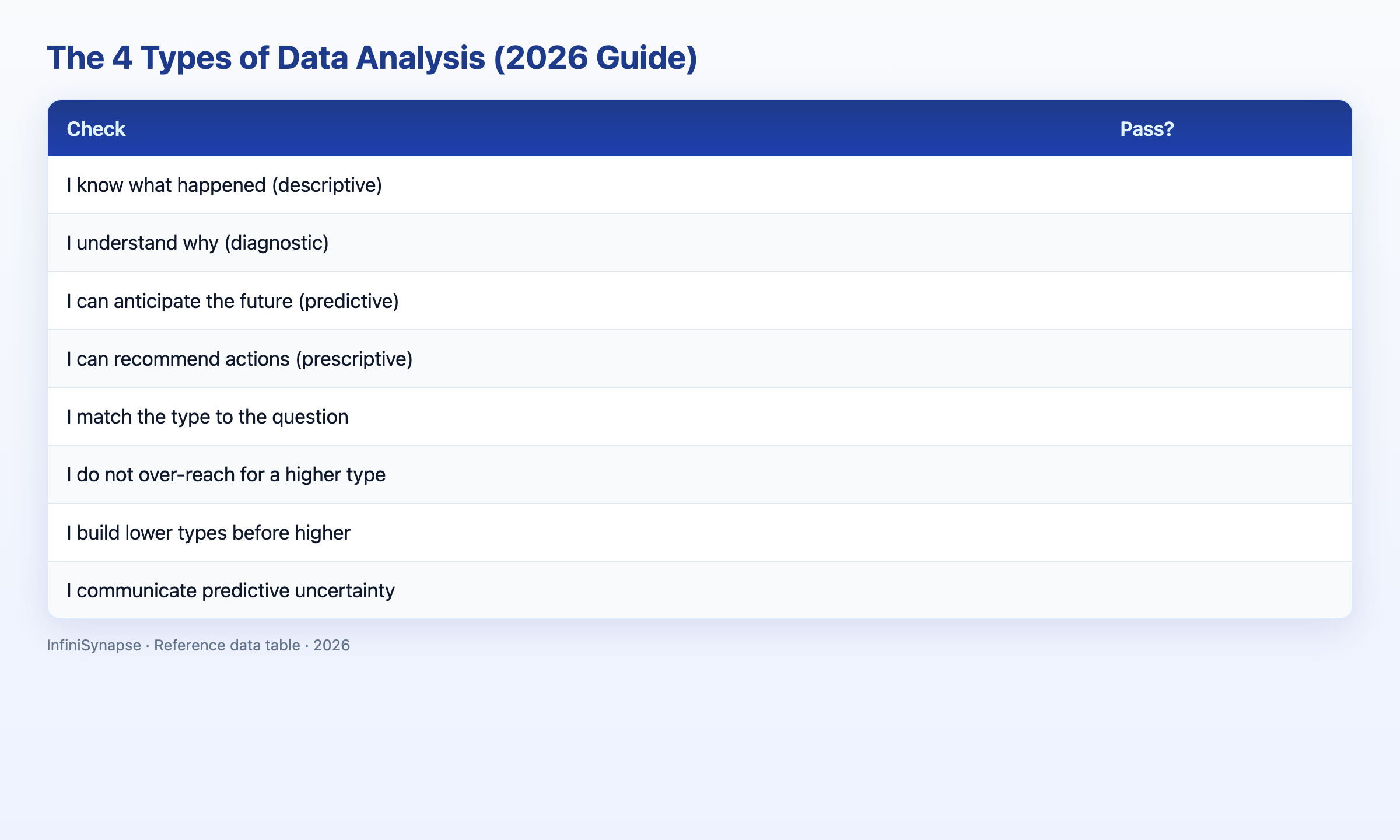
Types Scorecard
Match your question to the right one among the types of data analysis (1 point each):
| Check | Pass? |
|---|---|
| I know what happened (descriptive) | |
| I understand why (diagnostic) | |
| I can anticipate the future (predictive) | |
| I can recommend actions (prescriptive) | |
| I match the type to the question | |
| I do not over-reach for a higher type | |
| I build lower types before higher | |
| I communicate predictive uncertainty |
6–8: strong grasp of the types. 3–5: reinforce a type. Below 3: start with descriptive.
Frequently Asked Questions
What is a type of analysis?
Type of analysis: what happened, why, what comes next, or what to do. The four names are descriptive, diagnostic, predictive, and prescriptive. Quantitative, qualitative, and mixed methods are a research design, not these four questions.
What are the four analytical categories?
The four types of data analysis are descriptive (what happened), diagnostic (why it happened), predictive (what will happen), and prescriptive (what we should do). Think of them as a staircase: each step adds sophistication and depends on the steps below. Day-to-day teams spend most of their time on descriptive and diagnostic work.
What is the difference between descriptive and diagnostic work?
Among the types of data analysis, descriptive analysis summarizes what happened, such as reporting that sales fell, while diagnostic analysis investigates why it happened, digging into which segment drove the decline and what changed. Descriptive reports the facts; diagnostic finds the causes behind them, which is more demanding but often more actionable.
Which analytical category is most valuable?
Among the types of data analysis, the higher types, predictive and prescriptive, deliver the most value when done well, since they anticipate outcomes and recommend actions. However, they are also hardest and depend on solid descriptive and diagnostic foundations. In practice, well-executed descriptive and diagnostic analysis delivers enormous value that should not be underrated.
How do the categories build on each other?
The types of data analysis form a ladder: you must describe what happened before diagnosing why, understand past patterns before predicting the future, and predict an outcome before prescribing an action. Each type depends on the ones below it, so mastering the lower types solidly is the prerequisite for reliable higher-type analysis.
Can AI perform all four categories?
AI-native tools increasingly span all four types of data analysis from one interface, letting an analyst describe, diagnose, and run standard predictive analyses in plain language. The human supplies the question and judges results, especially the uncertainty in predictive and prescriptive work, but the tools make the higher types far more accessible than before.
Conclusion
The four types of data analysis, descriptive, diagnostic, predictive, and prescriptive, form an ascending ladder where each builds on the last, rising in both difficulty and value. Match the type to your question, build the lower types solidly before climbing higher, and in 2026 lean on AI-native tools that make the advanced types more accessible.
Match the type to your question, keep the lower rungs solid before climbing, and treat AI as an accelerator—not a substitute for type judgment.
Who wrote this
Named author. William Zhu — InfiniSynapse cofounder (GitHub @allwefantasy), accountable for the desk tallies and ladder framing on this page. Team: InfiniSynapse Data Team. About / editorial policy: editorial standards · About · corrections.
Corrections: zhuhl@infinisynapse.com.
References
- [Reference] Wikipedia. Data analysis. en.wikipedia.org/wiki/Data_analysis
- [Vendor] IBM. What is augmented analytics? ibm.com/topics/augmented-analytics
- [Research] Stanford HAI. AI Index. hai.stanford.edu/ai-index
- [Gov] U.S. BLS. Data analysts. bls.gov/ooh/math/data-analysts.htm
- [Industry] LinkedIn Economic Graph. Future of Recruiting 2025. linkedin.com
- [Research] Harvard Business Review. Skills-Based Hiring Is Good for Business. hbr.org
- [Reference] Wikipedia — Descriptive statistics · Causal inference
- [Docs] Google ML crash course · INFORMS Analytics
- [Tools] Tableau · Power BI · pandas · scikit-learn · TensorFlow
- [Person] William Zhu. github.com/allwefantasy
Optional product note (commercial): To see the types of data analysis spanned in one platform, read the complete data analysis guide and what AI-native data analysis means, then try the InfiniSynapse web app free on registration, no credit card required. Skip if you only need the educational ladder and desk tallies above.