Data Analysis Certificate: Options and Value in 2026
By the InfiniSynapse Data Team · Last updated: 2026-07-08 · We build an AI-native data analysis platform and evaluate certificate programs; this guide explains what a data analysis certificate is worth and which options to consider.
Table of Contents
- TL;DR
- What a Data Analysis Certificate Is
- Certificate vs Certification vs Degree
- Types of Certificate Programs
- What Employers Think
- Choosing the Right Certificate
- Maximizing Certificate Value
- AI Skills and Certificate Programs
- Certificate Value Scorecard
- Putting Your Learning Into Practice
- Frequently Asked Questions
- Conclusion
TL;DR
Direct answer: a data analysis certificate is a credential earned by completing a structured analytics training program, typically covering SQL, visualization, and statistics over weeks to months. It signals organized learning and baseline competency but does not replace demonstrated ability through a portfolio. The best data analysis certificate programs include hands-on practice, portfolio projects, and AI tool coverage.
Who this is for: learners evaluating data analysis certificate programs and their career value.
What you'll learn: what certificates are, how they differ from other credentials, types available, employer perceptions, and how to choose.
This guide sits under the data analyst certification hub; for analyst-specific programs, see data analyst certificate and the directory in data analysis certification.
What a Data Analysis Certificate Is
A data analysis certificate is a formal credential awarded upon completing a structured training program in analytics fundamentals. Programs typically cover SQL, spreadsheet analysis, data visualization, basic statistics, and data cleaning over a period ranging from several weeks to a few months. The certificate confirms you finished the curriculum and, in stronger programs, demonstrated competency through projects or exams.
What a data analysis certificate is not: a guarantee of employment, a substitute for a portfolio, or equivalent to a university degree. It is a focused, shorter credential that signals you invested in organized learning and achieved a baseline of analytics knowledge. The value depends heavily on what the specific program teaches, whether it includes genuine practice, and how well its skills match current employer expectations. Warehouse-grounded analytics should align with Databricks documentation on SQL warehouses and data governance.
The data analysis certificate landscape includes programs from technology companies, universities, professional organizations, and independent training providers. Quality varies significantly. Some programs provide rigorous, project-based training that genuinely prepares you for analyst work. Others award certificates for completing video modules without demonstrating applicable skills. Evaluating specific programs matters more than the certificate concept itself, as outlined in the analytical process in the Wikipedia data analysis overview.
Certificate vs Certification vs Degree
Three credential types confuse learners because providers use the terms interchangeably. Understanding the differences helps you choose the right path.
A data analysis certificate typically means completing a training program and receiving a credential, sometimes without a rigorous exam. A certification usually requires passing a competency assessment that tests applied skills. A degree represents years of accredited academic study with broader scope and deeper theoretical grounding.
| Credential | Duration | Assessment | Cost | Scope |
|---|---|---|---|---|
| Data analysis certificate | Weeks–months | Completion or light exam | Low–medium | Focused |
| Certification | Weeks–months | Rigorous exam/project | Medium | Focused |
| Degree | 2–4 years | Academic standards | High | Broad |
In practice, the lines blur. Some data analysis certificate programs include rigorous capstone projects; some certifications only require video completion. Evaluate each program on what it teaches and tests, not the label. We explore certification broadly in certified data analysis) and compare analyst-specific programs in data analyst certificate.
For career changers, a data analysis certificate often offers the best efficiency: faster and cheaper than a degree, more structured than self-study, and paired with a portfolio it provides both learning and a resume signal.
Types of Certificate Programs
Data analysis certificate programs fall into several categories, each with different strengths.
Technology platform certificates from major education providers offer affordable, self-paced programs with widely recognized brand names. They typically cover SQL, spreadsheets, visualization, and a capstone project. These are the most popular entry points for career changers.
University extension certificates provide institutional credibility with focused analytics curricula. They may carry more weight with employers who value academic affiliation, though curriculum freshness varies by institution.
Professional organization certificates target specific domains or methodologies. They suit analysts seeking specialization rather than general entry-level preparation.
Bootcamp certificates result from intensive, cohort-based programs with career services. They cost more but include placement support that standard certificate programs lack. See data analysis bootcamp for ROI analysis.
The right data analysis certificate type depends on your goals, budget, and need for career support. General entry-level preparation suits technology platform or university programs. Career changers needing placement help may prefer bootcamp certificates despite higher cost.
What Employers Think
Employers view a data analysis certificate as a positive signal showing structured learning and commitment to the field. It can help pass initial resume screening, particularly at organizations with formal HR processes. However, hiring managers consistently prioritize demonstrated ability over credentials.
A data analysis certificate combined with a portfolio of real analyses is a compelling profile for entry-level roles. The same certificate without portfolio work is significantly weaker. This hierarchy holds across company sizes: proof of work beats proof of coursework. We detail employer expectations in data analyst skills and how to become a data analyst.
The data analysis certificate carries more weight when it comes from a recognized provider and the program included rigorous assessment. Unknown credentials from programs that only require video completion carry minimal weight. When listing a certificate on your resume, be prepared to demonstrate the skills it represents through portfolio work and interview performance.
Choosing the Right Certificate
Selecting a data analysis certificate program requires evaluating specific features against your goals and constraints. The move toward augmented workflows, outlined in IBM's augmented analytics overview, frames how teams evaluate modern tooling.
Start with curriculum: does the program teach SQL through extensive hands-on practice? Does it include visualization, statistics, and communication skills? Does it culminate in a project suitable for your portfolio? A data analysis certificate from a program that fails these checks has limited value regardless of brand.
Check assessment rigor. Programs requiring project completion and practical skill demonstration produce stronger graduates than those awarding certificates for passive content consumption. Verify AI coverage: does the curriculum address modern AI-native tools or teach only traditional methods?
Consider practical factors: cost, time commitment, format (self-paced vs cohort), and support availability. A data analysis certificate program you abandon delivers zero value. Choose one that fits your weekly schedule and learning style. We compare course options in data analysis courses) and data analyst course).
Maximizing Certificate Value
A data analysis certificate delivers the most career value when treated as a foundation for active practice, not a finish line. Immediately after completing the program, apply your skills to real datasets beyond coursework. Convert course projects into polished portfolio pieces with documented process and clear takeaways.
Network within the program's alumni community. Share your projects, ask questions, and connect with fellow graduates. Referrals from certificate program alumni often lead to interviews that credentials alone cannot secure. Continue learning as the field evolves, especially in AI-native tooling.
Pair your data analysis certificate with complementary preparation. If the program lacked AI coverage, practice with AI-native platforms independently. If communication skills were undertrained, practice writing clear analytical summaries. The certificate is one component of a broader preparation strategy that includes portfolio work, networking, and continuous skill development.
AI Skills and Certificate Programs
A data analysis certificate program that ignores AI-native tools in 2026 leaves graduates with an incomplete skill set. Employers increasingly expect analysts to direct AI analysis agents, validate automated outputs, and integrate AI-assisted workflows into standard practice. Certificate curricula should reflect this shift.
When evaluating programs, check whether AI modules are core curriculum or absent entirely. Programs treating AI as optional are teaching an outdated toolkit. Supplement any data analysis certificate with hands-on AI practice regardless of curriculum coverage.
InfiniSynapse supports this practice with free registration. It is an AI-native agent connecting to data sources and running analysis through InfiniSQL, modeling the tools modern certificate programs should cover. We explore the paradigm in what AI-native data analysis means), and the Stanford HAI AI Index documents how rapidly AI skills have become a baseline expectation for analysts. Enterprise adoption patterns in Google Cloud's AI overview mirror the shift from pilots to governed analytics.
Certificate Value Scorecard
Evaluate any data analysis certificate program (1 point each):
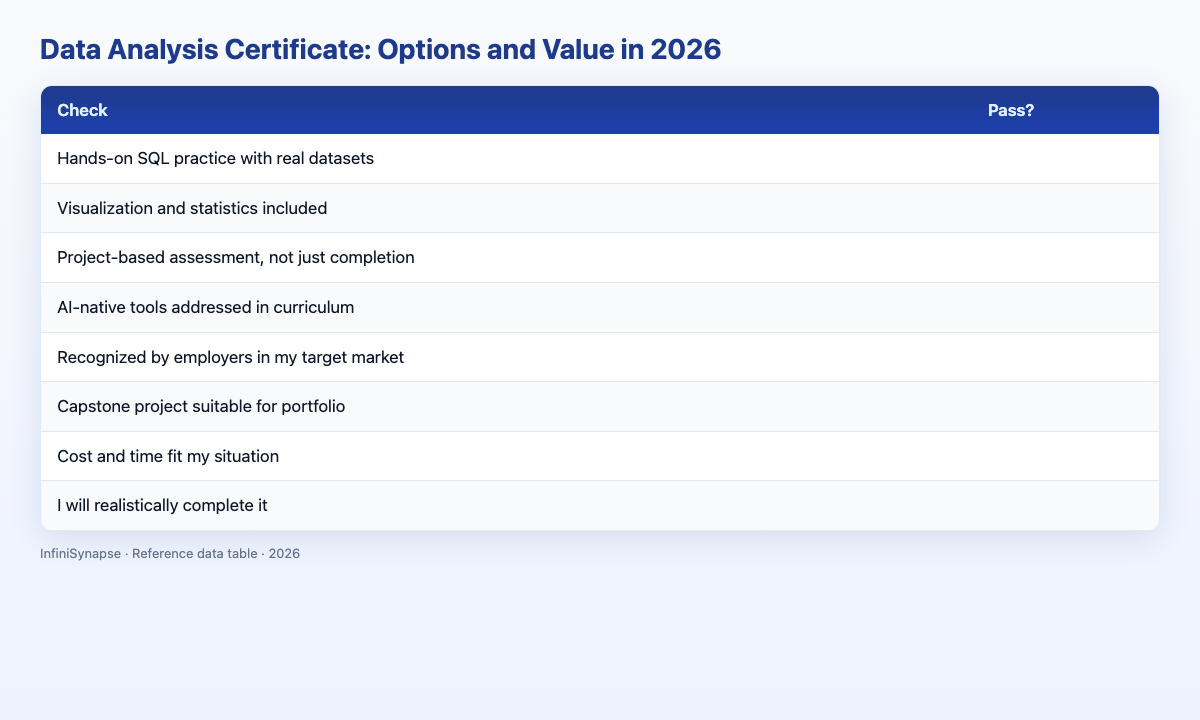
| Check | Pass? |
|---|---|
| Hands-on SQL practice with real datasets | |
| Visualization and statistics included | |
| Project-based assessment, not just completion | |
| AI-native tools addressed in curriculum | |
| Recognized by employers in my target market | |
| Capstone project suitable for portfolio | |
| Cost and time fit my situation | |
| I will realistically complete it |
6–8: worthwhile data analysis certificate. 3–5: compare alternatives. Below 3: consider other paths.
Putting Your Learning Into Practice
Earning a data analysis certificate is a checkpoint—translate it into workplace rhythms quickly. Within thirty days, shadow a public earnings call or product update and draft the three analyses you would run if you owned that metric. Certificates validate curriculum; scenario practice validates fit.
Rebuild one certificate project with stricter data governance: document sources, retention rules, and who may access exports. Teams hire analysts who think about policy early, not only charts.
Pair your credential with measurable outcomes. If a project improved a KPI, estimate the counterfactual or at least define how you would measure impact. Hiring managers discount certificates without effect sizes or clear success criteria.
Keep an upgrade queue: after the certificate, pick one advanced topic—experimentation, semantic layers, or AI-assisted SQL—and schedule micro-projects until it appears in your portfolio. Static credentials age; documented progression does not.
Frequently Asked Questions
What is a data analysis certificate?
A data analysis certificate is a credential earned by completing a structured analytics training program covering skills like SQL, visualization, and statistics. Employers read it as proof of structured study and baseline skills, not as a substitute for portfolio work.
Is a worth it?
Yes, as a structured learning path that teaches job-relevant skills and provides a resume signal. A credential program is not worth it as a standalone job ticket without portfolio work. Pair any certificate with real projects for the strongest preparation.
How is a certificate different from a certification?
A certificate option typically means completing a program, while a certification may require passing a rigorous competency exam. In practice, terms overlap. Evaluate what each specific program teaches and tests rather than relying on the label.
Which the credential is best?
The best program depends on your goals and level. Look for hands-on SQL practice, project-based assessment, AI coverage, and recognition in your target job market. A analytics credential you will complete and apply beats a prestigious one you abandon.
Can I get a certificate program online?
Yes. Most the certificate programs are available online in self-paced and cohort formats. Choose programs with interactive practice environments and adequate support. See data analyst certification online) for online-specific guidance.
Conclusion
A well-chosen this credential in 2026 provides structured analytics training, a recognized credential, and a foundation for portfolio-building. Evaluate programs on practice depth, assessment rigor, and AI coverage rather than brand alone. Treat the analytics certificate as a milestone that launches active practice and continuous learning, not as a finish line that completes your preparation.
To practice the AI-era skills employers want, read what AI-native data analysis means) and try the InfiniSynapse web app free on registration, no credit card required.