Data Analysis Bootcamps: Are They Worth It in 2026?
By the InfiniSynapse Data Team · Last updated: 2026-07-08 · We build an AI-native data analysis platform and have tracked bootcamp outcomes for years; this guide gives an honest ROI assessment.
Table of Contents
- TL;DR
- What Bootcamps Promise
- What Bootcamps Deliver
- Cost vs Outcome Analysis
- Bootcamp vs Alternatives
- Red Flags to Watch For
- Who Should Consider a Bootcamp
- AI Coverage in Bootcamp Curricula
- Bootcamp ROI Scorecard
- Putting Your Learning Into Practice
- Frequently Asked Questions
- Conclusion
TL;DR
Direct answer: a data analysis bootcamp can be worth it for career changers who need intensive structure, cohort accountability, and career placement support, but only if the specific program has verified outcomes and a current curriculum. Many bootcamps overpromise placement rates and underdeliver on AI-era skills. Evaluate any data analysis bootcamp on curriculum depth, graduate outcomes, and cost before enrolling.
Who this is for: career changers evaluating whether a data analysis bootcamp justifies the investment.
What you'll learn: what bootcamps promise vs deliver, cost-outcome analysis, alternatives, red flags, and who benefits most.
This guide sits under the data analyst certification hub; for specific options, see data analyst bootcamp and data analyst certificate. Warehouse-grounded analytics should align with Databricks documentation on SQL warehouses and data governance.
For related depth in this pillar, see Data Analyst Certification Online: 2026 Options.
What Bootcamps Promise
Data analysis bootcamp marketing typically promises a fast career transition: intensive training over three to six months, a portfolio of real projects, career coaching, and job placement within months of graduation. The appeal is speed and structure. For career changers who cannot spend years in a degree program and lack the discipline for fully self-directed learning, a data analysis bootcamp offers a guided, compressed path with built-in accountability.
The promises are not entirely unrealistic. Strong bootcamps do produce working analysts, particularly those with rigorous project-based curricula, active career services, and alumni networks that generate referrals. The key word is strong. The data analysis bootcamp market includes excellent programs and mediocre ones, and the marketing looks remarkably similar across both categories.
Understanding what a data analysis bootcamp actually delivers, as opposed to what it advertises, is essential before committing thousands of dollars and months of intensive effort. This guide provides that honest assessment, aligned with the skills described in data analyst skills and the analytical process in the Wikipedia data analysis overview.
What Bootcamps Deliver
In practice, data analysis bootcamp outcomes vary widely by program. Top-tier bootcamps deliver genuine SQL fluency, three or more portfolio projects, interview preparation, and placement rates that justify their cost for many graduates. Mid-tier programs teach usable skills but may lack strong career services or current curricula. Low-tier bootcamps issue certificates without building real ability, leaving graduates unprepared for interviews.
The most reliable outcome indicator is verifiable graduate employment data. Strong programs publish placement rates with methodology, share graduate employer names, and provide alumni references you can contact. Data analysis bootcamp providers that cite placement rates without explaining how they are calculated, or that count any employment rather than analyst roles specifically, are obscuring weaker outcomes.
Curriculum quality is the other critical delivery dimension. A data analysis bootcamp that teaches SQL deeply, includes messy real-world datasets, covers visualization and communication, and addresses AI-native tools delivers genuine value. One that rushes through drag-and-drop tools without query-writing practice produces graduates who struggle in technical interviews regardless of placement statistics.
Cost vs Outcome Analysis
Data analysis bootcamp costs typically range from five thousand to fifteen thousand dollars for full-time programs, with part-time options sometimes costing less. Additional expenses include living costs during full-time study and potential lost income if you leave your current job. The total investment can reach twenty thousand to forty thousand dollars when opportunity costs are included.
| Factor | Typical range |
|---|---|
| Tuition | $5,000–$15,000 |
| Duration | 3–6 months |
| Weekly hours | 20–40 (part/full time) |
| Opportunity cost | Varies significantly |
| Expected salary increase | $50,000–$80,000 entry-level |
The ROI calculation depends on whether you land an analyst role and how quickly. An entry-level data analyst salary of sixty to eighty thousand dollars means a data analysis bootcamp paying for itself within one to two years if you transition successfully. If you do not land a role, or land one at a lower salary than expected, the ROI turns negative quickly. This is why verifying placement outcomes before enrolling is not optional; it is the most important research step.
Compare the data analysis bootcamp cost against alternatives. A certification program costing five hundred to two thousand dollars plus six months of self-directed portfolio-building may produce similar job-search outcomes at a fraction of the price. A university degree costs more but provides broader career optionality. The bootcamp premium buys intensity, structure, and career services, not necessarily better skills. The move toward augmented workflows, outlined in IBM's augmented analytics overview, frames how teams evaluate modern tooling.
Bootcamp vs Alternatives
A data analysis bootcamp is one of several viable training paths, not inherently superior to alternatives.
Certification programs offer structured curricula and credentials at lower cost with more flexible pacing. They lack the intensity and career services of bootcamps but can produce similar skills for self-motivated learners. See data analyst training and certifications for data analyst.
Self-directed learning costs the least and offers maximum flexibility. Free courses, public datasets, and community feedback can build genuine skills without any program fee. The trade-off is no structure, no credential, and no career services.
University degrees provide the deepest foundation over years at the highest cost. They suit students wanting maximum optionality rather than career changers needing fast entry.
The data analysis bootcamp wins when you need external structure, benefit from cohort accountability, value career placement support, and can afford the investment. It loses when you are self-motivated enough for cheaper alternatives, already have partial skills that a bootcamp would repeat, or cannot verify the specific program's outcomes.
Red Flags to Watch For
Several warning signs suggest a data analysis bootcamp may not deliver value. Unverifiable placement rates, especially those above ninety percent without published methodology, are the most common red flag. Programs that refuse to connect you with recent graduates for honest conversations are hiding weak outcomes.
Curriculum red flags include: no substantial SQL training, reliance on drag-and-drop tools without query writing, no capstone projects using messy real-world data, and no mention of AI-native tools. A data analysis bootcamp teaching only Excel and basic visualization in 2026 is preparing you for a version of the role that is shrinking.
Other warning signs: pressure to enroll immediately with limited-time discounts, income-share agreements with unfavorable terms, instructors without working analyst experience, and curricula unchanged for years. Research any data analysis bootcamp thoroughly before committing. Read independent reviews, check graduate LinkedIn profiles, and compare curricula against current job postings.
Who Should Consider a Bootcamp
A data analysis bootcamp suits specific profiles well. Career changers with no technical background who need intensive structure and external accountability benefit most. People who have tried self-directed learning and stalled benefit from the deadlines and cohort support. Those who value career services such as resume review, mock interviews, and employer introductions benefit from bootcamp packages that include these services substantively.
A data analysis bootcamp is less appropriate for people who already have SQL and visualization skills and need only a credential and portfolio polish. It is a poor fit for those who cannot commit twenty or more hours weekly for several months. It is risky for those who enroll without verifying the specific program's graduate outcomes. And it is unnecessary for those who thrive with self-paced learning and can build accountability independently.
If you are unsure, try a low-cost certification program first. If you complete it successfully and still feel you need more structure and career support, a data analysis bootcamp may be the right next step. If you complete a certification and feel confident in your skills, invest in portfolio-building and job searching instead.
AI Coverage in Bootcamp Curricula
A data analysis bootcamp that ignores AI-native tools in 2026 is preparing graduates for yesterday's job market. As agents automate routine cleaning and querying, employers expect new analysts to direct AI tools effectively and validate their outputs. Bootcamp curricula should include modules on AI-assisted analysis, not treat AI as an afterthought or omit it entirely. Enterprise adoption patterns in Google Cloud's AI overview mirror the shift from pilots to governed analytics.
When evaluating a data analysis bootcamp, ask specifically about AI coverage. Does the curriculum include working with AI analysis agents? Do capstone projects incorporate AI-assisted workflows? Do instructors have experience with modern AI-native platforms? Programs answering no to these questions will leave you with a skills gap to fill after graduation.
InfiniSynapse represents the kind of tool bootcamps should teach. It is an AI-native agent connecting to data sources and running analysis through InfiniSQL, modeling how professional analysts work today. Practicing with it during or after a data analysis bootcamp builds fluency that traditional curricula often miss. We explore the paradigm in what AI-native data analysis means), and the Stanford HAI AI Index documents how rapidly these expectations have become standard.
Bootcamp ROI Scorecard
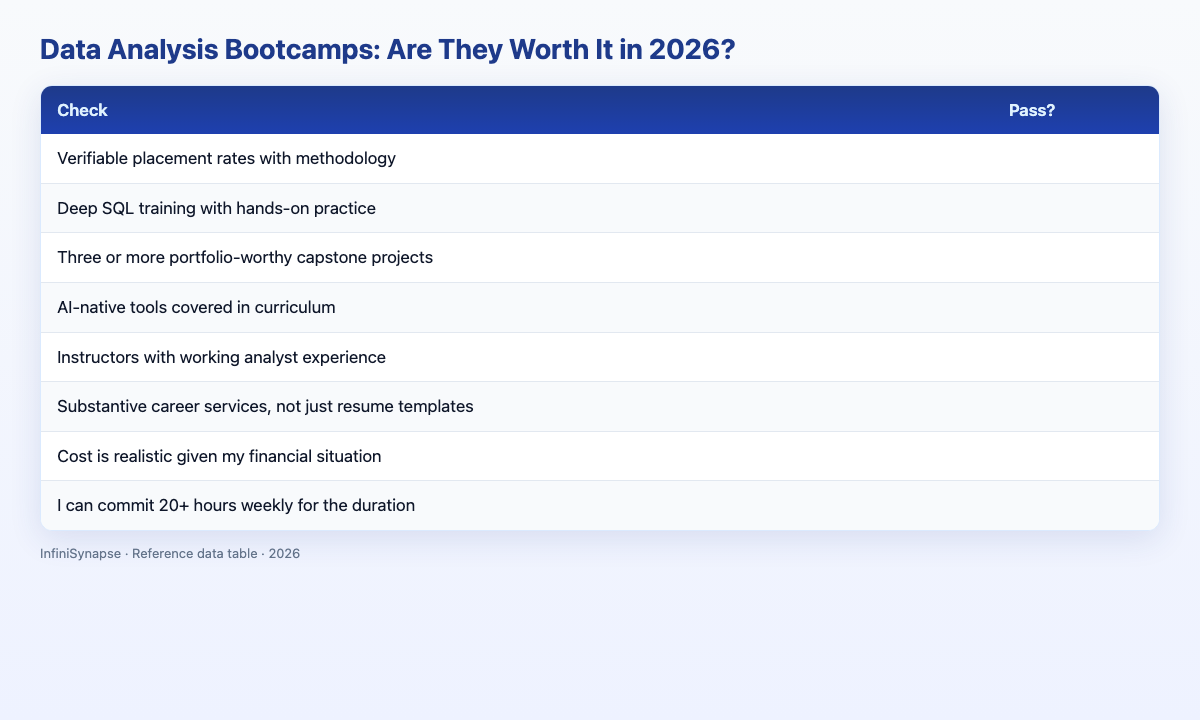
Evaluate any data analysis bootcamp (1 point each):
| Check | Pass? |
|---|---|
| Verifiable placement rates with methodology | |
| Deep SQL training with hands-on practice | |
| Three or more portfolio-worthy capstone projects | |
| AI-native tools covered in curriculum | |
| Instructors with working analyst experience | |
| Substantive career services, not just resume templates | |
| Cost is realistic given my financial situation | |
| I can commit 20+ hours weekly for the duration |
6–8: likely worth the investment. 3–5: compare carefully against alternatives. Below 3: consider other paths.
Putting Your Learning Into Practice
Bootcamps compress months of material into weeks; retention depends on what you build the month after graduation. Before the final week ends, line up two practice datasets and calendar daily rebuild sessions. Bootcamp velocity is useful only if skills survive without instructors.
Treat career services as a multiplier, not a magic lever. Bring polished stories: a bug you diagnosed, a metric you redefined, a chart you scrapped because it misled. Coaches can refine narratives you already own; they cannot invent experience you have not practiced.
Pair bootcamp stacks with production hygiene. Learn basic git branching, environment variables for credentials, and README templates hiring teams expect. Many bootcamp portfolios look identical; operational polish separates memorable candidates.
Negotiate your first role with portfolio evidence, not syllabus lists. Send hiring managers a one-page case study with SQL appendix. Bootcamp graduates who ship ongoing public work beat those who disappear after demo day.
Frequently Asked Questions
Are data analysis bootcamps worth the money?
A data analysis bootcamp is worth the money when it has verified placement outcomes, a current curriculum with deep SQL practice, and substantive career services. It is not worth it when placement rates are unverifiable, curricula are outdated, or you could achieve similar outcomes through cheaper certification and self-directed learning.
How much do data analysis bootcamps cost?
Most intensive course programs cost five thousand to fifteen thousand dollars, with total investment including opportunity costs potentially reaching twenty to forty thousand. Part-time options may cost less. Compare against certification programs at five hundred to two thousand dollars before committing to bootcamp pricing.
How long are bootcamp options?
Most the program programs run three to six months. Full-time programs require thirty to forty hours weekly; part-time programs require fifteen to twenty hours. Intensive formats may compress training into twelve weeks at higher weekly commitment.
Can I get a job after a intensive training?
Many graduates do land analyst roles, but outcomes vary significantly by program. Verify the specific bootcamp's placement data before enrolling. A bootcamp program combined with a strong portfolio and active networking produces better outcomes than relying on the bootcamp's career services alone.
What is the alternative to a the bootcamp?
Alternatives include certification programs, self-directed learning with free courses, and university degrees. Certification plus self-directed portfolio-building often produces similar skills at much lower cost. See data analyst training) for a full comparison of paths.
Conclusion
A this intensive program can be worth it for career changers who need intensive structure and verified career support, but the decision demands rigorous research into specific program outcomes, not generic faith in the bootcamp model. Evaluate curriculum depth, placement data, AI coverage, and cost against alternatives before enrolling. The best analytics bootcamp investment is one that builds genuine skills, produces a strong portfolio, and connects you to real job opportunities.
To practice the AI-era skills employers want, read what AI-native data analysis means) and try the InfiniSynapse web app free on registration, no credit card required.