Bayesian Data Analysis: Intuition First (2026)
By the InfiniSynapse Data Team · Last updated: 2026-07-08 · We build an AI-native data analysis platform; this guide builds the intuition behind a powerful statistical approach before the mathematics.
Table of Contents
- TL;DR
- The Core Idea
- Priors, Evidence, Posteriors
- Bayesian vs Frequentist
- When to Use It
- Common Applications
- Getting Started
- How AI Relates to It
- A Worked Intuition
- Scorecard
- Frequently Asked Questions
- Conclusion
TL;DR
Direct answer: bayesian data analysis is a statistical approach that updates beliefs with evidence. You start with a prior belief, observe data, and combine them into an updated posterior belief. Its intuitive strength is quantifying uncertainty directly and incorporating prior knowledge, making it powerful for many real problems, though it requires care and computation.
Who this is for: anyone curious about bayesian data analysis and wanting the intuition before the math.
What you'll learn: the core idea, priors and posteriors, how it differs from frequentist statistics, when to use it, applications, and how to start.
This guide sits within the advanced methods hub; for the broader method landscape, see data analysis methods.
For related depth in this pillar, see Predictive Data Analysis: Methods and Uses and Financial Data Analysis: Techniques and Tools.
The Core Idea
Bayesian data analysis rests on a simple, intuitive idea: update what you believe as you gather evidence. You begin with a belief about something, observe relevant data, and revise your belief in light of that data. This mirrors how people reason naturally, adjusting their views as new information arrives, which is why the core of the approach feels intuitive once stated plainly.
What makes bayesian data analysis powerful is that it does this belief-updating rigorously and quantitatively. Beliefs are represented as probability distributions, and the updating follows a precise rule. The result is a framework that handles uncertainty explicitly, telling you not just a single estimate but how confident to be in it. Grounded in the broader statistical toolkit described in the Wikipedia overview of data analysis, bayesian data analysis offers a coherent way to reason about uncertainty that many find more natural than the alternatives.
Priors, Evidence, Posteriors
Three concepts structure bayesian data analysis: the prior, the evidence, and the posterior. The prior captures what you believe before seeing the new data, perhaps informed by past studies or expert knowledge. The evidence is the data you observe. The posterior is your updated belief after combining the prior with the evidence, and it is the main output of the approach. Scripted analysis should follow Python documentation conventions for reproducibility and testable pipelines.
The interplay of these three is the engine of the approach. A strong prior combined with weak evidence yields a posterior close to the prior; weak prior beliefs combined with strong evidence yield a posterior dominated by the data. This sensible behavior, where beliefs shift in proportion to the strength of evidence, is a hallmark of the approach. The ability to incorporate prior knowledge explicitly is both a strength, using what you already know, and a responsibility, since the choice of prior influences the result and must be justified honestly.
Bayesian vs Frequentist
Understanding bayesian data analysis is sharper in contrast with the frequentist approach that dominates introductory statistics. Frequentist methods treat probability as long-run frequency and typically produce point estimates and confidence intervals, without incorporating prior beliefs. Bayesian data analysis treats probability as a degree of belief and produces full probability distributions over the quantities of interest.
The practical difference is in interpretation. Bayesian data analysis lets you say there is a ninety percent probability a parameter lies in a range, an intuitive statement frequentist confidence intervals cannot quite make. It also naturally incorporates prior knowledge and handles small samples gracefully. Neither approach is universally superior; each has strengths, and many analysts use both. But for problems where quantifying uncertainty directly and incorporating prior knowledge matter, bayesian data analysis offers advantages that explain its growing popularity across fields.
When to Use It
Bayesian data analysis is especially valuable in specific situations. When you have genuine prior knowledge worth incorporating, from previous studies or domain expertise, the approach uses it naturally. When quantifying uncertainty is central to the decision, bayesian data analysis provides full probability distributions rather than single estimates, which is invaluable for risk-aware decisions.
Bayesian data analysis also shines with small samples, where its ability to combine limited data with prior knowledge produces more stable estimates than methods relying on data alone. It suits sequential problems too, where data arrives over time and beliefs update continuously. For routine analysis with abundant data and no strong prior, simpler methods may suffice, so bayesian data analysis is worth the added complexity when its specific strengths, uncertainty quantification, prior incorporation, small samples, match the problem at hand.
Common Applications
Bayesian data analysis has broad applications. In medicine, it combines prior clinical knowledge with trial data and quantifies uncertainty about treatment effects. In machine learning, Bayesian methods handle uncertainty in predictions and enable models that express how confident they are. A/B testing increasingly uses bayesian data analysis to reason about which variant is better and by how much. Query-first analysis aligns with concepts in the Wikipedia SQL overview.
Other applications of the approach include forecasting, where prior knowledge and uncertainty both matter; risk analysis, where full probability distributions inform decisions; and any domain with sequential data that updates over time. The common thread is that these applications value explicit uncertainty and the incorporation of prior knowledge, which are precisely the strengths of the approach. Its spread across such varied fields reflects the general usefulness of reasoning coherently about uncertainty, which is a need that arises almost everywhere decisions are made under incomplete information.
Getting Started
Getting started with bayesian data analysis means building intuition first, then adding tools. Begin with the conceptual understanding, prior, evidence, posterior, since this intuition makes the mathematics approachable. From there, probabilistic programming libraries let you apply bayesian data analysis without deriving everything by hand, handling the computation that once made the approach impractical.
Learning bayesian data analysis benefits from working on a real problem where uncertainty matters, applying the approach and interpreting the posterior distributions it produces. Because the approach is mathematically richer than introductory statistics, expect a learning curve, and build understanding gradually. A grounding in general statistics helps, since bayesian data analysis extends rather than replaces statistical fundamentals. Approached intuition-first and applied to genuine problems, bayesian data analysis becomes a valuable addition to an analyst's toolkit, especially for the uncertainty-heavy questions where it excels.
How AI Relates to It
In 2026, bayesian data analysis and AI-native tools relate in complementary ways. Modern computation, including the tools that power AI, has made bayesian data analysis far more practical than in the past, since the intensive calculation it requires is now feasible. Meanwhile, for routine analysis, AI-native platforms handle everyday questions, letting specialized approaches like the Bayesian one be reserved for problems that genuinely need them.
InfiniSynapse represents the accessible, everyday side. It is not an NLP2SQL box or a ChatBI widget but a system that behaves like a professional data analyst, connecting to sources with one-click authorization and running analysis through InfiniSQL for the broad range of standard questions. Bayesian data analysis remains a specialist approach applied by those with the expertise for uncertainty-heavy problems. We explore the accessible paradigm in what AI-native data analysis means, and the Stanford HAI AI Index documents how AI broadens access to standard analysis while reasoning under uncertainty, the domain of the approach, remains an area where human statistical judgment is essential.
A Worked Intuition
A concrete example cements the idea. Suppose you want to know whether a new webpage converts better than the old one. Before running any test, you hold a prior belief, perhaps that the new page is probably about the same, with some chance of being better or worse. This prior might come from past redesigns that rarely moved conversion much, and it is expressed not as a single guess but as a spread of plausibilities. Predictive workflows should be interpreted against the Wikipedia machine learning overview.
Then you run the test and observe the data: so many visitors, so many conversions on each page. The approach combines your prior with this observed evidence to produce a posterior, an updated belief about how the two pages compare. If the data strongly favors the new page, the posterior shifts decisively toward it; if the data is sparse or mixed, the posterior stays closer to your prior caution. Crucially, the posterior is a full distribution, so it tells you not just which page is likely better but how confident you should be and by how much.
This is where the approach shines for decisions. Rather than a stark significant-or-not verdict, you get a nuanced statement like a high probability that the new page is better by a small margin, which is exactly what a decision-maker needs to weigh the change against its cost. The example shows why the framework feels natural: it mirrors how a thoughtful person actually reasons, starting with a sensible expectation, updating it in proportion to the strength of the evidence, and ending with a calibrated sense of confidence rather than false certainty. That calibrated confidence is the practical payoff that draws so many analysts to the method.
Scorecard
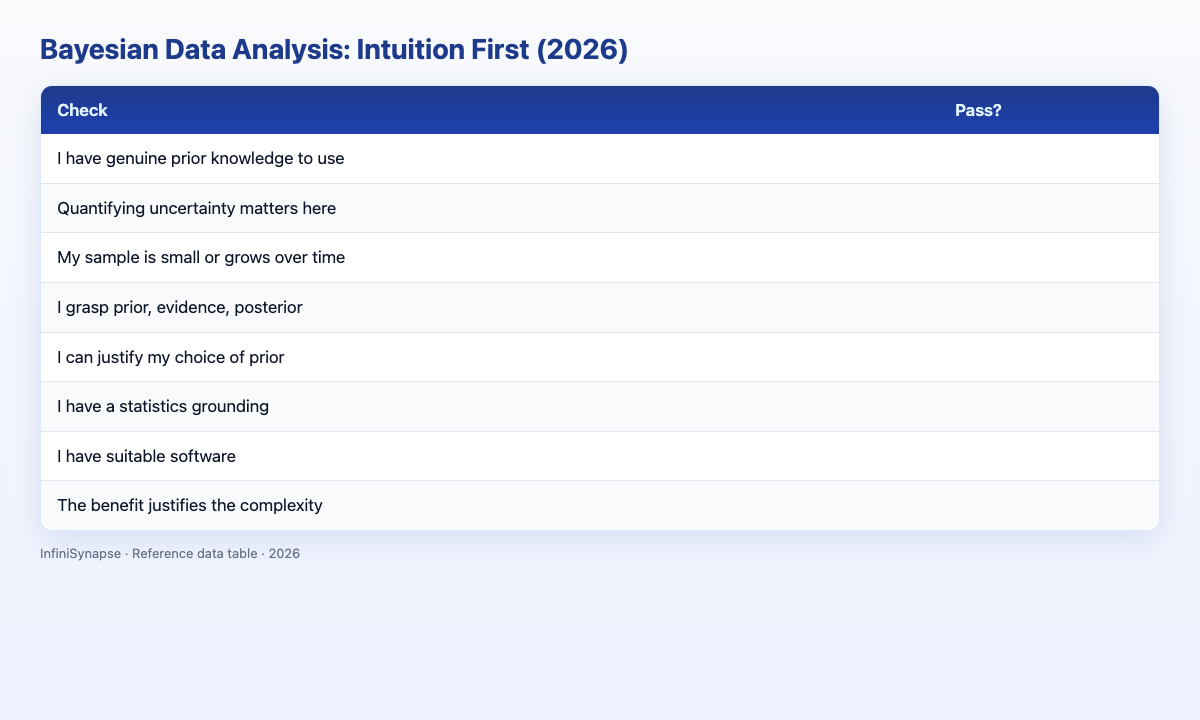
Assess whether Bayesian methods fit (1 point each):
| Check | Pass? |
|---|---|
| I have genuine prior knowledge to use | |
| Quantifying uncertainty matters here | |
| My sample is small or grows over time | |
| I grasp prior, evidence, posterior | |
| I can justify my choice of prior | |
| I have a statistics grounding | |
| I have suitable software | |
| The benefit justifies the complexity |
6–8: Bayesian methods may fit well. 3–5: weigh against simpler methods. Below 3: standard methods likely suffice.
Frequently Asked Questions
What is Bayesian data analysis?
Bayesian data analysis is a statistical approach that updates beliefs with evidence. You start with a prior belief, observe data, and combine them into an updated posterior belief, all represented as probability distributions. Its strength is quantifying uncertainty directly and incorporating prior knowledge, making it powerful for many real problems though it requires care.
What are priors and posteriors in Bayesian analysis?
In bayesian data analysis, the prior is what you believe before seeing new data, perhaps from past studies or expertise; the evidence is the observed data; and the posterior is your updated belief after combining prior and evidence. A strong prior with weak evidence stays near the prior, while strong evidence dominates a weak prior.
How is Bayesian different from frequentist analysis?
Frequentist methods treat probability as long-run frequency and produce point estimates and confidence intervals without prior beliefs, while bayesian data analysis treats probability as degree of belief and produces full distributions. Bayesian analysis can say a parameter has a ninety percent probability of lying in a range, incorporates prior knowledge, and handles small samples gracefully.
When should you use Bayesian data analysis?
Use bayesian data analysis when you have genuine prior knowledge worth incorporating, when quantifying uncertainty is central to the decision, when samples are small, or when data arrives sequentially and beliefs update over time. For routine analysis with abundant data and no strong prior, simpler methods may suffice without the added complexity.
Is formal training worth it\1?
Bayesian data analysis is mathematically richer than introductory statistics, so it has a learning curve, but its core intuition, updating beliefs with evidence, is approachable. Building understanding intuition-first, then using probabilistic programming libraries that handle the computation, makes it learnable, especially with a grounding in general statistics to build upon.
Conclusion
Bayesian data analysis updates beliefs with evidence through priors, data, and posteriors, quantifying uncertainty directly and incorporating prior knowledge. It excels for uncertainty-heavy problems, small samples, and sequential data, and while mathematically rich, its core intuition is graspable. In 2026, modern computation makes it practical while AI-native tools handle the routine cases.
For the everyday analysis that standard methods handle, read what AI-native data analysis means and try the InfiniSynapse web app free on registration, no credit card required.