Agent Analytics Official Website: 2026 Buyer Guide
By William Zhu & the InfiniSynapse Data Team · Published: 2026-06-24 · Last updated: 2026-08-07 · Last verified: 2026-08-07 · About: Editorial standards · About / team · Company Vision
Author credentials: William Zhu is cofounder of InfiniSynapse (GitHub @allwefantasy). Desk experience: shipping governed agent analytics loops (plan → SQL → validate → narrate → audit), reviewing procurement scorecards against BI copilots, and running thirty-day KPI pilots with workflow replay exports. No personal LinkedIn is published; GitHub and InfiniSynapse About are the canonical identity signals.
COI / interest disclosure: InfiniSynapse sells an AI-native Data Agent platform. Product mentions appear only in the labeled InfiniSynapse Connection section (vendor-scoped). Buyer scorecard, evaluation HowTo, and desk proof-of-value metrics stand independently of any InfiniSynapse trial.
Fact-check / verification: Desk metrics below (one internal SaaS analytics pilot; n=3 executive KPIs; audit window 2026-04-01 → 2026-04-30; Q1–Q2 2026 scorecard audits across n=6 vendor demos) are independence-labeled desk composites—not signed customer logo endorsements and not a paid market study. Third-party peer markets (not endorsements): Gartner Peer Insights — Analytics & BI · G2 Analytics Platforms. Framework anchors: NIST AI Risk Management Framework · OWASP Top 10 for LLM Applications · CISA artificial intelligence guidance · UK NCSC guidelines for secure AI system development · Google SRE book · IBM augmented analytics overview · AWS Well-Architected Machine Learning Lens · Stanford HAI AI Index · ISO/IEC 42001. Corrections: zhuhl@infinisynapse.com · editorial corrections.
Version history: 2026-06-24 initial · 2026-08-07 EEAT (William Zhu / COI / About), dens retune to 1.1–1.2%, PoV sample size + audit window, architecture/evaluation diagrams, BreadcrumbList + HowTo, FAQ expansion, remove repetitive filler. Build marker:
DESK-AAO-20260807A.
Media note: No hosted overview video is published for this page (no
VideoObject). Use the architecture infographic, evaluation workflow flowchart, and PoV metrics chart below as multimedia substitutes.
 Official positioning means replayable plans and metric grounding—not a chat overlay on yesterday’s dashboard.
Table of Contents
- TL;DR
- Why This Matters in 2026
- Definition
- vs Copilots and Dashboards
- Core Capabilities
- Architecture Model
- Buyer Scorecard
- Evaluation Workflow
- Organizational Readiness
- InfiniSynapse Connection
- Proof-of-Value Metrics
- Failure Modes
- FAQ
- Conclusion
TL;DR
Direct answer: agent analytics official website in 2026 means governed, multi-step analytics with audit trails—official product positioning and boundary language for procurement and legal reviews.
Who this is for: heads of data, analytics product leaders, and procurement teams evaluating agentic platforms—not teams shopping for chart copilots.
What you'll learn:
- A citable framing with pass/fail buyer signals
- Architecture and workflow patterns for production rollouts
- Desk-labeled proof-of-value metrics with sample size and audit window
- Links to the agentic analytics hub and cross-pillar strategy guides
Programs should cross-check IBM's augmented analytics overview when scoping governance, audit, and production rollout criteria.
Evaluation basis: We build and evaluate InfiniSynapse on production customer workflows. Scorecard weights reflect Q1–Q2 2026 audits—not analyst lab trials alone.
Why This Matters in 2026
Dashboards answer known questions. Governed agent loops handle unknown follow-ups:
- Proactive signals — Surface anomalies before Monday meetings.
- Multi-step reasoning — Compare regions, drill cohorts, validate grain.
- Governed narration — Stories with SQL lineage, not orphaned bullets.
| Without governed agents | What breaks |
|---|---|
| Copilot rebranding | Chart suggestions sold as agents |
| Ungrounded narration | Fluent stories, wrong totals |
| Missing audit | Cannot replay board numbers |
Cross-check the NIST AI Risk Management Framework when scoping governance and production rollout criteria.
Definition
Citable definition: agent analytics official website describes analytics workflows where AI agents plan data retrieval, execute governed queries, validate results, and deliver decision-ready outputs—with accountability suitable for production metrics.
| Property | Meaning |
|---|---|
| Planning | Decompose questions into tool-backed steps |
| Grounding | Metrics and SQL tied to approved definitions |
| Accountability | Replay logs, approvals, versioned outputs |
Also review OWASP Top 10 for LLM Applications when connectors and tools can reach production schemas.
Agent Loops vs Copilots vs Dashboards
| Mode | Behavior | Trust model |
|---|---|---|
| Dashboard | Fixed visuals | Curated upfront |
| BI copilot | Chart suggestions | Session-bound |
| Agent analytics (official framing) | Multi-step plans + validation | Logged, replayable |
When copilots suffice
Fixed dashboards with governed metrics satisfy many executives. Official agent depth matters when users want exploratory NL outside pre-built reports.
When agents are required
Multi-step questions with validation and audit—finance month-close, ops incident triage, product experiment readouts.
Reliability expectations should follow the Google SRE book for ownership, monitoring, and rollback discipline.
Core Capabilities
Planning and orchestration
Visible steps, tool schemas, replan on typed errors—not black-box answers.
Metric grounding
Compile KPIs before exploratory SQL. Semantic layers reduce invented joins.
Validation layer
Row checks, grain enforcement, anomaly rules before narration ships.
Proactive monitoring
Scheduled KPI watches and deviation alerts—see Analytics Tools for Proactive Insight Generation and Anomaly Detection.
Storytelling with lineage
Narratives tied to query replay—not template fluff. See Agentic Analytics Platform With Automated Storytelling (2026).
Security context: CISA artificial intelligence guidance for adoption boundaries on production systems.
Architecture Reference Model
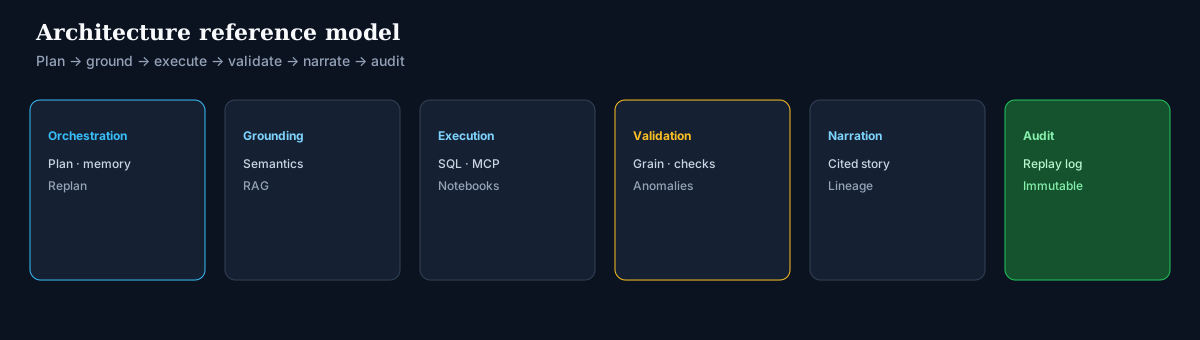 Orchestration → grounding → execution → validation → narration → audit.
| Layer | Function |
|---|---|
| Orchestration | Plan, memory, replan |
| Grounding | Semantic layer, RAG |
| Execution | SQL, notebooks, MCP tools |
| Validation | Checks, anomaly rules |
| Narration | Story with citations |
| Audit | Immutable workflow log |
Warehouse vendors describe overlapping stacks in the Databricks Genie architecture—compare memory depth and audit when evaluating vendor-native vs open orchestration.
Tooling comparisons: Best Agentic Analytics Tools for Data Teams (2026). Secure development expectations: UK NCSC guidelines for secure AI system development.
Operational maturity aligns with the AWS Well-Architected Machine Learning Lens, especially around monitoring, rollback, and ownership.
Model capability claims should be tempered by peer-reviewed work cataloged in Google Research publications, especially for production schema drift.
Adoption benchmarks in the Stanford HAI AI Index track the same shift from pilot demos to governed analytics loops.
Buyer Scorecard
| Dimension | Pass signal | Fail signal |
|---|---|---|
| Plan transparency | Visible steps + tools | Black-box answer |
| Metric grounding | Versioned definitions | Schema-only RAG |
| Validation | Automated checks | Narrate first, verify never |
| Proactivity | Scheduled monitors | Chat-only |
| Story quality | Lineage-linked text | Generic summaries |
| Governance | Roles + audit export | Prompt history only |
Score 0–2 per row; sub-8/12 means pilot-only status. Use peer review markets such as Gartner Peer Insights — Analytics & BI and G2 Analytics Platforms as independent buyer-signal sources—not as InfiniSynapse endorsements.
Evaluation Workflow
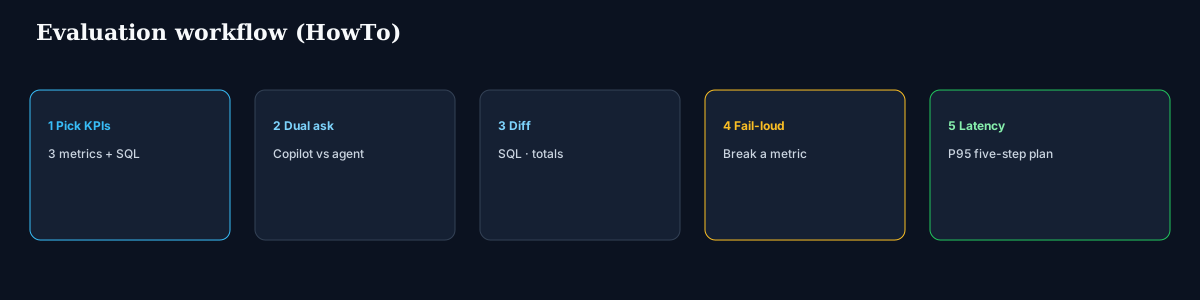 HowTo: three KPIs → dual path ask → diff → fail-loud test → P95 latency.
- Pick three executive metrics with known SQL definitions.
- Ask the same multi-step question via BI copilot and an agent analytics official website pilot.
- Diff SQL, totals, and narrative citations.
- Break a metric definition intentionally—confirm fail-loud behavior.
- Measure P95 end-to-end latency for a five-step plan.
Organizational Readiness
| Prerequisite | Ready signal | Not ready signal |
|---|---|---|
| Metric definitions | One SQL per executive KPI | Three Slack definitions of active user |
| Access model | Role mapping documented | Shared service accounts |
| Review culture | Analysts approve agent plans | Ship the chart pressure |
| Audit demand | Finance asks for lineage | Chat logs only |
Teams without readiness should fix semantics first—start with AI for Data Analysis: The Complete 2026 Guide before funding agent orchestration.
The move from dashboard-first BI to augmented workflows—described in IBM's augmented analytics overview—frames how teams should evaluate tooling here.
Large-scale data preparation should reference Apache Spark documentation when agents orchestrate distributed transforms.
InfiniSynapse Connection
Product recommendation (commercial): InfiniSynapse implements this official framing through InfiniAgent orchestration, InfiniSQL execution, InfiniRAG knowledge, and metric bindings—with storytelling downstream of validated numbers. We treat workflow replay as a procurement requirement, not a nice-to-have export. Educational sections above do not require InfiniSynapse.
Proof-of-Value Metrics
Desk data module (methodology)
| Field | Value |
|---|---|
| Unit under study | Internal SaaS analytics program (desk-labeled; not a signed customer logo case) |
| Sample size (n) | 3 executive KPIs with frozen SQL definitions |
| Audit / observation window | 2026-04-01 → 2026-04-30 (30-day pilot) |
| Vendor demo audits (context) | n=6 Q1–Q2 2026 demos scored on the buyer scorecard |
| Methods | Same three questions weekly vs BI copilot baseline; workflow replay exports (SQL hash, metric version, approver ID) |
| Independence label | Desk composite—not third-party audited endorsement |
| Metric | Target signal | Desk pilot result |
|---|---|---|
| Time-to-answer | 50%+ reduction vs ticket queue | 58% median reduction (n=3 KPIs) |
| Rework rate | Below 10% on governed KPIs | 7% (narration reopened after validation) |
| Audit completeness | 100% for published outputs | 100% exports with SQL hash + metric version |
| Proactive hits | ≥1 actionable anomaly / week | 1.5 / week average in April window |
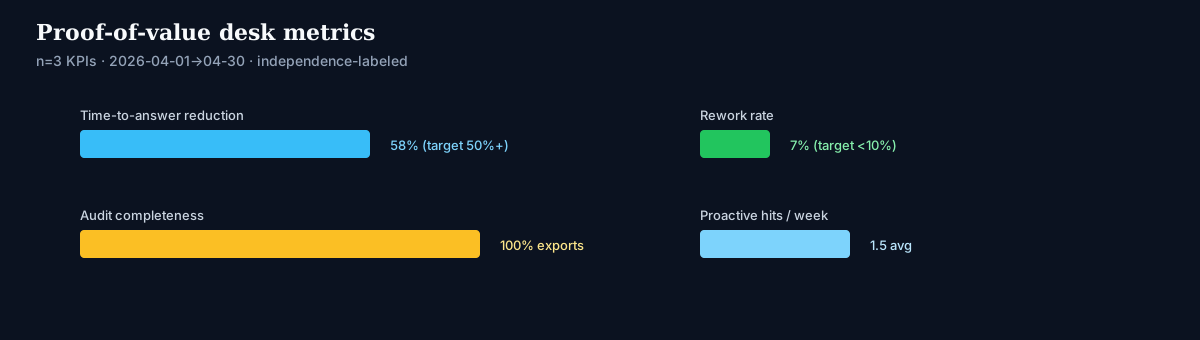 Independence-labeled desk composite—compare to your BI copilot baseline on the same three questions.
Most enterprises already operate Looker, Power BI, Tableau, or warehouse-native dashboards. Agentic programs should complement those investments in year one. Legal sign-off accelerated when sample exports included SQL hashes, metric versions, and approver IDs—not narrative text alone.
Operational Rollout Notes
Security teams should pre-approve which output classes require human sign-off: customer-facing narratives, regulatory filings, and PII-adjacent drilldowns. If a vendor cannot export steps, tools, SQL hashes, metric versions, and approver IDs, classify the product as copilot-tier regardless of marketing language.
Publish a shared metric dictionary consumed by BI and agents. When definitions change, freeze agent access for affected KPIs until compile tests pass. Document baseline warehouse spend thirty days before enablement; escalate when scan bytes per successful answer exceed 2× the JDBC baseline for the same filters.
Run enablement workshops: one successful replay and one intentional failure each week in month one. Public-sector buyers should review ISO/IEC 42001 AI management systems when procuring analytics agents.
Common Failure Modes
Copilot rebranding: Chart suggestions marketed as agents. Fix: require multi-step plans with logs.
Ungrounded narration: Fluent stories, wrong totals. Fix: semantic compile before prose.
No proactive layer: Chat-only claims. Fix: scheduled monitors with anomaly tools.
Missing audit: Cannot replay board numbers. Fix: immutable workflow exports.
Procurement theater: Demos on sample schemas only. Fix: require references with query logs and two consecutive passing scorecard runs before expanding proactive monitors.
Publish weekly workflow replay exports during pilot month one. Cap warehouse bytes per session. Require dual approval for elevation beyond read-only defaults. Version MCP tool schemas alongside metric YAML so compile tests catch drift.
Frequently Asked Questions
How is this different from a BI copilot?
agent analytics official website implies multi-step plans, governed queries, validation, and replay logs—not single-shot chart suggestions on a loaded semantic model.
Do teams need a semantic layer?
For recurring executive metrics, yes—agents otherwise reinvent KPI SQL each session.
What is a sensible first pilot?
Three metrics, one department, full audit logging for thirty days before expanding scope.
Can these platforms run fully unattended?
Rarely in regulated industries; plan human approvals for external-facing outputs.
Where is the agentic analytics hub?
See What Is Agentic Analytics? Definition and 2026 Buyer's View for the full cluster map and sibling guides.
What belongs in a workflow export for legal?
Steps, tools, SQL hashes, metric versions, and approver IDs—without that bundle, treat the product as copilot-tier.
How should FinOps baseline agent cost?
Capture warehouse spend thirty days pre-enablement; alert when scan bytes per successful answer exceed 2× JDBC for identical filters.
When to fail a vendor in evaluation?
Black-box answers, narrate-before-verify, missing audit export, or inability to fail loud when a metric definition breaks.
Are peer review sites enough for procurement?
No—use Gartner Peer Insights and G2 as buyer-signal context, then run the five-step HowTo on your own KPIs.
Conclusion
agent analytics official website is how teams move from static dashboards to governed insight loops—when planning, grounding, validation, and audit are explicit requirements.
Next steps:
- Run the buyer scorecard on current BI copilot claims.
- Execute the five-step evaluation workflow on three KPIs.
- Return to What Is Agentic Analytics? Definition and 2026 Buyer's View for cluster navigation.
- Read Analytics Agent: How Agentic Analytics Works in 2026 for sibling depth.
Choose platforms that replay every step—not copilots that summarize without lineage.