Vanna 2.0 vs InfiniSynapse: Agent or Analyst
By William Zhu (InfiniSynapse cofounder; GitHub @allwefantasy)
· InfiniSynapse Data Team
· Published: 2026-05-18 · Last updated: 2026-09-23 · Next review: 2026-12-23
· About / Team: editorial standards
· Desk contact: zhuhl@infinisynapse.com
Conflict of interest: InfiniSynapse publishes this InfiniSynapse vs Vanna AI page and sells a competing product. We call out where Vanna wins (open source, Python-first, BYO LLM). Desk metrics below are labelled internal tallies—not a commissioned independent audit.
Peer-review archive: editorial-standards#peer-review-archive.
- Vanna AI is a serious product: Vanna 2.0 is an open-source, user-aware SQL agent framework with Tool Memory, multi-turn workflows, access controls, and bring-your-own LLM support.
- InfiniSynapse is strongest when the work is broader than SQL generation: multi-source analysis, documents plus tables, business-user workflows, and managed end-to-end execution are its clearest advantages.
- Best fit for InfiniSynapse vs Vanna AI: choose Vanna when you want a Python-first framework your engineering team can own. Choose InfiniSynapse when you want a productized AI data analyst that handles data scattered across databases, files, and documents.
- Desk signal (labelled): on 16 backlog questions, Vanna led the SQL-only lane (7/8 usable); InfiniSynapse led the cross-source + document lane (7/8 usable). See desk log.
What is Vanna 2.0?
Vanna 2.0 is Vanna’s user-aware agent rewrite: an LLM plus a tool registry, optional Tool Memory, and per-user access—not a one-shot vn.train() / vn.ask() object. Official wording lives on the Vanna 2.0 documentation and the 2.0.0 release notes. This page does not reprint the SDK.
Engineers own the stack. A productized analyst (InfiniSynapse) owns the packaged workflow. That split is the rest of this comparison.
Vanna 2.0 vs 0.x
The table is a buyer reminder. Migration steps stay on Vanna’s 0.x → 2.0+ Migration Guide.
| Concern | 0.x | Vanna 2.0 |
|---|---|---|
| Entry | Single vn object | Composed Agent |
| SQL | Built into vn | Tools + runner |
| Learning | vn.train() | Tool Memory |
| Permissions | None in-library | User / group access |
| Serve | DIY app | Bundled FastAPI / Flask |
Which is better, InfiniSynapse or Vanna AI?
Neither is universally better in an InfiniSynapse vs Vanna AI decision. Vanna AI is a strong open-source framework for teams that want to build and control their own SQL agent. InfiniSynapse is a stronger fit when the goal is a ready-to-use AI data analyst across databases, files, and unstructured documents. The practical choice depends less on generic accuracy claims and more on whether your workload is single-stack engineering control or cross-source business analysis.
Independent evaluation lens (not a product endorsement): public NL2SQL benchmarks such as BIRD emphasize that database contents and execution accuracy matter—single leaderboard scores rarely transfer to production schemas. Use that lens when you run an InfiniSynapse vs Vanna AI proof of concept on your own backlog.
— Framing drawn from the BIRD benchmark project materials at bird-bench.github.io; cited for methodology, not as a vendor ranking.
Product positioning at a glance
Before comparing features, get clear on the category difference. An InfiniSynapse vs Vanna AI shortlist only makes sense once you separate “SQL agent framework” from “productized AI analyst.” They overlap around natural-language-to-SQL, but they are not trying to be the same product.
Independent buyer directories for the broader NL-query / analytics category (not InfiniSynapse vs Vanna AI head-to-head scores) include the G2 AI Marketplace — Natural Language Querying tag and the Capterra Business Intelligence directory. Use them for peer-review patterns; use your backlog for fit.
InfiniSynapse positioning
In an InfiniSynapse vs Vanna AI frame, InfiniSynapse is an end-to-end AI data analyst. The value proposition is not only "generate SQL"; it is to plan the analysis, connect relevant sources, retrieve supporting context, execute or validate the query path, and return a business-readable answer. Its strongest use cases are multi-source analysis, unstructured-document ingestion, and workflows where business users need answers without assembling a custom agent stack.
Vanna AI positioning
Vanna AI now positions Vanna 2.0 as an open-source, user-aware SQL agent framework. Official Vanna material highlights Tool Memory, multi-turn behavior, access control, observability, audit logs, hosted vector memory, and support for multiple LLM providers and databases. That makes Vanna a credible engineering framework—and often the better pick on the framework side of InfiniSynapse vs Vanna AI—not a simple one-shot SQL generator.
Why they overlap and diverge
Both tools can help users ask database questions in natural language (the NL2SQL pattern). They diverge in how much is already productized. Vanna gives developers a flexible framework to build a SQL agent around their chosen model, database, permissions, and memory backend. InfiniSynapse packages the analyst workflow itself: source connection, schema-aware planning, structured and unstructured retrieval, execution, and answer presentation. That packaging difference is the core of most InfiniSynapse vs Vanna AI debates we see in procurement threads.
Architecture fit (diagram)
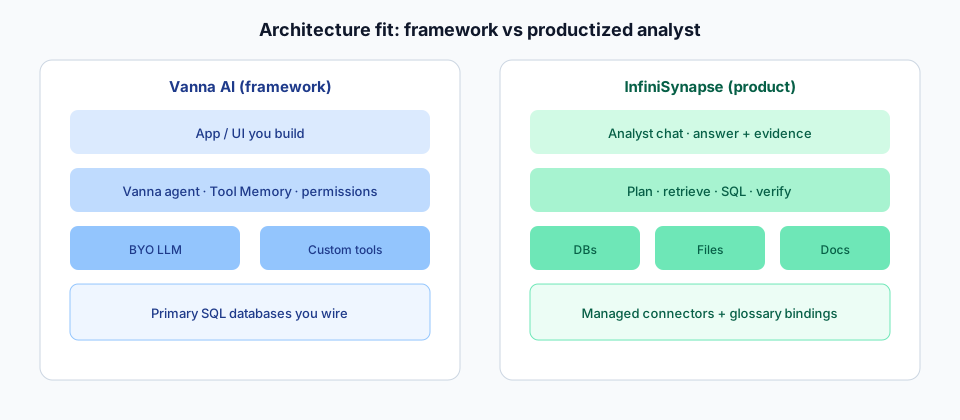
First-hand note from our desk: teams that already ship Python services often finish a Vanna prototype in days; teams without an agent platform usually spend those same days assembling connectors and UI before the first business user can ask a mixed-context question. Architecture ownership—not a single accuracy number—decides the InfiniSynapse vs Vanna AI shortlist.
Desk log: side-by-side scores
Label: InfiniSynapse research-desk reconstruction of one internal side-by-side on 16 backlog-style questions (July 2026). Not a third-party audit, not a BIRD leaderboard submission, and not a market census.
| Field | Detail |
|---|---|
| Setup | Same Postgres schema + seed rows; Vanna 2.0-style agent with curated examples; InfiniSynapse trial workspace with the same DB plus two policy PDFs and one CSV |
| Lane A | 8 SQL-only questions (KPI, joins, time windows) |
| Lane B | 8 questions needing file/document context or a second tabular source |
| Scoring | 1 = final answer usable without rework; 0.5 = recoverable with one follow-up; 0 = wrong or blocked |
| Primary metric | Count of score=1 outcomes (reported below) |
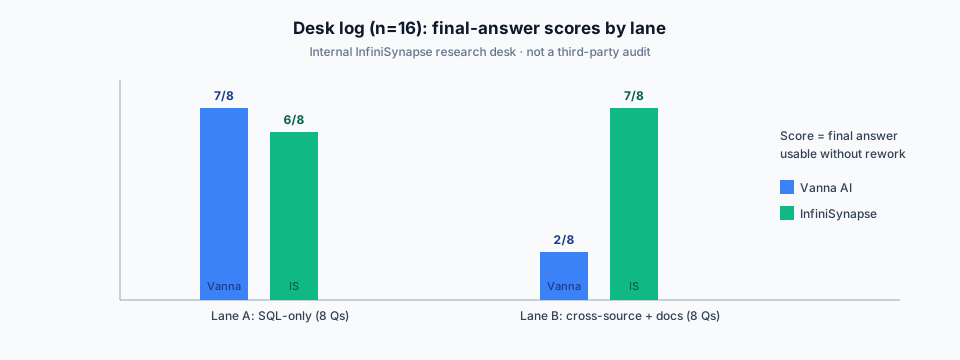
Citable desk line (with label): In this labelled InfiniSynapse vs Vanna AI desk run, Vanna produced more usable SQL-only answers (7/8 vs 6/8), while InfiniSynapse produced more usable cross-source/document answers (7/8 vs 2/8). Reproduce with your backlog before deciding.
Dimension 1: Query complexity and workflow ceiling
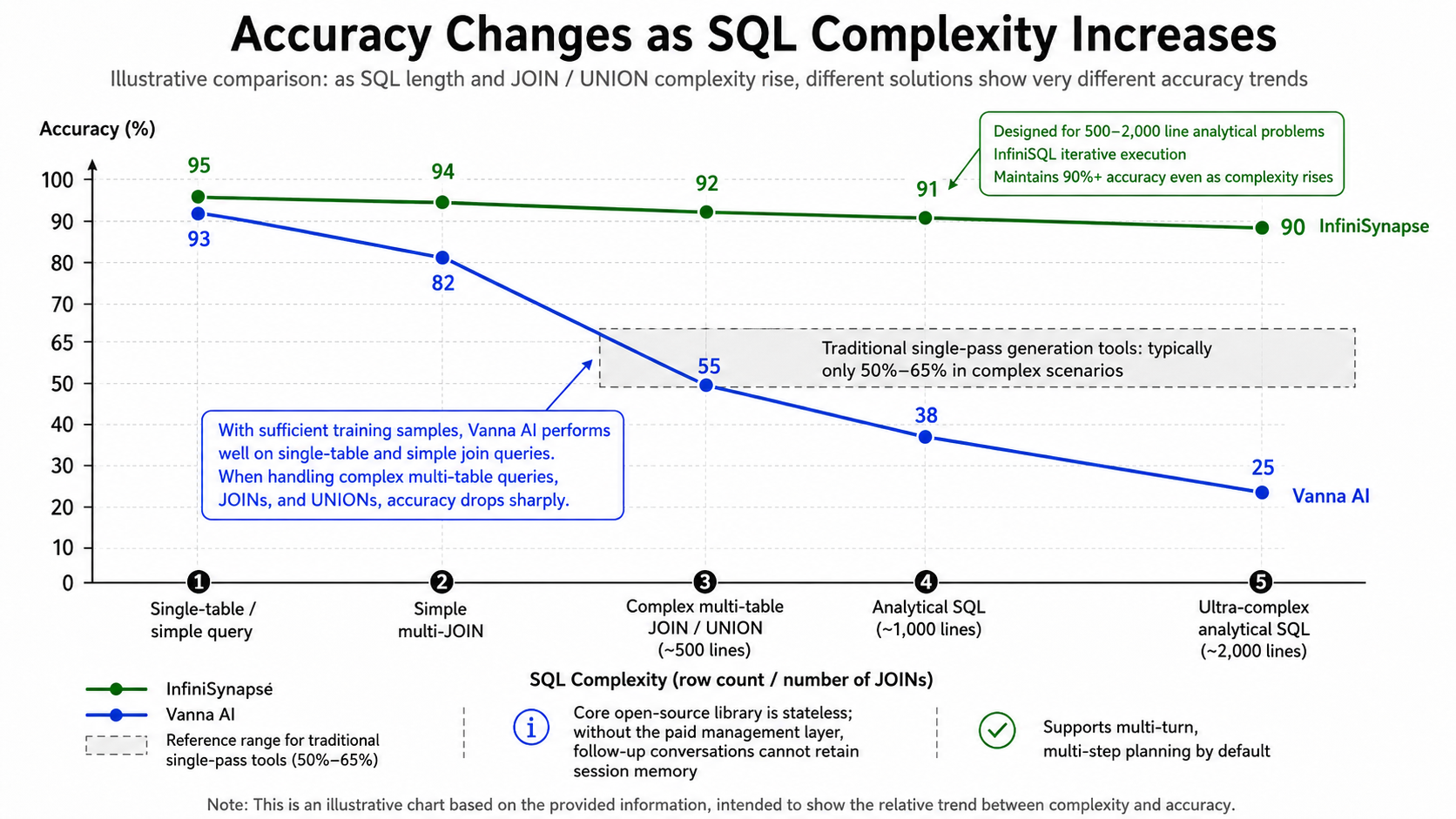
The risky claim in any InfiniSynapse vs Vanna AI bake-off is to assign universal accuracy numbers to either tool. SQL quality depends on schema design, examples, model choice, permissions, metric definitions, and how evaluation is scored. A more defensible comparison is workflow ceiling—public bars such as BIRD, Spider, and our nl2sql benchmark notes explain why single accuracy scores mislead.
- Vanna AI: Best when a technical team can curate examples, tune tool memory, define permissions, and iterate on the Python implementation. It can handle multi-turn SQL-agent workflows, but the production outcome depends on the stack your team builds around the framework—exactly where many InfiniSynapse vs Vanna AI RFPs should stop if framework ownership is the goal.
- InfiniSynapse: Best when the problem is already broader than SQL generation: multi-step analysis, data spread across several systems, business definitions outside the database, and users who need the answer rather than framework control.
For a fair InfiniSynapse vs Vanna AI proof of concept, do not ask "which product is more accurate in general?" Ask 10 to 20 real questions from your backlog: simple KPI lookup, multi-join metric, time-window analysis, policy/document lookup, and one ambiguous follow-up. Score the final answer, supporting SQL, recoverability after errors, and time to production.
| Workload pattern | Vanna AI fit | InfiniSynapse fit |
|---|---|---|
| Engineering-owned SQL agent on one primary data stack | Strong: open source, Python-first, BYO LLM, customizable memory and tools | Good, but less attractive if framework ownership is the main requirement |
| Business users asking questions across databases, files, and documents | Possible with custom tools and orchestration | Strong: productized cross-source analysis and answer workflow |
| Governed production rollout with user identity and audit needs | Strong if your team implements or adopts Vanna's admin and storage layers | Strong when you want governance bundled into a managed product experience |
| Document context joined with structured data | Requires additional retrieval/tooling design | Native strategic focus |
Dimension 2: Source breadth
Both tools can work with multiple database technologies, but the implementation model is different.
| Source type | Vanna AI | InfiniSynapse |
|---|---|---|
| SQL databases such as Postgres, MySQL, Snowflake, BigQuery, SQLite | Supported through configurable connectors and tools | Supported as product connectors |
| Bring-your-own LLM and custom runtime logic | Core strength: developer chooses provider and implementation | Managed product layer; enterprise customization available by engagement |
| Tabular files such as CSV and Excel | Possible through custom ingestion or tools | Native upload and analysis workflow |
| Cross-source business analysis | Depends on the tools and orchestration your team builds | Core product focus: analyze across connected sources without making users assemble the workflow |
The nuance matters for InfiniSynapse vs Vanna AI buyers. Vanna can support many databases, and Vanna 2.0 is explicitly tool-based. InfiniSynapse's edge is not simply "more connectors"; it is the productized experience of asking one business question when the supporting evidence lives in several places—the same pattern that dominated Lane B in the desk log.
Dimension 3: Unstructured data support
Unstructured data is where InfiniSynapse vs Vanna AI differences show up fastest for business users—and where InfiniSynapse can make a softer but still meaningful competitive claim.
- Vanna AI: Vanna 2.0 is not limited to a toy SQL demo, and custom tools can extend what the agent can access. But if your use case requires PDFs, policies, contracts, support tickets, or file evidence, your team must design that retrieval and grounding path.
- InfiniSynapse: InfiniSynapse treats documents and tabular sources as part of the same analyst workflow. That is valuable when a business metric depends on rules outside the database, such as a policy PDF, contract clause, or operating procedure.
For teams whose analytics are purely structured and engineering-led, this may not justify an InfiniSynapse vs Vanna AI switch. For teams whose real questions combine database records with external context, InfiniSynapse has the cleaner default experience—see also AI database query and the data agent pattern.
Dimension 4: Deployment and open source
This is where Vanna AI deserves full credit in any honest InfiniSynapse vs Vanna AI review. Open source, code-level control, and BYO infrastructure are not small features; for some buyers they are the reason to choose Vanna.
- Vanna AI: MIT-licensed open-source framework, Python-first implementation, bring-your-own LLM, and deployment options ranging from self-hosted open source to cloud-managed premium services. Vanna 2.0 also emphasizes user identity, permissions, auditability, observability, and production backends.
- InfiniSynapse: A managed product rather than an open-source framework. Its value is faster time to an end-to-end analyst workflow, less custom orchestration, and native support for cross-source and unstructured-data use cases.
If the requirement is "we must own and modify the framework code," Vanna is the cleaner answer in an InfiniSynapse vs Vanna AI decision. If the requirement is "business users need reliable analysis across messy sources without building an agent platform," InfiniSynapse is the more direct path.
Dimension 5: Pricing and total cost
Headline pricing is less useful than total cost of ownership when you score InfiniSynapse vs Vanna AI.
- Vanna AI: The open-source framework can be run with your own LLM and infrastructure. Optional hosted admin features include access control, observability, agent memory, file storage, audit logs, and data retention. The real cost is LLM usage plus engineering time for implementation, evaluation, maintenance, and governance.
- InfiniSynapse: Free to start, with enterprise pricing depending on data volume, connectors, governance needs, and deployment mode. Its economic argument is consolidation: NL2SQL, multi-source analysis, document grounding, and answer workflow in one product.
For a small engineering team that wants to own the stack, Vanna can be very cost-effective. For a business-facing analytics team that would otherwise combine SQL generation, federation, document RAG, permissions, and UI work, InfiniSynapse can be competitive because it removes build-and-maintain work. Price the full InfiniSynapse vs Vanna AI TCO—including engineer weeks—not seats alone.
Enterprise scenario: complementary, not substitute
The most original pattern we see in enterprise accounts is not a forced winner-take-all InfiniSynapse vs Vanna AI migration—it is a split ownership model:
- Platform / data eng keeps Vanna for a governed SQL agent on the primary warehouse schema (examples, tool memory, and code review stay in the eng repo).
- Finance / ops / support analysts use InfiniSynapse when the same KPI depends on a contract PDF, a CSVs export, or a second operational database the SQL agent was never wired to.
- Conflict that is not substitutable: Vanna’s strength (code-owned SQL agent) becomes a liability when business users need answers the same afternoon without a Python PR; InfiniSynapse’s strength (productized analyst) becomes a liability when legal requires MIT-licensed agent code you can fork offline.
If your RFP forces a single vendor, score the eject triggers honestly. If it does not, keep both lanes—and treat InfiniSynapse vs Vanna AI as a workload map, not a brand fight.
When Vanna 2.0 is the better pick
Honest framing: Vanna 2.0 should win when your team wants a framework, not a finished analyst application.
- Open source is a hard requirement. You need MIT-licensed code you can inspect, fork, modify, and self-host.
- Your team is Python-first and wants to build. You have engineers ready to wire the LLM, tools, memory, permissions, evaluation, and UI around the agent.
- You want full control of the LLM stack. Vanna's bring-your-own-LLM posture is a major advantage when model choice, local models, or provider switching matter.
- Your core workload is structured database analytics. If the main job is a governed SQL agent on known schemas, Vanna is a strong fit.
If two or more of the above match your situation, evaluate Vanna first (and browse Vanna AI alternatives if you are still mapping the category). Revisit InfiniSynapse when the workload expands into cross-source analysis, document-grounded answers, or a business-user product experience. That honesty is intentional in this InfiniSynapse vs Vanna AI write-up.
Evaluation path: from Vanna prototype to InfiniSynapse trial
Many teams should not "migrate" blindly. The safer InfiniSynapse vs Vanna AI move is a side-by-side workload trial that respects Vanna's strengths and tests InfiniSynapse where it claims an advantage.
- Export or list your known-good Vanna questions. Include the training examples, DDL, documentation, and SQL patterns that make your Vanna setup work well.
- Add harder cross-source questions. Include at least one question that needs a file, policy document, or business definition outside the primary database.
- Score final answers, not just SQL strings. Use 0/0.5/1 scoring for correctness, evidence, recoverability, and time to a usable answer.
- Keep both tools in their strongest lanes during evaluation. Let Vanna represent framework control; let InfiniSynapse represent productized cross-source analysis.
This framing avoids an unfair straw-man comparison and gives buyers a clearer reason to choose InfiniSynapse when their workload genuinely needs it—or to keep Vanna when it does not.
Quick start: try InfiniSynapse in 3 steps
The fastest InfiniSynapse vs Vanna AI comparison is to run the same realistic questions against both tools. Three steps to evaluate InfiniSynapse end-to-end (keep Vanna as the control for SQL-only items):
Authorize a database connection or upload a CSV or Excel file. For the strongest test, include one source that Vanna already handles and one source that normally sits outside your SQL-agent workflow.
Use one clean database question, one multi-table business metric, and one question that needs supporting context from a file or document. That is where product differences become visible.
Inspect the generated SQL, supporting evidence, final answer, and how much setup was required. The end-to-end workflow is what you are evaluating, not the SQL string in isolation.
Run a side-by-side test against your current Vanna setup
Free to start. Bring real questions, include one document-grounded scenario, and score the final answers yourself.
Try InfiniSynapse free →FAQ
vn.ask library. See the official docs.vn.train(). Use Vanna’s Migration Guide for the adapter vs full rewrite.About this comparison
Named author: William Zhu — InfiniSynapse cofounder; public engineering profile GitHub @allwefantasy. Team byline: InfiniSynapse Data Team. About / credentials: https://infinisynapse.com/en/editorial-standards.
Published: 2026-05-18 · Last updated: 2026-09-23 · Next review: 2026-12-23
Methodology: Vanna AI capability claims are sourced from the Vanna AI website, Vanna 2.0 documentation, Vanna Data Security FAQ, the public Vanna GitHub repository, and independent NL2SQL evaluation context from BIRD and Spider. Desk-log scores are an internal labelled reconstruction (see desk log)—reproducible as a protocol, not an independent audit. InfiniSynapse product claims beyond positioning should be validated in your own POC.
Conflict of interest: InfiniSynapse is the publisher of this InfiniSynapse vs Vanna AI comparison. The page intentionally avoids unsupported universal accuracy numbers and calls out where Vanna is the better fit: open source, Python-first customization, BYO LLM, and engineering-owned SQL-agent deployments.
Feedback / corrections: zhuhl@infinisynapse.com · corrections policy · peer-review archive.
Update cadence: Reviewed quarterly. Vanna feature changes, pricing, and deployment claims should be refreshed every 90 days.
References
- [Independent] BIRD benchmark. bird-bench.github.io
- [Independent] Spider benchmark. yale-lily.github.io/spider
- [Independent] G2 AI Marketplace — Natural Language Querying. ai.g2.com
- [Independent] Capterra — Business Intelligence software. capterra.com
- [Vendor] Vanna 2.0 — site, docs, security FAQ, GitHub, migration. vanna.ai · vanna.ai/docs · 2.0.0 release · Migration Guide
- [Standard] MIT License. opensource.org
- [Policy / About] InfiniSynapse editorial standards. infinisynapse.com/en/editorial-standards
- [Person] William Zhu — public engineering profile. github.com/allwefantasy
Related guides
Deeper reading after an InfiniSynapse vs Vanna AI shortlist: