
On this page本页目录
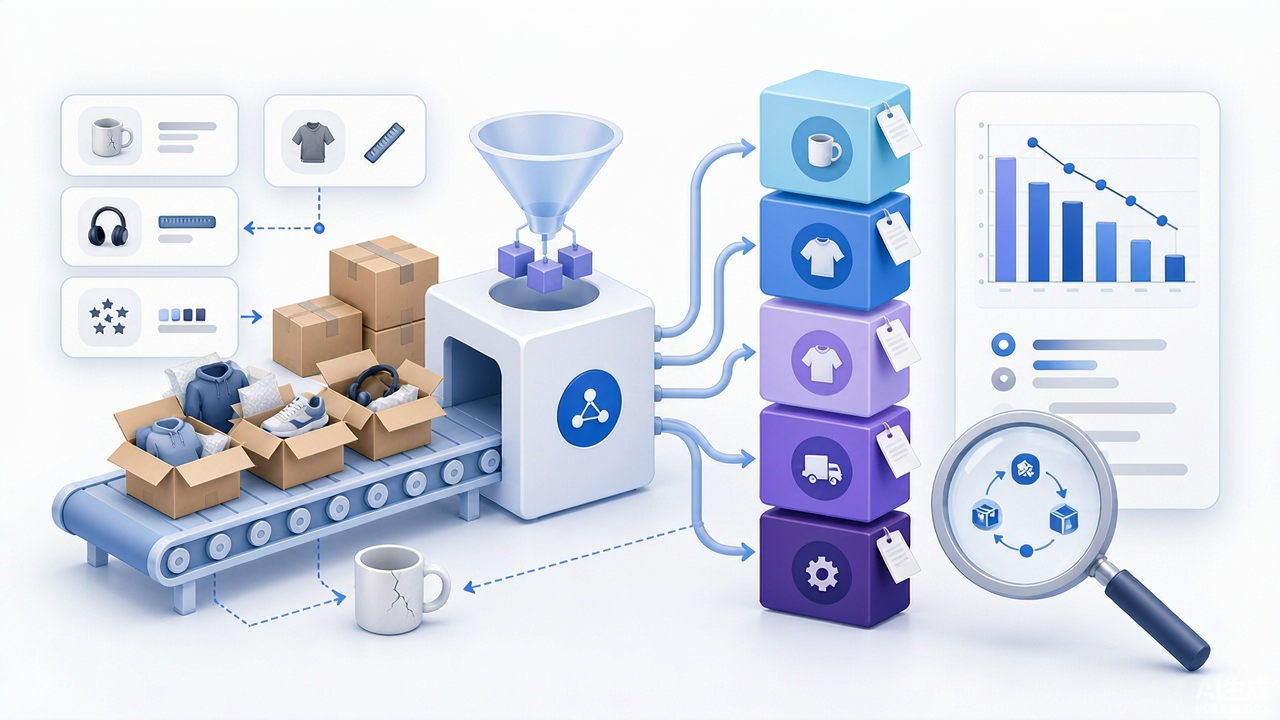
Return reason analysis is the process of standardizing why each item was returned, measuring each reason’s count, rate, and loss, and then testing the likely operational cause. A reason code such as “too small” is an observation—not proof that the size chart is wrong. Link it to SKU, variant, cohort, notes, inspection, content version, warehouse, and carrier evidence before selecting a fix.
退货原因分析,是把每件退货商品的原因标准化,衡量每个原因的次数、比例和损失,再验证可能的运营成因。“尺码过小”这样的原因编码只是观察结果,不能直接证明尺码表有误。选择措施前,应把它连接到 SKU、变体、订单群组、备注、质检、详情页版本、仓库和承运商证据。
Shopify tracks a return reason at line-item level and distinguishes physical return fields from broader sales reversals. That is the right unit for reason analysis: an order containing three returned items can contain three different reasons.
Shopify 在订单行层级记录退货原因,并把实体退货字段与更广义的销售冲销区分开。订单行也是更合适的原因分析单位:一个包含三件退货商品的订单,可能对应三个不同原因。
Separate four layers before analyzing product return reasons分析商品退货原因前,先区分四个层级
Was the item physically returned, refunded without return, exchanged, canceled, or charged back?
商品是实体退回、仅退款未退货、换货、取消,还是发生拒付?
The platform code and customer note: too small, damaged, not as described, wrong item, unwanted, other, or unknown.
平台编码与客户备注,例如尺码过小、破损、描述不符、发错商品、不想要、其他或未知。
Measurements, photos, inspection grade, content version, pick-pack scan, delivery event, batch, or supplier record.
包括尺寸测量、照片、质检等级、内容版本、拣货扫描、配送事件、批次或供应商记录。
The issue that evidence supports, its owner, corrective action, review date, and monitored outcome.
证据支持的问题、负责人、纠正措施、复核日期以及后续监控结果。
Build a small, versioned return reason taxonomy建立精简且有版本的退货原因分类体系
There is no single taxonomy that fits every product category. Use a stable reason family for cross-store comparison, a more specific canonical code for action, and preserve the raw source value for auditability.
没有一种分类体系适用于所有商品类目。可以用稳定的原因大类做跨店比较,用更具体的标准编码指导行动,同时保留原始来源值以便审计。
| Reason family原因大类 | Example canonical codes标准编码示例 | Likely owner to investigate建议调查负责人 |
|---|---|---|
| Fit or preference合身与偏好 | FIT_TOO_SMALL, FIT_TOO_LARGE, COLOR, STYLE, UNWANTED | Merchandising, product, content商品、产品、内容团队 |
| Product or quality商品与质量 | DEFECTIVE, MISSING_PART, QUALITY_EXPECTATION | Quality, supplier, product质量、供应商、产品团队 |
| Content or expectation内容与预期 | NOT_AS_DESCRIBED, COLOR_MISMATCH, CONTENTS_UNCLEAR | Content, creative, merchandising内容、创意、商品团队 |
| Fulfillment履约 | WRONG_ITEM, WRONG_QUANTITY, PICK_PACK_DAMAGE | Warehouse and order operations仓库与订单运营 |
| Delivery配送 | DAMAGED_IN_TRANSIT, LATE_ARRIVAL, DELIVERY_FAILURE | Packaging, logistics, carrier包装、物流、承运商 |
| Other or unknown其他与未知 | OTHER, UNKNOWN, NOTE_REQUIRED | Data owner and manual review数据负责人和人工复核 |
These codes are editorial examples, not an official universal standard. Shopify’s documented categories include color, defective, not as described, other, size too large, size too small, style, unknown, unwanted, and wrong item; current platform definitions should be checked before mapping.
以上编码属于编辑示例,不是官方通用标准。Shopify 文档中的类别包括颜色、破损或缺陷、描述不符、其他、尺码过大、尺码过小、款式、未知、不想要和发错商品;映射前应核对平台当前定义。
Normalize return reason codes without deleting the raw data在保留原始数据的前提下归一化退货原因编码
| Raw value原始值 | Canonical code标准编码 | Reason family原因大类 | Rule映射规则 |
|---|---|---|---|
| Runs small / Too tight / Size too small | FIT_TOO_SMALL | Fit or preference合身与偏好 | Map only explicit small-fit statements只映射明确表示偏小的内容 |
| Broken / Cracked / Defective | DEFECTIVE | Product or quality商品与质量 | Keep transit damage separate unless evidence exists没有证据时,不要与运输破损合并 |
| Looks different / Not what I expected | NOT_AS_DESCRIBED | Content or expectation内容与预期 | Retain the note for later content review保留备注,供后续内容核验 |
| Other / blank / unrecognized | OTHER or UNKNOWN | Data quality数据质量 | Never infer a confident cause from absence不能从缺失信息推断确定原因 |
- Keep source platform, raw reason, raw note, canonical code, taxonomy version, mapping method, and review status.
- Map deterministic synonyms first; send ambiguous text to manual review or a clearly labeled model-assisted queue.
- Version mappings when a code changes so historical reports remain reproducible.
- Do not overwrite UNKNOWN with the most common reason.
- 保留来源平台、原始原因、原始备注、标准编码、分类版本、映射方法和审核状态。
- 先用确定性规则映射同义词;模糊文本进入人工复核或明确标记的模型辅助队列。
- 编码变化时记录映射版本,保证历史报告可以复算。
- 不要用最常见原因覆盖 UNKNOWN。
Use four metrics instead of one reason pie chart不要只看原因饼图,同时使用四项指标
| Metric指标 | Formula公式 | Question answered回答的问题 |
|---|---|---|
| Reason share原因占比 | Returned units for reason ÷ all returned units × 100该原因退货件数 ÷ 全部退货件数 × 100 | What is common inside returns?退货内部最常见的是什么? |
| Reason-specific return rate原因专项退货率 | Returned units for reason ÷ eligible sold or delivered units × 100该原因退货件数 ÷ 符合口径的已售或已送达件数 × 100 | How exposed is the sales cohort?销售群组的暴露程度如何? |
| Reason-attributed loss原因归属损失 | Consistently allocated net loss for returned items assigned to reason归属于该原因退货商品的一致口径净损失 | Which reason costs the most?哪个原因造成的损失最大? |
| Unknown-rate quality未知原因率 | Unknown or unmapped returned units ÷ all returned units × 100未知或未映射退货件数 ÷ 全部退货件数 × 100 | How trustworthy is the distribution?原因分布的可信度如何? |
Use the return-rate guide to define the eligible denominator and the cost-of-returns guide to define the loss basis.
Worked example: 80 returned units can tell two stories完整示例:80 件退货商品可能讲出两个故事
This synthetic dataset contains 1,000 eligible delivered units and 80 returned units, an 8% unit return rate. Seventy-two units have a classifiable reason and eight are unknown.
这组假设数据包含 1,000 件符合口径的已送达商品和 80 件退货商品,件数退货率为 8%。其中 72 件可归类,8 件原因未知。
| Reason原因 | Units件数 | Share of all returns占全部退货比例 | Synthetic net loss假设净损失 |
|---|---|---|---|
| Fit合身 | 30 | 37.5% | $900 |
| Not as described描述不符 | 16 | 20.0% | $640 |
| Damaged破损 | 12 | 15.0% | $1,080 |
| Wrong item发错商品 | 6 | 7.5% | $300 |
| Unwanted不想要 | 8 | 10.0% | $240 |
| Unknown未知 | 8 | 10.0% | $480 |
Fit is the largest reason by count, but damaged items create the largest synthetic loss. The first pattern suggests a fit investigation; the second may deserve the first financial priority. Count and loss rankings should be shown together.
按件数看,合身问题最大;按假设损失看,破损问题最大。前者提示开展合身调查,后者可能具有更高财务优先级。报告应同时展示次数排名和损失排名。
Use Pareto analysis to prioritize, not to prove causation用帕累托分析确定优先级,而不是证明因果关系
A return Pareto table ranks standardized reasons from largest to smallest and adds a cumulative share. Build one by count, one by reason-specific rate, and one by loss. The leading bar identifies where investigation may start; it does not prove which fix will work. The supplied SEO plan explicitly treats Pareto analysis as a manual article method, not a confirmed Return Compass chart feature.
退货帕累托表把标准原因从大到小排列,并增加累计占比。应分别按次数、原因专项退货率和损失建立三张表。最高项目只说明调查可以从哪里开始,并不能证明哪项措施有效。SEO 规划明确把帕累托分析作为文章中的人工方法,而不是已经确认的逆向罗盘图表功能。
Treat every selected reason as a root-cause hypothesis把每个已选原因视为待验证的根因假设
| Selected reason选择的原因 | Possible causes可能成因 | Evidence to check需核验的证据 |
|---|---|---|
| Too small尺码过小 | Preference, size-chart error, variant tolerance, mislabeled unit个人偏好、尺码表错误、变体公差、标签错误 | Returned measurements, variant/batch, chart version, notes退回商品测量、变体/批次、尺码表版本、备注 |
| Damaged or defective破损或缺陷 | Manufacturing defect, pick-pack damage, packaging, transit制造缺陷、拣包损坏、包装、运输 | Inspection photos, defect code, package, lane, carrier, batch质检照片、缺陷码、包装、线路、承运商、批次 |
| Not as described描述不符 | Image color, dimensions, material, contents, outdated copy图片颜色、尺寸、材质、包装内容、旧版文案 | PDP version at order time, screenshots, notes, review themes下单时详情页版本、截图、备注、评论主题 |
| Wrong item发错商品 | Pick error, barcode mapping, substitution, packing error拣货错误、条码映射、替代发货、包装错误 | Ordered vs. shipped SKU, scan events, station, shift下单与发货 SKU、扫描事件、工位、班次 |
Amazon Science research reports that customer reviews can contain nuanced return-reason signals beyond fixed codes. That supports using notes and review themes as supporting evidence, but model-inferred themes still require validation and should never replace the recorded customer reason silently.
Amazon Science 的研究显示,客户评论可能包含固定原因编码之外的细分退货信号。因此,备注和评论主题可作为支持证据;但模型推断的主题仍需验证,不能在不披露的情况下替换客户记录的原因。
Investigate fit, damage, and not-as-described returns differently用不同方法调查合身、破损与描述不符退货
Split too small from too large. Compare variant, supplier batch, customer-selected size, measurements, region, and size-chart version. Do not diagnose one SKU from a category average.
把尺码过小与过大分开。比较变体、供应商批次、客户选择尺码、实际测量、地区和尺码表版本;不要用类目均值诊断单个 SKU。
Separate defect, warehouse handling, and transit damage. Inspection photos, packaging type, fulfillment site, carrier, and lane help assign the correct owner.
区分商品缺陷、仓库处理损坏与运输破损。质检照片、包装类型、履约站点、承运商和线路有助于确定负责人。
Join the return to the product-detail version seen at purchase. Review imagery, dimensions, materials, color, compatibility, included parts, and localized copy.
把退货连接到客户下单时看到的详情页版本,并核验图片、尺寸、材质、颜色、兼容性、包含部件和本地化文案。
Treat their share as a data-quality KPI. Sample notes regularly and add a new code only when a repeated pattern supports a distinct action.
把其占比作为数据质量 KPI。定期抽样备注,只有当重复模式对应独立行动时才增加新编码。
If your return rate is high, test five explanations first退货率偏高时,先验证五类解释
- Metric change.指标变化。 A new denominator, return window, reversal definition, or delayed data load changed the number.新的分母、退货窗口、冲销定义或延迟数据导入改变了结果。
- Mix shift.结构变化。 Sales moved toward a category, variant, channel, region, or promotion with different exposure.销售转向了风险不同的类目、变体、渠道、地区或促销。
- Product or content issue.商品或内容问题。 One SKU, batch, chart, photo set, or description version produced a concentrated pattern.某个 SKU、批次、尺码表、图片组或描述版本产生了集中问题。
- Fulfillment or delivery issue.履约或配送问题。 A warehouse, station, carrier, lane, or packaging change increased wrong-item or damage reasons.某个仓库、工位、承运商、线路或包装变更增加了发错或破损。
- Policy or behavior change.政策或行为变化。 Eligibility, fees, self-service options, seasonality, or customer behavior changed the selected reasons.资格条件、费用、自助选项、季节性或客户行为改变了原因分布。
Run return reason analysis in six reviewable steps用六个可审核步骤完成退货原因分析
- Define events and cohorts.定义事件与群组。 Choose physical returns, eligible units, dates, window, exclusions, and currency.确定实体退货、符合口径件数、日期、窗口、排除项和币种。
- Preserve source fields.保留来源字段。 Keep order, line item, SKU/variant, raw code, note, platform, and timestamps.保留订单、订单行、SKU/变体、原始编码、备注、平台和时间戳。
- Normalize and version.归一化并记录版本。 Apply deterministic mappings, label assisted classifications, and retain unknowns.应用确定性映射,标记辅助分类,并保留未知项。
- Calculate four metrics.计算四项指标。 Report count, reason share, reason-specific rate, attributed loss, and sample size.报告次数、原因占比、专项退货率、归属损失和样本量。
- Rank and segment.排名并分组。 Use Pareto views by count and loss, then segment by SKU, variant, channel, cohort, and owner.按次数和损失制作帕累托视图,再按 SKU、变体、渠道、群组和负责人分组。
- Verify and monitor.核验并监控。 Review evidence, record the chosen action and owner, then compare a predeclared outcome window.复核证据,记录行动和负责人,再比较预先声明的结果窗口。
Connect each reason to the SKU and evidence that can verify it把每个原因连接到 SKU 和可验证证据
Prepare order and line-item IDs, SKU and variant, source platform, raw reason code, customer note, normalized reason, taxonomy version, return date, quantity, refund or loss field, product condition, fulfillment location, carrier, and review status. Then use Return Compass to organize available files and identify issues that need human review. Confirm current input formats, security requirements, login conditions, and pricing before use; the tool must not invent missing reasons or claim an unverified root cause.
准备订单与订单行 ID、SKU 与变体、来源平台、原始原因编码、客户备注、标准原因、分类版本、退货日期、数量、退款或损失字段、商品状况、履约地点、承运商和审核状态,再使用逆向罗盘整理已有文件并定位需要人工核验的问题。使用前应确认当前输入格式、安全要求、登录条件和收费方式;工具不能编造缺失原因,也不能把未经验证的假设当作根因。
Open Return Compass打开逆向罗盘Download the return-reason evidence starter下载退货原因证据起始模板
Use this vendor-neutral CSV to preserve source identifiers, event distinctions, metric inputs, cost fields, coverage, evidence and ownership. Its example row is synthetic; remove it before loading authorized data and approve definitions with the responsible owners.
使用此厂商中立 CSV 保留来源标识、事件区别、指标输入、成本字段、覆盖、证据与责任。示例行为模拟数据;加载授权数据前请删除,并由相关负责人批准定义。
Download CSV starter下载 CSV 起始模板 ↓Sources, method, and commercial disclosure来源、方法与商业披露
The taxonomy, formulas, and worked example are editorial analysis definitions designed for reproducibility. They are not a universal standard. Platform fields and product-category rules can change, so preserve raw values and record the mapping version.
本页分类、公式和示例属于为可复算分析设计的编辑定义,不是通用标准。平台字段和商品类目规则可能变化,因此应保留原始值并记录映射版本。
- Shopify Developer Documentation: ReturnReason — documents reason values at returned-line-item level.
- Shopify Help Center: Creating returns and exchanges — explains that available reasons can vary by product category and can be analyzed for trends.
- Shopify Help Center: Sales reports — distinguishes physical-return fields and return-line-item reasons from broader sales reversals.
- Amazon Science: Why do customers return products? — 2024 research on review signals and nuanced return reasons beyond selected codes.
- Shopify 开发者文档:ReturnReason——说明退回订单行层级的原因值。
- Shopify 帮助中心:创建退货与换货——说明原因可能随商品类目变化,并可用于趋势分析。
- Shopify 帮助中心:销售报表——区分实体退货字段、订单行退货原因与广义销售冲销。
- Amazon Science:客户为何退货——2024 年关于评论信号和固定原因编码之外细分原因的研究。
Commercial disclosure: InfiniSynapse publishes this educational page and promotes Return Compass. Product statements come from the supplied planning brief and are not an independent product review. The taxonomy and 1,000-unit example are synthetic. This page does not promise a lower return rate or claim that Return Compass provides Pareto charts, automatic root-cause proof, or any unverified feature.
商业披露:本教育页面由 InfiniSynapse 发布,并推广逆向罗盘。产品说明来自提供的规划简报,不属于独立产品评测。分类体系和 1,000 件示例均为假设数据。本页不承诺降低退货率,也不宣称逆向罗盘提供帕累托图、自动证明根因或任何未经核实的功能。
Frequently asked questions常见问题
It standardizes item-level reasons, measures their frequency, rate, and financial impact, and tests the operational cause behind each pattern.
它把订单行层级原因标准化,衡量其次数、比例和财务影响,并验证每个模式背后的运营成因。
Use stable families for fit/preference, product/quality, content/expectation, fulfillment, delivery, and other/unknown. Preserve raw platform values.
使用合身/偏好、商品/质量、内容/预期、履约、配送和其他/未知等稳定大类,同时保留平台原始值。
No. The selected reason is an observed label. A root cause requires evidence from measurements, content versions, inspection, warehouse scans, or carrier data.
不等于。所选原因只是观察标签;根因需要尺寸、内容版本、质检、仓库扫描或承运商数据等证据支持。
Divide units returned for the reason by eligible sold or delivered units, then multiply by 100. Reason share instead divides by all returned units.
用该原因退货件数除以符合口径的已售或已送达件数,再乘以 100;原因占比的分母则是全部退货件数。
Keep them visible as a data-quality metric, sample their notes, and add a new code only when a recurring pattern supports a distinct action.
把它们作为数据质量指标持续展示,抽样检查备注;只有重复模式对应独立行动时才增加新编码。
Publish the reason definition beside every chart在每张图表旁发布原因定义
A credible return reason report lets another analyst reproduce the mapping. Keep the event definition, raw field, canonical code, taxonomy version, denominator, window, exclusions, unknown count, sample size, loss basis, mapping method, and last refresh beside the result. After expert review, connect this P4 Hub to the wider ecommerce returns analytics workflow.
可信的退货原因报告应允许另一位分析人员复算映射。把事件定义、原始字段、标准编码、分类版本、分母、时间窗口、排除项、未知数量、样本量、损失口径、映射方法和最后刷新时间放在结果旁。完成专家审核后,把该 P4 Hub 连接到完整的电商退货分析流程。