Codex SEO: Audit, Then a JSON Gate
Use Codex SEO as a review file, then keep a JSON gate that can fail the merge. See what exec may write and what CI must still reject.
Author credentials: William Zhu is cofounder of InfiniSynapse (GitHub @allwefantasy · auto-coder). Desk: shipping SEO Health and the /en/tool/ visibility pages. No personal LinkedIn published. About: team / editorial standards.
Publisher credentials: InfiniSynapse has public profiles on GitHub, YouTube, and X. A 2026 WAIC Future Tech OPC excellence award covers the Agentic Data Infra entry (WAIC; third-party recap: Xinhua / Caohejing). That award does not review this page or SEO Health. Method CLI: infinitegrowth on npm. Archive: recognition and scope notes.
On this page
By William Zhu · Cofounder, InfiniSynapse · Published: 2026-09-09 · Last updated: 2026-09-24 · Last verified: 2026-09-24 · Reviewed by the InfiniSynapse Data Team.
Reviewed by: InfiniSynapse Data Team · method review 2026-09-14. First-party read of root
AGENTS.mdplus localgate.mjsfixture exits.
Trust / COI: About · Corrections. SEO Health is a commercial product from this team. The
AGENTS.mdnotes below are a desk read of this repository, not a hosted Codex run and not a customer merge.
Codex SEO on this page is a non-interactive review. The run writes a constrained file. A separate JSON gate can still fail the merge. It does not issue a Google score.
TL;DR
Root AGENTS.md points at a portfolio blog path and Prisma. It does not define issues[].status. A Codex SEO audit that treats non-interactive prose as that field is inventing a gate.
Direct answer: Codex SEO here means a review file from
codex exec, then a JSON gate. The file may list recommendations.codex exectext is notissues[].status. A later CI parser still has to exit 1 on a content red.
The sample size is one root AGENTS.md plus local fixtures. That sample cannot establish that a hosted Codex run graded a page, and it does not prove a ranking outcome. A Codex SEO audit record that drops the package version is already unreplayable.
What you will learn
- What root
AGENTS.mdactually contains - Why Prisma notes are not a JSON SEO gate
- How the wrong
npxargv fails before a fetch - Where
codex execstops and the parser begins - Where this Codex SEO audit page stops and the hub owns policy
What Codex SEO means on this page
Codex SEO on this page is one non-interactive review of a repository, with instructions, an optional output schema, and a sandbox. The useful output is a constrained review file. A skill repository that bundles many SEO workflows is a different result. This page keeps the audit, then the JSON gate.
Codex SEO audit versus a skill pack
A Codex SEO skill pack is a set of workflows an assistant can run. A Codex SEO audit here is the handoff after that run: keep codex-review.json if you want recommendations, and let CI read issues[].status. The model does not declare the pull request green. Both can exist. The merge job still belongs to the parser.
Codex SEO in three steps
- Read the repository instructions, including root
AGENTS.md, and record what they do not define. - Write the schema-constrained review file. Recommendations stay in that file.
- Let CI parse
issues[].status. Exit 1 on a content red. Exit 2 when required arrays are missing.
Those three steps are the whole Codex SEO path on this page. The fixtures and the 2026-09-14 AGENTS.md read below are the evidence for steps 1 and 3.
What the Codex SEO file may contain
The desk CLI JSON includes url, page, onPage, issues, images, keywords, speed, seoData, and cached. Rows expose name and status. Across six first-party tool URLs the desk recorded good and warning only, and every CLI process exited 0 beside one warning. A Codex SEO file that quotes a model enum instead of that array is skipping the only assignable field. good and exit 0 can sit next to a warning. Keep both.
What a Codex SEO audit owns here
Key definition: A Codex SEO audit is non-interactive review with repository instructions, an optional output schema, and a sandbox. It does not certify rankings. It does not issue an official Google grade. Its useful output is a constrained review file, not a required check.
The OpenAI Codex CLI reference documents codex exec for non-interactive runs. That is an agent process. It is not a schema for this product’s issues[].
People open a Codex SEO audit when they want a read-only review beside a later merge job. They do not need the model to declare the pull request green.
Codex prose is not issues[].status. An InfiniSynapse Server API long-task workspace that streams SSE /api/ai/events still cannot stand in for the parser exit.
Non-interactive text is not a merge vote
The observed CLI JSON still includes url, page, onPage, issues, images, keywords, speed, seoData, and cached. Rows expose name and status. Across the six first-party tool URLs the desk recorded good and warning only. Every CLI process exited 0 beside one warning. A Codex SEO audit that quotes changes_required from an agent schema instead of that array is skipping the only assignable field.
Output schema is not issues status
OpenAI non-interactive mode is why --output-schema can constrain the final message. A review object with status, files_reviewed, and recommendations is useful. It is still not SEO_RED Title Length.
AGENTS.md inventory on 2026-09-14
Node v22.18.0. Package infinitegrowth@0.1.1. Path: repository-root AGENTS.md. The file holds Codex notes for a portfolio blog path plus Prisma migration commands. It does not define a JSON SEO merge gate.
Topic in root AGENTS.md | Present? | SEO gate field? |
|---|---|---|
| Portfolio blog path | yes | no |
| Prisma schema / migrations | yes | no |
seo-health pin | no | no |
issues[].status | no | no |
gate.mjs exit 1/2 | no | no |
That is an operator note for databases and a different blog tree. A Codex SEO audit that files those paragraphs as merge evidence is filing the wrong object.
The six first-party CLI documents still share one warning field: Image Alt Text missing on two of five images. Speed 72. cached=false. JSON SEO report title length 41. Those rows do not appear inside AGENTS.md.
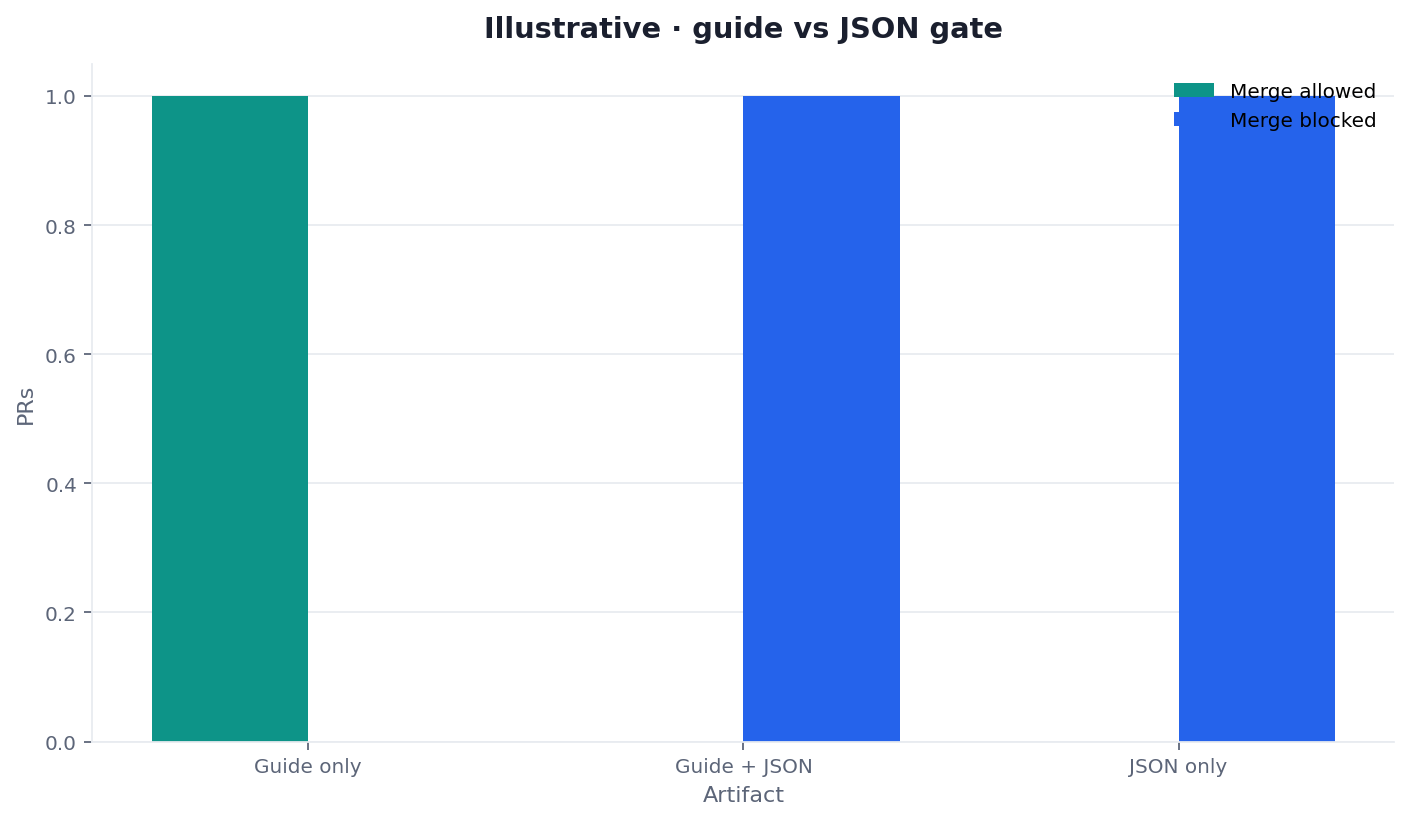
Figure: Two series from the same desk. Topic count is not a gate-field count. Neither series is a ranking score.
Prisma notes are not a parser
npm run db:migrate is a database command. It does not write issues[].status. A Codex SEO audit should send the agent to the retained JSON, not to a migration status.
Portfolio path is not this tool URL
The file names /Users/williamzhu/projects/hailin.zhu.portfolio as “my blog.” This cluster lives under /en/tool/. Do not let a Codex session audit the wrong tree and call that a Codex SEO audit of the preview you are about to merge.
How to reproduce the AGENTS.md read
Read the root file. Then call the pinned CLI so the later required Codex-side check still has a JSON document.
A short Codex SEO audit note should also record that AGENTS.md names Prisma and does not name gate.mjs.
python3 - <<'PY'
from pathlib import Path
text = Path("AGENTS.md").read_text()
print("has_prisma", "Prisma" in text)
print("has_issues_status", "issues[].status" in text)
print("has_seo_health", "seo-health" in text)
print("has_gate_mjs", "gate.mjs" in text)
PY

npx --yes -p infinitegrowth@0.1.1 seo-health check \
  --format json --lang en \
  https://infinisynapse.com/en/tool/json-seo-report
The wrong argv fails first. Codex review that calls npx --yes infinitegrowth@0.1.1 seo-health check URL dies at unknown command 'seo-health' with exit 1. Pin with -p. As of 2026-09-14 the working command on the JSON report URL wrote about 72 KB, title length 41, word count 3319, speed 72, TTFB 1144 ms, and left process 0. A Codex SEO audit still has to hand that file to a parser.
Why the Codex argv must pin -p
Omitting -p inside a Codex sandbox never reaches the preview. Put that failure in the agent runbook before the first preview. RFC 8927 is one way to constrain structured output. A chat paraphrase is not issues[].status.
Where Codex SEO stops and CI starts
Codex SEO stops when the review file is written. CI starts when a parser reads issues[].status and chooses the exit code. Prose in the pull request is not that exit. The section below is the boundary in detail.
Codex SEO for articles is a different job
Using Codex to draft an article is an editor-instruction job. That comparison lives on cursor seo skill. This Codex SEO page stays on the audit file and the merge gate.
What non-interactive text still cannot be
Contrast the root note with a codex exec review that is still honest about its limits. A useful Codex SEO audit can ask the model to list title, description, heading, link, and alt findings. It cannot let that list replace the CLI file.
Sandbox is a permission, not a grade
OpenAI Codex security is why --sandbox read-only is the right default for review. Read-only is a permission boundary. It does not parse onPage[]. Do not treat a clean sandbox as a page pass.
Schema-valid review still needs CI
--output-schema can reject a malformed final message. That is useful. The merge job still has to pin infinitegrowth@0.1.1, write JSON, and parse issues[]. Return 1 on error. Return 2 on missing arrays. Keep warning visible. A Codex SEO audit that stops at codex-review.json leaves the page ungraded.
The OWASP secure-by-design framework is why the review command should not echo secrets. It does not make the structured file an official Google score.
A Codex SEO audit instruction file that embeds a live key is already a leak. Keep the default check path keyless.
Fixture exits the merge job still needs
Local gate.mjs on the Codex desk returned the exits below. Those codes are the parser contract a later CI step would call. They are not a Codex verdict.
| Codex-desk fixture | Exit | stderr captured |
|---|---|---|
red.fixture.json | 1 | SEO_RED Title Length |
malformed.fixture.json | 2 | SEO_CONTRACT missing_result_arrays |
warn.fixture.json | 0 | (empty) |
good.fixture.json | 0 | (empty) |
| no path | 2 | usage: node gate.mjs <report.json> |
Those five Codex-desk exits are the contract a later required check would return.
The red fixture is valid JSON with one error row. The malformed fixture has a url and no result arrays. json.loads is not enough if you never check those arrays. A Codex SEO audit that lets the model “repair” a missing array in prose still needs exit 2 on disk.
Local gate.mjs numbers
Exit 1 means a named content red. Exit 2 means usage, file, or contract failure. The live JSON-report CLI exited 0 with a warning. Reproduce both layers before you treat codex exec as done. Description length 158, HTML 101.5 KB, one blocking script. That row is still not an AGENTS.md field.
Failure modes that confuse prose with status
Prisma notes treated as a gate. Migration commands are not issues[].status.
Structured review treated as page pass. changes_required is a model enum. It did not read Image Alt Text. A Codex SEO audit still needs the file.
Green transport. CLI exit 0 plus a warning row. Parse the array. The JSON report document already showed that pair.
Agent approval treated as evidence. A model can praise the title. The parser still has to see name and status. Keep the transcript if you want context. Do not let it override the file.
Exec binary drift. A Codex PATH that is not CLI 0.1.1 is a different review executable. Pin, then upgrade in its own change.
Missing artifact treated as skip. If CI never writes the JSON, a Codex SEO audit cannot name the row. Require the file.
The afternoon registry GET returned HTTP 200 and 0.1.1, while license, repository, and homepage stayed empty strings. That identity is useful. It is not a Codex run.
This website repository still has no .github/workflows at the app root and no .gitlab-ci.yml. Do not claim a hosted job ran because codex exec printed JSON.
Place structured review next to the hub
The SEO CI/CD complete guide owns the shared rule: file, fields, exit, required check. This page owns the AGENTS.md inventory and the split between codex-review.json and parser exit 1.
Claude Code SEO is the comparison when the control point is an interactive hook rather than codex exec. When the schema itself is under review, open JSON SEO report and test required fields independently of the agent. Editor instructions that live in .cursor/skills/ belong on cursor seo skill.
A Codex SEO audit rollout that begins by asking the model for a 50-page review hides the parser. Prove the negative fixture first. Then connect one public preview. Only then make the named job required.
A codex exec review that this website does not treat as merge evidence can still list title, description, heading, link, and alt findings under --output-schema. That list is a recommendation file. It is not issues[].status. Root AGENTS.md still talks about Prisma and a portfolio blog path. It does not pin seo-health. A reviewer who pastes changes_required into the pull request is filing a model enum, not a Codex SEO audit gate.
The JSON-report live row remains the first-party document this desk actually fetched for the sibling CLI: title 41, description 158, 3319 words, speed 72, TTFB 1144 ms, HTML 101.5 KB. CLI exit 0 sat beside the Image Alt Text warning. A Codex SEO audit that treats schema-valid prose as that warning’s resolution is skipping the array. Keep the file. Re-run after the next deploy. Do not claim a hosted Codex job already graded the page.
Test the URL before you trust the structured review
Run the browser form once, then reproduce the same JSON from the pinned CLI and keep the file.
Run SEO Health CheckerFrequently Asked Questions
What is Codex SEO?
On this page, Codex SEO is a non-interactive review that writes a constrained file, followed by a JSON gate. The file can list recommendations. CI still exits 1 on a content red. It does not issue a Google score, and it is not a pack of SEO skills.
Does the deterministic check require a login?
No. Default check, audit, and links do not need a CLI key. eeat, aivisibility, and gsc do. Keep those deep commands out of the default Codex SEO audit path unless a named owner accepts the spend.
What happens when the retained JSON is missing arrays?
Fail closed. The desk used exit 2 for SEO_CONTRACT missing_result_arrays. Keep stderr. Malformed data is not a warning, because a Codex SEO audit cannot prove the required checks ran.
Can a successful Codex process replace report parsing?
No. The live JSON-report CLI exited 0 while Image Alt Text was warning. Parse issues[] and onPage[]. Preserve name and status. Then apply the repository rule.
Is the structured result an official Google score?
No. Product traffic lights enforce a local merge rule. They do not mint a Google 100, promise indexation, or forecast clicks from exec output. A schema-valid review file is also not that grade.
Does root AGENTS.md already define the SEO gate?
No. The 2026-09-14 read found Prisma notes and no issues[].status. A Codex SEO audit still needs a retained file and a parser.
Conclusion
Use a Codex SEO audit when the job is to keep non-interactive prose from standing in for issues[].status. The 2026-09-14 desk shows a Prisma-and-portfolio AGENTS.md, no named JSON gate, fixture exits 1 and 2, and a live JSON-report CLI that exited 0 beside a warning. Stop the Codex write-up when the command, the pin, the raw fields, and the parser exit are still sitting beside the review file. A desk read of AGENTS.md is more useful than an unsupported exec badge.
Visit the InfiniSynapse web app only if a signed-in owner starts a deep task after exec. The routine path stays the pinned CLI and the retained JSON.
William Zhu · Cofounder, InfiniSynapse · GitHub @allwefantasy
Desk-validated SEO Health methods. Corrections: zhuhl@infinisynapse.com · corrections policy.