What Do Data Analysts Do? Tasks by Industry in 2026
By the InfiniSynapse Data Team · Last updated: 2026-07-09 · We build an AI-native data analysis platform and see analysts across many industries; this guide reflects how the work actually varies by sector.
Table of Contents
- TL;DR
- How We Evaluated Industry Variation
- The Common Core
- What Data Analysts Do in E-commerce
- What Data Analysts Do in Healthcare
- What Data Analysts Do in Finance
- What Data Analysts Do in SaaS
- The Shared Workflow Beneath the Variety
- Choosing Which Industry to Enter
- Readiness Scorecard
- The Portability Advantage
- Failure Modes
- Frequently Asked Questions
- Conclusion
TL;DR
Direct answer: what do data analysts do varies by industry in its questions but not its method. Across e-commerce, healthcare, finance, and SaaS, analysts gather, clean, analyze, and communicate data — the domain changes the questions and the metrics, while the underlying workflow stays constant.
Who this is for: anyone asking what do data analysts do and wanting to see how the role differs across sectors.
What you'll learn: how we evaluated industry variation, the common core of the role, concrete examples in four major industries, and the shared workflow that unites them all.
This guide sits under the data analyst career hub; for the singular day-in-the-life framing, see what does a data analyst do.
For related depth in this pillar, see What Is a Data Analyst? The Role Defined for 2026.
How We Evaluated Industry Variation
We built this guide to what do data analysts do across sectors from occupational research and cross-industry hiring patterns rather than generic role summaries. We cross-referenced the universal analyst competencies listed in the Bureau of Labor Statistics occupational profile for data analysts — analytical thinking, communication, and technical fluency — with sector-specific demand signals in LinkedIn's 2025 Future of Recruiting report, which notes that skills assessments and portfolio evidence increasingly influence hiring alongside formal credentials. We aligned industry examples with the job-market patterns in data analyst jobs and the day-to-day cycle in what does a data analyst do.
The table below summarizes what do data analysts do in four high-hiring sectors, with typical metrics, data sources, and compensation context. Individual companies vary, but these patterns hold across most hiring we observe.
| Industry | Typical questions | Key metrics | Data sources | Pay context (U.S.) |
|---|---|---|---|---|
| E-commerce | Funnel drop-offs, segment value | Conversion rate, LTV, AOV | Web analytics, orders DB | Mid-range; high volume |
| Healthcare | Outcomes, operations, compliance | Readmission rate, utilization | EHR, claims, ops systems | Stable; regulation-heavy |
| Finance | Risk, fraud, performance | Default rate, Sharpe, loss rate | Transactions, market feeds | High; BLS finance medians lead |
| SaaS | Retention, engagement, growth | Churn, NRR, activation rate | Product events, billing | High in tech hubs; fast cycles |
Practical example: an analyst moving from retail e-commerce to healthcare can answer what do data analysts do in the new sector by carrying the same gather-clean-analyze-communicate method while learning HIPAA constraints and clinical outcome metrics — and land the role with a portfolio showing audit-ready documentation, the kind of demonstrated ability that Harvard Business Review's skills-based hiring research describes as increasingly decisive when credentials alone are ambiguous.
The Common Core
Before examining industry differences, it helps to establish what do data analysts do universally. In every sector, analysts turn raw data into decisions through the same cycle: gather the relevant data, clean it into a trustworthy form, analyze it to answer a question, and communicate the result to those who will act. The method is remarkably consistent across wildly different fields.
What changes when you ask what do data analysts do in a specific industry is the content, not the process. The questions, the metrics, the data sources, and the regulations differ, but the analyst's workflow does not, which is why analysts can and do move between industries by carrying their method and learning new context. This universality, grounded in the disciplined process described in the Wikipedia data analysis overview, is what makes the role so portable across a career.
What Data Analysts Do in E-commerce
In e-commerce, what do data analysts do centers on the customer and the funnel. They study conversion rates, cart abandonment, customer segments, and product performance, answering questions like why a checkout step loses users or which segment drives the most lifetime value. The data comes from web analytics, transaction databases, and marketing platforms that must be joined.
The distinctive challenge of what do data analysts do in e-commerce is the sheer volume and velocity of behavioral data. Analysts here often work with millions of events, which strains spreadsheet tools and pushes them toward databases or AI-native agents that handle scale. When our team helped a growth team segment tens of millions of user events, the bottleneck was never the analytical question but the ability to process the volume — a recurring theme in this sector.
What Data Analysts Do in Healthcare
In healthcare, what do data analysts do revolves around outcomes, operations, and compliance. They analyze patient outcomes, hospital efficiency, resource utilization, and quality metrics, answering questions that directly affect care and cost. The stakes are high, and the regulatory environment is strict, which shapes every aspect of the work.
The defining feature of what do data analysts do in healthcare is the premium on accuracy and auditability. A wrong number can affect patient care or compliance standing, so analysts here weight validation and documented, traceable methods heavily. This makes tools that expose an inspectable audit trail especially valuable, and it makes the communication half of the role — explaining findings responsibly to clinicians and administrators — particularly consequential in a field where misinterpretation carries real risk.
What Data Analysts Do in Finance
In finance, what do data analysts do focuses on risk, performance, and fraud. They analyze portfolio returns, credit risk, transaction patterns for fraud, and market trends, working with large, sensitive datasets under tight scrutiny. Precision and defensibility are paramount, since financial decisions carry direct monetary consequences.
The hallmark of what do data analysts do in finance is rigor. Methods must be reproducible and defensible, results must withstand audit, and the tolerance for error is low. Analysts here often use statistical techniques more heavily than in other sectors and lean on tools with strong governance and lineage. The domain knowledge required — understanding financial instruments and regulations — also runs deep, which is why finance analysts often specialize and command strong compensation for that depth. The move toward augmented workflows, outlined in IBM's augmented analytics overview, frames how teams evaluate modern tooling in regulated environments.
What Data Analysts Do in SaaS
In SaaS, what do data analysts do concentrates on retention, engagement, and product usage. They analyze churn, feature adoption, activation funnels, and cohort behavior, answering questions that guide product and growth decisions. The data is largely behavioral and event-based, generated continuously by the product itself.
The characteristic pattern of what do data analysts do in SaaS is tight collaboration with product and growth teams, often in fast iteration cycles. Analysts here need to move quickly, which favors tools that reduce the time from question to answer, and they must communicate findings that directly shape the product roadmap. The recurring nature of SaaS metrics — weekly retention, monthly cohorts — also rewards tools with memory that avoid rebuilding the same analysis each cycle.
The Shared Workflow Beneath the Variety
For all the sector differences, what do data analysts do rests on one shared workflow, and recognizing it is liberating for anyone entering the field. Gather, clean, analyze, communicate: master this cycle and you can apply it in any industry, learning the domain-specific questions and metrics as you go. The method transfers even when the subject matter does not.
AI-native tools accelerate every phase of that cycle — gathering, cleaning, and analyzing — which frees analysts to focus on the sector-specific judgment and communication that create value. We explore the paradigm in what AI-native data analysis means, and the Stanford HAI AI Index documents how broadly this automation is reshaping analytical work across industries.
Choosing Which Industry to Enter
Since what do data analysts do varies so much by sector in its questions, choosing an industry is a meaningful early career decision. The most reliable guide is genuine curiosity: an analyst who cares about the questions a domain asks will learn its context faster and sustain the effort through the tedious parts. Someone fascinated by consumer behavior will thrive on the funnel questions that define what do data analysts do in e-commerce, while someone drawn to clinical outcomes will find healthcare analysis energizing rather than draining.
Practical factors matter alongside interest. Consider what do data analysts do day to day in a sector and whether that rhythm suits you: finance rewards rigor and tolerates little error, SaaS rewards speed and tight collaboration with product teams, and healthcare demands careful, auditable work under regulation. Compensation, stability, and growth prospects also differ — we cover pay bands in data analyst salary — so weigh what do data analysts do in a field against how that field treats and pays its analysts.
Finally, remember that the choice is not permanent. Because the core of what do data analysts do is portable across industries, an analyst can start in one sector and move to another by carrying their method and learning the new domain. Many successful analysts have pivoted between fields more than once, each time deepening their versatility.
Readiness Scorecard
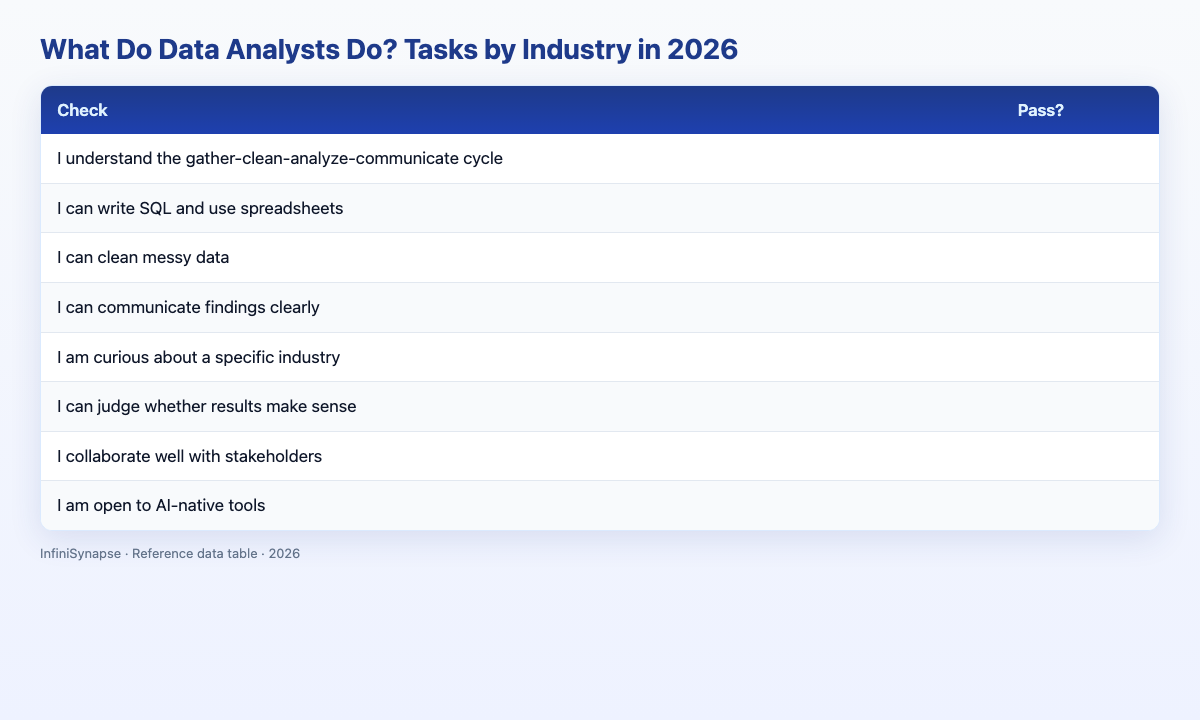
Assess your fit for what data analysts do (1 point each):
| Check | Pass? |
|---|---|
| I understand the gather-clean-analyze-communicate cycle | |
| I can write SQL and use spreadsheets | |
| I can clean messy data | |
| I can communicate findings clearly | |
| I am curious about a specific industry | |
| I can judge whether results make sense | |
| I collaborate well with stakeholders | |
| I am open to AI-native tools |
6–8: strong fit. 3–5: build a skill or pick a domain. Below 3: start with fundamentals.
The Portability Advantage
One underappreciated benefit of understanding what do data analysts do universally is portability. Because the core workflow is identical across sectors, an analyst's skills are not locked to a single industry the way some specialized professions are. A retail analyst can move to healthcare, a finance analyst to a SaaS company, carrying the gather-clean-analyze-communicate method intact and simply learning the new domain's questions and metrics. This mobility is a genuine career asset that few fields offer to the same degree.
Portability also provides resilience. If one industry contracts, an analyst who grasps what do data analysts do at the methodological level can pivot to a healthier sector rather than being stranded. The transferable core — technical fluency plus judgment and communication — remains in demand across the economy, so the skills compound into options rather than dependence on a single employer or industry.
Failure Modes
Failure 1: Assuming the role is identical everywhere. What do data analysts do varies by domain in questions and metrics.
Failure 2: Ignoring domain knowledge. Method without context produces shallow analysis.
Failure 3: Underrating communication. Every sector rewards clear explanation over raw output.
Failure 4: Forcing spreadsheet tools on big data. High-volume sectors need database-backed or AI-native tools.
Frequently Asked Questions
What do data analysts do in different industries?
What do data analysts do varies by industry in its questions but not its method. In e-commerce they study funnels and segments; in healthcare, outcomes and operations; in finance, risk and fraud; in SaaS, retention and engagement. Across all of them, the gather-clean-analyze-communicate workflow stays the same.
Do data analysts need industry knowledge?
Yes. While the analytical method transfers across sectors, what do data analysts do effectively requires understanding the domain's specific metrics, regulations, and data quirks. Domain knowledge lets an analyst ask sharper questions and interpret results with context, which is why domain depth raises both influence and pay over time.
What do data analysts do that is the same across industries?
Across industries, what do data analysts do follows one shared workflow: gather relevant data, clean it into a trustworthy form, analyze it to answer a question, and communicate the result to decision-makers. This portable method is why analysts can move between sectors by carrying their process and learning new context.
Which industry is best for a data analyst?
The best industry for a data analyst is one whose questions genuinely interest you, since curiosity sustains development and domain depth compounds over time. Finance and technology tend to pay most, healthcare offers high stakes and stability, and e-commerce and SaaS offer fast-moving, data-rich environments — see data analyst salary for compensation context.
How do AI tools affect what data analysts do?
AI-native tools accelerate the shared workflow beneath what do data analysts do — gathering, cleaning, and analyzing — in every industry. This frees analysts to focus on the sector-specific judgment and communication that create value, rather than on mechanical preparation, making the tools broadly useful regardless of domain.
Conclusion
What do data analysts do? Across every industry, they turn data into decisions through one portable workflow — gather, clean, analyze, communicate — while the questions and metrics shift by sector. Master the method, pick a domain you find interesting, and let its context deepen your value.
Because the workflow is universal, tools that accelerate it help everywhere; see what AI-native data analysis means and try the InfiniSynapse web app free on registration, no credit card required.