What is database credentials management?
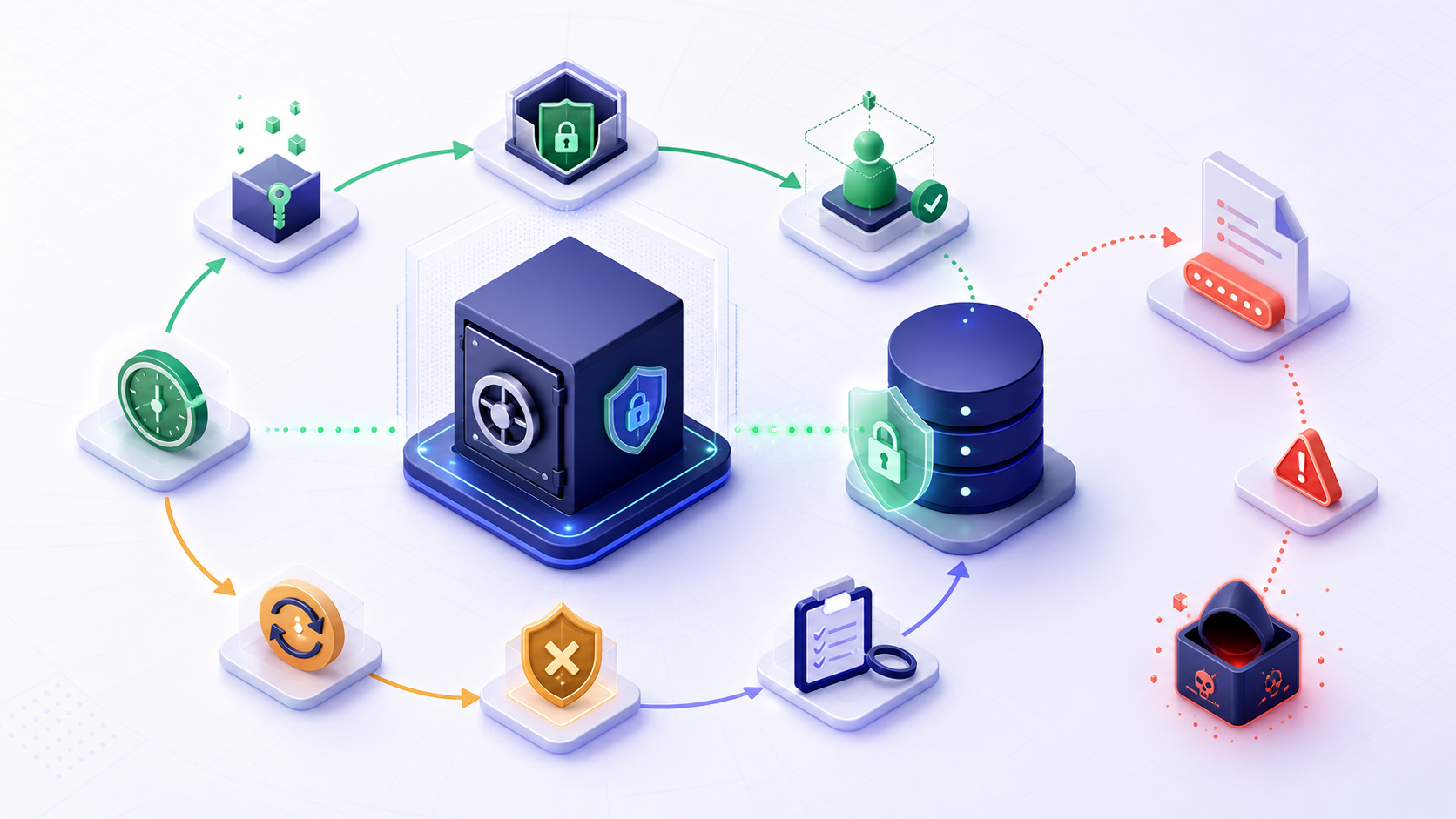
Database credentials management stores passwords and proofs in one system of record, rotates them on a schedule, and separates application identities from human access. Official product glossaries still say “use a secrets manager”; this page is the lifecycle: store, deliver, rotate, revoke, and audit without taking the app down.
Database credentials are the secret or cryptographic identity inputs a database client uses to authenticate a human, application, service, or workload. They can include usernames and passwords, certificates and private keys, tokens, cloud or workload identities, Kerberos material, and secret references. A hostname, database name, port, role, or full connection string may accompany credentials but should not automatically be treated as the secret itself.
A secure design keeps secret values out of source code, images, tickets, chat, logs and analytics; gives each workload an attributable least-privilege identity; delivers credentials only at runtime; supports controlled rotation and revocation; and records use without recording the secret.
Database credentials types and trust boundaries
Choose credential and authentication types according to platform support, workload location, revocation needs, automation, auditability and failure behavior. Avoid treating every identity method as a permanent username and password.
| Type | Strength when well managed | Main operational risk |
|---|---|---|
| Username and password | Widely supported and simple to bootstrap. | Long life, reuse, copying, weak rotation and lockout from stale clients. |
| Certificate and private key | Strong cryptographic identity with explicit trust chains. | Private-key exposure, certificate expiry, hostname or EKU mismatch. |
| Short-lived token | Limited lifetime and identity-provider policy. | Wrong issuer, audience, tenant, clock or token leakage. |
| Managed or workload identity | Reduces distributed static secrets and improves attribution. | Incorrect binding, database mapping, environment support or fallback. |
| Kerberos or integrated identity | Central identity, delegation and policy integration. | SPN, delegation, DNS, time synchronization or runtime identity mismatch. |
Are usernames database credentials?
A username identifies a principal but is not normally sufficient to authenticate it. It may still be sensitive when it reveals internal naming, privileged accounts or customer tenancy. Classify and handle the username with its context, but reserve the strongest secret protections for passwords, private keys, bearer tokens and other reusable proof material.
Database credentials versus a connection string
A connection string is the configuration artifact that describes how a client connects: host, port, database, driver properties, TLS options and sometimes credentials. When it embeds a password or token, the entire string becomes secret-bearing. Prefer secret references, runtime identity or separate protected parameters so the non-secret connection configuration can be managed and observed safely.
Where to store database credentials safely
Use an organization-approved secret manager, key vault, workload identity platform, protected operating-system store, or equivalent control that supports access policy, encryption, versioning, audit and revocation. “Encrypted” alone is insufficient if every workload can decrypt every secret.
Why database credentials should not be stored in source code
Source code is copied into developer machines, forks, build caches, logs, code-review tools, package registries, backups and deployment artifacts. Deleting a secret from the latest commit does not remove its history. If a credential enters version control, treat it as potentially exposed: revoke or rotate it, identify uses, investigate distribution, and remove the value from history according to policy. Run a secret scanner (gitleaks, TruffleHog, or GitHub secret scanning) in CI; a deleted line is not a rotation.
CI/CD and OIDC: do not treat the pipeline as a second vault
Use the platform secret store, never a plaintext password in the workflow file. A proper store is write-only. Anyone who can edit a pipeline can still add a step that prints the secret, so gate who changes workflows. Better: skip the stored database password and mint a short-lived credential at run time with OIDC (or the cloud equivalent). That is still database credentials management — the system of record stays the vault or identity provider, not a copied Actions variable.
Are environment variables safe for database credentials?
Environment variables can be a delivery mechanism, but they are not automatically a secure source of truth. They may appear in process diagnostics, crash dumps, support bundles, container definitions, deployment systems or inherited child processes. Prefer fetching short-lived values or references from an approved secret system at runtime, restrict process and diagnostic access, and prevent application startup logs from printing configuration.
How encryption and access policy work together
Encrypt secrets in transit and at rest, but also control which identity can request which version under which environment and purpose. Separate administrative control of the vault from permission to read database secrets. Protect encryption keys, audit secret retrieval, alert on unusual volume or source, and test recovery without exporting an unprotected master list.
Deliver database credentials to workloads without leaking them
Separate application and human database credentials
Give the application its own principal. Give analysts a different, usually read-only, identity. Do not share one production account across services, environments, humans, and automation. Distinct identities improve attribution, least privilege, selective rotation and revocation. Role-based access control (RBAC) decides what the principal may do; database credentials management decides where the secret lives and how it is rotated. Permission design stays on database 1 access.
Use a distinct database identity for each workload boundary
Define the boundary according to risk and operational ownership: application, environment, service, tenant or job. Too many unmanaged identities create their own risk, so automate ownership, expiry, review and deprovisioning.
Prevent database credentials from entering logs and telemetry
Redact credential fields before serialization, not after collection. Configure drivers, frameworks, APM agents, exception handlers and support tooling to avoid full connection strings, authorization headers, environment dumps and command arguments. Test redaction with synthetic markers. Restrict access to logs because redaction can fail, and treat any observed secret as exposed rather than assuming nobody read it.
Rotate database credentials on a schedule, not on an incident
Database credentials management rotates on a calendar and after every suspected leak — not only when audit or a breach forces the question. Rotation is a coordinated state change across the identity source, secret system, every consumer, connection pools, monitoring and rollback. Simply changing the database password can create stale retries, account lockout and partial outages.
A two-version database credential rotation pattern
Where the platform supports it, create or activate a new credential version, distribute its reference, update consumers in controlled waves, validate fresh authenticated sessions and representative operations, then revoke the old version after all consumers and rollback conditions are known. The overlap window should be explicit and short; indefinite dual credentials double the attack surface.
How connection pools affect credential rotation
Existing pooled sessions can continue using the database even after the old credential can no longer create sessions. That can hide an incomplete rollout. Verify new connections deliberately, monitor authentication failures, and recycle pools gradually after readiness is proven. An immediate global restart may turn a recoverable inconsistency into a full outage.
When database credentials need emergency rotation
Rotate or revoke promptly when a credential appears in source control, logs, chat, tickets, public artifacts, an unauthorized device, a compromised workload, or suspicious access evidence. Containment must include all copies and consumers, not only the database account. Preserve incident evidence without retaining the secret value, assess data access, and replace any derived or reused credentials.
Short-lived and dynamic credentials
Prefer managed or workload identity and short-lived tokens where the engine supports them. Dynamic issuance (mint, use, expire) shrinks the window a leaked static password stays valid. HashiCorp documents the pattern in Vault database credentials — that tutorial is theirs. This page stays the lifecycle: if you still have a long-lived password, it still needs one vault, a rotation schedule, and a tested revoke path.
Troubleshoot database credentials without exposing secrets
Why database credentials work locally but fail in production
Local and production workloads may use different identities, secret versions, vault paths, environment bindings, endpoints, TLS trust stores, drivers, database mappings or network sources. Compare metadata and references—not secret values. Confirm the runtime identity can retrieve the intended version, the application actually reloads it, and a fresh connection uses the expected authentication method.
How to diagnose an invalid database credential after rotation
Inventory every consumer and replica, secret reference, deployment revision, retrieval timestamp, pool state and retry loop. Check whether the server accepts both versions during transition, whether the principal was changed instead of only the secret, and whether escaping or encoding altered the delivered value. Stop high-frequency retries that can trigger lockout and obscure the original failure.
Audit and govern the database credential lifecycle
What should a database credential inventory contain?
Track a non-secret identifier, credential type, database principal, owner, business service, environment, engine, allowed secret store, consumers, privilege role, creation and last rotation, expiry or review date, rotation method, revocation status, and audit destination. Never turn the inventory into a spreadsheet of passwords. The inventory should point to controlled systems rather than duplicate their secret values.
Metrics that reveal database credential risk
Useful measures include unowned credentials, shared principals, static secrets beyond policy age, failed or overdue rotations, unused credentials, excessive privilege, retrieval from unusual sources, plaintext findings, secrets without tested revocation, and authentication failures after deployment. Interpret metrics with context: a low retrieval count can indicate dormancy or missing telemetry. RBAC gaps (shared admin logins, unused grants) belong in the same review as vault age — they are how database credentials management fails even when the password is stored correctly.
A repeatable database credentials lifecycle workflow
Use this database credentials management lifecycle for new identities, migrations, periodic review, rotation and incident response. Each step should be automated where practical and owned by a named team.
- Create an attributable identityAssign ownership, purpose, environment, least-privilege role, authentication method, expiry and review requirements.
- Store in an approved control planeUse a secret manager, key vault or workload identity system with encryption, policy, versioning and audit.
- Deliver only to the runtime identityAuthorize the exact workload and environment to retrieve only the credential or token it needs.
- Use without disclosurePrevent output in logs, errors, traces, process lists, tickets, chat, support bundles and analytics.
- Rotate and validate fresh sessionsCoordinate consumers and pools, validate a new version, monitor failures, then revoke the old version.
- Review, revoke and prove removalRemove unused access, test that new sessions fail, handle existing sessions, and retain sanitized audit evidence.
Prepare database credentials evidence for compatibility review
Prepare only non-secret metadata: engine, driver, endpoint, database, authentication method, credential type, principal identifier, secret-store reference, version identifier, workload identity, TLS mode, lifecycle state, exact error stage and recent rotation. Never paste a password, token, private key or secret-bearing connection string.
Review database credential compatibility safely
Use the InfiniSynapse DB Compatibility Checker to organize endpoint, driver, TLS and authentication compatibility questions using sanitized metadata. Treat the output as guidance, then validate with the approved secret-delivery path and a fresh least-privilege session.
Open DB Compatibility CheckerDatabase credentials FAQ
What is database credentials management?
Database credentials management stores secrets in one vault, rotates them on a schedule, and separates application identities from human access. Store, deliver, rotate, revoke, and audit stay one lifecycle — not three env files and a forgotten .pgpass.
What are database credentials?
Database credentials are secret or cryptographic identity inputs used to authenticate a human, application, service, or workload to a database.
Where should database credentials be stored?
Use an organization-approved secret manager, key vault, workload identity platform, protected operating-system store, or equivalent control with access policy, encryption, versioning, audit and revocation.
Is an environment variable enough for database credentials management?
No. An environment variable can deliver a value at runtime, but it is not the system of record. Values leak into dumps, child processes, and deployment manifests. Fetch from the vault (or mint a short-lived token) and keep env as a delivery slot, not the inventory.
Should database credentials be stored in a connection string?
Avoid embedding reusable secrets where possible. Use a secret reference, runtime identity, token provider, or separate protected parameter. If a connection string contains a secret, protect the entire string.
Are environment variables safe for database passwords?
They can deliver values but are not automatically secure. Values may appear in diagnostics, dumps, deployment definitions or child processes. Prefer approved runtime secret retrieval and prevent configuration logging.
How often should database credentials be rotated?
Use risk and policy-based lifetimes, and rotate immediately after suspected exposure. Prefer short-lived or managed identities where supported, and test the entire delivery and revocation process.
Why do database credentials fail after rotation?
A consumer, replica, job, pool or deployment may still use the old version; the application may not reload; encoding may change the value; or the identity mapping may differ. Inventory every consumer and validate fresh sessions.