What database 1 access is
Database 1 access is the grant on that one database, not a server login. Check the mapping before you widen the role. Database access is still the governed ability of a verified human or workload identity to connect to a database and perform explicitly authorized actions on approved data. A TCP connection or successful login is only part of that decision. Effective access also depends on the selected database, active role, schema and object grants, row-level policies, session context, data classification, network source, and the operation being attempted.
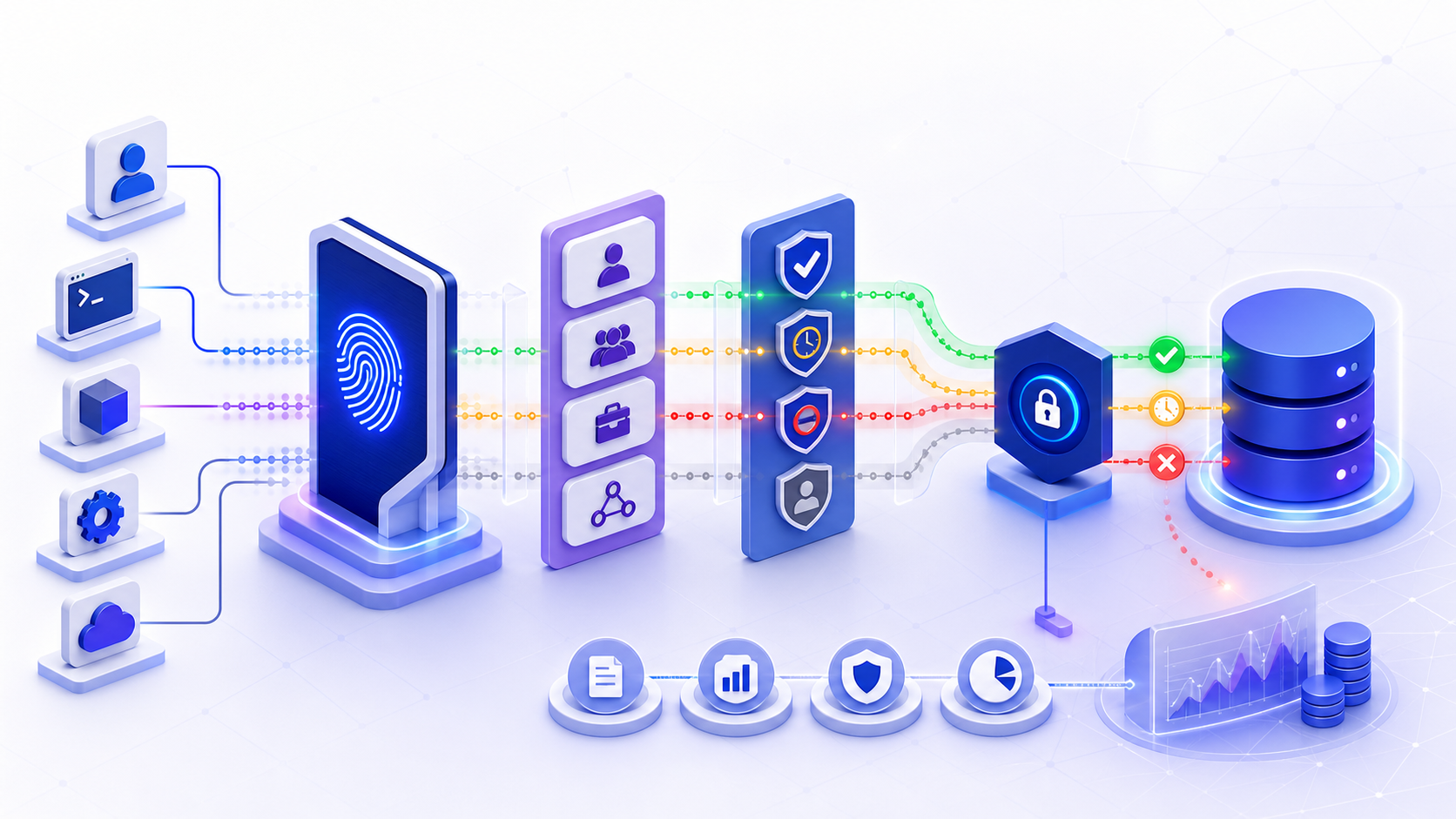
Treat database access control as a sequence of evidence-producing gates. When access fails, identify the first gate that did not pass instead of granting broader privileges. When access succeeds, verify that it is no broader, longer, or less observable than the business task requires.
Database access control layers and decision points
A reliable model separates connectivity, authentication, authorization, data scope, and monitoring. Blurring these layers creates dangerous fixes: opening a firewall for a missing role, rotating a password for a DNS error, or granting ownership because one table is unavailable.
| Layer | Question | Evidence to collect |
|---|---|---|
| Network path | Can the approved source reach the intended host and port? | Resolved address, source, route, port and TCP result. |
| Authentication | Which identity is presented, and can it prove who it is? | Authentication method, principal, account state and sanitized error. |
| Authorization | Which roles and grants permit the requested operation? | Effective roles, grants, denials and ownership chain. |
| Data scope | Which database, schema, objects, rows and columns are in scope? | Database selection, search path, tenant context and policy predicates. |
| Session controls | Do source, time, device, TLS and workload conditions still match policy? | Session attributes, expiry, certificate and policy decision. |
| Audit and response | Can the organization explain and revoke actual use? | Login, query, privilege-change and revocation records. |
Authentication versus authorization in database access
Authentication establishes which principal is connecting: a named user, service account, workload identity, certificate subject, federated identity, or another supported principal. Authorization answers what that principal may do after authentication. A valid password with no table grant should fail at authorization; an expired credential should fail earlier. Preserve that distinction in tickets and alerts.
Why database ownership is not a troubleshooting shortcut
Owner or administrator roles collapse multiple decision points and can make a symptom disappear without identifying its cause. They may expose unrelated schemas, permit destructive DDL, bypass row-level controls, or prevent the application from behaving like production. Test with the intended role and grant the smallest missing capability only after the failing operation and object are known.
Design least-privilege database access that still works
Least privilege is not merely fewer grants. It is an explicit match between identity, operation, data scope, environment, duration, and evidence. A role can have few permissions but still be dangerous if shared by many workloads, valid forever, or usable from any network.
How to build a database access role from observed operations
Start with the application or analyst workflow: list required connection targets, read and write operations, stored procedures, sequences, temporary objects, metadata queries, migration tasks, and failure behavior. Separate runtime from deployment and emergency administration. Create roles around stable duties rather than individuals, then assign identities to those roles through an approved process.
Validate with representative tests, including negative tests. Confirm that required operations succeed and prohibited operations fail cleanly. Test after schema changes because new tables, ownership changes, default privileges, synonyms, or stored procedure execution context can silently expand or break effective access.
When should database access expire?
Human troubleshooting, vendor support, migration, and incident access should normally have a documented owner, reason, approval, start time, and automatic expiry. Long-lived application access still needs periodic review and credential or identity lifecycle controls. Expiry is not complete without revocation testing: prove that an expired assignment can no longer create a new session and decide how existing sessions are handled.
A database access request checklist that produces evidence
What should a database access request include?
A useful request names the requesting identity, identity owner, application or business task, environment, database and schema, required operations, data classification, source workload or network, authentication method, start and expiry, approval owner, and validation plan. Avoid vague requests such as “read access to production” because they do not define objects, rows, purpose, duration, or acceptable use.
- Scope: exact engine, environment, endpoint, database, schema and object set.
- Operations: SELECT, INSERT, UPDATE, DELETE, EXECUTE, metadata, DDL or administration.
- Conditions: source, TLS, device/workload identity, time window and tenant context.
- Evidence: approver, ticket, test cases, audit destination, expiry and review date.
How should emergency database access differ?
Emergency access should be faster to activate but more constrained and observable, not permanently broad. Use a separately controlled identity or role, strong authentication, short expiry, explicit incident linkage, session and query logging where policy allows, and post-use review. Test the break-glass path before an incident; an emergency control that has never been exercised is only an assumption.
Name the operation on that one database
Database 1 access names one operation on that database: SELECT, INSERT, UPDATE, DELETE, EXECUTE, or a narrower object grant. A privilege list for every engine is not the check. The request still has to name this database and this operation.
A server login is not access to that database
A server login can succeed while this database has no user mapping, no active role, or no object grant. Fix that row. Do not grant a server-wide role to make one database respond.
Troubleshoot database access denied without overgranting
“Access denied” can describe a network policy, authentication rejection, missing database mapping, inactive role, object grant, row-level predicate, ownership chain, or data governance rule. A permission denial is not a database availability failure: availability is whether an authorized operation finishes correctly and on time. Preserve the exact sanitized error and test context before changing anything.
Why can login succeed but a table query fail?
Login confirms authentication to a server or service; it does not guarantee access to every database or object. The session may land in a default database where the principal is mapped differently, use an inactive role, resolve an unqualified table name to another schema, or meet a row-level rule that returns no rows. Capture the current database, effective principal and roles, fully qualified object, operation, and policy context.
How to distinguish an explicit denial from a missing grant
Permission systems differ, but an explicit deny can override grants inherited through other roles, while absence of a grant simply provides no authorization path. Review effective permissions rather than only direct grants. Include nested roles, group synchronization, ownership or definer rights, default privileges, impersonation, and policy engines. Remove unintended deny rules only with the same change control used for grants.
One database fails, the others do not
When every other database answers and this one does not, the failure is on this mapping, role, or object grant. Find the first gate that failed before you copy a grant from a database that already works.
Audit database access based on effective use, not lists
What evidence should a database access review use?
A role membership export is necessary but insufficient. Combine identity ownership, approval records, current grants, last authentication, observed queries or object access where permitted, failed access patterns, privilege changes, dormant accounts, shared identities, break-glass use, and data sensitivity. Distinguish “not observed” from “not required”; logging gaps can make a necessary workload appear dormant.
How often should database access be reviewed?
Set frequency by risk rather than one global calendar. Privileged production access, sensitive data, third-party access, and shared or emergency identities deserve shorter review cycles and event-triggered checks. Re-review after role changes, team transfers, application retirement, data reclassification, migration, credential compromise, policy changes, or an unexplained privilege failure.
Database access mistakes that create hidden risk
Shared accounts, embedded secrets and permanent grants
Shared accounts weaken attribution and make selective revocation difficult. Embedded credentials couple access to source code or deployment artifacts. Permanent grants outlive projects and owners. Prefer attributable human identities, distinct workload identities, managed secret delivery or federation, and expiry appropriate to the use case. Where legacy constraints remain, document the compensating controls and retirement plan.
Granting broad read access can still expose sensitive data
Read-only does not mean low risk. Broad reads can expose personal, financial, security, operational, or model-training data; permit bulk extraction; reveal schemas and relationships; and create expensive queries. Limit database, schema, table, column, row, tenant, purpose, source, and duration. Use views or governed interfaces when they better express the approved data contract.
Do not open a second database to fix the first
Connecting a second Access file, or adding access one system at a time, does not prove the grant on this database. This page does not walk through multi-file connections or a desktop sharing setup.
Replay the effective grant before you keep it
Run the allowed operation and one prohibited operation with the intended identity. Keep the grant only when the effective role matches that database, not a broader role you used for the test.
A repeatable database access validation workflow
Use the following sequence for new access, troubleshooting, periodic review, and post-change validation. Each step should leave a small, sanitized evidence record.
- Define the business operationName the actor, purpose, data, environment, allowed operations, prohibited operations, start, expiry and owner.
- Verify the endpoint and sourceConfirm host, port, database, TLS expectation, network source and whether the test matches the real workload path.
- Verify the presented identityRecord the intended principal and authentication method without placing passwords, tokens or connection strings in the ticket.
- Inspect effective authorizationEvaluate active roles, inherited grants, explicit denials, object ownership, policy predicates and session context.
- Run positive and negative testsProve required operations succeed and representative prohibited operations fail, using sanitized non-production data where possible.
- Review, expire and revokeSet review and expiry, confirm audit coverage, test revocation and document the owner responsible for follow-up.
Prepare database access evidence for compatibility review
Prepare a sanitized record of engine, endpoint, port, database, authentication method, intended role, required operation, source environment, TLS expectation, exact failure stage, and recent changes. Never include a live password, token, private key, or full secret-bearing connection string.
Structure the next database access check
Use the InfiniSynapse DB Compatibility Checker to organize endpoint and compatibility questions before a real connection test. Treat the output as diagnostic guidance, then validate effective access with the approved identity, driver, environment, least-privilege role, and representative operations.
Open DB Compatibility CheckerWhat this page will not open
phpMyAdmin steps, Microsoft Access multi-user sharing, and a MySQL account manual stay on those products’ own docs. PostgreSQL roles and the SQL Server permissions hierarchy stay in the sources below.
Database access FAQ
What is database 1 access?
Database 1 access is the grant on that one database, not a server login. Check the mapping before you widen the role.
What is database access?
Database access is the governed ability of an authenticated identity to connect to a database and perform explicitly authorized actions within defined data, environment, time, and policy boundaries.
What is the difference between database authentication and authorization?
Authentication establishes which identity is connecting. Authorization determines which databases, objects, rows, procedures, and operations that authenticated identity may use.
Why is database access denied after login succeeds?
The identity may lack a database mapping, active role, object grant, row or tenant entitlement, procedure permission, or required session context. Capture the exact operation and effective role before changing grants.
How do I grant database access safely?
Define the task and data scope, assign an attributable identity to a duty-based least-privilege role, set conditions and expiry, test required and prohibited operations, enable audit evidence, and review or revoke access.
Is read-only database access always safe?
No. Broad read access can expose sensitive data, permit bulk extraction, reveal structure, and create expensive workloads. Limit database, object, row, column, tenant, purpose, source, and duration.
What should a database access review include?
Review identity ownership, approvals, effective roles and grants, denials, recent use, dormant or shared identities, privilege changes, sensitive data scope, emergency access, expiry, audit coverage, and revocation evidence.