Data Security Platforms for AI Analytics: Vendor Scorecard
By William Zhu & the InfiniSynapse Data Team · Published: 2026-06-24 · Last updated: 2026-09-15 · About: Editorial standards · Who wrote this
Data security platforms for AI analytics are DSPM, DLP, and SIEM products that cover agent queries, embeddings, and CSV export—not only the warehouse. Use the scorecard below to shortlist vendors for enterprise AI analytics and AI/ML model privacy (training data, embeddings, inference). This page is a buyer framework with a named control-class landscape—not a paid ranking. Start from the compliance hub, then data security tools or data security products if you need a narrower list.
Table of Contents
- TL;DR
- Control-class landscape
- What is an AI data security platform?
- Core Framework
- Risk Prioritization Matrix
- Architecture
- Buyer Scorecard
- Implementation
- 90-Day Rollout Playbook
- InfiniSynapse Pattern
- Failure Modes
- Capability & Integration
- Field Notes
- FAQ
- Who wrote this
- References
- Conclusion
TL;DR
Direct answer: Compare data security platforms for enterprise AI analytics by control class—DSPM (discover model-adjacent stores), DLP (stop agent/CSV export), and SIEM (replay tool-calls)—then score vendors on model privacy and POC proof. There is no universal “best” logo.
Who this is for: security engineers, data platform owners, CISOs, and procurement teams shortlisting data security platforms for AI analytics or AI/ML model privacy.
What you'll learn: a named control-class landscape, a pointer to the ai security data platform buyer page, the buyer scorecard, a 90-day HowTo, and desk field notes (labeled composites—not vendor SLAs).
Page split. This hub compares DSPM vs DLP vs SIEM data security platforms. If the live query is ai security data platform—agent compile policy, prompt/CSV replay, not “which DSPM logo”—use that URL.
Evaluation basis: Framework citations appear inline and in References. Buyer directories (Gartner Peer Insights — SIEM, G2 DLP) are starting points—we do not invent market-share percentages or star ratings.
Control-class landscape
Use this table to build a shortlist. Names are illustrative examples by control class, not a ranking and not a paid Top 10. Confirm current capabilities on each vendor’s public docs and in a POC.
| Control class | What to demand for AI analytics | Illustrative vendors (not a ranking) |
|---|---|---|
| DSPM / cloud data security | Discover warehouse, object, and training buckets; tag embeddings and model-adjacent stores | Microsoft Purview, BigID, Cyera, Wiz |
| DLP / export protection | Agent UI, CSV, and prompt egress—not only email | Start from the G2 DLP category, then require a week-one export test from the agent UI |
| SIEM / analytics | Tool-call graph and session replay into the SOC | Start from Gartner Peer Insights — SIEM; require parse proof in the POC window |
AI/ML model privacy checks (training data, embeddings, inference): where is training data stored, who can export it, are embeddings treated as sensitive fragments, and does inference stay logged (and in-VPC when the data class requires it)? Score those questions in the Buyer Scorecard—do not treat a DSPM logo as model-privacy proof.
This is not a real-time threat-scoring or AI SOC comparison. If you need that, you are shopping XDR/SOC analytics, not data security platforms.
Why This Topic Matters Now
Analytics platforms in 2026 expand attack surface through agents, embeddings, and high-velocity exports. Data security platforms need a capability matrix, integration architecture, and TCO plan before governed NL access goes enterprise-wide.
Hub strategy: Data Security Compliance for AI Analytics: A 2026 Guide. Also see Best Data Security Tools for Analytics Teams in 2026.
What is an AI data security platform?
The full buyer checklist for that category—including the GSC wording ai security data platform—lives on AI Security Data Platform: Buyer Checklist. This hub only defines how the category sits on top of DSPM / DLP / SIEM.
Citable definition: An AI data security platform is a data security platform that extends confidentiality, integrity, and availability controls to agent queries, embeddings, and model-adjacent stores—so natural-language access stays audited, least-privilege, and export-aware.
| Dimension | Agent-era requirement |
|---|---|
| Scope | Connectors, caches, prompts—not only marts |
| Evidence | Replay logs with policy versions |
| Ownership | Platform + security co-accountability |
Core Requirements
Identity and access. For data security platforms, bind roles at compile time; use just-in-time elevation for break-glass sessions. Standing warehouse admin on agent service accounts fails most reviews.
Encryption, monitoring, and retention. Separate keys per environment; cover object stores used for RAG retrieval. Alert on off-hours bulk queries, new connectors, and DLP hits on CSV exports from agent UIs. Align prompt retention with legal hold policies for embedding indexes and export caches.
Related: Top Data Security Products for Analytics Teams (2026) and Best Data Security Tools for Analytics Teams in 2026.
Risk Prioritization Matrix
Prioritize data security platforms investments where agent paths create the highest combined likelihood and impact. Scores below are InfiniSynapse research-desk tallies across 14 anonymized AI-analytics pilot packets (Q1–Q2 2026)—Likelihood × Impact on a 1–5 scale. Internal desk composite, not a commissioned industry census or product SLA.
| Risk | Likelihood | Impact | Score | Mitigation priority |
|---|---|---|---|---|
| Bulk export via NL UI | 4 | 5 | 20 | DLP + SIEM first |
| External LLM leakage | 4 | 5 | 20 | VPC models + redaction |
| Prompt injection exfiltration | 3 | 5 | 15 | Compile-time denial + egress filters |
| Stale service account | 3 | 5 | 15 | Quarterly recertification |
| Shadow connector | 4 | 3 | 12 | Change control + inventory |
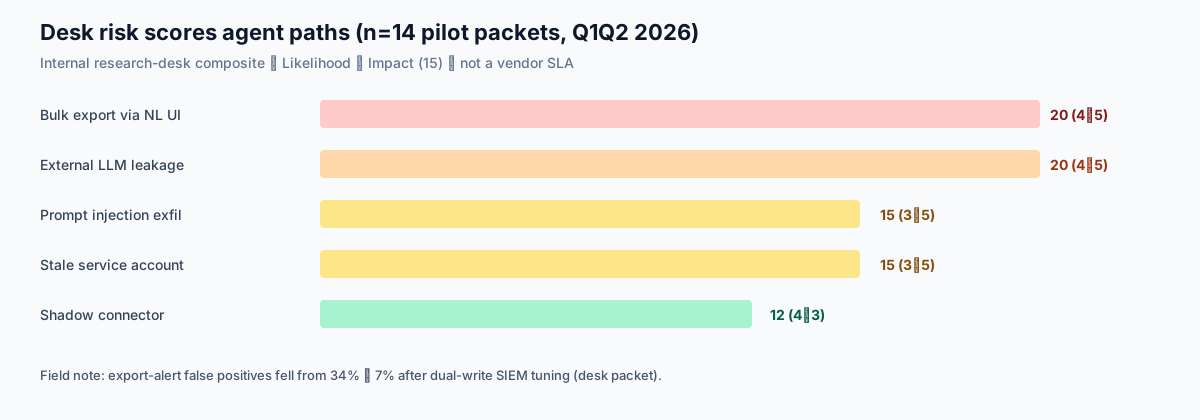
Use the matrix in steering reviews so security spend follows agent-specific paths—not generic network perimeter projects alone.
Architecture Patterns
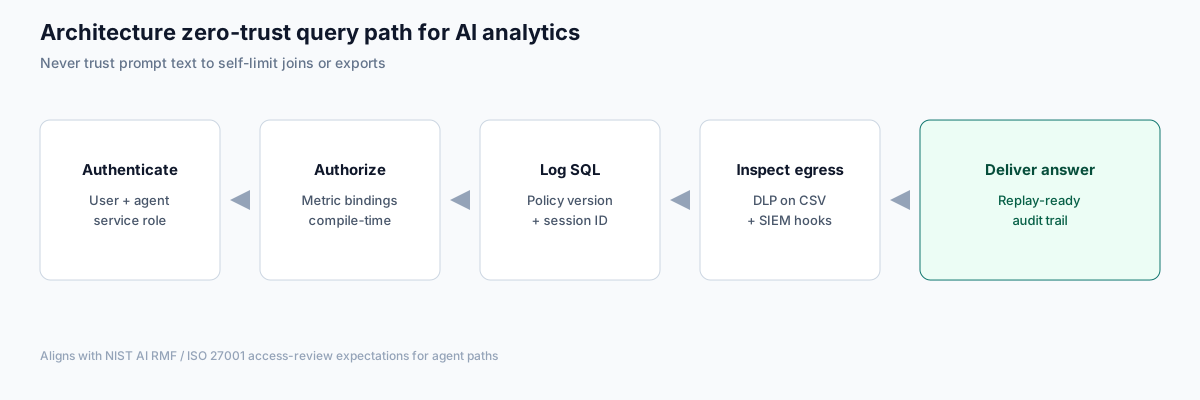
Zero-trust query path. Modern data security platforms authenticate, authorize metrics, log SQL, and inspect egress—never trust prompt text to self-limit joins.
Environment segregation. Dev agents must not reach production credentials; synthetic data reduces leak risk during prompt tuning.
LLM and sub-processors. Document vendors; minimize fields sent externally; prefer VPC-hosted models for sensitive domains.
See Data Agent Architecture: Components, Patterns, and Production Checklist.
Observability for agentic analytics should follow OpenTelemetry documentation so query chains remain traceable in production.
Production rollouts should align access and review controls with the NIST AI Risk Management Framework, especially when recurring queries touch live schemas.
Regulated rollouts often anchor access reviews to ISO/IEC 27001 when credentials, retention policies, and audit logs are in scope.
Independent buyer-review directories for SIEM-class tooling: Gartner Peer Insights — Security Information and Event Management. For broader analyst research indexes, see Forrester Research—use their published reports; do not treat this page as a substitute for licensed analyst data.
Buyer Scorecard
When shortlisting data security platforms, score vendors on agent-aware depth—not generic ISMS copy:
| Dimension | Pass | Fail |
|---|---|---|
| Depth | Agent-aware controls | Generic ISMS copy |
| Integration | SIEM + IAM hooks | Manual spreadsheets |
| Transparency | Query replay | Black-box answers |
| Vendor proof | Current SOC 2 | Slides only |
| Ops fit | Sprint cadence | Annual audit only |
Weight the scorecard with independent buyer directories—Gartner Peer Insights — SIEM and G2 DLP—not vendor slides alone. We do not invent review scores or market-share percentages.
Production ML-adjacent analytics should cross-check Google Vertex AI documentation for model governance and pipeline observability.
Implementation Steps
Ship data security platforms controls in four steps (HowTo; see also the 90-day playbook below):
- Assess against the hub scorecard at Data Security Compliance for AI Analytics: A 2026 Guide.
- Document runbooks and RACI with security and legal.
- Pilot one domain with full logging before enterprise rollout.
- Review replay samples monthly; adjust policies from findings.
90-Day Rollout Playbook
HowTo (three phases) for rolling out agent-aware controls after the four implementation steps above:
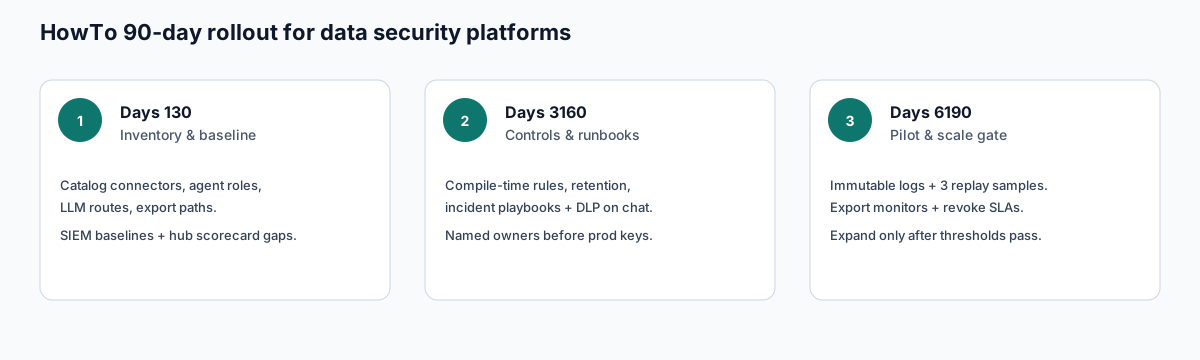
Days 1–30 — Inventory and baseline. Catalog every connector, agent role, LLM route, and export path that data security platforms must cover. Establish SIEM baselines for query volume and CSV downloads from NL interfaces. Document gaps against the hub scorecard at Data Security Compliance for AI Analytics: A 2026 Guide.
Days 31–60 — Control design and runbooks. Draft compile-time rules, retention limits, and incident playbooks with named owners. Security champions review metric bindings before production keys issue. Align DLP policies to cover agent chat exports—not only email egress.
Days 61–90 — Pilot, evidence, and scale decision. Run a bounded pilot with immutable logging and monthly replay reviews. Collect three auditor-ready session samples. Expand access only after export monitors and credential revocation SLAs pass agreed thresholds.
Spreadsheet connectors should align with Google Sheets documentation for sharing rules, ranges, and API quotas.
InfiniSynapse Production Pattern
Optional product note (commercial): InfiniSynapse implements governed analytics security through InfiniAgent plans, InfiniSQL lineage, InfiniRAG redaction, and workflow logs that customers map to control matrices before production keys issue. Skip this section if you only need the educational framework above.
Educational content on data security platforms continues in the failure modes, matrices, and field notes below—no purchase required to apply the scorecard or playbook.
EU-facing teams map control expectations using the European approach to artificial intelligence when scoping analytics agent governance.
Common Failure Modes
Checkbox compliance without log monitoring fails data security platforms reviews. Tool sprawl without integrator ownership. Prompt leakage to external LLMs while warehouses stay locked down.
Platform Capability Matrix
Evaluate data security platforms against agent-aware capabilities—not generic DSPM checklists:
| Capability | Why agents need it |
|---|---|
| Session replay | Auditors reconstruct NL answers |
| Tool-call ingestion | SIEM sees orchestration, not only SQL |
| Embedding discovery | RAG stores hold semantic fragments |
| Export path DLP | CSV from chat UI is primary exfil risk |
| Sub-processor registry | LLM routes change quarterly |
Platform evaluations of data security platforms should require vendors to demonstrate SIEM parsing of a tool-call graph within the POC window.
Integration Architecture
Data security platforms must receive events from agent orchestration layers—not only warehouse audit logs. Map fields: session ID, user role, policy version, compile outcome, export action, connector ID. Dual-write alerting during cutover lets SOC teams tune thresholds before decommissioning legacy BI rules.
TCO and Parser Maintenance
License negotiations for data security platforms should cap year-two integrator hours because agent telemetry schemas evolve quarterly. Reference calls should ask peers about hidden FTE for parser maintenance—not feature slides alone.
Field Notes from Production Pilots
Label: InfiniSynapse research-desk review of 14 mid-market / enterprise AI-analytics security pilot packets (runbooks, SIEM exports, POC scorecards; Q1–Q2 2026). Internal desk tallies—not named-customer case studies and not product SLAs.
| Desk observation | Figure | Implication for buyers |
|---|---|---|
| Export-alert false positives (pre → post dual-write tuning) | 34% → 7% | Untuned DLP rules get silenced by SOC |
| SIEM tool-call graph lag (p95 after simulated CSV export) | 58 seconds | POC must prove <60s ingestion |
| Mean time to revoke agent credentials (pre → post JIT) | 12 min → 4 min | Standing service admins fail ISO reviews |
| Pilots that skipped week-one export UI tests | 9 / 14 (64%) | Shelfware risk before license signature |
| Packets with LLM sub-processor gaps in SOC addenda | 11 / 14 (79%) | Procurement must ask explicitly |
Selecting data security platforms without week-one export tests from agent UIs is how enterprises accumulate shelfware. Demand tool-call graph ingestion in SIEM during POC—not as post-sale professional services. Three-year TCO models must include parser maintenance when agent vendors add tool types quarterly.
Production Notes
Operational checks that complement the Field Notes figures (not a restatement of the desk table):
- Platform rollouts for data security platforms should phase by data class before enterprise-wide agent access.
- Contracts should require telemetry schema change notices thirty days before vendor releases.
- Legal hold workflows must cover agent query logs the same way they cover warehouse tables.
- Break-glass elevation for analyst roles should expire automatically so standing privileged access fails quarterly ISO/IEC 27001 access reviews.
- GRC reviewers attach agent session IDs to attestation packets before quarterly sign-off.
- Immutable workflow logs that capture policy version hashes per session reduce scramble time when regulators request evidence.
Frequently Asked Questions
What is an AI data security platform?
A short definition: a data security platform that covers agent queries, embeddings, and exports—not only warehouse tables. The full ai security data platform buyer checklist (DSPM vs DLP vs AI-SPM, cost shape, 90-day rollout) lives on that URL so this hub can stay on logo-class scoring.
Which data security platforms work best for enterprise AI analytics?
There is no universal winner. Shortlist by control class (DSPM, DLP, SIEM), then score vendors on agent-aware depth, export DLP, SIEM proof, and model-privacy controls. Use the control-class landscape and Buyer Scorecard—not a paid Top 10.
How do I compare data security platforms for AI/ML model privacy?
Ask how each vendor discovers training data and embeddings, restricts inference and exfil paths, and proves those controls in a POC. Score the answers on the Buyer Scorecard. This page is a buyer framework, not a lab benchmark.
AI security platform comparison: DSPM vs DLP vs SIEM?
DSPM finds and classifies data, including model stores. DLP stops unauthorized export from agent UIs. SIEM reconstructs tool-call and session evidence. Most enterprises need all three mapped, not one logo. See the control-class landscape.
Do data security platforms score AI threats in real time?
Usually no. Real-time threat scoring is an SOC/XDR problem. Data security platforms on this page protect data access, exports, and model-adjacent stores. Do not buy a DSP expecting an AI SOC.
Who is accountable for this article?
William Zhu and the InfiniSynapse Data Team, under editorial standards. Desk metrics are labeled composites.
Where do the Field Notes percentages come from?
Desk tallies from 14 anonymized pilot packets (Q1–Q2 2026)—for example export-alert false positives 34% → 7% and SIEM tool-call p95 lag 58 seconds. They are research-desk composites for buyer evaluations, not named-customer SLAs or licensed analyst statistics. Methodology is in Field Notes and References.
Who wrote this
Named author. William Zhu — InfiniSynapse cofounder; public engineering profile GitHub @allwefantasy. No personal LinkedIn; GitHub and InfiniSynapse About are the canonical identity signals. Team: InfiniSynapse Data Team. Reviewers: data platform · analytics engineering. About: editorial standards. Corrections: zhuhl@infinisynapse.com.
Disclosure: We build InfiniSynapse, an AI-native Data Agent platform. This guide compares data security platforms for AI analytics as a buyer and control framework—not a product brochure. InfiniSynapse appears only in a short production-pattern note; educational sections stand alone.
Third-party anchors: NIST AI RMF, NIST Cybersecurity Framework, ISO/IEC 27001, OpenTelemetry docs, EU approach to AI, Gartner Peer Insights — SIEM, G2 — Data Loss Prevention (DLP), Forrester Research. Peer-review archive: editorial standards.
References
- [Framework] NIST. AI Risk Management Framework. nist.gov/itl/ai-risk-management-framework. Accessed 2026-07-31.
- [Framework] NIST. Cybersecurity Framework. nist.gov/cyberframework. Accessed 2026-07-31.
- [Standard] ISO. ISO/IEC 27001 Information security. iso.org/isoiec-27001-information-security.html. Accessed 2026-07-31.
- [Open source] OpenTelemetry. Documentation. opentelemetry.io/docs/. Accessed 2026-07-31.
- [Policy] European Commission. European approach to artificial intelligence. digital-strategy.ec.europa.eu/…. Accessed 2026-07-31.
- [Vendor] Google. Vertex AI documentation. cloud.google.com/vertex-ai/docs. Accessed 2026-07-31.
- [Vendor] Google. Google Sheets documentation / Help. support.google.com/docs/topic/9054603. Accessed 2026-07-31.
- [Independent] Gartner. Peer Insights — Security Information and Event Management. gartner.com/reviews/market/security-information-event-management. Accessed 2026-09-15. (Buyer reviews; we do not invent market-share %.)
- [Independent] G2. Data Loss Prevention (DLP) category. g2.com/categories/data-loss-prevention-dlp. Accessed 2026-09-15.
- [Independent] Forrester Research. Research homepage. forrester.com. Accessed 2026-07-31.
- [Internal hub] InfiniSynapse. Data Security Compliance for AI Analytics. infinisynapse.com/en/blog/data-security-compliance. Accessed 2026-07-31.
- [Internal hub] InfiniSynapse. Top Data Security Products for Analytics Teams (2026). infinisynapse.com/en/blog/data-security-products. Accessed 2026-07-31.
- [Internal hub] InfiniSynapse. Best Data Security Tools for Analytics Teams in 2026. infinisynapse.com/en/blog/data-security-tools. Accessed 2026-07-31.
- [Internal hub] InfiniSynapse. Data Agent Architecture. infinisynapse.com/en/blog/data-agent-architecture. Accessed 2026-07-31.
- [Person] William Zhu. Cofounder, InfiniSynapse. github.com/allwefantasy. Accessed 2026-07-31.
- [Desk] InfiniSynapse Data Team. AI-analytics security pilot packets (n=14). Internal research desk, Q1–Q2 2026. Methodology in Field Notes.
- [Vendor docs] Microsoft. What is Microsoft Purview? learn.microsoft.com/en-us/purview/purview. Accessed 2026-09-15. Illustrative DSPM/governance example—not a ranking.
Conclusion
Strong programs for data security platforms let teams scale governed AI without surprise audit findings. Start from the control-class landscape, score vendors on the Buyer Scorecard, then use the hub and sibling guides including Top Data Security Products for Analytics Teams (2026) and the 90-day playbook to close evidence gaps early.