Logistics Analytics Software: Methods, Sources, and When to Buy
DESK-DAL-20260807A.
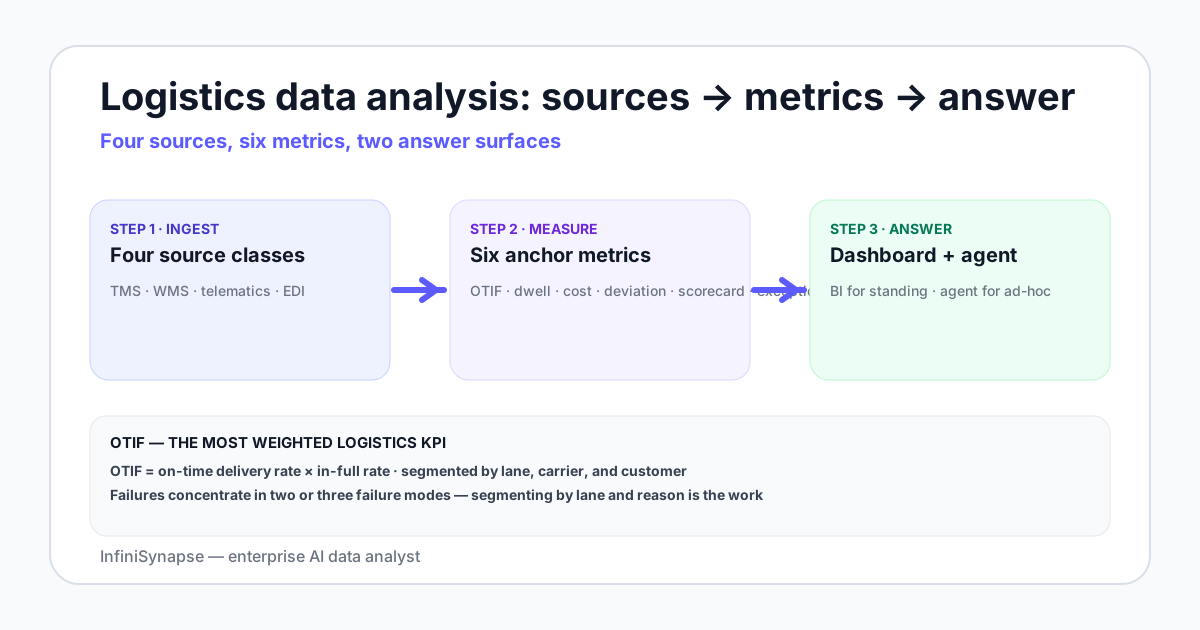
- Logistics analytics software joins TMS, WMS, telematics, and EDI — a TMS dashboard is not a logistics data platform. Use it when OTIF, dwell, and spend questions need one grain.
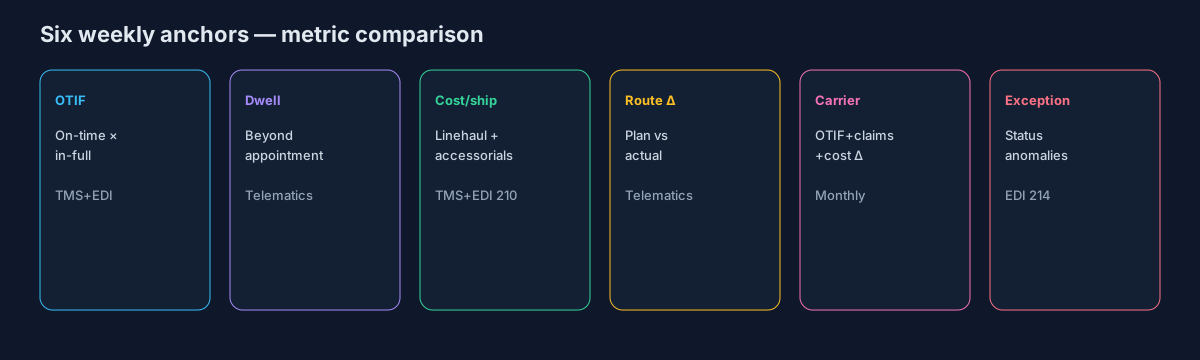
- Six metrics anchor most weekly work: OTIF (on-time, in-full), dwell time, cost per shipment, route deviation, carrier scorecard, and exception rate.
- OTIF decomposes into on-time delivery rate × in-full rate; the failures concentrate by lane, carrier, and shipper-of-record — segmenting the failure mode is the analytical work.
- Tooling runs from TMS-native dashboards to a warehouse plus BI plus dbt, with AI data agents now handling ad-hoc anomaly investigation on top.
- AI agents help with three recurring patterns: dwell-time spike triage, carrier scorecard root cause analysis, and what-if questions across lanes and carriers.
TMS reports vs logistics analytics software vs a data platform
Searchers asking for logistics analytics software usually already have a TMS. The buying question is whether native reports are enough, or whether you need a joined grain for OTIF and transportation spend.
| Layer | What it answers | What it cannot |
|---|---|---|
| TMS-native reports | Loads, tenders, in-app OTIF | WMS dwell, EDI exceptions, true spend across systems |
| Logistics analytics software | OTIF, dwell, and spend on one grain | Ingest or dispatch — you still need TMS/WMS |
| Logistics data platform | Warehouse + four sources + tested models | Replace a TMS; it is not one vendor dashboard |
Stay on rung 1 of the tool ladder when a single carrier and Excel still close the week. Graduate when the same OTIF or spend question needs TMS + WMS + EDI every Monday.
The four source classes a logistics stack pulls from
Logistics database example
A logistics database example is not a standalone “logistics DB” product. It is a warehouse table at shipment grain with keys back to four systems: TMS load/shipment IDs, WMS receipt/ship events, telematics stop events, and EDI 214/210 message IDs. Without that shared grain, every OTIF or spend debate becomes a spreadsheet war.
- Transportation Management System (TMS). Oracle TMS, Blue Yonder, MercuryGate, FreightPath, Project44 (visibility), Shipwell. Loads, shipments, lanes, carriers, costs.
- Warehouse Management System (WMS). Manhattan, SAP EWM, HighJump, Fishbowl. Inbound, outbound, putaway, picking, packing, dock-to-stock time.
- Telematics. Samsara, Geotab, Motive (formerly KeepTruckin). Vehicle GPS, dwell, harsh-braking events, idle time, driver hours.
- EDI message data. 204 (load tender), 214 (carrier status), 210 (invoice), 856 (advance ship notice), 990 (response to tender). The communication layer between shippers, carriers, and 3PLs.
The warehouse — Snowflake, BigQuery, Redshift, or Postgres data warehouse — is where these four land via ELT and are modeled together. Without that shared grain, every question becomes a cross-system query the team writes by hand, and OTIF or dwell debates turn into spreadsheet wars instead of reproducible SQL.
The six metrics that anchor most weekly work
| Metric | Definition | Primary source |
|---|---|---|
| OTIF | On-time delivery rate × in-full rate, by lane and customer | TMS + EDI 214 + EDI 210 |
| Dwell time | Time at origin or destination beyond the appointment window | Telematics + TMS appointment |
| Cost per shipment | Total cost (line haul + accessorials + fuel) per shipment, by lane | TMS + EDI 210 |
| Route deviation | Distance or time variance vs the planned route | Telematics |
| Carrier scorecard | OTIF + claims rate + cost variance + tender acceptance, monthly | TMS + WMS + EDI |
| Exception rate | Share of shipments with status code anomaly | EDI 214 + TMS |
Most weekly work is repeating these six segmentations along lane, carrier, customer, and time. The remaining work is investigating drift in any of the six.
Third-party benchmarks you can cite
Industry publications still disagree on exact OTIF formulas, which is why McKinsey’s OTIF definition paper (Trading Partner Alliance survey of 24 major North American retailers and CPG manufacturers) matters: 92% of those companies agreed an industry-standard OTIF definition would create value. Use that figure when stakeholders argue about windows and case-fill vs delivery-date grain—not as your own OTIF target.
McKinsey’s digital logistics survey (260+ shipper and provider respondents) reports that more than 85% of respondents say digital logistics projects added organizational value—yet many still cite data quality, systems integration, and change management as the payoff delays. That maps directly to why a reconciled warehouse layer sits under serious data analysis in logistics programs.
On performance lift, McKinsey’s agility research finds more agile supply chains report service levels about seven percentage points higher and inventory about 23 days lower than less agile peers (How agile is your supply chain?). For vendor landscape scans—not scorecards—see Gartner Peer Insights — Transportation Management Systems.
OTIF — the underlying decomposition
OTIF is the most weighted logistics KPI for shippers because retailers penalize it directly. The decomposition is simple but the analytical work concentrates in the failure modes:
OTIF = on-time delivery rate × in-full rate
on-time delivery rate = shipments delivered within delivery window / total shipments
in-full rate = shipments delivered with full quantity / total shipments
Two SQL examples on a typical schema:
-- On-time delivery rate by carrier, last 4 weeks
SELECT carrier_id,
       COUNT(*) AS shipments,
       SUM(CASE WHEN actual_delivery <= delivery_window_end THEN 1 ELSE 0 END) * 1.0 / COUNT(*) AS on_time_rate
FROM shipments
WHERE pickup_date >= CURRENT_DATE - INTERVAL '28 day'
GROUP BY carrier_id
ORDER BY on_time_rate DESC;
-- In-full failure top causes, last 4 weeks
SELECT failure_reason, COUNT(*) AS occurrences
FROM shipment_exceptions
WHERE exception_type = 'short_shipment'
AND pickup_date >= CURRENT_DATE - INTERVAL '28 day'
GROUP BY failure_reason
ORDER BY occurrences DESC
LIMIT 10;The analytical pattern is the same across logistics metrics: a top-line rate, a segmentation by carrier or lane, and a drill into failure reasons. See the PostgreSQL data analysis tools guide for the dialect-specific syntax on date arithmetic.
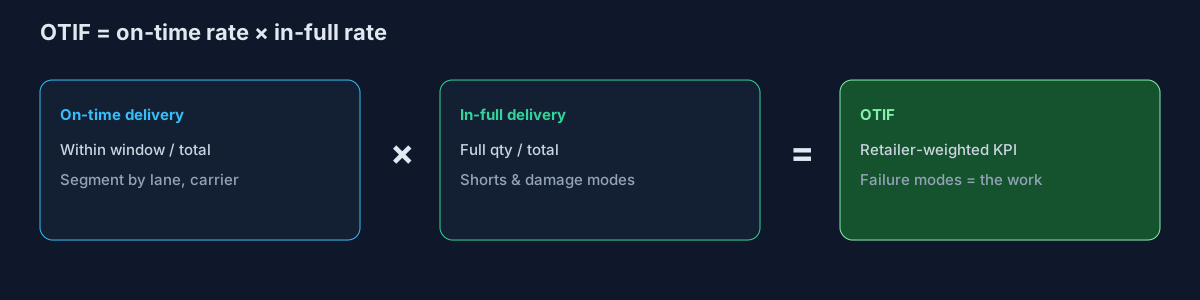
McKinsey’s consumer-sector OTIF work is the right external anchor when retail chargebacks disagree with your TMS grain. Internally, keep the product of on-time × in-full, then segment failures—the analytical work does not stop at the top-line rate.
Core definitions
OTIF. On-time, in-full — on-time delivery rate × in-full rate, usually by lane and customer.
Dwell time. Time at origin or destination beyond the appointment window (telematics + TMS appointments).
Carrier scorecard. Monthly blend of OTIF, claims rate, cost variance, and tender acceptance.
Exception rate. Share of shipments with a status-code anomaly (EDI 214 + TMS).
Desk evidence (n=14) and anonymized case
Label: InfiniSynapse first-party data — Source: InfiniSynapse 2025–2026 Logistics Analytics Desk Composite (n=14) from anonymized 3PL and shipper dwell/OTIF triage reviews. Not a paid market survey. Principles: editorial standards.
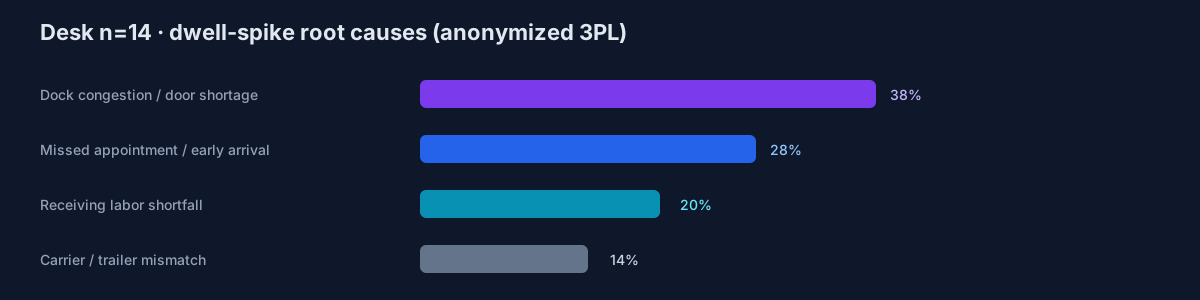
| Desk finding | Share / result | Implication |
|---|---|---|
| Dwell spikes with dock congestion / door shortage as top cause | 38% of spike weeks | WMS door utilization + labor join before blaming carriers |
| Missed appointment / early arrival | 28% | TMS appointment discipline beats telematics-only alerts |
| Receiving labor shortfall | 20% | Ops staffing is a data join, not a telematics bug |
| Median time-to-ranked-cause with written join playbook | ~45 min vs ~4.5 h ad-hoc | Playbooks beat hero SQL |
Anonymized case (Peer 3PL A): A regional 3PL saw Wednesday dwell at one DC jump ~2.1× vs the prior four-week median. The team joined telematics arrival stamps to TMS appointments and WMS unload events. Ranked causes showed two doors offline for maintenance plus a receiving crew short two heads on first shift—not a carrier-quality collapse. Renegotiation was deferred; door maintenance and labor coverage fixed the spike within two weeks. Composite pattern, not a named customer endorsement.
Quotable desk assertion: in this n=14 set, a written four-source join playbook cut median dwell-spike investigation from ~4.5 hours to ~45 minutes. Re-measure on your tickets before citing internally. Teams that treat data analysis in logistics as a join problem—not a single-dashboard problem—see the same pattern.
Lineage on a one-lane dock-to-dock pilot
A one-lane data analysis in logistics packet is a different object than the network scorecard above: the decision is whether planners trust a reroute this shift, not whether to buy a platform. Illustrative desk pattern (not a named customer): one-region dock-to-dock latency that joined TMS, WMS, and carrier status APIs. The first win was assembling context in minutes instead of hunting portals.
Drivers and planners adopted the workflow when recommendations separated facts from suggestions. The agent listed delayed loads and probable causes; humans chose reroutes. Log override reasons—bad geocodes, manual appointment changes—and feed them back into the next run. Measure mean time to situational awareness, not alert count. Roll out on one lane or hub before network-wide automation.
Do not auto-dispatch a reroute without a named planner. Inventory and lead-time loops stay on AI data analysis for supply chain. This is the unique slice kept from the retired /en/blog/ai-data-analysis-logistics synonym URL (301 here as of 2026-09-20).
HowTo: triage an anomaly in one shift
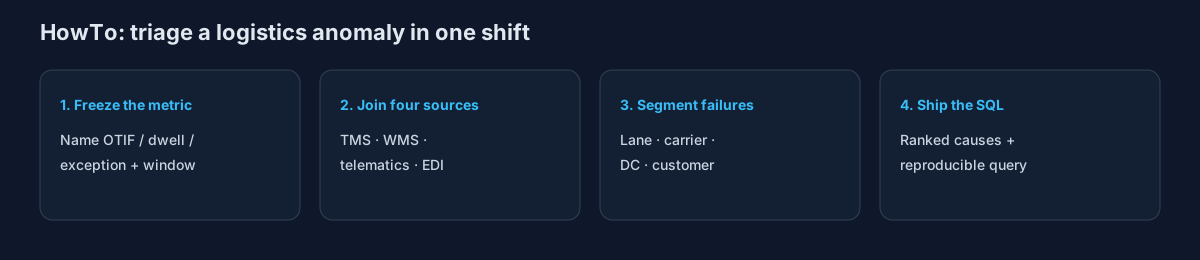
- Freeze the metric. Name OTIF, dwell, or exception rate and the exact window.
- Join four sources. TMS, WMS, telematics, and EDI on one shipment grain.
- Segment failures. Lane, carrier, DC, customer—find concentration.
- Ship the SQL. Ranked causes plus the reproducible query for ops.
Three weekly questions and how the answer comes together
1. "Why did dwell time spike at the Atlanta DC on Wednesday?"
The dashboard shows the spike. The analyst joins telematics (when trucks arrived) to TMS appointments (when they were scheduled) to WMS receiving events (when actually unloaded). The driver of the spike is usually one of: missed appointment, dock-door congestion, labor shortfall on receiving. The output is a ranked list of candidate causes with the underlying SQL.
2. "Which carriers are getting worse this quarter?"
Carrier scorecard, last 90 days vs prior 90 days, delta on OTIF, claims rate, cost variance, tender acceptance. The carriers with the biggest negative delta on two or more dimensions are the ones to renegotiate or remove.
3. "What is the cost-to-serve for our top 10 customers?"
Cost per shipment × shipments per period × customer, plus accessorial charges allocated by customer. Combined with revenue per customer and gross margin, this surfaces customers where the freight cost exceeds the contribution.
Tool ladder for logistics analytics
This ladder is the practical answer to “do we need logistics analytics software?” — not a vendor scorecard.
| Rung | Stack | When you stay | When you graduate |
|---|---|---|---|
| 1 | TMS-native dashboards + Excel | Small fleet, single carrier | Cross-system questions become weekly |
| 2 | Warehouse + ELT (TMS + WMS) + BI | 3PL or shipper with 3–10 carriers and dozens of lanes | Ad-hoc questions outpace dashboard build |
| 3 | Stack 2 + telematics + EDI integration + dbt | Enterprise shipper, 20+ carriers, regulated retail customers | Operations managers need on-demand answers without analyst tickets |
| 4 | Stack 3 + AI data agent | Open-ended questions on cost-to-serve, lane mix, carrier risk | — |
Where AI data agents earn the seat in logistics analytics
Modern data analysis in logistics still depends on standing dashboards for the recurring 80%. Agents earn the seat on the ad-hoc 20%—the cross-system joins that used to wait in a BI queue while a dock or retailer chargeback burned cash. Three patterns where an AI data analyst changes the workflow:
- Dwell-time spike triage. When dwell spikes at a DC, the agent decomposes by dock door, shift, carrier, appointment vs walk-in, and returns the candidates with the SQL it ran. 20 minutes instead of half a day.
- Carrier scorecard deep dive. A scorecard panel shows a carrier slipping. The agent joins TMS + EDI + telematics, returns the lane-level breakdown, and identifies whether the slip is concentrated in two lanes or general. This is the input to the next negotiation.
- Cost-to-serve and customer questions. Letting the operations analyst translate questions into BI tickets. The "I just need to check one thing" question pile is the highest-yield place to add an AI data agent — the alternative is a five-day BI ticket cycle.
The pattern is the same as other domains: dashboards answer the standing 80%, the agent answers the ad-hoc 20%. See AI database query for the connection setup and database + knowledge base binding for why a bound business glossary matters in logistics where carrier and lane definitions vary by customer.
Product recommendation (commercial)
Ask an open-ended logistics question across your warehouse
Connect Snowflake, BigQuery, Postgres, or another warehouse where your TMS, WMS, telematics, and EDI feeds land. Seed a small business glossary — what counts as an exception, which appointment window applies. Then ask one question the dashboard does not answer.
Try InfiniSynapse onlineFAQ
Methodology and review notes
Reporting by: William Zhu (cofounder; desk experience with 3PL/shipper analytics stacks). Last updated: 2026-09-20 · Next scheduled review: 2026-12-20 · Marker DESK-DAL-20260807A.
This methods guide synthesizes TMS and WMS vendor documentation, telematics references from Samsara and Geotab, DCSA standards, MIT CTL research, public logistics studies including McKinsey OTIF and digital logistics publications, Gartner Peer Insights for TMS, and InfiniSynapse desk composites (n=14). The six-metric anchor, OTIF decomposition, and tool ladder reflect observed practice across operating logistics data teams.
Conflict of interest: InfiniSynapse publishes this guide and sells an enterprise AI data analyst. The page leads with methods, treats InfiniSynapse as one option among many, labels the product CTA commercial, and links external sources for third-party numeric claims. Desk percentages are first-party only.
Update cadence: Reviewed every 90 days for accuracy and link health. Corrections: zhuhl@infinisynapse.com · editorial corrections.
Sources and references
- [Independent] McKinsey. Defining ‘on-time, in-full’ in the consumer sector (TPA survey; 92% support standard OTIF). mckinsey.com/.../defining-on-time-in-full-in-the-consumer-sector. Accessed 2026-08-07.
- [Independent] McKinsey. Digital logistics: Into the express lane? (260+ respondents; >85% report digital value). mckinsey.com/.../digital-logistics-into-the-express-lane. Accessed 2026-08-07.
- [Independent] McKinsey. How agile is your supply chain? (~7pp service / ~23 days inventory). mckinsey.com/.../how-agile-is-your-supply-chain. Accessed 2026-08-07.
- [Independent] Gartner Peer Insights. Transportation Management Systems. gartner.com/reviews/market/transportation-management-systems. Accessed 2026-08-07.
- [Vendor] Samsara. Fleet telematics documentation. samsara.com/products.
- [Vendor] Geotab. Telematics reference. geotab.com.
- [Vendor] Project44. Visibility platform documentation. project44.com.
- [Standard] DCSA. EDI standards reference. dcsa.org.
- [Independent] MIT Center for Transportation and Logistics. Research portal. ctl.mit.edu.
- [Independent] Yao et al. ReAct: Synergizing Reasoning and Acting in Language Models. arxiv.org/abs/2210.03629.
- [Vendor] Anthropic. Building Effective Agents. anthropic.com/research/building-effective-agents.
- [Standard] NIST. AI Risk Management Framework. nist.gov/itl/ai-risk-management-framework.
- [Independent] BIRD-SQL benchmark. bird-bench.github.io.
- [Publisher] InfiniSynapse. Editorial standards. infinisynapse.com/en/editorial-standards.