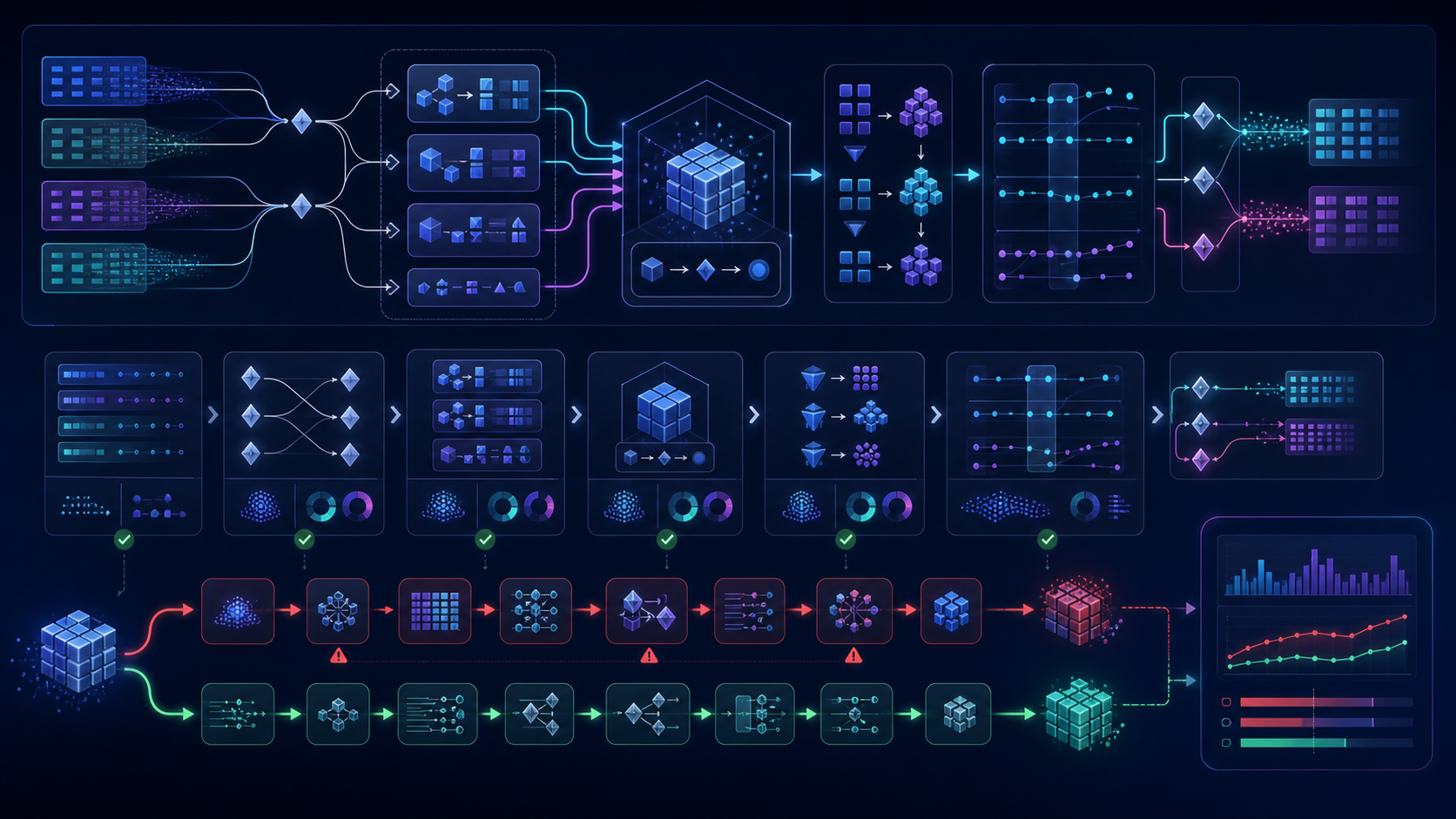
What makes a SQL query complex?
A complex SQL query combines several interacting transformations whose grain, cardinality, predicates, ordering, and business rules must remain consistent from source to final output. Complexity is not line count. A short correlated expression can be harder to reason about than a long sequence of named stages with explicit contracts.
The safest starting point is an output contract: one sentence defining one row, required columns, population, time semantics, duplicate policy, and acceptance tests. Then build small relational stages and validate each grain transition. Optimize only after the result is correct and the actual execution mechanism is known.
Write the grain before writing the SELECT list
Examples of precise grain are “one row per tenant and invoice,” “one row per account per UTC calendar month,” or “one row per session containing its first qualifying conversion.” Include the key expected to be unique. If the key cannot be stated, reviewers cannot tell whether a join duplicates rows or an aggregate collapses distinct facts.
The contract also defines exclusions, late-arriving data, effective dates, timezone, currency conversion, null policy, and whether the result is point-in-time reproducible. Store this context beside the query. SQL alone rarely communicates all assumptions required to interpret a business metric.
Decompose the query into relational responsibilities
A useful architecture separates source normalization, population filtering, key selection, deduplication, joins, aggregation, window analysis, and final presentation. A stage should perform one meaningful grain transition or policy decision. Names such as eligible_accounts, invoice_totals, and ranked_events communicate more than cte1.
WITH eligible_accounts AS (...),
invoice_totals AS (
  SELECT tenant_id, account_id, month_start,
         SUM(amount) AS revenue
  FROM normalized_invoices
  GROUP BY tenant_id, account_id, month_start
),
compared AS (
  SELECT i.*,
    LAG(revenue) OVER (
      PARTITION BY tenant_id, account_id
      ORDER BY month_start
    ) AS prior_revenue
  FROM invoice_totals i
)
SELECT * FROM compared;
CTEs improve reviewability but are not automatic optimization barriers or performance improvements. Database behavior varies. Use named stages to express intent, then inspect whether the engine inlines, materializes, repeats, or reorders them.
Control fan-out before adding more logic
Most serious errors in complex SQL begin with an unexamined join. For every join, state the expected relationship: one-to-one, many-to-one, one-to-many, or many-to-many. Verify key uniqueness on both sides using the actual filtered populations. A declared constraint may not cover effective dates, tenant keys, or snapshots used by the query.
When the final query sums revenue after a many-to-many join, duplication can produce plausible but inflated totals. Pre-aggregate the many side to the required key or choose one row with a documented deterministic rule before joining. Measure row counts before and after each join, plus unmatched keys in both directions.
Place predicates where their meaning is preserved
A predicate in WHERE, a join condition, an aggregate HAVING, or a post-window filter answers a different question. Moving a right-table predicate from an outer join's ON clause to WHERE can eliminate unmatched left rows. Filtering detail before aggregation differs from filtering groups after aggregation.
Classify each predicate as population, relationship, measurement, qualification, or presentation. Write a plain-language sentence for it. Pushdown can reduce work, but only when it does not change outer-join preservation, window population, or aggregate inputs. Confirm both semantics and the actual plan.
Aggregate at one declared grain per stage
Mixing invoice-line, invoice, account-month, and account-lifetime measures in one SELECT makes accidental double counting hard to see. Create one stage for each aggregation level, declare its key, and join only after dimensions are compatible. Distinguish COUNT(*), COUNT(column), and COUNT(DISTINCT key); each answers a different question.
Distinct is not a general repair for duplicates. It can conceal an incorrect join while dropping legitimate repeated facts. Find the mechanism, decide the intended grain, and resolve duplication at the earliest stage where the business rule is known.
Protect partitions, order, and frame semantics
Window functions preserve rows while calculating across related rows. Their risk comes from hidden sequence assumptions. State the partition entity, provide deterministic ordering when peers matter, and specify the frame when cumulative or moving calculations depend on it. The default frame can include peers or stop at the current ordering value in ways reviewers do not expect.
Calculate reusable windows in one named stage. Preserve raw values, ordering keys, and derived outputs for reconciliation. Check sort costs, partition skew, spills, and whether slightly different window specifications force repeated work.
Choose nested shapes by contract, not habit
Scalar subqueries require at most one row. Set subqueries interact with NULL through three-valued logic. Correlated subqueries can express existence elegantly but may also trigger repeated work. Derived tables can isolate a transformation yet hide grain if aliases are vague. Label the expected shape and validate its cardinality.
Use EXISTS when the question is whether any match exists. Prefer NOT EXISTS over nullable NOT IN for anti-existence. Refactor repeated lookups or deep nesting when it improves clarity or removes a measured bottleneck, then prove equivalence.
Build a monthly revenue and retention query safely
Assume the output is one row per tenant, account, and UTC month. Normalize invoice timestamps and currency first. Aggregate paid invoice lines to invoice, then account-month, so later joins cannot multiply revenue. Create an account-month spine if zero-activity months must remain visible. Join eligible accounts using the complete tenant-account key.
Apply LAG over each account to obtain prior-month revenue, but only after the continuous month spine exists. Derive retention status from current and prior values with explicit rules for new, retained, expanded, contracted, and churned. Finally join descriptive dimensions that are unique for the report's effective date.
At each stage, assert unique keys and reconcile revenue totals to a trusted ledger population. This design may be longer than one nested statement, but every grain change and business decision is inspectable.
Test invariants and adversarial data before performance
- Assert uniqueness at every declared stage grain.
- Record row counts and unmatched keys before and after joins.
- Test duplicate dimension rows and many-to-many relationships.
- Test NULL keys, NULL measures, zero denominators, and empty populations.
- Test date boundaries, timezone changes, late data, and effective-date overlaps.
- Preserve intermediate reconciliation columns during review.
- Compare old and new outputs in both difference directions.
- Validate representative large and skewed entities, not only averages.
Read the actual plan as evidence of work
Inspect actual versus estimated rows, join algorithms, scan and seek patterns, sorts, hashes, spills, exchanges, memory grants, repeated operators, and predicate placement. Large estimate errors often explain unsuitable join choices or memory behavior. Identify the operator that dominates elapsed time or resource use and trace the data mechanism feeding it.
An index recommendation is a hypothesis, not a verdict. Evaluate key order, selectivity, included columns, write amplification, storage, maintenance, and whether a structural rewrite reduces more work. Re-test with representative parameters, warm and cold considerations, and concurrency where relevant.
Change one mechanism and preserve the contract
Useful interventions include pre-aggregating before a join, replacing repeated scalar lookups with one set-based relation, separating independent window specifications, reducing width before a sort, eliminating redundant distinct operations, or materializing a genuinely reused expensive stage. Tie each change to plan evidence.
Use one controlled change at a time when possible. Re-run equivalence checks first, then benchmark repeated executions with identical data and parameter sets. Report median and tail behavior, resource changes, affected workloads, and remaining limitations. A faster result that changes population or duplicates money is not an optimization.
Diagnose doubled revenue after a feature join
Suppose a monthly report adds product tags and revenue doubles for some accounts. The account-month fact is joined to multiple tag rows before the final SUM. Compare row counts at the account-month grain, count tags per product, and preserve invoice identifiers through a diagnostic version. The many-to-many fan-out becomes visible.
The fix depends on intent. If tags are filters, use EXISTS. If one category is required, define a deterministic category rule. If revenue must be allocated across tags, define an allocation model whose weights reconcile to one. Do not add DISTINCT to the final projection; it cannot reliably repair multiplied measures.
Inspect the full complex SQL statement
Paste a sanitized complete query into the InfiniSynapse SQL Complexity Checker to review joins, CTEs, nested layers, aggregates, windows, filters, and repeated structures together. Use its structural review to focus human analysis, then verify meaning and runtime with your database's actual plan.
Open SQL Complexity CheckerRemove credentials, secrets, personal data, and sensitive literals.Complex SQL queries frequently asked questions
Interacting grains, joins, predicates, aggregation, windows, nested logic, and business rules create complexity.
Define the output grain, population, keys, time semantics, and acceptance tests first.
They can improve clarity, but performance depends on the database and actual plan.
Compare bidirectional differences, duplicates, NULLs, aggregates, invariants, and edge cases.
Actual rows, estimate errors, joins, access paths, sorts, spills, memory, and repeated work.
Official SQL design and plan references
Package the query with reproducible evidence
A production-ready complex query should ship with its output contract, representative fixtures, invariant checks, reconciliation totals, plan capture, benchmark conditions, and known limitations. Record the database version, statistics state, parameter set, data volume, concurrency assumptions, and observed median and tail runtime. This makes later regressions diagnosable rather than anecdotal.
Assign ownership for the business rule and the operational query separately when appropriate. A correct formula can fail because of stale inputs, changed constraints, or plan regression. Monitoring should cover data freshness, key uniqueness, row-count ranges, reconciliation drift, latency, spills, and failure rate so meaning and operation remain observable together.