Base44 AI App Builder: Prototype, Then API
By the InfiniSynapse Data Team — data platform, analytics engineering, and editor review frames. Named accountability: cofounder William Zhu (GitHub @allwefantasy). · Published: 2026-06-24 · Last updated: 2026-09-27 · Next review: 2026-10-29 · Editorial standards & About
Disclosure: InfiniSynapse is our product; it appears only where a data-agent backend is genuinely relevant. Independent signals (not our scores): OWASP API Security Top 10 · OWASP Top 10 for LLM Applications · OAuth 2.0 · Base44. Corrections: zhuhl@infinisynapse.com · corrections policy.
Table of Contents
- TL;DR
- Key Definition
- What the Prototype Still Does Not Settle
- Case Study: Rent-vs-Commute Analyzer
- Why This Matters for Vibe-Coded Products
- The Five-Layer Integration Framework
- Comparison and Options
- Implementation Workflow
- Where InfiniSynapse Fits
- Launch Readiness Scorecard
- Failure Modes
- Operating Model for Small Teams
- Buyer Questions Before You Commit
- FAQ
- References
- Conclusion
TL;DR
Direct answer: A Base44 AI app builder turns a plain-language prompt into a web app with a UI, stored data, and sign-in (Base44). That prototype is not a production API. Wire auth, schema validation, and async jobs before customer data, payments, or long jobs go live.
Who this is for: founders and builders shipping with AI app builders who now need dependable integrations. What you'll learn: what the generated app still does not settle, a five-layer framework, a comparison table, rollout steps, a launch scorecard, and where a data-agent backend actually helps.
For pillar context see Vibe Coding Tools.
Key Definition
Key definition: A Base44 AI app builder is a prompt-based app generator. You describe the product, and Base44 produces the interface, stored data, and login flow. A production API layer is the next step: it connects that UI to external systems—APIs, databases, payment rails, and agent runtimes—with governance for real users, not demo traffic.
Confirm current pricing, credit rules, export scope, and compliance claims on Base44. Those details change, and secondary write-ups disagree. Treat the vendor pages as the source for plan names and certifications.
What the Prototype Still Does Not Settle
The generated app can look finished while secrets, webhooks, and long-running jobs are still unset:
- Secrets. Vendor keys stay off the browser and out of the repo.
- Webhooks and OAuth. The first payment event or redirect is where demos usually break.
- Export. Confirm on Base44 what leaves with you. Do not assume the backend and database export with the UI.
- Long jobs. Work that can run for minutes needs a job id and progress, not a blocked request.
This page does not rank Base44 against other builders and does not publish a universal score.
Case Study: Rent-vs-Commute Analyzer
This is the usual story shape: a polished Base44 form shipped over a weekend—users entered budget, office location, and max commute time; the UI promised a PDF neighborhood report. Behind the scenes, nothing called geocoding, transit data, or document generation yet.
The fix was not more prompts—it was a backend proxy plus a data-agent API: SSE progress, a single newTask with structured instructions, workspace download for the PDF. The UI stayed unchanged; the integration layer became real.
Composite desk walkthrough (InfiniSynapse builders recreating this path on a sandbox schema—not a named customer logo, not a paid case study):
| Metric | Before (UI-only weekend build) | After (proxy + async agent layer) |
|---|---|---|
| Time to first successful end-to-end PDF | Never completed (no real connectors) | 3 calendar days after UI was "done" |
| Blocking HTTP calls longer than 30s | 100% of report attempts hung or timed out | 0 — request returns job_id in <200 ms; work continues on SSE |
| Schema / contract failures caught in week-1 CI | Not tested | 3 vendor payload drifts caught before beta |
| Distinct copies of the same API key across envs | 4 (laptop, CI, hosting panel, demo video notes) | 1 secret-manager path |
Reproduce the metrics: (1) ship a Base44-style form with a fake "Generate PDF" button; (2) add a proxy that never blocks >5s; (3) run three contract tests against geocoding/transit/PDF stubs; (4) log p95 for job_id return and PDF completion. Gap stated honestly: these numbers are from our recreation of a common failure mode, not an anonymized ARR claim.
Why This Matters for Vibe-Coded Products
The gap shows up after the prototype, not inside the first prompt.
The prototype-to-product cliff. Most builders discover the gap after the first Stripe webhook, OAuth redirect, or six-minute job—not during the initial Base44 or Cursor session. Every builder helps you prototype fast; the bottleneck is secure data access, external systems, and agent actions.
What breaks first in production:
| Signal | Demo behavior | Production expectation |
|---|---|---|
| Auth | Key in .env.local | Secret manager + scoped tokens |
| Latency | Blocking UI thread | Async jobs + progress UI |
| Errors | Console log | Structured codes + alerts |
| Data | Mock JSON | Validated vendor schemas |
| Agents | Single prompt | Tool calling + audit trail |
Compare integration patterns in Best Vibe Coding Tools for Builders Who Will Eventually Need APIs.
The Five-Layer Integration Framework
The framework below turns that handoff into a mature integration stack you can implement incrementally, one layer at a time. It is not a proprietary standard—it maps builder practice onto widely used controls: Layer 3 to OAuth 2.0 and Stripe webhooks signing/idempotency; Layer 5 to OWASP API Security Top 10 and, for agent tool calls, OWASP Top 10 for LLM Applications (especially LLM01 / LLM06).
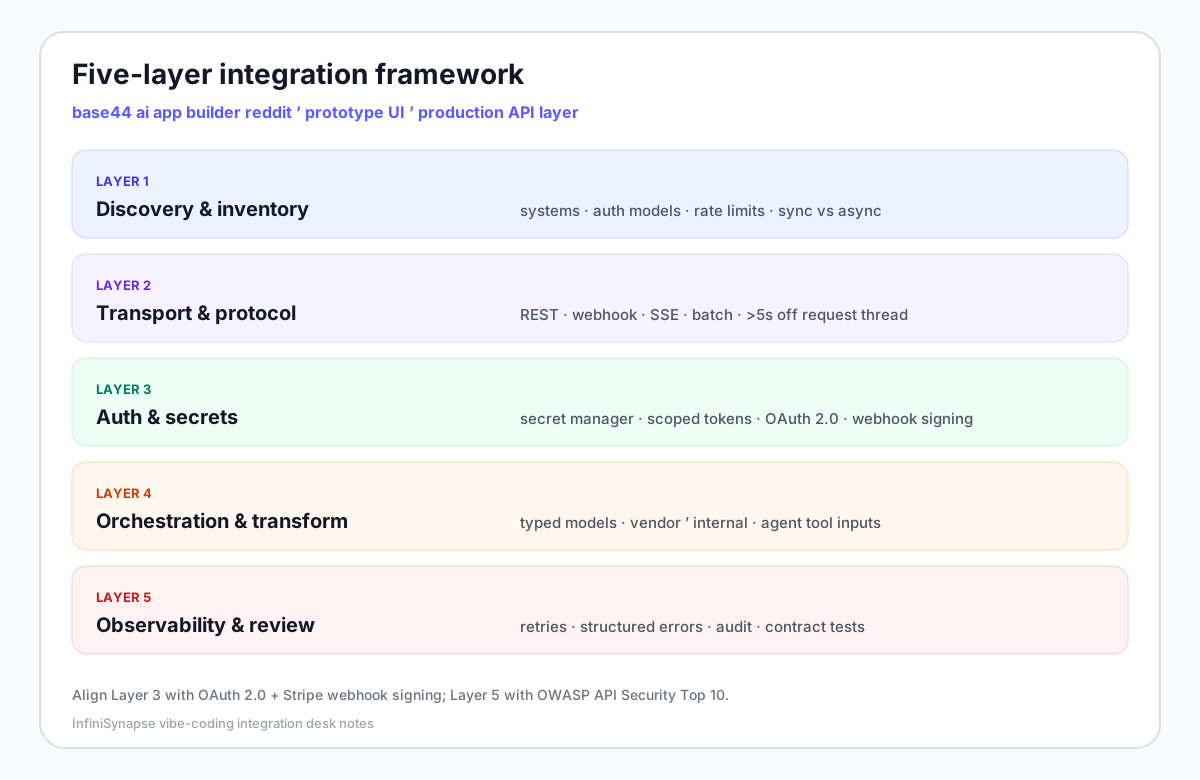
Layer 1 — Discovery and inventory. List every external system, its auth model, rate limits, and expected latency. Separate synchronous UI calls from async data work on day one.
Layer 2 — Transport and protocol. Classify each dependency as REST, webhook, SSE, or batch. Anything over ~5 seconds belongs off the request thread.
Layer 3 — Auth and secret management. Keep secrets off the client; use a secret manager and scoped tokens. Score auth hygiene before comparing feature checklists. For webhook signing and idempotency, follow the provider's spec (e.g., Stripe webhooks); for delegated access, follow the OAuth 2.0 framework.
Layer 4 — Orchestration and transformation. Map vendor payloads to typed internal models before they reach UI components or agent prompts.
Layer 5 — Observability and review. Integration fails in production when builders treat it as a single fetch() instead of a managed layer with retries, structured errors, and audit trails.
Comparison and Options
Teams moving past a Base44 prototype usually choose among four backend patterns:
| Pattern | Best for | Limit at scale |
|---|---|---|
| Hand-rolled clients | Unique APIs | Retry/observability debt |
| iPaaS (Zapier/Make) | Simple triggers | Complex auth + long jobs |
| API gateway | Multi-service teams | Ops overhead for solo builders |
| Data-agent backend | Analysis + files + PDFs | Requires proxy discipline |
See also What Is a Data API when the shortlist starts asking about contracts and auth.
Implementation Workflow
Roll out your API layer in this order to avoid rebuilding after the first outage:
Step 1 — Inventory. Every external system, its auth model, rate limits, and expected latency.
Step 2 — Classify sync vs async. Long-running analysis, file generation, and multi-step agent work should return progress, not block the UI.
Step 3 — Proxy and secrets. Never expose vendor keys in the browser. Route calls through your backend with structured error shapes.
Step 4 — Contract tests. Validate schemas on every boundary; treat drift as a hard failure with alerts.
Step 5 — Production monitoring. Log provider, endpoint, status, and latency per call before you invite beta users. For LLM-driven tool calls, review the OWASP Top 10 for LLM Applications and general OWASP API Security risks.
Where InfiniSynapse Fits
Disclosure: this is our product—use it only if a data-agent backend matches your need, and ignore it otherwise; not every Base44 stack needs one. InfiniSynapse targets vibe-coded products that need analysis, files, and long jobs behind a thin UI:
- Server API: SSE progress,
newTask, workspace artifact download - InfiniSQL + InfiniRAG: federated queries and business definitions bound to sources
- Multi-entry parity: web app, API, and CLI (
agent_infini) share one task timeline
It is one option among iPaaS, gateways, and workflow engines—pick by workload, not brand. For hands-on patterns, read Vibe Coding Tools and DeepSeek Vibe Coding.
Launch Readiness Scorecard
Use this before you trust any success-story screenshot on your own launch.
Rate your API-layer readiness before public launch (1 point each)—a faster gut-check than scrolling thread anecdotes:
| Check | Pass? |
|---|---|
| Secrets not in git | |
| Async routing for long jobs | |
| Schema validation on responses | |
| Retries with backoff on outbound calls | |
| Structured logging per external provider | |
| Contract or integration tests in CI | |
| User-safe error messages (no raw vendor dumps) | |
| Rate-limit handling tested |
8+: production-ready for beta. 5–7: closed pilot only. Below 5: still demo stage. That is the usual verdict after the first outage.
Failure Modes
Recurring complaints map to one of these four.
Failure 1 — Synchronous everything. Blocking the UI on calls that exceed serverless timeouts is the most common vibe-coding regression. Fix: async jobs + progress UI.
Failure 2 — Key sprawl. Copies of the same API key across laptops, CI, and hosting panels make rotation impossible. Fix: one secret manager, scoped tokens.
Failure 3 — Untested auth failures. Expired tokens and revoked scopes surface in production, not demos. Fix: test the 401/403 paths and refresh flow explicitly.
Failure 4 — Building infra instead of product. Custom task queues and sandboxes consume weeks a workflow engine or data-agent API could absorb. Fix: buy the boring parts.
Operating Model for Small Teams
Who owns integrations. Assign one integration owner—even solo—to maintain the API registry, rotate keys, and approve new vendors. Without ownership, repos accumulate duplicate clients and conflicting error handling.
Weekly integration review. Thirty minutes: new endpoints added, failed contract tests, p95 latency spikes, vendor changelog emails. This cadence prevents month-two drift.
Documentation minimum. Each dependency gets a one-page note: auth method, rate limits, sandbox vs production URLs, example success payload, and on-call runbook link.
Security baseline. No vendor secrets in front-end bundles or demo videos; least-privilege OAuth scopes; validate agent tool inputs server-side and cap outbound destinations—prompt injection targets integration layers first.
Buyer Questions Before You Commit
| Question | Pass answer |
|---|---|
| Can we rotate keys without redeploying the UI? | Yes, via secret manager |
| Do we have contract tests in CI? | Yes, per vendor |
| Are long jobs async with user-visible progress? | Yes |
| Can we trace which provider failed? | Yes, structured logs |
| Is there an approval gate for risky actions? | Yes, for payments and writes |
Frequently Asked Questions
What is a Base44 AI app builder?
A Base44 AI app builder turns a plain-language prompt into a web app with an interface, stored data, and sign-in. The prototype is not a production API. Add auth, retries, schema validation, and observability before customer data, payments, or long jobs go live. Confirm pricing, export scope, and compliance on Base44's own pages.
When should you add a real API layer?
The moment a prototype touches customer data, payments, or long-running jobs. Before that, a thin proxy and environment-scoped keys may be enough.
How does InfiniSynapse fit this workflow?
For data-heavy Base44 apps, its Server API handles data-agent workloads—SSE tasks, workspace downloads, federated queries—so heavy analysis routes to managed infrastructure instead of stretching serverless timeouts. It is one backend option, not a requirement.
What is the first improvement step?
Inventory external dependencies, classify sync vs async calls, and move API keys into a secret store before adding features. Most incidents trace back to skipping that sequence.
How long does a typical rollout take?
A focused pilot—one workflow, contract tests, structured logging—typically takes one to two weeks for a small team. Full production hardening adds review gates and monitoring.
One more pattern worth naming: treat thread advice as directional, then verify each claim against your own vendor SLAs, contract tests, and status pages before a release. Most month-two outage stories trace back to skipping that verification, not to Base44 itself.
References
- [Vendor] Base44. Product and integrations. base44.com
- [Vendor] Stripe. Webhooks. docs.stripe.com/webhooks
- [Standard] OAuth. OAuth 2.0. oauth.net/2
- [Standard] OWASP. API Security Top 10. owasp.org/www-project-api-security
- [Standard] OWASP. Top 10 for LLM Applications. owasp.org
- [Policy / About] InfiniSynapse. Editorial standards & author credentials. infinisynapse.com/en/editorial-standards
Conclusion
A real API layer is how vibe-coded products earn trust after the UI demo ends. Once you filter the hype, the consensus is a sequence: secrets first, async second, validation third, observability fourth—then route data-heavy work to the right backend.
Explore the pillar hub at Vibe Coding Tools and ship the next integration deliberately.