Api Integration Platforms Reddit: System Not Connectors
By William Zhu & the InfiniSynapse Data Team · Published: 2026-07-06 · Last updated: 2026-08-07 · Last verified: 2026-08-07 · About: Editorial standards · About / team
Author credentials: William Zhu is cofounder of InfiniSynapse (GitHub @allwefantasy). Desk experience: wrapping Stripe/CRM/warehouse connectors into a typed registry, enforcing vault-backed keys, and reviewing webhook idempotency failures that show up in builder threads on r/vibecoding, r/SaaS, r/dataengineering, and r/iPaaS—not as a sponsored iPaaS affiliate. No personal LinkedIn is published; GitHub and InfiniSynapse About are the canonical identity signals.
COI / interest disclosure: InfiniSynapse sells an AI-native Data Agent platform used when long-running analysis sits behind an integration registry. Product mentions appear only in the labeled InfiniSynapse Connection section (vendor-scoped). Connector scorecards, rollout HowTo, and the billing-sync desk case stand independently of any InfiniSynapse trial.
Fact-check / verification: Desk metrics below (one internal vibe-coded SaaS billing sync rebuild; observation window 2026-03-01 → 2026-05-30, n=5 production connectors) are independence-labeled desk composites—not a Reddit Inc. survey and not a third-party audited customer logo study. Framework anchors: OWASP API Security Top 10 · NIST Cybersecurity Framework · Google SRE book · Stripe idempotency docs · OWASP Top 10 for LLM Applications. Corrections: zhuhl@infinisynapse.com · editorial corrections.
Version history: 2026-07-06 initial · 2026-08-07 EEAT (William Zhu / COI / About), dens retune to 1.1–1.2%,
datePublished+ BreadcrumbList + HowTo (rollout) + ItemList (scorecard), case methodology module. Build marker:DESK-AIP-20260807A.
Media note: No hosted overview video is published for this page (no
VideoObject). Use the hero diagram and rollout flowchart below as multimedia substitutes.
 Connectors get you to vendor one; a registry, vault, and idempotency layer get you past vendor five.
Table of Contents
- TL;DR
- Key Definition
- Connectors vs Integration Platform
- Platform Types Compared
- When to Graduate from Connectors
- Secret and Environment Discipline
- Mini Platform Architecture
- Connector Registry Pattern
- Governance and Observability
- Readiness Scorecard
- Rollout Workflow
- Failure Modes
- InfiniSynapse Connection
- Buyer Evaluation Questions
- Hybrid Rollout Pattern
- Operating Model
- Webhook Idempotency Pattern
- Contract Test Example
- Migration from Connector Sprawl
- Agent and LLM Boundaries
- Cost Triggers for Enterprise iPaaS
- Case Study
- FAQ
- Conclusion
TL;DR
Direct answer: For api integration platforms reddit threads, you need a platform—not scattered connectors—when vendor count, webhook idempotency, and audit requirements exceed what ad hoc zaps and copy-paste clients can govern.
If you have spent time in r/vibecoding, r/SaaS, r/dataengineering, and r/iPaaS, you have seen these arguments. Here is what held up when teams outgrew connectors—not the "buy enterprise ESB day one" hype.
- Connectors = one-off clients or zaps per vendor.
- Platform system = registry, auth vault, retry policy, observability, and contract tests shared across vendors.
- iPaaS can be your platform early; custom proxy layer wins when webhooks and jobs exceed platform limits.
- Graduate when three+ production vendors share the same failure modes (keys, retries, schema drift).
Who this is for: vibe-coded teams adding vendor five through fifteen. What you'll learn: platform types, architecture, registry code, scorecard, case study.
See Integration Platform vs Custom and API Integration Services.
Key Definition
Key Definition: api integration platforms reddit describes the shift from isolated API connectors to a governed integration system—central registry, credential management, standardized errors, retries, logging, and testing—whether built on iPaaS or custom infrastructure.
The phrase matters when each new Stripe, HubSpot, or warehouse connector duplicates retry logic and nobody knows which key lives where.
Integration security aligns with OWASP API Security Top 10 when platforms expose shared outbound paths to many vendors.
Connectors vs Integration Platform
| Aspect | Point connectors | Platform system |
|---|---|---|
| Auth | Per-file env vars | Central secret store + rotation |
| Errors | Inconsistent shapes | Standard { code, message, request_id } |
| Retries | Copy-paste backoff | Policy per vendor class |
| Observability | Console logs | Per-provider metrics |
| Testing | Manual | Contract tests in CI |
| Onboarding | New script per vendor | Register connector in catalog |
Reddit post-mortems cite connector sprawl at vendor four—not vendor one. That pattern is what builders mean when they search api integration platforms reddit for a system rather than another zap. Catalog ownership and shared retry policy matter more than which iPaaS logo appears on the invoice. Teams that skip the catalog usually rediscover the same timeout bug on every new vendor, then blame the model or the zap tool instead of the missing platform boundary that should have owned retries, timeouts, and standard error shapes for every outbound production call path.
Platform Types Compared
| Type | Examples | Best for | Limit |
|---|---|---|---|
| Lightweight iPaaS | Zapier, Make | Triggers, internal alerts | Webhook idempotency, long jobs |
| Enterprise iPaaS | Workato, Tray | Many SaaS, governed B2B | Cost, custom async |
| API gateway + workers | Kong + queue | Custom control | You build catalog UX |
| Event bus | Kafka, SNS/SQS | High volume events | Needs schema registry |
| Self-hosted mini platform | Node workers + Postgres registry | Webhooks + typed clients | Engineering time |
Practical advice: iPaaS as platform until webhook replay or six-minute jobs force custom workers—then hybrid, not rip-and-replace.
NIST Cybersecurity Framework applies when the platform holds credentials for multiple tenants.
When to Graduate from Connectors
Graduate to platform thinking when any three apply:
- Same bug, different vendor — missing timeout, duplicate webhook, wrong error shape.
- Key rotation pain — three+ vendors, no secret manager workflow.
- No integration owner — nobody can list active outbound dependencies.
- Customer audit — buyer asks for connector inventory and SLA evidence.
- Agent tools — LLMs call multiple APIs; need one execution boundary.
Stay on connectors longer only for solo MVPs with one payment vendor and mock data elsewhere.
Secret and Environment Discipline
Platforms treat credentials as first-class infrastructure—not .env files checked into vibe-coded repos:
| Practice | Why it matters |
|---|---|
| Vault or cloud secret manager | Rotation without redeploy |
| Per-environment connector IDs | Prevents prod keys in staging |
| Scoped tokens (read vs write) | Limits blast radius on leak |
| Audit log on secret access | Buyer security questionnaires |
When a thread asks "where do I put my Stripe key," the platform answer is always vault-backed injection at runtime—never hard-coded in the agent prompt or frontend bundle. Aligns with OWASP API Security on broken object level authorization when keys leak across tenants.
Mini Platform Architecture
[ UI / Agent ]
      |
      v
[ Integration API / BFF ]
      |
      v
[ Connector registry ] --> auth vault, rate limits
      |
 +----+----+----+
 v    v    v    v
[Stripe][CRM][WH][...]  workers + retry policy
      |
      v
[ Observability ]  logs, metrics, alert on error rate
Async jobs (>5s) enqueue off HTTP thread—API Data Integration patterns apply.
Connector Registry Pattern
Minimal registry pattern used in production:
type ConnectorDef = {
  id: string;
  auth: "oauth" | "api_key" | "m2m";
  baseUrl: string;
  timeoutMs: number;
  retryPolicy: { maxAttempts: number; backoffMs: number[] };
  execute: (ctx: ConnectorContext, input: unknown) => Promise<unknown>;
};

const registry: Record<string, ConnectorDef> = {
  stripe: {
    id: "stripe",
    auth: "api_key",
    baseUrl: "https://api.stripe.com",
    timeoutMs: 8000,
    retryPolicy: { maxAttempts: 3, backoffMs: [1000, 3000, 9000] },
    execute: stripeExecute,
  },
};

export async function callConnector(
  id: string,
  ctx: ConnectorContext,
  input: unknown
) {
  const def = registry[id];
  if (!def) throw new Error("unknown_connector");
  return withRetry(def.retryPolicy, () => def.execute(ctx, input));
}
New vendors register once—UI and agents call callConnector("stripe", ...) not raw fetch scattered across repos.
Webhook ingress uses separate idempotency store—see Webhook Relay Data Model.
Governance and Observability
Platforms track per connector:
| Metric | Alert when |
|---|---|
| Error rate | 2× 7-day baseline |
| p95 latency | SLO breach |
| Retry exhaustion | Any sustained spike |
| Auth refresh failures | >0 in prod |
| Schema contract test fail | CI or nightly |
Catalog metadata: owner team, data classification, sandbox URL, last rotation date.
Google SRE practices apply—treat each connector as a small service with SLIs.
Readiness Scorecard
Rate platform readiness (1 point each). This checklist is also published as ItemList structured data for machines:
| # | Check | Pass? |
|---|---|---|
| 1 | Connector catalog documented | |
| 2 | Secrets in vault, not git | |
| 3 | Standard error envelope | |
| 4 | Shared retry policy | |
| 5 | Per-vendor contract test | |
| 6 | Structured logs with provider tag | |
| 7 | Webhook idempotency | |
| 8 | Integration owner assigned | |
| 9 | Async queue for slow calls | |
| 10 | Runbook per critical vendor |
8–10: platform maturity. 5–7: connector phase with plan. Below 5: demo connectors only.
Rollout Workflow
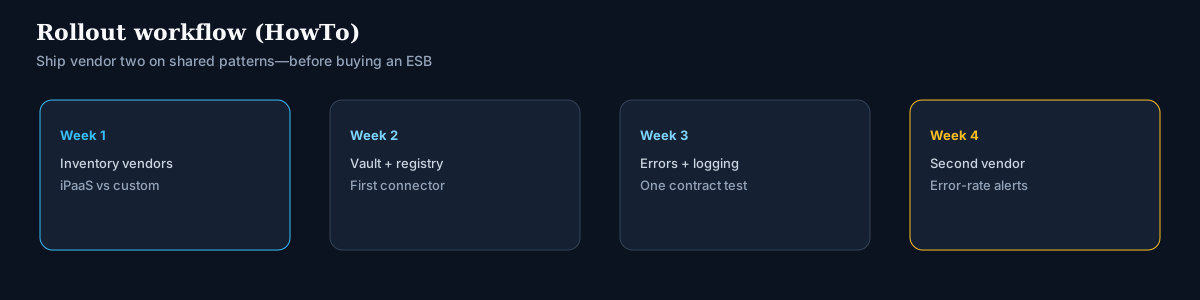 HowTo: inventory → vault + first connector → errors/tests → second vendor + alerts.
| Week | Focus |
|---|---|
| 1 | Inventory vendors; pick platform (iPaaS vs custom) |
| 2 | Secret store + first connector in registry |
| 3 | Standard errors + logging + one contract test |
| 4 | Second vendor via same patterns; alert on error rate |
Do not buy enterprise ESB before shipping vendor two—threads warn against resume-driven architecture.
Failure Modes
Failure 1: Platform tourism — buy Workato, still write side scripts. Fix: one catalog, all paths registered.
Failure 2: iPaaS for payment webhooks — duplicate charges under replay. Fix: custom idempotency layer.
Failure 3: Registry without tests — schema drift silent. Fix: CI contract test per connector.
Failure 4: No owner — connector graveyard. Fix: named integration owner + weekly review.
Failure 5: Agents bypass platform — raw URLs in tools. Fix: tools call registry only.
InfiniSynapse Connection
Product recommendation (commercial): Mature stacks route long analysis connectors to InfiniSynapse Server API while the registry handles auth and metering for short calls. See Manage Multiple API Integrations. Educational sections above do not require InfiniSynapse.
Buyer Evaluation Questions
Procurement and engineering leads evaluating options should ask:
| Question | Strong answer |
|---|---|
| Can we list all active connectors and owners? | Yes, catalog with metadata |
| Webhook replay handling? | Idempotency documented + tested |
| Key rotation without UI redeploy? | Secret manager integration |
| Per-connector error rate in dashboard? | Yes, tagged logs/metrics |
| Contract tests in CI? | Yes, per vendor |
Weak answers on webhook idempotency predict month-two billing incidents regardless of platform brand.
Hybrid Rollout Pattern
Most mature stacks stay hybrid:
- iPaaS — internal Slack alerts, sheet sync, low-risk triggers
- Custom registry — payments, CRM writes, warehouse, agent tools
- Shared observability — one dashboard tags both paths by
provider
Document which path each new vendor uses before merge—prevents "temporary zap" becoming production critical without tests.
Operating Model
Assign one integration platform owner:
- Maintains connector catalog and deprecation dates
- Reviews new vendor PRs for registry compliance
- Runs weekly error-rate review across providers
- Owns runbooks for top three vendors by traffic
Thirty minutes weekly prevents the connector graveyard that triggers rewrite posts on builder forums.
Webhook Idempotency Pattern
Payment and CRM webhooks need deduplication outside iPaaS defaults:
async function handleWebhook(eventId: string, payload: unknown) {
  const inserted = await db.webhookEvents.insertIfAbsent({
    id: eventId,
    provider: "stripe",
    receivedAt: new Date(),
  });
  if (!inserted) return { status: "duplicate" };
  await registry.call("stripe", ctx, { action: "process_event", payload });
  return { status: "processed" };
}
Store event IDs with TTL aligned to vendor replay window—Stripe recommends 72 hours for idempotency keys per Stripe idempotency docs. Threads that skip this step report duplicate rows within weeks, not months.
Contract Test Example
def test_stripe_connector_error_shape(registry, mock_ctx):
    with mock_upstream(status=500):
        result = registry.call("stripe", mock_ctx, {"action": "list_invoices"})
    assert "error" in result
    assert result["error"]["code"] == "upstream_error"
    assert "request_id" in result["error"]
One test per connector catches schema drift before agents or UI depend on wrong shapes. Publish connector SLAs internally—even informal p95 targets help prioritize registry hardening over new vendor demos.
Migration from Connector Sprawl
When untangling legacy connector debt:
| Phase | Action |
|---|---|
| 1 | Inventory every outbound URL and env var |
| 2 | Pick top traffic vendor; wrap in registry |
| 3 | Add logging tag connector_id on all calls |
| 4 | Migrate second vendor; delete duplicate retry code |
| 5 | Retire direct fetch from UI/agent tools |
Do not big-bang rewrite five vendors—incremental registry adoption beats a month-long freeze.
Agent and LLM Boundaries
Agents must not receive raw vendor API keys. The execution layer injects credentials and validates tool inputs—aligns with Tool Calling and OWASP LLM Top 10 excessive agency guidance.
Tool schema example: call_connector with enum connector_id allowlist—not free-form URLs.
Cost Triggers for Enterprise iPaaS
Upgrade from lightweight iPaaS when:
- Task count pricing exceeds one engineer-day/month of maintenance
- Buyers require VPC egress or static IP proof
- Audit demands connector inventory export you cannot produce from zaps
Cost debates should compare task pricing vs incident cost—not license list price alone. Document vendor changelog review cadence—breaking API changes hit registry wrappers before they hit production UI if someone reads release notes weekly.
Case Study: Billing Sync Platform
Desk data module (methodology)
| Field | Value |
|---|---|
| Unit under study | Internal vibe-coded B2B SaaS (desk-labeled; not a customer logo case) |
| Sample size (n) | 5 production connectors (Stripe, HubSpot, Slack, warehouse, email) |
| Observation window | 2026-03-01 → 2026-05-30 (pre: Mar 1–Mar 20 · rebuild: Mar 21–Apr 7 · post: Apr 8–May 30) |
| Intervention | Typed connector registry, vault keys, standard errors, idempotent webhook table; Workato retained for Slack alerts only |
| Methods | Incident log review + onboarding time diary + security questionnaire re-run; independence-labeled desk composite |
| Exclusions | Marketing zaps and one-off scripts not in the catalog |
A vibe-coded SaaS had five connectors—each with different retry and error formats. Month-two incident: duplicate invoice rows from webhook retry without idempotency.
Platform rebuild (18 days):
- Connector registry (TypeScript)
- Vault-backed keys
- Standard error envelope
- Idempotent webhook table
- Workato retained only for internal Slack alerts
Measured (same window):
- Integration incidents/month: 4 → 0.5
- New vendor onboarding: ~3 days → ~1 day (registry template)
- p95 outbound latency visible per connector
- Security review passed (was blocked on key sprawl)
A team used api integration platforms reddit language to frame the rebuild for leadership—registry first, brand second.
Frequently Asked Questions
Platform vs iPaaS?
iPaaS can be your layer early; custom registry when webhooks and jobs exceed limits.
When not to build a platform?
One vendor, demo stage—thin proxy enough.
Replace Zapier entirely?
Rarely—hybrid: platform for money/data, iPaaS for ops alerts.
How is this different from API gateway?
Gateway routes traffic; a platform adds catalog, auth patterns, and vendor lifecycle.
Agents and platforms?
Agent tools should call registry endpoints—never vendor URLs directly.
How long to mini platform?
Registry + two connectors + tests—often 2–3 weeks for small team. Focused api integration platforms reddit pass: inventory + vault + one registry entry.
What breaks first without a platform?
Webhook replay and key rotation—both show up in post-mortems before scale issues do.
Sandbox vs production connectors?
Separate registry entries with distinct vault paths; never share API keys across environments in one connector definition.
Conclusion
api integration platforms reddit is the graduation from connectors to system: registry, vault, retries, observability, and tests—not more copy-paste fetch wrappers.
Priority order: inventory, secret store, one registry pattern, two vendors, idempotent webhooks, then expand catalog.
Ship the integration system your fifth vendor needs on day one—not the connector your first vendor needed.
Explore Integration Platform Reddit and Cloud Integration Platforms for buy-vs-build depth.