SQL Data Analysis: Patterns and Queries (2026)
By the InfiniSynapse Data Team · Last updated: 2026-07-08 · We build an AI-native data analysis platform; this guide reflects the SQL patterns that actually matter for analysis, and how plain-language querying is changing them.
Table of Contents
- TL;DR
- Why SQL Matters for Analysis
- The Core Query Patterns
- Aggregation and Grouping
- Joins Across Tables
- Window Functions
- From SQL to Natural Language
- Common SQL Mistakes
- Where SQL Data Analysis Fits Your Stack
- SQL Scorecard
- Frequently Asked Questions
- Conclusion
TL;DR
Direct answer: SQL analysis uses SQL queries to retrieve and summarize data directly where it lives, in a database. The core patterns, filtering, aggregation, joins, and window functions, cover most analytical needs. In 2026, AI-native tools increasingly turn plain-language questions into SQL, but understanding the patterns remains essential to trust the results.
Who this is for: anyone learning SQL analysis or wanting to sharpen their query patterns.
What you'll learn: why SQL matters, the core patterns, aggregation, joins, window functions, and how natural-language querying changes the picture.
This guide sits within the advanced methods hub; for a query cookbook, see data analysis using sql.
For related depth in this pillar, see Data Analysis of Qualitative Data: Step by Step.
Why SQL Matters for Analysis
Sql data analysis matters because most organizational data lives in databases, and SQL is the language for querying it directly. Rather than exporting data to another tool, SQL analysis lets you retrieve exactly what you need, summarized as you fetch it, which is efficient and scales to large datasets that would overwhelm a spreadsheet.
SQL is also a durable, transferable skill; it has been the standard for decades and remains foundational, so time invested in SQL analysis pays off across tools and roles. The general activity SQL supports is the disciplined process described in the Wikipedia SQL overview, applied to the querying and summarizing stages of analysis. For analysts, SQL analysis is often the first step, pulling and shaping data before deeper work, which is why it is among the most requested skills in analytics roles. Predictive workflows should be interpreted against the Wikipedia machine learning overview.
The Core Query Patterns
Effective SQL analysis rests on a handful of core patterns rather than exotic syntax. Selecting and filtering rows with WHERE narrows data to what matters. Aggregating with functions like SUM, COUNT, and AVG summarizes it. Grouping with GROUP BY breaks summaries down by category. Joining combines data across tables. Window functions compute running and ranked calculations. These patterns cover the vast majority of SQL analysis.
Mastering these core patterns of SQL analysis matters more than memorizing every SQL feature, because they recur constantly while advanced features appear rarely. An analyst fluent in filtering, aggregating, grouping, joining, and windowing can answer most questions that SQL analysis is used for. The following sections cover the patterns that most reward attention, and our companion data analysis using sql guide offers a practical cookbook of concrete queries built on these foundations.
Aggregation and Grouping
Aggregation is the heart of SQL analysis, condensing many rows into summary figures. Functions like SUM, COUNT, AVG, MIN, and MAX compute totals and averages, and combined with GROUP BY, they produce summaries broken down by category, such as revenue per region or orders per customer. This grouped aggregation answers a large share of analytical questions directly in SQL analysis.
The power of grouping in SQL analysis is that a single query can summarize millions of rows into a compact, decision-ready table. Adding HAVING filters the grouped results, letting you find, for example, only the categories exceeding a threshold. Mastering aggregation and grouping is the highest-leverage skill in SQL analysis, because these patterns alone answer so many everyday questions, and they scale effortlessly to data volumes that would freeze a spreadsheet, which is precisely where SQL earns its place.
Joins Across Tables
Real data lives in multiple tables, so joins are essential to SQL analysis. A join combines rows from two tables based on a related column, letting you analyze data that spans, say, orders and customers together. Understanding the join types, inner joins that keep only matching rows and outer joins that preserve unmatched ones, is crucial to correct SQL analysis.
Joins are also where SQL analysis most often goes wrong, because a misunderstood join can silently duplicate or drop rows, corrupting the analysis. A careful analyst verifies that a join produces the expected number of rows before trusting the result. Mastering joins, and checking their effect, is a core competency in SQL analysis, since most interesting questions require combining data from several tables, and the correctness of that combination determines the correctness of everything built on it. The discipline follows the process described in the Wikipedia overview of data analysis.
Window Functions
Window functions are the pattern that elevates intermediate SQL analysis to advanced. Unlike GROUP BY, which collapses rows into summaries, window functions compute calculations across a set of rows while keeping each row, enabling running totals, moving averages, rankings, and comparisons to previous rows. These are invaluable for time-series and ranking questions in SQL analysis.
For example, window functions let SQL analysis compute each month's revenue alongside a running annual total, or rank customers within each region, in a single query. They handle questions that would otherwise require complex self-joins or post-processing. Though they take some effort to learn, window functions substantially expand what SQL analysis can do directly in the database, and they are well worth mastering for anyone doing serious analytical work with SQL, since they turn many multi-step problems into a single elegant query.
From SQL to Natural Language
The biggest 2026 shift in SQL analysis is that AI-native tools increasingly turn plain-language questions into SQL. Rather than writing queries by hand, an analyst can ask a question in ordinary words and have an agent generate and run the SQL, which democratizes access to data locked in databases. This does not make SQL knowledge obsolete, however.
InfiniSynapse embodies this shift. It is not an NLP2SQL box or a ChatBI widget but a system that behaves like a professional data analyst, connecting to sources with one-click authorization and performing SQL analysis through InfiniSQL, a query language optimized for large models, with an inspectable trail showing the queries it ran. Understanding the SQL patterns remains essential to verify that generated queries are correct, especially joins. We explore this in natural language to SQL and what AI-native data analysis means, and the Stanford HAI AI Index documents how quickly plain-language querying matured. The pattern knowledge that underpins SQL analysis is what lets you trust the results.
Common SQL Mistakes
Several mistakes undermine SQL analysis. The most consequential is the misunderstood join that silently duplicates or drops rows, so always verify row counts after joining. The second is forgetting that WHERE filters before grouping while HAVING filters after, which trips up many learners of SQL analysis.
A third mistake in SQL analysis is neglecting NULL handling, since NULLs behave unexpectedly in comparisons and aggregations and can distort results if ignored. A fourth is writing queries that are correct but so convoluted that no one, including the author later, can verify them. Clear, well-structured queries are part of sound SQL analysis. Avoiding these mistakes, especially by verifying joins and handling NULLs deliberately, keeps SQL analysis trustworthy rather than confidently wrong, which matters as much when reviewing AI-generated SQL as when writing it yourself. Scripted analysis should follow Python documentation conventions for reproducibility and testable pipelines.
Where SQL Data Analysis Fits Your Stack
Understanding where sql data analysis fits among other tools clarifies when to reach for it. In most analytical stacks, sql data analysis is the first step: it pulls and shapes data directly from the database before any further work. Because databases hold the bulk of organizational data, sql data analysis is often the most efficient way to retrieve and summarize it at scale, avoiding the need to export large datasets elsewhere.
From there, sql data analysis frequently hands off to other tools. An analyst might use sql data analysis to aggregate raw data into a manageable summary, then move that summary into Python for modeling or into a visualization tool for dashboards. This handoff pattern, where sql data analysis does the heavy retrieval and aggregation and another tool does specialized work, is common and effective, matching each tool to its strength rather than forcing everything through one.
The scalability of sql data analysis is its defining advantage in the stack. A query can summarize millions of rows in the database far faster than pulling them into a spreadsheet or notebook, which is why sql data analysis remains essential even as other tools proliferate. For recurring reporting, sql data analysis embedded in a scheduled pipeline delivers fresh summaries automatically. Knowing that sql data analysis occupies the retrieval-and-aggregation layer, feeding cleaner, smaller data to downstream tools, helps you design an efficient workflow rather than misusing one tool for a job another does better, and it explains why sql data analysis endures as a foundational skill across the whole analytics landscape.
SQL Scorecard
Assess your SQL analysis skills (1 point each):
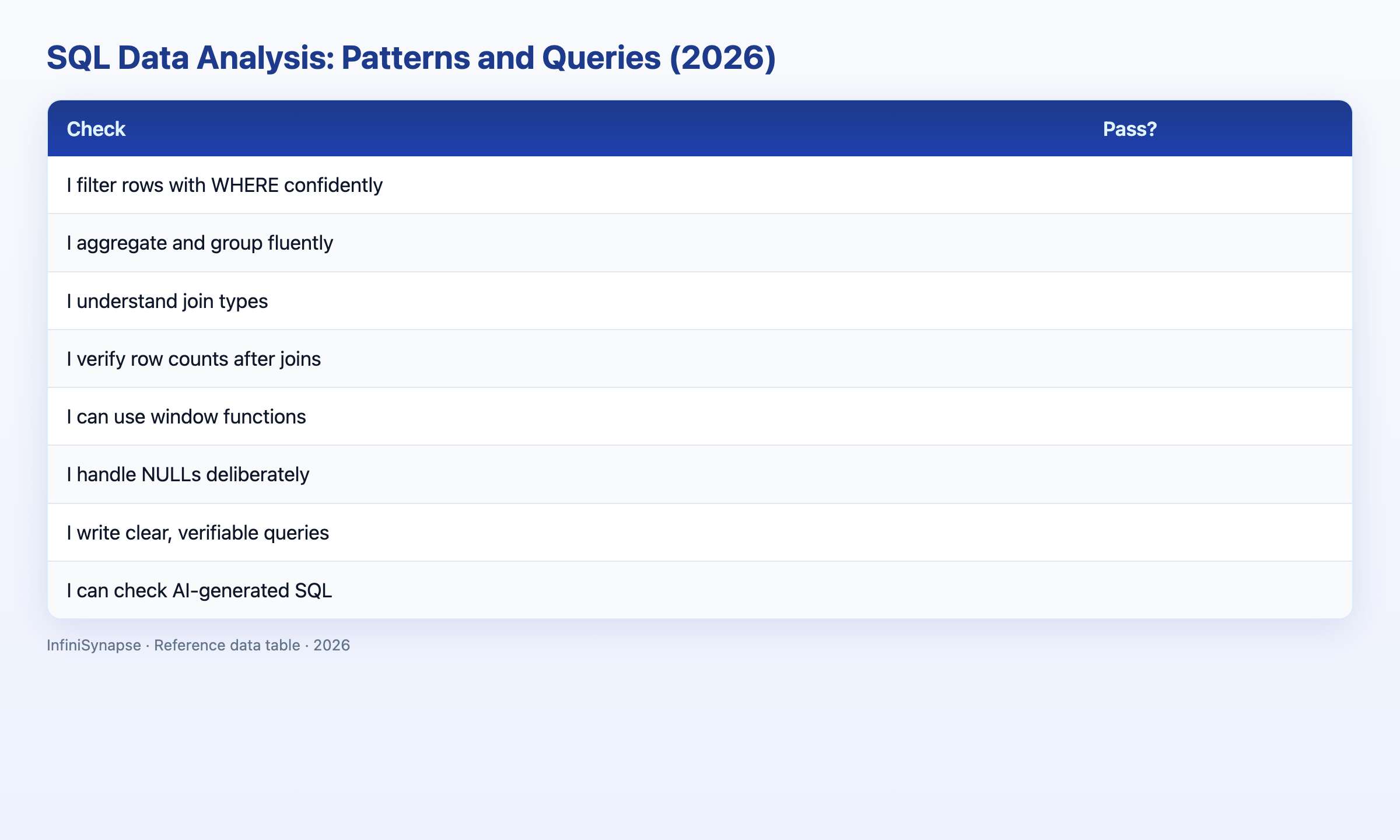
| Check | Pass? |
|---|---|
| I filter rows with WHERE confidently | |
| I aggregate and group fluently | |
| I understand join types | |
| I verify row counts after joins | |
| I can use window functions | |
| I handle NULLs deliberately | |
| I write clear, verifiable queries | |
| I can check AI-generated SQL |
6–8: strong SQL analysis. 3–5: reinforce a pattern. Below 3: master aggregation and joins first.
Frequently Asked Questions
What is SQL data analysis?
SQL data analysis uses SQL queries to retrieve and summarize data directly in a database, rather than exporting it elsewhere. Its core patterns, filtering, aggregation, grouping, joins, and window functions, cover most analytical needs and scale to large datasets. SQL is a durable, transferable skill foundational to analytics roles.
What SQL do I need for data analysis?
For SQL data analysis you need the core patterns: selecting and filtering with WHERE, aggregating with SUM, COUNT, and AVG, grouping with GROUP BY, joining across tables, and window functions for running and ranked calculations. Mastering these covers most questions; exotic features matter far less than fluency in these fundamentals.
Why are joins important in ?
Joins are important in SQL data analysis because real data lives in multiple tables, and most interesting questions require combining them, such as analyzing orders alongside customers. Joins are also where analysis most often goes wrong, since a misunderstood join can silently duplicate or drop rows, so verifying row counts after joining is essential.
Do I still need SQL if AI can write it?
Yes. Even as AI-native tools turn plain-language questions into SQL, understanding SQL data analysis patterns remains essential to verify that generated queries are correct, especially joins and NULL handling. The pattern knowledge lets you trust the results rather than accepting confidently wrong output, making SQL literacy more valuable, not less.
What are common mistakes in ?
Common SQL data analysis mistakes include misunderstood joins that duplicate or drop rows, confusing WHERE (filters before grouping) with HAVING (filters after), neglecting NULL handling that distorts comparisons and aggregations, and writing convoluted queries no one can verify. Verifying joins and handling NULLs deliberately keeps analysis trustworthy.
Conclusion
Sql data analysis queries and summarizes data directly in the database using a handful of core patterns, filtering, aggregation, joins, and window functions, that cover most needs and scale to large data. In 2026, AI-native tools turn plain-language questions into SQL, but pattern knowledge remains essential to trust the results.
For anyone building analytical skills, sql data analysis is among the highest-return investments available. The patterns of sql data analysis, filtering, aggregation, joins, and window functions, transfer across every database and tool, so sql data analysis skill compounds over a career. Even as AI generates queries, the analyst who understands sql data analysis can verify and refine them, which makes sql data analysis literacy more valuable rather than less. Master these patterns, practice sql data analysis on real questions, and you gain a durable capability that underpins nearly all serious analytical work.
To see plain-language querying with an inspectable trail, read natural language to SQL and try the InfiniSynapse web app free on registration, no credit card required.