
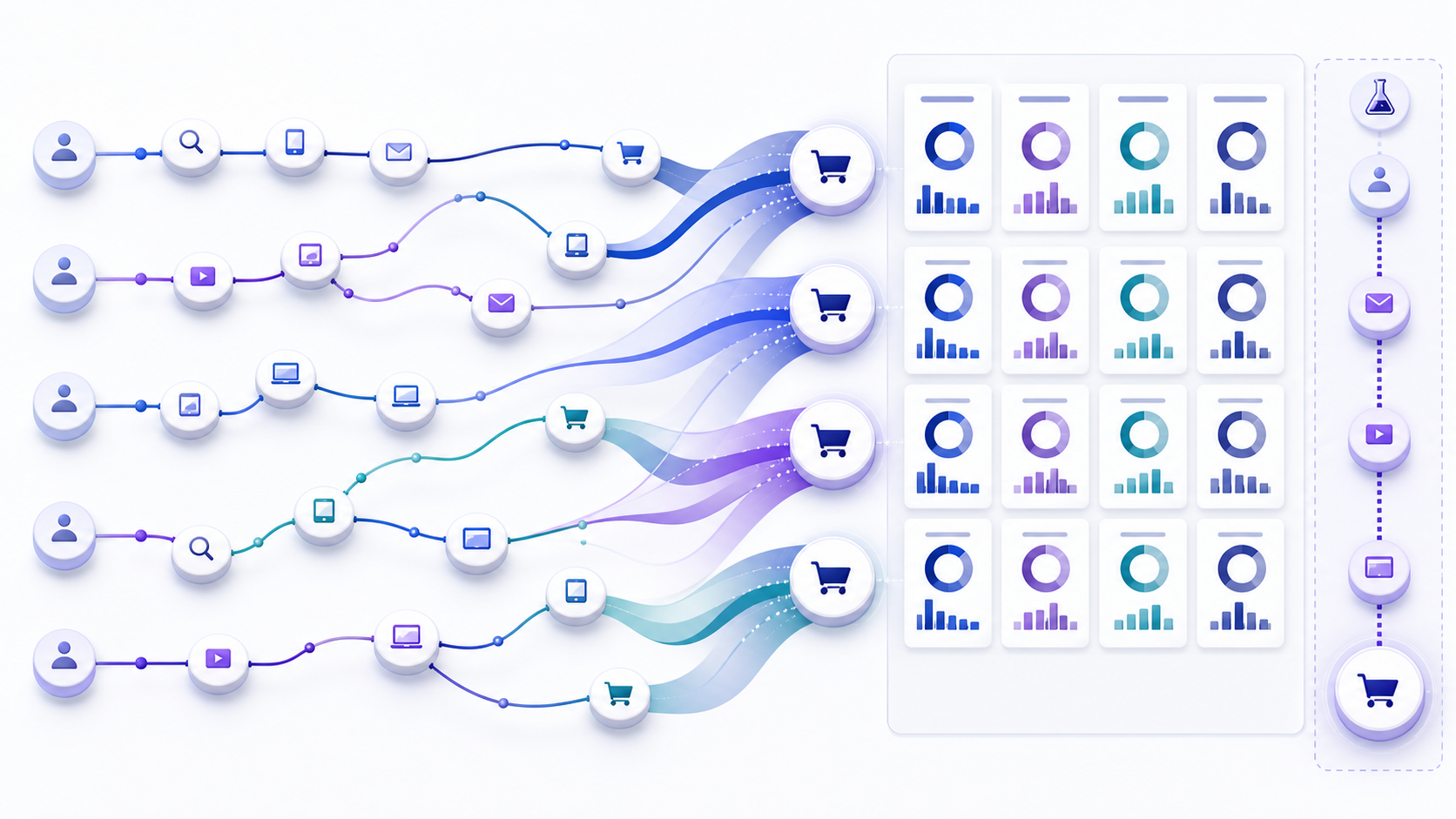
Multi-touch attribution is a model of observed paths多触点归因是已观察路径的模型
Multi-touch attribution links eligible interactions to a defined conversion and distributes a fixed amount of credit across those interactions. It answers “how would this model describe the observed path?” It does not, by itself, answer “what would have happened without the marketing?”
多触点归因把合格互动连接到明确转化,并在这些互动之间分配固定总量的贡献。它回答“该模型如何描述已观察路径”,本身并不回答“没有营销时会发生什么”。
This page explains model design and validation. For connectors, vendor evaluation, implementation services, and commercial selection, use the separate marketing attribution software guide.
本页解释模型设计与验证。有关连接器、厂商评估、实施服务与商业选型,请使用独立的营销归因软件指南。
Compare attribution models by their assumptions按照假设比较归因模型
| Model模型 | Credit rule贡献规则 | Useful diagnostic适用诊断 | Main limitation主要限制 |
|---|---|---|---|
| First touch首次触点 | All credit to earliest eligible interaction全部贡献分配给最早合格互动 | Recorded discovery source记录的发现来源 | Ignores later path忽略后续路径 |
| Last touch末次触点 | All credit to final eligible interaction全部贡献分配给最终合格互动 | Conversion handoff转化前交接点 | Overweights closers过度强调收口触点 |
| Linear线性 | Equal credit to every eligible touch每个合格触点平均分配 | Path participation路径参与情况 | Assumes equal contribution假设贡献相等 |
| Time decay时间衰减 | More weight near conversion越接近转化权重越高 | Recency-sensitive paths时效敏感路径 | Decay rate is chosen, not discovered truth衰减率是选择,不是真相 |
| Position based位置型 | Preset weight to first, last, and middle为首、末与中间位置预设权重 | Discovery and close narrative发现与收口叙事 | Position weights remain assumptions位置权重仍是假设 |
Construct an auditable path before calculating credit计算贡献前先构建可审计路径
Define the conversion event, conversion value, customer or account entity, eligible channels, interaction event, timestamp standard, lookback window, deduplication rule, direct-traffic treatment, consent boundary, and late-arriving data policy. Preserve raw event identifiers and source fields so an attributed row can be traced back to evidence.
需要定义转化事件、转化价值、客户或账户实体、合格渠道、互动事件、时间戳标准、回溯窗口、去重规则、直接流量处理、同意边界和迟到数据政策。保留原始事件 ID 与来源字段,使每条归因结果都能追溯到证据。
Reconciliation gate: conversion count and value in the attribution population must reconcile to the declared source after exclusions. If they do not, model comparisons are premature.
对账门槛:排除规则生效后,归因总体中的转化数量与价值必须和声明来源对账。若无法对账,比较模型还为时过早。
Select a model for a reporting question, not a causal claim为报告问题选择模型,而不是制造因果主张
Choose first touch when the reporting need is recorded discovery, last touch for the final recorded handoff, and fractional models when the team needs a stable description of path participation. Compare more than one defensible model when allocation changes a decision. Large swings indicate model dependence and should be shown, not hidden behind one preferred number.
当报告需要描述记录中的发现来源时可用首次触点;描述最终交接时可用末次触点;需要稳定呈现路径参与时可用分数模型。当贡献分配会影响决策时,应比较多个可辩护模型。结果大幅变化说明模型依赖性强,应该展示,而不是隐藏在单一偏好数字后面。
A data-driven model can estimate patterns conditional on observed data, but it cannot recover untracked exposure, resolve arbitrary identity gaps, or automatically identify counterfactual lift.
数据驱动模型可以估计已观察数据条件下的模式,但不能恢复未追踪曝光、自动解决任意身份缺口,也不能自动识别反事实增量。
Calculate multi-touch attribution in seven controlled steps用七个受控步骤计算多触点归因
- Freeze the conversion population and value.冻结转化总体与价值。
- Normalize eligible interaction timestamps and channels.统一合格互动时间与渠道。
- Resolve identity under documented deterministic or probabilistic rules.按记录的确定性或概率规则解析身份。
- Build ordered paths within the lookback window.在回溯窗口内构建有序路径。
- Apply each declared credit rule so every conversion sums to one.应用声明的贡献规则,确保每次转化贡献合计为一。
- Aggregate with count, value, path, and uncertainty diagnostics.结合数量、价值、路径与不确定性诊断汇总。
- Compare models and reconcile outputs before interpretation.解释前比较模型并对账输出。
Validate the path, arithmetic, and decision sensitivity验证路径、计算与决策敏感性
| Test测试 | Question问题 |
|---|---|
| Coverage覆盖 | What share of conversions has zero, one, or multiple eligible touches?零个、一个或多个合格触点的转化各占多少? |
| Conservation守恒 | Does credit sum to one per conversion and reconcile in aggregate?每次转化贡献是否合计为一,汇总后是否对账? |
| Window sensitivity窗口敏感性 | How do allocations change under plausible lookback windows?在合理回溯窗口下,分配如何变化? |
| Identity sensitivity身份敏感性 | What changes when uncertain matches are removed?移除不确定匹配后,结果如何变化? |
| Decision stability决策稳定性 | Would the recommended action reverse under another defensible model?换用另一合理模型时,建议行动是否会反转? |
Worked example: one observed path, four different stories示例:同一条已观察路径,四种不同叙事
Consider an eligible path of paid social → organic search → email → direct conversion. First touch assigns 100% to paid social; last touch assigns 100% to direct; linear assigns 25% to each; a position-based rule might assign 40% to paid social, 40% to direct, and 10% to each middle touch. The observed path has not changed—only the allocation rule has.
假设一条合格路径为:付费社交 → 自然搜索 → 邮件 → 直接转化。首次触点把 100% 分给付费社交;末次触点把 100% 分给直接访问;线性模型各分 25%;位置型规则可能给付费社交和直接访问各 40%,中间两个触点各 10%。已观察路径没有变化,变化的只是分配规则。
Report the model name beside every allocation and test whether the business decision survives other plausible rules. Use holdouts or another credible causal design when the question is incremental impact.
每项分配都应同时报告模型名称,并检验业务决策能否经受其他合理规则。若问题是增量影响,应使用留出组或其他可信因果设计。
Do not confuse observed credit with customer persuasion不要把已观察贡献误认为客户说服效果
Paths are incomplete when exposure cannot be observed, devices cannot be linked, offline influence is absent, consent limits collection, or platforms report modeled events. Repeated touches may reflect a customer already likely to convert. Channels can also appear late because customers use them to navigate, not because they created demand.
当曝光不可观察、设备无法关联、线下影响缺失、同意限制采集或平台报告建模事件时,路径并不完整。重复触点可能只是反映客户本来就更可能转化。某些渠道出现在路径后段,也可能只是用于导航,而不是创造了需求。
Boundary: attribution organizes observed evidence; incrementality estimates a counterfactual difference. Use both when the decision needs path visibility and causal confidence.
边界:归因组织已观察证据;增量测量估计反事实差异。当决策同时需要路径可见性与因果置信度时,应结合使用。
Validate the stack before and after launch上线前后验证营销分析技术栈
Acceptance testing should cover data, logic, permissions, usability, and operations. Use a frozen test period so every candidate receives identical inputs. Reconcile source totals before derived metrics, then trace a sample record through collection, transformation, model, and report. Compare time zones, currencies, filters, and attribution windows explicitly.
验收测试应覆盖数据、逻辑、权限、易用性和运营。使用冻结测试周期,让每个候选接收相同输入。先对账源总数,再检查派生指标;抽取样例记录,沿采集、转换、模型和报告全链路追踪,并明确比较时区、币种、过滤器和归因窗口。
- Data: required fields, history, duplicates, nulls, late data, deletions, and source totals are tested.数据:测试必要字段、历史、重复、空值、延迟数据、删除和源总数。
- Logic: approved metric definitions reproduce expected results on known examples and edge cases.逻辑:批准的指标定义能在已知示例和边界情况上重现预期结果。
- Access: representative roles can see only intended data; export, deletion, and audit behavior are verified.访问:代表性角色只能看到预期数据;导出、删除和审计行为得到验证。
- Operations: refresh failures, schema changes, retries, backfills, ownership, escalation, and rollback are rehearsed.运营:演练刷新失败、Schema 变化、重试、回填、责任、升级和回滚。
- Adoption: target users complete recurring tasks, explain the output, and know when not to use it.采用:目标用户能完成周期任务、解释输出,并知道何时不应使用。
After launch, monitor freshness, reconciliation variance, connector errors, definition changes, usage, manual overrides, and unresolved questions. Review whether the stack changes actual decisions; a technically healthy dashboard that nobody uses is not a successful implementation. Retire duplicate reports and unused components so the system remains understandable.
上线后应监控数据新鲜度、对账差异、连接器错误、定义变更、使用情况、手工覆盖和未解决问题,并检查工具栈是否真正改变决策。技术健康但无人使用的仪表板并不算成功实施。应淘汰重复报告和闲置组件,使系统保持可理解。
Where InfiniSynapse fits after attribution data is prepared归因数据准备完成后 InfiniSynapse 的位置
An AI analysis layer can reduce the friction of comparing model outputs, investigating unmatched records, reconciling attribution exports with warehouse revenue, and answering follow-up questions. It does not remove the need for reliable collection, lawful data use, identity resolution, explicit model policy, or causal validation.
AI 分析层可以降低模型输出比较、未匹配记录调查、归因导出与仓库收入对账以及追问分析的摩擦,但不能替代可靠采集、合规数据使用、身份解析、明确模型政策或因果验证。
Before opening the app, prepare the touchpoint and conversion tables or governed warehouse connection, metric dictionary, model and window definitions, reconciliation totals, comparison question, and known gaps. Then use InfiniSynapse for natural-language, multi-source analysis while a responsible reviewer checks joins, filters, assumptions, evidence, and conclusions.
打开应用前,请准备触点与转化表或受治理仓库连接、指标字典、模型与窗口定义、对账总数、比较问题和已知缺口。随后可使用 InfiniSynapse 进行自然语言多源分析,同时由负责人复核连接、过滤、假设、证据和结论。
Open the InfiniSynapse analysis app打开 InfiniSynapse 分析应用InfiniSynapse is not presented here as the pixel or SDK for every channel, a consent manager, a customer identity graph, a dedicated attribution engine, or proof of causal impact. Its evidenced role is a professional AI data analyst that can work across connected databases and prepared sources. Use it as an analysis layer beside the systems that collect, govern, and model attribution evidence.
本页不会把 InfiniSynapse 描述为所有渠道的 Pixel 或 SDK、同意管理器、客户身份图谱、专用归因引擎或因果影响证明。其已有产品角色是可跨已连接数据库和准备好数据源工作的专业 AI 数据分析工具,应把它作为采集、治理和建模归因证据系统旁的分析层。
Multi-touch attribution frequently asked questions多触点归因常见问题
Multi-touch attribution connects observed campaign touchpoints with defined conversions and assigns credit under a stated attribution model. It helps compare channels and paths, but its result depends on data coverage, identity rules, attribution windows, and model assumptions.
多触点归因把已观察的活动触点连接到已定义转化,并按明确归因模型分配贡献。它帮助比较渠道与路径,但结果取决于数据覆盖、身份规则、归因窗口和模型假设。
Start with the decision and conversion definition, then test source coverage, identity handling, model transparency, reconciliation, privacy controls, exports, operator workflow, and total implementation cost on representative data.
先明确决策和转化定义,再用代表性数据测试来源覆盖、身份处理、模型透明度、对账、隐私控制、导出、运营工作流和实施总成本。
Multi-touch attribution software distributes conversion credit across more than one observed interaction. The weighting may be rule-based or algorithmic; the output remains model-dependent and should be compared with other evidence.
多触点归因软件把转化贡献分配给一个以上的已观察互动。权重可以基于规则或算法;输出仍取决于模型,应与其他证据比较。
No. Attribution allocates credit among observed touchpoints; it does not by itself estimate what would have happened without the marketing activity. Use a suitable experiment or another credible causal design for incremental impact.
不能。归因在已观察触点之间分配贡献,本身并不估计没有该营销活动时会发生什么。需要衡量增量影响时,应使用合适实验或其他可信因果设计。
Usually not. B2B evaluation often emphasizes account identity, CRM stages, long sales cycles, and offline touches, while ecommerce often emphasizes order and refund reconciliation, product margins, and faster media feedback.
通常不应。B2B 评估常重视账户身份、CRM 阶段、长销售周期和线下触点;电商则常重视订单与退款对账、商品利润和更快的媒体反馈。
InfiniSynapse can analyze governed attribution exports or connected warehouse data through natural-language, multi-source workflows. It is not presented as a replacement for channel collection, consent management, identity resolution, or causal experimentation.
InfiniSynapse 可通过自然语言多源工作流分析受治理的归因导出或已连接仓库数据,但它不替代渠道采集、同意管理、身份解析或因果实验。
Official sources and verification references官方来源与验证参考
- IAB Multi-Touch Attribution implementation primerIAB 多触点归因实施入门文档 — an industry-body reference on attribution data, models, implementation, validation, and operational use.由行业组织提供的归因数据、模型、实施、验证与运营使用参考。
- UK ICO guidance on cookies and similar technologies英国 ICO 关于 Cookie 与类似技术的指南 — an official privacy reference relevant to some measurement implementations.与部分衡量实施相关的官方隐私参考。