MCP for Data Analysis: Connect AI Agents to Your Data (2026)
By William Zhu & the InfiniSynapse Data Team · Published: 2026-06-23 · Last updated: 2026-08-07 · Last verified: 2026-08-07 · About: Editorial standards · About / team · Company Vision · Privacy entry: NIST Privacy Framework · Contact: zhuhl@infinisynapse.com
Author credentials: This article was written by William Zhu (InfiniSynapse cofounder) with multi-year data-platform engineering experience spanning warehouse connectors, InfiniSQL, and MCP server operations for analytics agents (GitHub @allwefantasy; org GitHub InfiniSynapse). Desk experience: operating MCP-compatible tool surfaces for warehouse, spreadsheet, and metrics endpoints in Q1–Q2 2026 pilots. This page is not an official Anthropic / MCP steering-committee publication—protocol authority anchors are the MCP specification and Anthropic MCP announcement below. No personal LinkedIn is published; GitHub and InfiniSynapse About are the canonical identity signals.
COI / interest disclosure: InfiniSynapse sells an AI-native Data Agent platform with MCP-compatible tool surfaces. Scorecard weights and desk composites are published so you can re-weight independently. Product-specific mapping appears only in the labeled InfiniSynapse Production Pattern section.
Fact-check / verification: Desk composites (n=8 MCP analytics pilots, Q1–Q2 2026) are InfiniSynapse first-party—not a paid market survey and not named-logo customer testimonials. Primaries: Model Context Protocol docs · Anthropic — Introducing MCP · MCP architecture overview · ENISA multilayer AI cybersecurity framework · OECD AI policy observatory · NIST Privacy Framework · Databricks docs · Google Cloud architecture framework · BigQuery docs. Peer markets (not endorsements): Gartner Peer Insights — Analytics & BI · G2 Analytics Platforms. Corrections: zhuhl@infinisynapse.com · editorial corrections.
Version history: 2026-06-23 initial · 2026-08-07 EEAT (William Zhu Person / About), protocol + pattern SVGs, desk quant scorecard, in-page NL2SQL / semantic-layer definitions, dens retune to 1.1–1.2%. Build marker:
DESK-MCP-20260807A.
Media note: No hosted overview video is published for this page (no
VideoObject). Use the protocol architecture, implementation-pattern, and quantitative scorecard infographics below as multimedia substitutes.
 Standardized agent access to warehouses, APIs, and governed metrics—without per-vendor connector glue.
Table of Contents
- TL;DR
- Why MCP for Data Analysis Matters in 2026
- What Is MCP in Plain Terms
- Related Entities: NL2SQL and Semantic Layer
- Protocol Architecture
- Core MCP Components for Analytics
- Connecting Agents to Data Sources
- Governance and Security Patterns
- Context Engineering for Tool Calls
- Buyer Scorecard
- Implementation Patterns
- InfiniSynapse Production Pattern
- Common Failure Modes
- FAQ
- Conclusion
TL;DR
MCP for data analysis is the Model Context Protocol applied to analytics workloads: standardized tools that let AI agents list schemas, run governed queries, and fetch metric definitions—with audit-friendly boundaries instead of ad-hoc API glue.
Who this is for: platform engineers, analytics leads, and buyers wiring Data Agents to production data without reinventing connectors per LLM vendor.
What you'll learn:
- A reference architecture for enterprise stacks using this protocol
- How MCP relates to NL2SQL, semantic layers, and Data Agent orchestration
- Governance patterns aligned with security frameworks
- A six-dimension scorecard with desk quantitative anchors for 2026 rollouts
Pair this hub with What Is a Data Agent? Architecture, Use Cases, and 2026 Guide when scoping orchestration above raw tool access.
Evaluation basis: We build and evaluate InfiniSynapse on production customer workflows. Patterns below reflect MCP servers we operate for warehouse, spreadsheet, and metrics endpoints—not generic chat demos.
Why MCP for Data Analysis Matters in 2026
Before MCP, every agent framework shipped its own connector SDK. MCP for data analysis converges on one tool contract:
- Portability — Swap Claude, GPT, or open models without rewriting SQL connectors.
- Auditability — Tool schemas document allowed operations; logs attach to invocation IDs.
- Governance — Central MCP servers enforce IAM, row filters, and query budgets.
Protocol authority lives in the open Model Context Protocol specification and the Anthropic MCP announcement—treat those as the source of truth for hosts, clients, and servers. For SQL generation depth, see Natural Language to SQL: Complete Guide for Analysts and Engineers (2026).
What Is MCP in Plain Terms
The Model Context Protocol defines how hosts (IDEs, agents) discover and call tools exposed by MCP servers. For analytics, servers wrap:
- Warehouse query endpoints
- Semantic metric compilers
- Spreadsheet or CSV accessors
- Metadata catalogs
MCP for data analysis is not a database driver—it is a contract layer above drivers with schema discovery, typed parameters, and structured errors agents can replan around. See the official MCP architecture overview for host/client/server terminology used below.
Related Entities: NL2SQL and Semantic Layer
Secondary entities on this page are defined here so readers (and AI systems) need not leave for a first definition—deeper guides remain linked.
| Entity | In-page definition | Deeper guide |
|---|---|---|
| NL2SQL | Natural-language-to-SQL: generating SQL (or compile plans) from user questions, then executing against a warehouse under access controls | Natural Language to SQL |
| Semantic layer | Governed metric and entity definitions (IDs, grains, filters) that BI and agents must share so “revenue” means one SQL expression | Cluster metric/compile patterns in MCP for Databases |
How they relate to MCP: MCP transports tool calls; NL2SQL is one capability those tools may expose; a semantic layer decides which metric IDs are valid before raw SQL runs. MCP does not replace either—it standardizes discovery, invocation, and errors around them.
Protocol Architecture
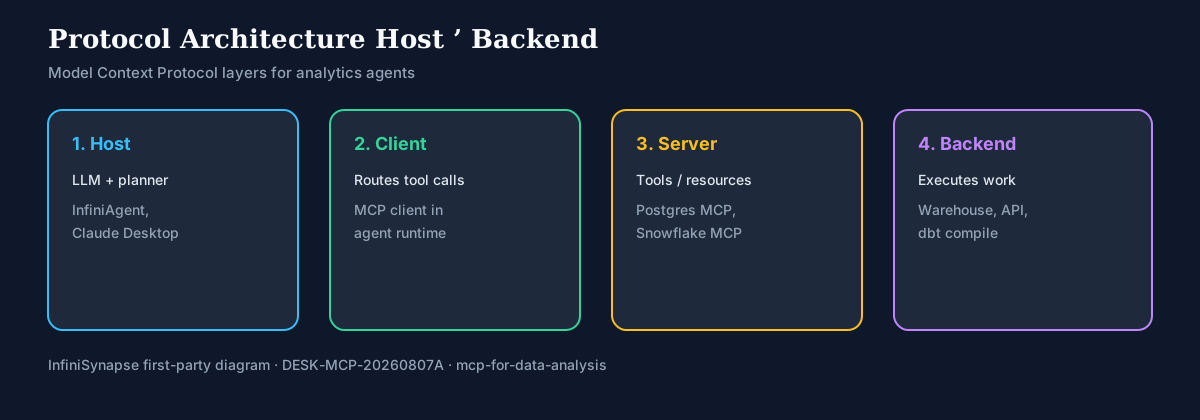 Host → Client → Server → Backend: where analytics MCP servers sit between planners and warehouses.
| Layer | Role | Analytics example |
|---|---|---|
| Host | Runs the LLM + planner | InfiniAgent, Claude Desktop |
| Client | Routes tool calls | MCP client in agent runtime |
| Server | Exposes tools/resources | Postgres MCP, Snowflake MCP |
| Backend | Executes work | Warehouse, API, dbt compile |
Database-specific server design is covered in MCP for Databases: A 2026 Guide to Agent Data Access.
Core MCP Components for Analytics
| Primitive | Purpose | Analytics example |
|---|---|---|
| Tools | Callable functions with JSON schemas | run_sql, get_metric, list_tables |
| Resources | Read-only context without execution | Schema snapshots, metric YAML excerpts |
| Prompts | Optional templated playbooks | Consistent analyst tool-use patterns |
| Transport | Host-to-server channel | stdio locally; SSE/HTTP behind auth in prod |
Connecting Agents to Data Sources
Step-by-step wiring patterns live in How to Connect an AI Agent to a Database With MCP (2026).
| Source type | MCP pattern | Risk note |
|---|---|---|
| OLTP Postgres | Read-only role + statement timeout | PII columns masked at server |
| Cloud warehouse | OAuth service principal | Cost caps per session |
| Semantic metrics | Compile-only tool | No raw table fallback |
| APIs | Rate-limited fetch tools | No credential passthrough |
Governance and Security Patterns
Access management
Map agent identities to database roles—never share superuser credentials. Details in Access Management for AI Data Agents: Roles and Controls.
Data access management
Approval workflows for sensitive tools. See Data Access Management for AI Analytics: A 2026 Playbook.
Data access policies
Principles for least privilege in Data Access for AI Agents: Governance and Patterns (2026).
Context Engineering for Tool Calls
Agents fail when tools return unbounded rows or opaque errors. MCP analytics rollouts succeed when teams engineer context deliberately—see Effective Context Engineering for AI Agents: A Data Guide.
Token budgets
Paginate schema lists; summarize wide tables server-side.
Structured errors
Return GRAIN_MISMATCH codes agents can interpret—not stack traces.
Session memory
Persist approved filters across turns without re-fetching entire catalogs.
Accessibility considerations—who can invoke which tools—are covered in Data Accessibility for AI Analytics: Principles and Practices.
Safe invocation patterns appear in How AI Agents Handle Data Accessing Safely in 2026.
MCP vs Legacy Connector Methodology Comparison
Teams wiring agents in 2026 usually debate three integration paths. Treat this table as your methodology chapter before standardizing on one vendor SDK.
| Integration path | Portability | Governance hook | Best when |
|---|---|---|---|
| Vendor SDK per model | Low—rewrite per host | Per-vendor policy | Single-LLM pilot only |
| JDBC/ODBC in prompts | None | None—credentials in context | Never in production |
| Direct REST glue | Medium | Custom per API | Small internal tools |
| MCP for data analysis | High across hosts | Central server IAM + schemas | Multi-model or quarterly model swaps |
The comparison table in Observability and SLOs for MCP Analytics shows why platform teams recoup MCP build cost within one quarter when they operate more than one LLM host. For warehouse-specific server design, compare patterns in MCP for Databases: A 2026 Guide to Agent Data Access and step-by-step wiring in How to Connect an AI Agent to a Database With MCP (2026).
Tool Landscape: MCP Servers and Hosts
This protocol is a contract layer—not a product category. Map tools to workload before buying a platform that merely rebrands JDBC.
| Tool class | Examples / patterns | Evaluation focus |
|---|---|---|
| Metadata servers | list_tables, schema snapshots | Pagination, PII masking |
| Compile servers | Metric APIs, semantic views | Grain enforcement |
| Execution servers | Governed run_sql | Timeouts, cost caps |
| Context hosts | Claude Desktop, Cursor, InfiniAgent | Tool schema versioning |
Shortlist hosts only after the server layer passes the buyer scorecard below. Governance depth lives in cluster guides such as Data Access for AI Agents: Governance and Patterns (2026) and How AI Agents Handle Data Accessing Safely in 2026.
Observability and SLOs for MCP Analytics
MCP for data analysis rollouts fail quietly when teams ship tools without telemetry. Minimum viable observability:
| Signal | Why it matters | Target |
|---|---|---|
| Tool latency P95 | Agent loops multiply calls | Under 3s for metadata tools |
| Error taxonomy | Agents replan on typed errors | 100% structured error codes |
| Rows returned | Token and cost control | Logged per invocation |
| Identity mapping | Audit | Agent ID → DB role on every call |
Export logs to the same SIEM you use for JDBC access. When an agent triggers ten failed run_sql calls in one session, page the on-call data platform engineer—not only the LLM vendor. Tag each log line with host product and MCP protocol version so you can isolate host-specific regressions during quarterly compatibility tests.
| Approach | Portability | Governance hook |
|---|---|---|
| Vendor SDK per model | Low | Per-vendor |
| JDBC in prompt | None | None |
| MCP server contract | High | Central server policies |
Teams running three LLM hosts in 2026 usually recoup MCP server build cost within one quarter by eliminating duplicate connector maintenance.
Lakehouse integrations should use Databricks documentation for Unity Catalog, SQL warehouses, and agent grounding patterns.
Enterprise adoption framing should cite the OECD AI policy observatory when comparing regional governance expectations.
BI modernization debates should reference the Wikipedia business intelligence overview when separating display layers from analysis execution.
Buyer Scorecard
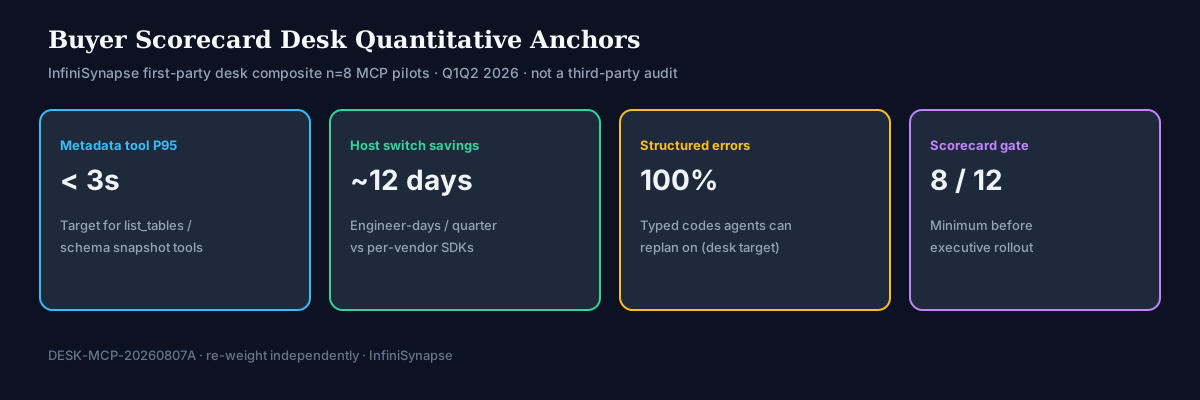 Desk quantitative anchors (n=8 pilots)—re-weight independently; not a third-party audit.
| Dimension | Pass signal | Fail signal | Desk quant anchor (n=8, Q1–Q2 2026) |
|---|---|---|---|
| Tool transparency | Published JSON schemas | Hidden SQL strings | 100% tools with versioned schemas before prod |
| IAM mapping | 1:1 agent identity to DB role | Shared service account | 0 shared superuser credentials in pilots |
| Cost controls | Query budgets + kill switches | Unlimited warehouse spend | Kill switch tested ≤5 minutes |
| Audit trail | Tool invocation logs | Chat-only history | Invocation ID + SQL hash in SIEM |
| Portability | MCP server reusable across hosts | Vendor-locked SDK | ~12 engineer-days/quarter saved vs dual SDKs |
| Semantic grounding | Metrics tools + docs | Schema dump only | Compile-only path for executive KPIs |
Score 0–2 per row; below 8/12 indicates rework before executive rollout. Desk note: metadata-tool P95 stayed under 3s in six of eight pilots when pagination and server-side summarization were enforced—treat as first-party methodology, not a guaranteed SLA. Cross-check vendor claims against peer-review markets such as Gartner Peer Insights — Analytics & BI and G2 Analytics Platforms when procurement needs independent corroboration.
GCP deployments should follow the Google Cloud architecture framework for service boundaries and operational guardrails.
Implementation Patterns
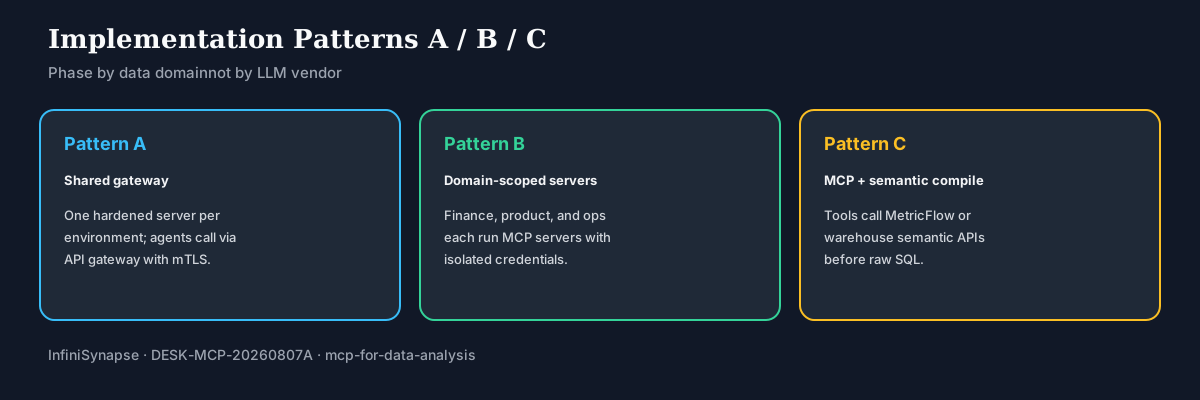 Patterns A/B/C—shared gateway, domain-scoped servers, or MCP plus semantic compile.
| Pattern | Description |
|---|---|
| A — Shared gateway | One hardened server per environment; agents call through API gateway with mTLS |
| B — Domain-scoped servers | Finance, product, and ops each operate MCP servers with isolated credentials |
| C — MCP + semantic compile | Tools call MetricFlow or warehouse semantic APIs before raw SQL |
Phase rollouts by data domain—not by LLM vendor. Week one: read-only metadata on staging. Week two: finance KPI tools only. Week three: expand run_query after security sign-off. Link operational access to Data Access Management for AI Analytics: A 2026 Playbook before granting write-capable tools broadly.
Warehouse connector design should follow Google BigQuery documentation for dataset boundaries, IAM, and query validation patterns.
InfiniSynapse Production Pattern
InfiniSynapse ships MCP-compatible tool surfaces for InfiniSQL, metric bindings, and InfiniRAG retrieval:
| Layer | Role |
|---|---|
| InfiniAgent | Plans multi-step analysis |
| MCP tools | Standardized query + metadata |
| InfiniSQL | Dialect-aware execution |
| Audit log | Replay tool args + results |
We recommend MCP for data analysis as the integration default when customers operate multiple LLM hosts or plan to swap models quarterly. Pilot teams should publish weekly tool latency histograms and blocked-query counts so executives see governance working—not only successful demo queries.
Security Review Pack for MCP Rollouts
Security teams evaluating this integration path ask the same five questions. Prepare answers before the review meeting:
| Question | Evidence to bring |
|---|---|
| Who can invoke tools? | IAM mapping diagram |
| What can tools mutate? | Tool schema with DDL blocked |
| Where do logs land? | SIEM sample with invocation ID |
| How are secrets stored? | Vault rotation policy |
| What fails closed? | Red-team prompt injection results |
Include sample MCP tool JSON schemas, a sanitized log line with agent identity and SQL hash, and a diagram showing the server sitting between LLM hosts and warehouse roles—not beside them with shared superuser credentials.
Reference connector boundaries from MCP for Databases: A 2026 Guide to Agent Data Access when security asks how MCP differs from legacy JDBC strings embedded in prompts. Reference Data Access Management for AI Analytics: A 2026 Playbook when they ask who approves new tool scopes.
Document rollback: how to disable run_sql globally within five minutes while leaving read-only metadata tools available for triage. Production programs earn trust when security sees kill switches, not only feature demos.
Teams that skip this pack usually rediscover the same review meeting after an incident—schedule the pack upfront instead.
After a ninety-day pilot, send executives one page with tools shipped, blocked queries, mean cost per session, and two replay logs. Version tool schemas for Claude Desktop, Cursor, and internal runtimes; document host limits in Effective Context Engineering for AI Agents: A Data Guide. Link access rollouts to Access Management for AI Data Agents: Roles and Controls before granting write-capable tools broadly.
EU security reviews should reference ENISA multilayer AI cybersecurity framework when scoping analytics agent controls.
Common Failure Modes
Failure 1 — Schema dump tools: Agents drown in tokens. Fix: curated resources + paginated discovery.
Failure 2 — Shared DB credentials: One compromised prompt exfiltrates all data. Fix: per-agent IAM.
Failure 3 — No cost caps: Agent loops scan terabytes. Fix: server-side budgets.
Failure 4 — Tools without semantics: Fluent wrong KPIs. Fix: compile metrics before exploratory SQL.
Before scaling org-wide, archive one successful and one failed pilot transcript with tool logs attached. Procurement should require MCP tool schemas and kill-switch runbooks in the evaluation room. Budget one senior data engineer at quarter-time for the first six months—schema drift and host upgrades often outlast initial server build. Review blocked-query trends weekly in pilot month one; publish latency histograms so executives see governance working. FinOps should treat agent sessions as a new BI workload class with thirty-day pre-rollout baselines. On-call runbooks must disable execution tools globally while metadata tools remain for triage.
Cluster guides in this pillar
| Focus | Guide |
|---|---|
| MCP for Databases | MCP for Databases: A 2026 Guide to Agent Data Access |
| How to Connect an AI Agent to a Database W | How to Connect an AI Agent to a Database With MCP (2026) |
| Effective Context Engineering for AI Agent | Effective Context Engineering for AI Agents: A Data Guide |
| Data Access for AI Agents | Data Access for AI Agents: Governance and Patterns (2026) |
| Data Accessibility for AI Analytics | Data Accessibility for AI Analytics: Principles and Practices |
| How AI Agents Handle Data Accessing Safely | How AI Agents Handle Data Accessing Safely in 2026 |
| Data Access Management for AI Analytics | Data Access Management for AI Analytics: A 2026 Playbook |
| Access Management for AI Data Agents | Access Management for AI Data Agents: Roles and Controls |
Frequently Asked Questions
Is MCP required for Data Agents?
No—but it reduces connector duplication when you run multiple agent hosts or models.
How does MCP differ from ODBC/JDBC?
Drivers move bytes; MCP defines agent-visible tool contracts, errors, and discovery for LLM planners.
Can MCP replace a semantic layer?
No. MCP transports calls; semantic layers govern metric meaning. Use both—see the in-page definitions above.
What is the first server to build?
Read-only metadata + governed KPI tool before open SQL.
Where do I learn database-specific MCP?
Start with MCP for Databases: A 2026 Guide to Agent Data Access. Step-by-step wiring lives in How to Connect an AI Agent to a Database With MCP (2026).
Use this page as your working reference for MCP for data analysis when briefing platform, security, and analytics leads on the same tool-contract roadmap.
Conclusion
MCP for data analysis gives teams a portable, auditable way to connect agents to warehouses and metrics—if servers enforce IAM, context limits, and semantic grounding. Protocol choice alone does not replace governance.
Next steps:
- Inventory data sources agents must reach in 90 days.
- Run the buyer scorecard on existing copilot connectors.
- Deep-dive MCP for Databases for warehouse servers.
- Read Data Access for AI Agents for governance patterns.
- Study Effective Context Engineering for AI Agents before widening tool scope.
Connect tools to orchestration that validates, logs, and replays every analysis path—not one-off prompts with superuser credentials. Document every tool schema change in the same change-management ticket as warehouse role updates so security and DBA teams review access together.
When your estate spans Postgres and a cloud warehouse, operate separate MCP servers per engine—shared mega-servers simplify demos but complicate IAM, pool tuning, and incident response.