Langchain Tool Calling Reddit: When Abstractions Help and Hide Risk
By William Zhu & the InfiniSynapse Data Team · Published: 2026-06-24 · Last updated: 2026-08-07 · About: Editorial standards · About / team · Vision
Author credentials: William Zhu is cofounder of InfiniSynapse (GitHub @allwefantasy; org GitHub InfiniSynapse). Desk experience: shipping LangChain/LangGraph tool agents that wrap production APIs (including InfiniSynapse Server tasks) with StructuredTool schemas, ToolNode safe wrappers, and checkpointed graphs. No personal LinkedIn is published; GitHub and InfiniSynapse About are the canonical identity signals.
COI / interest disclosure: InfiniSynapse publishes this guide and ships a Data Agent whose Server API can be wrapped as LangChain tools. Patterns below are labeled first-party where they come from our deployments. Product CTA is commercial and separate from the engineering checklist.
Version history: 2026-06-24 initial · 2026-07-03 refresh · 2026-08-07 EEAT / FAQ / Breadcrumb / H2–H3 / flowchart SVGs. Marker:
DESK-LTC-20260807A.
Table of Contents
- TL;DR
- Key Definition
- Core Binding Pipeline
- Agents and LangGraph
- Production Readiness
- Ops Patterns
- InfiniSynapse Connection
- Case Study: Ops Copilot
- FAQ
- References
- Conclusion
TL;DR
Direct answer: For langchain tool calling reddit threads, production agents need correct
bind_toolsusage, typedStructuredTooldefinitions, and explicitToolNodeexecution with validation—not default tutorial agents without timeouts or error shapes.
If you have spent time in r/LangChain, r/LocalLLaMA, r/OpenAI, and r/vibecoding, you have seen these arguments. Here is what held up when teams shipped LangChain tool agents—not notebook demos that never handle bad args.
- Stack:
StructuredTool→model.bind_tools(tools)→ AIMessagetool_calls→ToolNodeexecute →ToolMessageback to model. create_react_agentwraps the loop but still needs custom error handling and step caps.- LangGraph adds checkpointing around ToolNode—preferred when chains fail mid-flight.
- Provider differences (OpenAI vs Claude) stay in the chat model layer; tools stay provider-agnostic.
Who this is for: teams building on LangChain/LangGraph. What you'll learn: binding patterns, ToolNode, agents, scorecard, failure modes.
For wire formats see OpenAI Tool Calling and Claude Tool Calling. Verify APIs against the official LangChain tool calling how-to and LangGraph ToolNode docs.
Key Definition
Key Definition (standalone, citable): langchain tool calling reddit discussions usually mean LangChain’s tool binding pipeline—declaring tools, attaching them to chat models via
bind_tools, executing invocations through ToolNode or agent executors, and returningToolMessageresults for the next inference.
That pipeline matters when a notebook demo calls tools successfully but production crashes on schema drift, uncaught tool exceptions, or unbounded agent steps. Docs evolve quickly—pin package versions and re-read the how-to for your installed release. Core concepts: bind, invoke, ToolMessage.
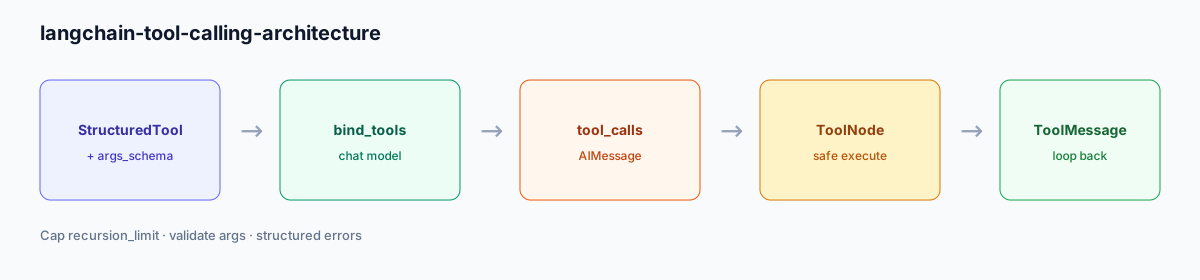 Architecture—schema-bound tools, model bind, ToolNode execution, ToolMessage feedback.
Core Binding Pipeline
StructuredTool and Schema Binding
Define tools with explicit schemas—quality starts here:
from langchain_core.tools import StructuredTool
from pydantic import BaseModel, Field

class LookupOrderInput(BaseModel):
    order_id: str = Field(description="UUID from confirmation email")

def lookup_order(order_id: str) -> dict:
    # runtime auth + HTTP here
    return {"status": "shipped"}

lookup_tool = StructuredTool.from_function(
    func=lookup_order,
    name="lookup_order",
    description="Fetch order status. Read-only; never create orders.",
    args_schema=LookupOrderInput,
)
Pydantic models generate JSON Schema for the model. Descriptions on fields matter as much as tool description—models read both.
Avoid @tool decorators without schemas on production paths unless args are zero-parameter—validation gaps show up first on enum fields.
bind_tools on Chat Models
Attach tools to the chat model:
from langchain_openai import ChatOpenAI

llm = ChatOpenAI(model="gpt-4o", temperature=0)
llm_with_tools = llm.bind_tools([lookup_tool, search_kb_tool])

response = llm_with_tools.invoke([
    {"role": "user", "content": "Where is order ord_9f2a?"}
])
Inspect response.tool_calls—list of { "name", "args", "id" } on recent LangChain versions (field names may vary slightly by provider wrapper). For provider wire formats, compare OpenAI function calling and Anthropic tool use.
For Anthropic:
from langchain_anthropic import ChatAnthropic

claude = ChatAnthropic(model="claude-sonnet-4-20250514")
claude_with_tools = claude.bind_tools([lookup_tool])
Tip: keep one tool list per agent persona; swapping tools mid-graph requires re-bind or dynamic graph nodes—see LangGraph Workflow.
tool_choice passthrough varies by integration—consult provider-specific LangChain docs for forced tool invocation in tests.
ToolNode Execution
ToolNode runs tool_calls from an AIMessage and returns ToolMessages:
from langgraph.prebuilt import ToolNode

tool_node = ToolNode([lookup_tool, search_kb_tool])

# state contains messages with AIMessage tool_calls
result = tool_node.invoke({"messages": [ai_message_with_tool_calls]})
# result["messages"] appended with ToolMessage per call
Wrap underlying functions with try/except—return JSON error dict instead of raising:
def safe_lookup(order_id: str) -> dict:
    try:
        return lookup_order(order_id)
    except Exception as e:
        return {"error": "execution_failed", "message": str(e)}
ToolNode passes return value to ToolMessage content—structured errors let the model replan.
For parallel tool_calls in one AIMessage, ToolNode executes all—confirm concurrency meets your backend limits; add semaphores for rate-limited APIs.
Agents and LangGraph
create_react_agent Pattern
Prebuilt ReAct agent (LangGraph):
from langgraph.prebuilt import create_react_agent

agent = create_react_agent(llm_with_tools, [lookup_tool, search_kb_tool])

result = agent.invoke(
    {"messages": [("user", "Find order ord_9f2a and summarize return policy")]},
    config={"recursion_limit": 15},
)
Production changes to defaults:
- Set
recursion_limitexplicitly—default may be too high for serverless - Add middleware or custom ToolNode for validation logging
- Stream with
agent.streamfor UX; still validate before execute on streamed tool_calls
create_react_agent does not replace auth, idempotency, or write approval—you implement those inside tool functions or a wrapping ToolNode.
Compare loop design with Agentic Orchestration.
LangGraph Integration
For checkpointed flows:
from langgraph.graph import StateGraph, MessagesState, END

graph = StateGraph(MessagesState)
graph.add_node("agent", call_model)      # bind_tools inside
graph.add_node("tools", tool_node)
graph.add_edge("tools", "agent")
graph.add_conditional_edges("agent", should_continue, {"tools": "tools", END: END})
app = graph.compile(checkpointer=memory)
Checkpoint after ToolNode—resume long chains without re-running side effects when using idempotent tools.
Event-driven resume pairs with InfiniSynapse SSE: external event triggers app.invoke with new ToolMessage injected—see Agentic AI Orchestration.
Migrating From Legacy AgentExecutor
Older code used AgentExecutor + create_tool_calling_agent. Migration path:
- Replace with LangGraph
create_react_agentor custom StateGraph - Map
return_intermediate_steps=Trueto checkpoint + message history - Port custom
handle_parsing_errorsto ToolNode wrappers - Set
recursion_limitwheremax_iterationslived
Do not run both executors in production—tracing and error shapes diverge.
Production Readiness
Production Hardening
Checklist beyond tutorials for langchain tool calling reddit production debates:
| Concern | Pattern |
|---|---|
| Timeouts | asyncio.wait_for inside async tools |
| Retries | Tenacity on transient HTTP only—not on validation errors |
| Logging | LangSmith or OpenTelemetry callbacks on tool start/end |
| Secrets | Tools read env at execute; never pass keys in args |
| Result size | Truncate ToolMessage content before next agent node |
| Version lock | Pin langchain-core + provider packages in CI |
Validate args with Pydantic before side effects—even when the model already emitted structured calls. For independent observability patterns, see OpenTelemetry and LangChain’s LangSmith tracing docs.
Readiness Scorecard
Rate readiness (1 point each):
| Check | Pass? |
|---|---|
| Tools use StructuredTool + args_schema | |
| bind_tools on correct provider chat model | |
| ToolNode or equivalent catches exceptions | |
| recursion_limit / max steps configured | |
| ToolMessage errors are structured JSON | |
| Parallel tool_calls rate-limited if needed | |
| LangGraph checkpoint if chains exceed 5 steps | |
| Callbacks export tool latency metrics | |
| Write tools gated inside function body | |
| Integration tests with bad args + tool downtime |
8–10: production beta. 5–7: pilot one agent. Below 5: fix ToolNode errors before launch.
Failure Modes
Failure 1: Raw exceptions in ToolNode — agent crash. Fix: safe wrappers returning error dict.
Failure 2: Unbounded recursion_limit — runaway cost. Fix: cap + circuit breaker.
Failure 3: Schema-less @tool — arg hallucination. Fix: Pydantic args_schema.
Failure 4: Giant ToolMessage — context overflow. Fix: summarize results.
Failure 5: Provider mismatch — Claude model with OpenAI-only tool_choice hacks. Fix: use langchain-anthropic bind path.
Failure 6: Skipping validation — trusting model args for SQL. Fix: validate + read-only roles.
Observability Checklist
| Signal | Action |
|---|---|
| ToolMessage parse errors | Alert—often provider SDK mismatch |
| recursion_limit hits | Review prompt or add compression |
| p95 tool latency by name | Capacity or vendor ticket |
| Invalid args rate | Schema/description PR |
Add golden agent.invoke tests to release pipeline—regressions frequently ship as innocent dependency bumps without running tool binding tests against frozen prompts.
Document which environment variables each StructuredTool reads at import vs execute time; import-time secret reads break CI and leak keys in stack traces.
Keep a changelog entry template for tool description edits—teams need to correlate wrong-tool spikes with schema PR dates, not model release dates.
Run load tests on ToolNode with five parallel tool_calls before launch—default concurrency may exceed downstream rate limits hidden in happy-path demos.
Ops Patterns
Testing LangChain Tools in CI
def test_lookup_order_schema_rejects_bad_id():
    with pytest.raises(ValidationError):
        LookupOrderInput(order_id="")

def test_tool_node_returns_error_dict(monkeypatch):
    monkeypatch.setattr("app.tools.lookup_order", lambda _: (_ for _ in ()).throw(RuntimeError("down")))
    out = tool_node.invoke({"messages": [fake_ai_tool_call("lookup_order", {"order_id": "x"})]})
    assert "error" in out["messages"][-1].content
CI should include bad-args and down-tool cases—not only happy paths.
Operating Model
- Pin langchain-core, langgraph, provider packages monthly
- LangSmith project per environment with tool latency alerts
- One CODEOWNERS on
tools/registry - Review new StructuredTool descriptions like API schema PRs
Provider Switching With LangChain
Same tools bound to different chat models for failover:
def build_agent(primary: str):
    if primary == "openai":
        llm = ChatOpenAI(model="gpt-4o").bind_tools(tools)
    else:
        llm = ChatAnthropic(model="claude-sonnet-4-20250514").bind_tools(tools)
    return create_react_agent(llm, tools)
Tools stay identical; only the chat model wrapper changes. Validate both paths in CI—provider failover is worthless if Claude path never tested ToolMessage shape.
See LLM Tool Calling for cross-provider comparison tables.
Async Tools in LangGraph
Long tools should not block the event loop:
@tool
async def run_heavy_analysis(query: str) -> dict:
    task_id = await enqueue_job(query)
    return {"status": "queued", "task_id": task_id}
Resume graph when webhook or SSE fires—inject ToolMessage with final artifact. Graphs that poll inside tool functions burn worker threads and hide latency in wrong spans.
LangChain RunnableConfig callbacks attach user/session IDs to every tool span—wire them in create_react_agent invocations so support can trace one bad production run without reproducing locally.
When upgrading langchain-core minor versions, re-run tool binding tests—schema serialization for bind_tools has broken teams on patch bumps who skipped CI.
Prefer explicit MessagesState reducers over default append if you inject system reminders mid-graph—duplicate ToolMessages from reducer bugs look like model irrationality in support tickets.
Packaging and Deployment
Ship tools as importable modules with lazy registration—hard-coded tool lists in agent files fork across microservices. A shared tools/registry.py keeps behavior consistent when API workers and batch jobs invoke the same graph.
Container images should pin Python, langchain-core, and provider SDK together; document upgrade runbook with regression prompts that must pass before promote.
For serverless, cold start plus tool import time dominates short queries—warm pools or minimal tool sets on latency-sensitive routes beat 40-tool agents on every invocation.
InfiniSynapse Connection
Product recommendation (commercial)
Label: The following is a commercial product recommendation, separate from the editorial checklist above.
For data agents: StructuredTool wrapping InfiniSynapse Server API newTask; ToolNode returns download URL; LangGraph checkpoint waits for async SSE before next agent node.
Federated query tools via InfiniSQL fit the same pattern—one tool per capability, sharp descriptions. Try at https://app.infinisynapse.com/.
Case Study: Ops Copilot
Desk pilot (first-party)
An internal ops team shipped a LangGraph tool agent: five StructuredTools, create_react_agent baseline migrated to a custom graph with checkpointing. This is a first-party InfiniSynapse desk composite—not a named customer logo or third-party review.
Stack: GPT-4o, ToolNode with safe wrappers, recursion_limit 14, LangSmith traces.
Measured pilot (400 queries/month):
- End-to-end p50: 18s
- Correct tool selection vs logged intent: 89%
- Agent exceptions after safe wrappers: near zero (from 23/week)
- Checkpoint resume success after deploy interrupt: 100% in test suite
- Engineer hours saved vs ad-hoc scripts: ~12 hrs/month
Biggest win: StructuredTool schemas + explicit recursion_limit—not upgrading the base model. That result matches what serious langchain tool calling reddit threads argue after the first outage: schemas and step caps beat “just use a bigger model.”
When you re-run the pilot script, force a mid-flight tool timeout and confirm the graph resumes from checkpoint without replaying side effects. Treat that resume test as a release gate—alongside bad-args and down-tool CI cases—before promoting a new langchain-core pin.
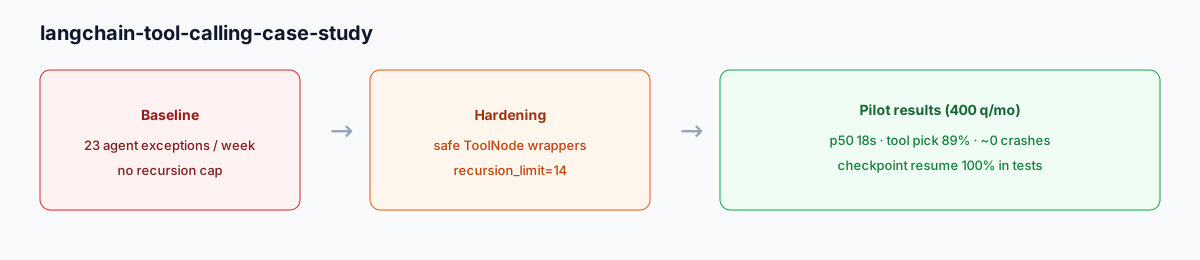 Case study flow—safe wrappers and recursion caps beat model upgrades for stability.
Frequently Asked Questions
What does langchain tool calling reddit usually mean?
Summary: Community shorthand for LangChain’s bind → ToolNode → ToolMessage pipeline. Threads in r/LangChain and related subs debate schemas, recursion limits, and provider wrappers—not a separate product.
Do I need LangGraph for every agent?
Summary: No. Start with create_react_agent if the loop is short; move to a custom StateGraph with checkpoints when chains exceed a handful of steps or need resume after deploy interrupts.
How do I stop ToolNode from crashing the agent?
Summary: Never raise raw exceptions from tool functions—return structured error dicts the model can replan on. Cap recursion_limit and rate-limit parallel tool_calls.
Should I use @tool or StructuredTool?
Summary: Prefer StructuredTool + Pydantic args_schema on production paths. Schema-less decorators are fine for zero-arg utilities only.
How do OpenAI and Claude differ under LangChain?
Summary: Tools stay the same; chat model wrappers differ. Validate both bind paths in CI. See OpenAI and Anthropic primary docs linked in References.
References
- LangChain — How to use tools — https://python.langchain.com/docs/how_to/tool_calling/
- LangGraph — How to call tools — https://langchain-ai.github.io/langgraph/how-tos/tool-calling/
- OpenAI — Function calling — https://platform.openai.com/docs/guides/function-calling
- Anthropic — Tool use — https://docs.anthropic.com/en/docs/agents-and-tools/tool-use/overview
- LangSmith — Tracing — https://docs.smith.langchain.com/
- OpenTelemetry — Documentation — https://opentelemetry.io/docs/
- InfiniSynapse — Editorial standards — https://infinisynapse.com/en/editorial-standards
Conclusion
langchain tool calling reddit is bind → invoke → ToolNode → ToolMessage, with Pydantic schemas, error-shaped returns, step caps, and LangGraph checkpoints for longer chains.
Master provider wire formats in Tool Calling; add orchestration from Tool Chaining when steps depend on prior outputs.