
Quick Answer: What Is Inventory Optimization?快速回答:什么是库存优化?
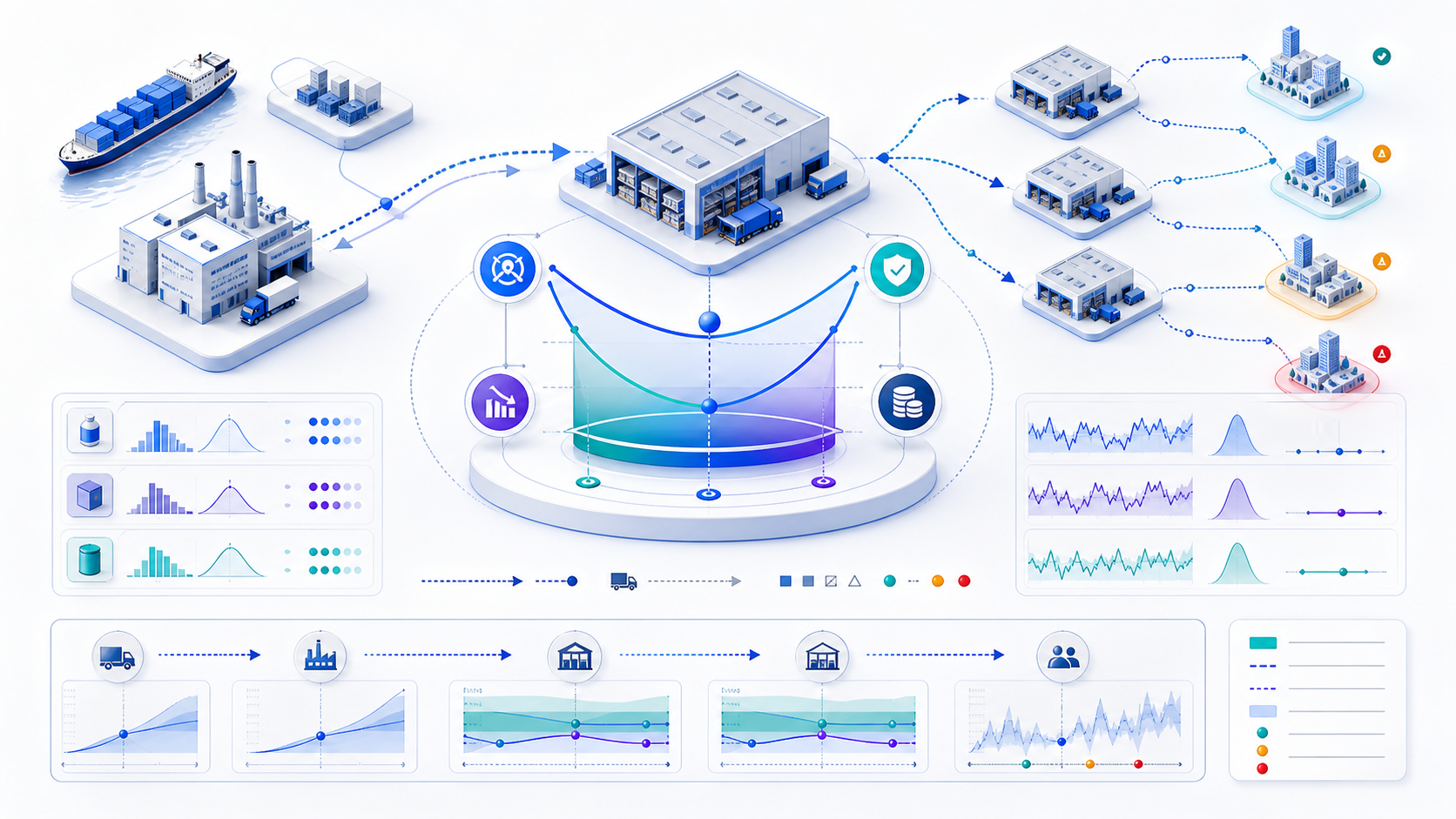
Inventory optimization is the governed process of setting where and how much inventory to hold, when to replenish it and in what quantity so defined service objectives are met at acceptable cost and risk. It combines demand and lead-time uncertainty, inventory status, supply options, service policies, item economics and network constraints to recommend target stock, safety stock, reorder points, review rules and placement by product and location.
库存优化是一个受治理流程,用于决定库存放在哪里、持有多少、何时补货以及每次补多少,从而以可接受的成本和风险实现明确服务目标。它连接需求与提前期不确定性、库存状态、供应方案、服务政策、物品经济性和网络约束,为不同产品与地点推荐目标库存、安全库存、补货点、评审规则和库存布局。
Optimization does not mean minimizing inventory everywhere. A lower buffer can increase stockouts, expedites and lost service; a higher buffer consumes cash and raises storage, damage and obsolescence risk. The useful result is a documented trade-off and a policy that can be simulated, approved, executed in planning systems and measured against actual demand and supply.
优化并不意味着在所有地方压低库存。更低缓冲可能增加缺货、加急与服务损失;更高缓冲则占用现金并提高仓储、损坏和呆滞风险。真正有用的结果是有记录的权衡,以及能够被模拟、批准、在计划系统中执行并用实际供需验证的政策。
1. Inventory Optimization Objectives and Decision Scope1. 库存优化的目标与决策范围
Start with the service promise and decision boundary. Which demand must be served, from which locations, within what response time and with which exceptions? Then define the controllable decisions: safety stock, reorder point, order-up-to level, lot size, review frequency, sourcing rule, inventory location or postponement point. A policy for a stable finished good in one warehouse is different from a policy for an intermittent spare part or a component shared across plants.
应从服务承诺和决策边界开始:哪些需求必须被满足、由哪些地点供应、响应时间是多少、允许哪些例外?随后定义可控制决策,包括安全库存、补货点、订货至水平、批量、评审频率、来源规则、库存地点或延迟点。单仓稳定成品的政策,与间歇需求备件或跨工厂共享零部件的政策完全不同。
Specify the grain, horizon and timing. Item-location-day policies support operational replenishment; category-region-month scenarios may support budgeting or S&OP. State whether quantities are physical on hand, net available, available to promise, in transit, blocked, expired or committed. Include review period, order and inbound processing time, supplier lead time and transport time. Ambiguous inventory measures lead to precise but unusable recommendations.
必须明确粒度、期限与时序。物品—地点—日政策支持运营补货;品类—区域—月情景可能服务预算或 S&OP。说明数量是实物现有、净可用、可承诺、在途、冻结、过期还是已占用,并包含评审周期、下单与入库处理时间、供应商提前期及运输时间。含糊库存指标会产生精确却不可用的建议。
Probability or quantity of demand served within a defined window.
在明确时间窗口内满足需求的概率或数量。
Cycle, safety, pipeline and excess stock in units and value.
以数量和价值衡量的周期、安全、在途与过量库存。
Stockout, disruption, expiry, obsolescence and concentration.
缺货、中断、过期、呆滞与集中风险。
Target, buffer, trigger, quantity, placement and review rule.
目标、缓冲、触发、数量、布局与评审规则。
2. Inventory Optimization vs Management, Planning and Replenishment2. 库存优化与管理、计划及补货的区别
Inventory management is the broader discipline of tracking, controlling, storing, counting and using inventory. Inventory planning converts demand, supply and policies into time-phased requirements. Inventory replenishment decides or executes when and how much to order under an approved policy. Optimization evaluates alternative policies and placements against service, uncertainty, cost and constraints.
库存管理是跟踪、控制、存储、盘点与使用库存的广义纪律;库存计划把需求、供应与政策转化为分时需求;库存补货依据批准政策决定或执行何时、补多少;库存优化则根据服务、不确定性、成本与约束评估不同政策和布局。
Inventory control formulas are components, not the whole optimization problem. A safety stock formula estimates a buffer under assumptions. A reorder point combines expected demand during protection time with a buffer. Economic order quantity trades ordering and holding costs under a simplified steady-state model. Multi-echelon optimization considers how stock at one node affects service and risk at others.
库存控制公式只是组成部分,不是完整优化问题。安全库存公式在特定假设下估计缓冲;补货点把保护期预期需求与缓冲结合;经济订货量在简化稳态模型中权衡订货与持有成本;多级库存优化则考虑一个节点的库存如何影响其他节点的服务与风险。
| Process流程 | Primary question核心问题 | Output输出 |
|---|---|---|
| Management管理 | What inventory exists and how is it controlled?存在哪些库存,如何控制? | Records, controls and execution记录、控制与执行 |
| Planning计划 | What supply is needed over time?不同时期需要什么供应? | Time-phased requirements and exceptions分时需求与异常 |
| Replenishment补货 | When and how much should be ordered?何时以及补多少? | Planned or released replenishment计划或已释放补货 |
| Optimization优化 | Which policy best balances service, cost and risk?哪项政策最能平衡服务、成本与风险? | Recommended targets, placement and scenarios推荐目标、布局与情景 |
3. Inventory Optimization Data and Prerequisites3. 库存优化的数据与前提
Core inputs include dated demand or consumption, unconstrained demand where stockouts censor sales, forecasts and forecast versions, on-hand and inventory status, open orders, receipts, transfers, backorders and returns. Add product-location master data, units, pack sizes, shelf life, substitutions, bills of material, sourcing, calendars and lifecycle. Preserve demand-event flags for promotions, launches, end-of-life and one-time orders.
核心输入包括带日期需求或消耗、缺货导致销售受限时的无约束需求、预测及版本、现有库存与状态、开放订单、收货、调拨、欠单和退货;还需加入产品—地点主数据、单位、包装量、保质期、替代关系、物料清单、来源、日历与生命周期,并保留促销、新品、退市和一次性订单等需求事件标记。
Lead time must be measured from the policy's order trigger to usable availability, not copied blindly from a supplier master. Separate order processing, supplier production, queue, transport, border, receiving and quality-release time where decisions can affect them. Store requested, confirmed and actual timestamps. Cancelled orders, expedites and partial receipts can bias history if excluded without explanation.
提前期应从政策触发下单开始,衡量到库存可用为止,不能盲目复制供应商主数据。对于可影响的环节,应拆分下单处理、供应商生产、排队、运输、边境、收货与质量放行时间,并保存要求、确认和实际时间戳。取消订单、加急和部分收货如果被无说明排除,会扭曲历史。
Economic inputs may include unit value, holding-rate components, order or setup cost, transfer cost, expedite cost, markdown, disposal, lost-margin proxy and capacity or budget constraints. These values are uncertain and politically sensitive; document source and sensitivity instead of presenting one total cost as fact. Optimization also needs approved service definitions, ownership and the execution system that will consume the policy.
经济输入可能包括单位价值、持有率构成、订货或设置成本、调拨成本、加急成本、降价、处置、损失毛利代理,以及产能或预算约束。这些数值具有不确定性且可能敏感,应记录来源与敏感性,而不能把单一总成本作为事实。优化还需要批准的服务定义、责任归属以及消费政策的执行系统。
4. SKU-Location Segmentation for Inventory Policies4. 面向库存政策的 SKU—地点分层
One policy rarely fits an entire portfolio. Segment at the decision grain, usually item-location, because the same product may be stable in one region and intermittent in another. ABC segmentation commonly uses annual consumption value or another business-value measure. XYZ can represent demand variability or predictability. Add criticality, margin, substitution, shelf life, lifecycle, supply risk, lead time and customer commitment where they materially change the policy.
一种政策很少适合整个组合。应在决策粒度上分层,通常为物品—地点,因为同一产品在一个区域可能稳定,在另一个区域却呈间歇需求。ABC 常按年度消耗价值或其他业务价值衡量;XYZ 可表示需求波动或可预测性;当关键性、毛利、替代性、保质期、生命周期、供应风险、提前期和客户承诺会实质改变政策时,也应加入。
Use segments to assign modeling and review rules, not to replace analysis. High-value stable items may justify frequent review and tight parameter validation. Low-value intermittent critical spares may need a service-risk model rather than a normal-demand formula. New products need analogs and scenarios; end-of-life items need declining demand, final-buy and residual-risk logic. Review segment migration so a stale classification does not freeze the wrong policy.
分层用于分配建模与评审规则,而不能替代分析。高价值稳定物品可能需要高频评审与严格参数验证;低价值但间歇且关键的备件可能需要服务风险模型,而非正态需求公式;新品需要类比与情景;退市物品需要下降需求、最后采购与剩余风险逻辑。应复核分层迁移,避免陈旧分类固化错误政策。
ABC is not a service policy. Revenue or consumption value alone does not capture criticality, substitution, margin, variability or shortage consequence. Use segmentation as a routing layer for policy decisions.
ABC 本身不是服务政策。收入或消耗价值不能单独反映关键性、替代性、毛利、波动与短缺后果。应把分层作为政策决策的路由层。
5. Modeling Demand and Lead-Time Uncertainty5. 建模需求与提前期不确定性
A point forecast is not enough. Inventory buffers respond to the distribution of demand over the protection period: replenishment lead time plus any review interval during which a new order cannot protect service. Use forecast errors at the same horizon, grain and information cutoff as the policy. A one-week error cannot represent a twelve-week replenishment horizon without an aggregation model. Signed bias should be addressed before adding buffer for random variation.
点预测并不足够。库存缓冲响应保护期内的需求分布,保护期由补货提前期加上无法通过新订单保护服务的评审间隔构成。应使用与政策相同期限、粒度和信息截止点的预测误差;如果没有聚合模型,一周误差不能代表十二周补货期限。对于有符号偏差,应先修正系统性问题,再为随机变化增加缓冲。
Lead-time uncertainty often matters as much as demand variability. Model the distribution by supplier, lane, item class and order condition where samples permit. Distinguish ordinary variation from structural events such as shutdowns, strikes or launches; use scenarios for rare disruptions rather than forcing all risk into a standard deviation. Correlation also matters: demand or supply shocks may affect many items and locations simultaneously.
提前期不确定性往往与需求波动同样重要。在样本允许时,应按供应商、路线、物品类别和订单条件建模分布。区分普通变化与停产、罢工或上市等结构性事件;对罕见中断使用情景,而不是把所有风险塞进标准差。相关性也很重要,需求或供应冲击可能同时影响多个物品和地点。
Intermittent, lumpy, seasonal, promotional, perishable and constrained demand need specialized treatment. The normal approximation can produce misleading buffers when distributions are skewed or zero-heavy. Compare empirical simulation, intermittent-demand methods or scenario policies with simple benchmarks. Backtest not only average service but the tail, because a policy can look adequate overall while repeatedly failing during critical periods.
间歇、块状、季节、促销、易腐和受限需求需要专门处理。当分布偏斜或大量为零时,正态近似可能产生误导性缓冲。应把经验模拟、间歇需求方法或情景政策与简单基准比较,并不仅回测平均服务,还要检查尾部,因为一项政策总体看似足够,却可能在关键时期反复失败。
6. An Eight-Step Inventory Optimization Workflow6. 八步库存优化工作流
- Define service and scope.定义服务与范围。 Specify demand class, grain, horizon, response window, decision rights and constraints.明确需求类别、粒度、期限、响应窗口、决策权限与约束。
- Reconcile inventory and flows.对账库存与流量。 Validate status-aware stock, open supply, demand, units, locations and object identities.验证带状态库存、开放供应、需求、单位、地点与对象身份。
- Segment the portfolio.对组合分层。 Group item-locations by value, variability, criticality, lifecycle and supply characteristics.按价值、波动、关键性、生命周期与供应特征划分物品—地点。
- Estimate uncertainty.估计不确定性。 Measure forecast and lead-time distributions at the policy horizon and information cutoff.在政策期限与信息截止点衡量预测及提前期分布。
- Generate policy candidates.生成政策候选。 Calculate buffers, triggers, order quantities, placement and review rules under explicit assumptions.在明确假设下计算缓冲、触发、订购量、布局与评审规则。
- Simulate scenarios and constraints.模拟情景与约束。 Compare service, stock, cost and risk under demand, lead-time, budget, capacity and shelf-life conditions.比较不同需求、提前期、预算、产能与保质期条件下的服务、库存、成本和风险。
- Approve and deploy policies.批准并部署政策。 Record version, owner, exceptions and effective dates; transfer approved values to planning systems.记录版本、责任人、例外与生效日期,并把批准数值交给计划系统。
- Monitor and learn.监控并学习。 Compare achieved service, inventory and exceptions with the frozen recommendation; recalibrate material changes.把实际服务、库存与异常同冻结建议比较,并对重大变化重新校准。
7. Choosing the Right Inventory Service-Level Definition7. 选择正确的库存服务水平定义
“95% service” is incomplete without a definition. Cycle service level is the probability that a replenishment cycle has no stockout. Fill rate measures the share of demand quantity served immediately from stock. Order-line or case fill, on-time-in-full and ready rate answer different questions. Two policies can have the same cycle service but different shortage quantities, or the same fill rate with different customer impact.
“95% 服务”如果没有定义是不完整的。周期服务水平表示一个补货周期不发生缺货的概率;满足率衡量需求数量中由库存立即满足的比例;订单行或箱级满足、OTIF 与备货率则回答不同问题。两项政策可能具有相同周期服务却产生不同短缺数量,也可能具有相同满足率却对客户造成不同影响。
Assign targets by segment and business consequence. Criticality, substitution, margin, customer commitment, response time and shortage recovery influence the target. Higher service normally requires more buffer, and the incremental inventory can rise sharply near the upper tail. Show the service–inventory curve and test alternatives instead of setting 99% for every item. Aggregate targets must also be checked at item-location level so poor service is not hidden by easy volume.
应按分层与业务后果分配目标。关键性、替代性、毛利、客户承诺、响应时间与短缺恢复都会影响目标。更高服务通常需要更多缓冲,接近分布上尾时增量库存可能急剧上升。应展示服务—库存曲线并测试替代方案,而不是为所有物品设置 99%。聚合目标还必须在物品—地点层检查,避免容易满足的大量需求掩盖低服务。
8. Safety Stock, Reorder Points and Policy Assumptions8. 安全库存、补货点与政策假设
Under a simplified continuous-review model with independent normal demand and constant lead time, safety stock is often expressed as z multiplied by the standard deviation of demand during lead time. The reorder point is expected demand during lead time plus safety stock. If both demand and lead time vary, the protection-period variance must reflect both. A periodic-review policy also includes demand during the review interval. These formulas depend on the selected service definition and assumptions.
在简化的连续评审模型中,如果需求独立且服从正态分布、提前期固定,安全库存通常表示为 z 值乘以提前期需求标准差;补货点等于提前期预期需求加安全库存。如果需求与提前期都变化,保护期方差必须反映两者;定期评审政策还要包括评审间隔内需求。这些公式依赖所选服务定义与假设。
Do not add separate safety factors for forecast error, lead-time risk and a managerial cushion without checking overlap; double counting produces excess stock. Conversely, using average lead time and raw sales can understate risk when receipts are variable or stockouts censor demand. Validate units, calendars, variance aggregation, z-score mapping and rounding. Document minimum order quantities, pack sizes and expiration limits before turning a mathematical target into an executable policy.
不能在未检查重叠时分别为预测误差、提前期风险和管理缓冲添加安全系数,否则会重复计算并产生过量库存。相反,当收货波动或缺货抑制需求时,使用平均提前期与原始销售又会低估风险。应验证单位、日历、方差聚合、z 值映射与取整,并在把数学目标变为可执行政策前记录最小订购量、包装量与过期限制。
A safety-stock calculation is a policy hypothesis. Freeze its inputs and assumptions, simulate it, deploy with controls and compare achieved service and stock with the expected result.
安全库存计算是一项政策假设。应冻结输入与假设,进行模拟,带控制部署,并把实际服务与库存同预期结果比较。
9. Order Quantities, EOQ and Practical Constraints9. 订购量、EOQ 与实际约束
Order quantity determines cycle inventory and workload. The classic EOQ balances a fixed order or setup cost with holding cost under assumptions such as stable demand, constant cost, immediate replenishment and no shortages. It is a useful benchmark, not a universal answer. Transportation brackets, supplier minimums, production campaigns, capacity, pallet layers, shelf life and calendar constraints can dominate the mathematical optimum.
订购量决定周期库存与工作负荷。经典 EOQ 在稳定需求、固定成本、即时补货和不允许短缺等假设下,平衡固定订货或设置成本与持有成本。它是有用基准,而不是普遍答案。运输价格档、供应商最低量、生产批次、产能、托盘层数、保质期与日历约束可能比数学最优值更重要。
Evaluate feasible candidates after rounding to executable quantities. Calculate average and peak inventory, orders per period, capacity use, expiration exposure, total landed cost and service. For slow or expensive items, a lot-for-lot or periodic policy may outperform EOQ. For shared components, coordinated ordering may reduce setups but increase concentration. Keep the trigger decision separate from the batch decision even when an ERP stores both in one item policy.
对可执行数量取整后再评估可行候选,计算平均与峰值库存、周期订单数、产能使用、过期暴露、总到岸成本与服务。对于慢速或高价物品,逐批或定期政策可能优于 EOQ;对于共享零部件,协调订货可以减少设置,却可能增加集中。即使 ERP 把触发与批量都存储在同一物品政策中,也应把两项决策分开分析。
10. Multi-Echelon Inventory Optimization and Placement10. 多级库存优化与布局
Single-echelon calculations optimize each location independently and can duplicate buffers across a network. Multi-echelon inventory optimization considers upstream and downstream dependencies, cumulative lead times, service commitments, pooling and replenishment relationships. A central buffer can pool demand variability, but it may increase response time. Downstream stock can protect fast service, but it is fragmented and harder to redeploy.
单级计算独立优化每个地点,可能在网络中重复缓冲。多级库存优化考虑上下游依赖、累计提前期、服务承诺、风险池化与补货关系。中央缓冲可以汇聚需求波动,却可能增加响应时间;下游库存可保护快速服务,但更分散且更难重新部署。
Define the network, sourcing alternatives, bill-of-material or distribution relationships, service times, costs, capacities and postponement options. Evaluate where product differentiation occurs. Holding common components upstream may reduce total uncertainty exposure when final demand is diverse, while finished goods near customers may be necessary for immediate service. Results are sensitive to correlation and transfer assumptions, so compare the optimized network with current and simple policies.
应定义网络、替代来源、物料清单或分销关系、服务时间、成本、产能与延迟选项,并评估产品差异化发生的位置。当最终需求多样时,在上游持有通用零部件可以降低总体不确定性暴露;而若需要即时服务,则可能必须在客户附近持有成品。结果对相关性与调拨假设敏感,因此应把优化网络同当前政策及简单政策比较。
11. Scenario Planning, Lifecycle and Policy Constraints11. 情景规划、生命周期与政策约束
Optimization should expose trade-offs across coherent scenarios. Test base, upside, downside and disruption cases with aligned demand, lead time, availability and cost assumptions. Add budget, warehouse capacity, production minimums, supplier constraints, shelf life and customer priorities. A recommendation that violates a hard constraint is not deployable; a soft constraint should show its penalty and the value of relaxing it.
优化应通过一致情景暴露权衡。测试基准、上行、下行与中断情景,并协调需求、提前期、可用性与成本假设;加入预算、仓库容量、生产最低量、供应商约束、保质期与客户优先级。违反硬约束的建议无法部署;对于软约束,应展示其惩罚以及放宽约束的价值。
Lifecycle overrides require expiry and evidence. Launch policies may use analog ranges and staged commitments. Promotions need base demand, incremental lift, prebuild, residual stock and post-event decay. End-of-life policies need last-buy scenarios, service horizon, substitution and disposal exposure. Perishables require age buckets and waste, not only total units. Record which values are model outputs and which are approved business overrides.
生命周期调整需要失效日期与证据。上市政策可使用类比区间与分阶段承诺;促销需要基准需求、增量提升、预建库存、剩余库存与活动后衰减;退市政策需要最后采购情景、服务期限、替代与处置暴露;易腐品需要库龄桶与浪费,而不仅是总数量。应记录哪些数值来自模型,哪些是批准的业务调整。
12. Inventory Optimization KPIs and Validation12. 库存优化 KPI 与验证
Measure service, inventory, cost, risk and process together. Service measures include fill rate, cycle service, line fill, stockout duration, backorder age and OTIF where relevant. Inventory measures include average and peak units, value, safety and cycle stock, excess, obsolete and aged stock. Inventory turnover ratio and days inventory outstanding are useful financial efficiency views but should not replace SKU-location service analysis.
应同时衡量服务、库存、成本、风险与流程。服务指标包括满足率、周期服务、订单行满足、缺货持续时间、欠单库龄及相关 OTIF;库存指标包括平均与峰值数量、价值、安全与周期库存、过量、呆滞及库龄。库存周转率和库存周转天数是有用财务效率视图,但不能替代 SKU—地点服务分析。
Cost measures can include holding, ordering, transfer, expedite, markdown and disposal, with documented assumptions. Risk measures include shortage exposure, expiry probability, supplier or lane concentration and tail scenarios. Process metrics include data readiness, recommendation coverage, override rate, approval latency, policy age and execution adherence. Diagnose deviations: a good policy can fail if the execution system uses stale values or orders are not released.
成本指标可包括持有、订货、调拨、加急、降价与处置,并记录假设;风险指标包括短缺暴露、过期概率、供应商或路线集中与尾部情景;流程指标包括数据就绪、建议覆盖、调整率、批准延迟、政策年龄与执行遵从。应诊断偏差:如果执行系统使用陈旧数值或订单未释放,即使政策良好也会失败。
Backtest policies on frozen historical cutoffs so they never use future information. Compare current policy, simple benchmark and candidate on the same demand and supply paths. Use rolling origins and segment results. Simulate operational constraints and validate target service against achieved service with uncertainty intervals. After deployment, preserve the approved version and measure actual outcomes before recalibration.
政策回测必须使用冻结历史截止点,不能使用未来信息。把当前政策、简单基准与候选放在相同供需路径上比较,采用滚动起点并按分层展示结果。模拟运营约束,并用不确定区间比较目标服务与实际服务。部署后应保留批准版本,在重新校准前衡量实际结果。
13. Worked Example: Item-Location Policy Review13. 示例:物品—地点政策评审
Consider a hypothetical distributor reviewing one stable item at a regional warehouse. Average demand is 100 units per day, replenishment lead time averages 10 days, and the current policy holds 700 units of safety stock. The team does not immediately reduce stock. It first confirms that demand is unconstrained, validates lead-time timestamps, defines fill rate as the service objective and freezes the policy cutoff.
假设某分销商评审区域仓库中的一个稳定物品。平均需求为每天 100 件,补货提前期平均 10 天,当前政策持有 700 件安全库存。团队不会立即降低库存,而是先确认需求未受缺货限制,验证提前期时间戳,把满足率定义为服务目标并冻结政策截止点。
Historical simulation shows the existing policy achieved 99.5% fill rate, above the approved 97.5% target, but several late receipts occurred together. Candidate A lowers the buffer substantially under an independent normal model and fails disruption weeks. Candidate B uses empirical protection-period demand and a supplier-delay scenario, recommending 520 units with an exception trigger when confirmed lead time exceeds its normal band. Numbers are illustrative, not a benchmark.
历史模拟显示,现有政策实现 99.5% 满足率,高于批准的 97.5% 目标,但多次迟到收货存在聚集。候选 A 使用独立正态模型大幅降低缓冲,却在中断周失败;候选 B 使用经验保护期需求与供应商延误情景,建议 520 件,并在确认提前期超过正常区间时触发异常。数字仅为示例,不是基准。
The team deploys Candidate B for a controlled period, preserving pack-size rounding and supplier minimums. It monitors fill rate, backorders, average inventory, expedites, policy adherence and delay-trigger performance. If service remains within its interval and execution is compliant, the evidence supports wider rollout. If not, the team can identify whether uncertainty, assumptions or execution caused the gap.
团队在受控周期部署候选 B,同时保留包装取整与供应商最低量,监控满足率、欠单、平均库存、加急、政策遵从与延误触发表现。如果服务保持在目标区间且执行合规,证据支持扩大应用;如果没有达到,则可以识别差距来自不确定性、假设还是执行。
14. AI Inventory Optimization With Multi-Source Analytics14. 多源分析中的 AI 库存优化
AI can help discover relevant data, classify demand patterns, generate analytical queries, summarize policy changes, compare scenarios and flag validation failures. It should not invent costs, service targets or missing demand. A governed workflow preserves source tables, cutoffs, joins, filters, transformations, forecast version, lead-time definition, assumptions, candidate policies and approval history so an analyst can reproduce the recommendation.
AI 可以帮助发现相关数据、分类需求模式、生成分析查询、总结政策变化、比较情景并标记验证失败。它不能虚构成本、服务目标或缺失需求。受治理工作流会保留源表、截止点、连接、筛选、转换、预测版本、提前期定义、假设、候选政策与批准历史,使分析人员能够重现建议。
InfiniSynapse fits as an analytical and intelligence layer: connect governed ERP, orders, inventory, procurement and warehouse data; ask cross-source questions; plan and generate queries; compare segments and scenarios; and retain an evidence trail. It does not automatically create purchase orders, change safety-stock parameters, execute warehouse tasks or replace planning approval. Approved policies remain under accountable operational owners.
InfiniSynapse 适合作为分析与智能层:连接受治理的 ERP、订单、库存、采购与数仓数据,提出跨源问题,规划并生成查询,比较分层与情景,并保留证据链。它不会自动创建采购订单、修改安全库存参数、执行仓库任务或替代计划批准;批准政策仍由有责任归属的运营人员管理。
Prepare one item-location decision, service definition, approved grain, source systems, cutoff and current policy. Use InfiniSynapse to examine joined demand, inventory and lead-time evidence and preserve a reviewable analysis trail.
准备一个物品—地点决策、服务定义、批准粒度、来源系统、截止点与当前政策。使用 InfiniSynapse 检查连接后的需求、库存与提前期证据,并保留可复核分析链路。
Try InfiniSynapse Online在线体验 InfiniSynapsePlace this guide within the supply chain analytics pillar. Use demand forecasting and demand planning for demand estimation and consensus. Keep inventory optimization software as a separate commercial-evaluation page.
15. Common Inventory Optimization Failures and Checklist15. 库存优化常见失败与检查清单
Optimize explicit service, cost and risk trade-offs.
优化明确的服务、成本与风险权衡。
Segment by value, variability, criticality, lifecycle and supply.
按价值、波动、关键性、生命周期与供应分层。
Measure full, conditional distributions and structural scenarios.
衡量完整条件分布与结构性情景。
Specify cycle, fill, time window, grain and demand class.
明确周期、满足、时间窗口、粒度与需求类别。
Backtest assumptions and compare with simple policies.
回测假设并与简单政策比较。
Version, approve, deploy and monitor policy adherence.
对政策进行版本、批准、部署与遵从监控。
- Define service, decision grain, protection period, scope, constraints and owner.定义服务、决策粒度、保护期、范围、约束与责任人。
- Reconcile demand, status-aware inventory, open supply, lead time and master data.对账需求、带状态库存、开放供应、提前期与主数据。
- Segment item-locations and assign appropriate modeling and review rules.对物品—地点分层,并分配适当建模与评审规则。
- Model uncertainty at the policy horizon without future information.在政策期限建模不确定性,不能使用未来信息。
- Compare feasible candidates across service, inventory, cost and tail risk.比较可行候选的服务、库存、成本与尾部风险。
- Record assumptions, overrides, effective dates, approval and execution handoff.记录假设、调整、生效日期、批准与执行交接。
- Measure achieved outcomes and diagnose model, data or execution gaps.衡量实际结果并诊断模型、数据或执行差距。
Frequently Asked Questions常见问题
Inventory optimization is the governed process of setting inventory placement, safety stock, reorder and order-quantity policies to meet defined service objectives at acceptable cost and risk.
库存优化是受治理地设置库存布局、安全库存、补货与订购量政策,从而以可接受成本和风险实现明确服务目标的流程。
Typical inputs include demand history and forecasts, inventory status, open supply, lead-time history, product and location master data, service targets, costs, constraints and lifecycle events.
典型输入包括需求历史与预测、库存状态、开放供应、提前期历史、产品与地点主数据、服务目标、成本、约束和生命周期事件。
Inventory management tracks and executes inventory activities. Optimization analyzes service, uncertainty, cost and network trade-offs to recommend policies that management processes can review and execute.
库存管理跟踪并执行库存活动;优化分析服务、不确定性、成本与网络权衡,推荐可由管理流程评审和执行的政策。
Safety stock buffers defined demand and supply uncertainty. Its quantity depends on the service definition, variability, replenishment lead time, review policy, network position and model assumptions.
安全库存缓冲明确的供需不确定性,其数量取决于服务定义、波动、补货提前期、评审政策、网络位置与模型假设。
Track service, fill rate, stockouts, inventory value, turnover, days on hand, excess, obsolescence, forecast and lead-time error, policy adherence and expedite cost by segment.
按分层跟踪服务、满足率、缺货、库存价值、周转、在库天数、过量、呆滞、预测与提前期误差、政策遵从和加急成本。
Review frequency should match demand volatility, lead-time changes, lifecycle and decision cadence. Use scheduled reviews plus event-driven exceptions for material changes.
评审频率应匹配需求波动、提前期变化、生命周期与决策节奏,并通过定期评审加事件驱动异常处理重大变化。
Sources and Evidence Notes资料来源与证据说明
The definitions, service-level relationships, planning-value calculations and safety-stock limitations in this guide are supported by official product documentation and first-party references. The worked example is explicitly hypothetical and not a benchmark.
本指南的定义、服务水平关系、计划值计算与安全库存局限基于官方产品文档和第一方资料。示例明确为假设,不是基准。
- IBM — What is inventory optimization?IBM — 什么是库存优化?
- Oracle NetSuite — Inventory optimization segmentation and planning valuesOracle NetSuite — 库存优化分层与计划值
- Oracle NetSuite — Service level, safety stock and reorder calculationsOracle NetSuite — 服务水平、安全库存与补货点计算
- Microsoft Learn — Safety stock fulfillment and planning behaviorMicrosoft Learn — 安全库存履行与计划行为
- SAP Help — EOQ and service-level calculationsSAP Help — EOQ 与服务水平计算
- Oracle — Multi-level inventory and service-level decision factorsOracle — 多级库存与服务水平决策因素