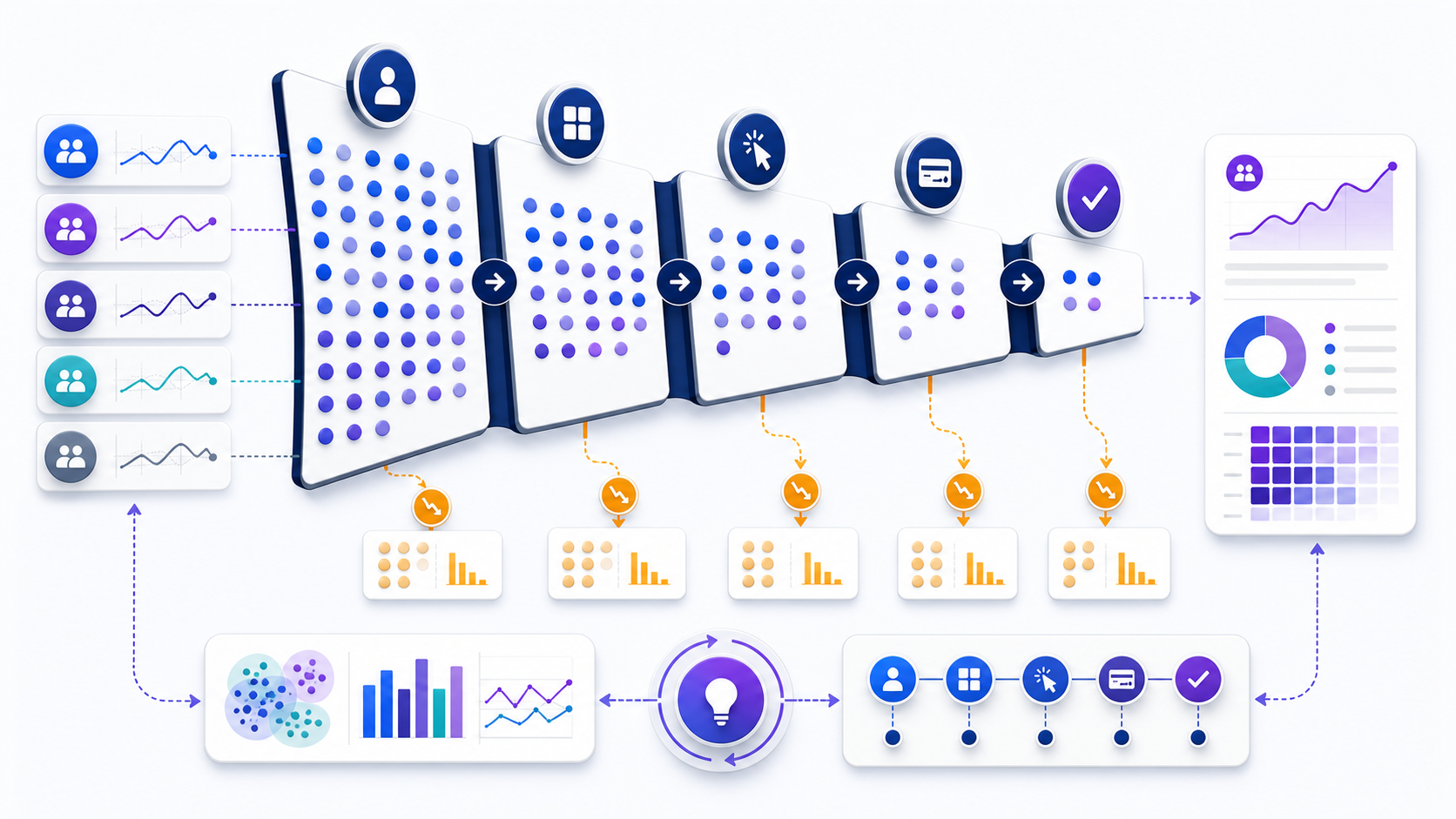
Funnel analysis: the quick answer漏斗分析:快速回答
Funnel analysis measures how a defined population moves through an ordered sequence of events toward an outcome, and where people stop progressing. A sound analysis reports both step-to-step and end-to-end conversion, applies one explicit identity and time-window rule, then compares meaningful segments before proposing a change.
漏斗分析衡量一个明确定义的用户群体如何按顺序完成一组事件并到达目标,以及用户在哪里停止前进。可靠分析应同时报告相邻步骤转化率与端到端转化率,明确身份识别和时间窗口规则,再比较有业务意义的分群,最后才提出改动方案。
A funnel is useful when the expected journey is known: signup, onboarding, checkout, lead qualification, or feature activation. It is not proof of causation. A large drop shows where to investigate, not why the drop happened. The “why” usually requires segment breakdowns, event-quality checks, qualitative research, performance data, and controlled experiments.
当预期路径已知时,漏斗最有价值,例如注册、引导、结账、线索筛选或功能激活。漏斗不能证明因果关系。较大流失只指出应调查的位置,并不能解释原因;“为什么”通常需要结合分群拆解、事件质量检查、定性研究、性能数据和受控实验。
When funnel analysis is the right method什么时候漏斗分析是正确方法
Choose a funnel when steps have a defensible order and a clear success event: account created, project published, order paid, or subscription activated.
当步骤存在可解释的先后顺序,并且成功事件明确时使用漏斗,例如创建账户、发布项目、支付订单或激活订阅。
If you do not know which routes users take, start with path analysis. A preselected funnel can hide detours, repeated actions, and alternative success routes.
如果尚不知道用户实际采用哪些路径,应先做路径分析。预设漏斗可能隐藏绕行、重复操作和其他成功路线。
Use cohort analysis when the core question is whether users return in week 1, week 4, or month 3. A funnel can complement retention, but it does not replace a retention curve.
如果核心问题是用户是否在第 1 周、第 4 周或第 3 个月回来,应使用 cohort 分析。漏斗可补充留存分析,但不能替代留存曲线。
Events show observable behavior. Surveys, interviews, usability tests, and support logs are needed to understand confusion, expectations, or trust concerns.
事件只能展示可观察行为。要理解困惑、预期或信任问题,还需要调查、访谈、可用性测试和客服记录。
Prepare trustworthy inputs before calculating计算前准备可信的数据输入
Start with an event dictionary, not a chart. For every step, record the event name, business meaning, trigger location, required properties, identity key, timestamp field, source, and owner. Decide whether the counting unit is a person, account, device, or session. Mixing units can create impossible rates or double-count people who switch devices.
先建立事件字典,而不是先画图。对每一步记录事件名、业务含义、触发位置、必填属性、身份键、时间戳字段、数据源和负责人。明确计数单位是用户、账户、设备还是会话。混用单位可能产生不可能的转化率,或重复计算跨设备用户。
| Decision决策项 | What to document需要记录什么 | Failure if omitted遗漏后果 |
|---|---|---|
| Population分析人群 | Who is eligible and when eligibility begins谁符合条件,以及资格从何时开始 | Changing denominator分母漂移 |
| Identity身份规则 | user_id, account_id, session_id, and merge policyuser_id、account_id、session_id 与合并策略 | Duplicates or fragmented journeys重复或碎片化旅程 |
| Sequence步骤顺序 | Required order, optional events, repeated events强制顺序、可选事件、重复事件 | Users counted in the wrong step用户被计入错误步骤 |
| Window时间窗口 | Maximum elapsed time and timezone最长完成时间与时区 | Old behavior mixed with current UX旧行为与当前体验混合 |
| Success成功定义 | One observable final event and validation source一个可观察的最终事件与验证来源 | Proxy mistaken for outcome把代理指标误当真实结果 |
Run three preflight checks: compare event counts with the source system, inspect a sample of complete user timelines, and quantify missing identity or timestamp values. Freeze the event definition for the comparison period. If instrumentation changed during the period, annotate the change or split the analysis.
进行三项预检:将事件数量与源系统对账;抽查完整用户时间线;量化身份键或时间戳缺失比例。在比较周期内冻结事件定义。如果埋点在周期中发生变化,应标注变化或拆分分析。
How to run funnel analysis step by step如何逐步执行漏斗分析
State one decision question. “Where does conversion fall?” is too broad. Prefer: “Which onboarding step explains the decline in first-project publication among new self-serve accounts after the release?”
写出一个决策问题。“转化在哪里下降”过于宽泛。更好的问题是:“版本发布后,新注册自助账户首次发布项目的下降由哪个引导步骤解释?”
Define the eligible population. Specify acquisition date, product version, geography, account type, consent rules, exclusions, and whether internal or test accounts are removed.
定义符合条件的人群。明确获客日期、产品版本、地区、账户类型、同意规则、排除条件,并去除内部或测试账户。
Choose three to seven decision-relevant steps. Each step should represent a meaningful state change. Avoid adding every click; noisy micro-events make the funnel fragile and hard to act on.
选择三到七个与决策相关的步骤。每一步应代表有意义的状态变化。不要加入每次点击;过多微事件会让漏斗脆弱且难以采取行动。
Set order and conversion window. Decide whether intervening events are allowed, how repeats are handled, and how quickly a user must reach the next step. Match the window to the real task cycle.
设定顺序和转化窗口。确定是否允许中间事件、如何处理重复事件,以及用户必须多快到达下一步。窗口应匹配真实任务周期。
Calculate counts, rates, and elapsed time. Report unique entrants at each step, step conversion, drop-off count, drop-off rate, cumulative conversion, and median time between steps.
计算人数、比率和耗时。报告每一步的唯一进入者、相邻步骤转化、流失人数、流失率、累计转化率和步骤间中位耗时。
Segment with a hypothesis. Compare device, plan, acquisition channel, geography, app version, or first-time versus returning users only when the split could change the next action.
带着假设进行分群。仅当拆分结果可能改变后续行动时,才比较设备、套餐、获客渠道、地区、应用版本或新老用户。
Validate, investigate, and test. Reconcile totals, inspect individual timelines, review release and incident logs, then choose one measurable intervention and an experiment or staged rollout.
验证、调查并测试。对账总数、抽查单个用户时间线、查看发布与事故日志,然后选择一个可衡量的干预,并通过实验或分阶段发布验证。
Calculate funnel conversion and drop-off correctly正确计算漏斗转化率与流失率
For adjacent steps A and B, use unique eligible entities under the same identity and window rule:
对相邻步骤 A 与 B,应在相同身份和时间窗口规则下使用符合条件的唯一实体:
Suppose a hypothetical onboarding funnel has 10,000 eligible visitors, 6,000 account creators, 4,200 verified accounts, 2,100 first projects, and 1,680 published projects. Overall conversion is 16.8%. The biggest absolute loss is visitor to account (4,000 people), while the weakest step rate is verified account to first project (50%). Those are different prioritization signals: one reflects scale; the other reflects local friction.
假设一个引导漏斗包含 10,000 名符合条件的访问者、6,000 名创建账户者、4,200 名已验证账户、2,100 名创建首个项目者和 1,680 名发布项目者。整体转化率为 16.8%。绝对流失最大的是访问到建号(4,000 人),而最弱的相邻步骤是验证账户到创建首个项目(50%)。两者是不同的优先级信号:前者反映规模,后者反映局部摩擦。
Do not rank problems by drop-off percentage alone. Consider eligible volume, business value, fixability, confidence in the data, and whether users can succeed through an alternative path.
不要只按流失百分比排列问题。还要考虑符合条件的用户规模、业务价值、可修复性、数据可信度,以及用户是否能通过替代路径成功。
Diagnose funnel drop-offs without guessing不靠猜测诊断漏斗流失
Move from observation to explanation with a hypothesis tree. First ask whether the change is real: did the event fire, did identity resolution change, or did ingestion arrive late? Then check product and technical causes: release changes, errors, latency, permissions, price or copy. Finally check population mix: channel, geography, device, plan, and seasonality.
使用假设树从观察走向解释。首先确认变化是否真实:事件是否触发、身份解析是否改变、数据是否延迟到达。随后检查产品与技术原因:版本改动、错误、延迟、权限、价格或文案。最后检查用户结构变化:渠道、地区、设备、套餐与季节性。
| Question问题 | Evidence证据 | Action行动 |
|---|---|---|
| Is the drop a measurement artifact?下降是否为测量假象? | Event QA, source reconciliation, schema changes事件 QA、源系统对账、Schema 变化 | Repair tracking before product changes先修复埋点,再改产品 |
| Is it concentrated?问题是否集中? | Device, version, channel, region, plan segments设备、版本、渠道、地区、套餐分群 | Target the affected segment针对受影响分群 |
| Did experience or reliability change?体验或可靠性是否变化? | Release log, error rate, latency, replay发布日志、错误率、延迟、回放 | Fix defect or simplify the step修复缺陷或简化步骤 |
| Does the proposed fix cause the outcome?拟议改动能否带来结果? | Randomized test or guarded rollout随机实验或受控发布 | Ship, iterate, or stop上线、迭代或停止 |
Guard against Simpson’s paradox: an aggregate decline can occur even when every segment improves if traffic shifts toward a lower-converting segment. Compare rates within stable segments and inspect segment weights. Also avoid slicing until a tiny group produces a dramatic but unstable percentage; report counts and uncertainty alongside rates.
注意辛普森悖论:即使每个分群都改善,只要流量转向低转化分群,整体仍可能下降。应在稳定分群内比较比率,并检查各分群权重。同时避免不断切分直至小样本出现夸张但不稳定的百分比;应同时报告人数、比率和不确定性。
Funnel analysis vs path, cohort, and journey analysis漏斗分析与路径、Cohort、旅程分析的区别
| Method方法 | Best question最适合回答的问题 | Main limitation主要局限 |
|---|---|---|
| Funnel analysis漏斗分析 | Where do users fail in a known sequence?用户在已知顺序的哪里失败? | Predefined steps hide alternative routes预定义步骤会隐藏替代路径 |
| Path analysis路径分析 | What routes do users actually take?用户实际采用哪些路线? | Complex paths can be difficult to prioritize复杂路径难以确定优先级 |
| Cohort analysisCohort 分析 | How does behavior or retention change over age or start period?行为或留存如何随用户年龄或起始周期变化? | Does not locate every within-session friction point无法定位每个会话内摩擦点 |
| Journey analytics用户旅程分析 | How do channels and touchpoints connect across a lifecycle?渠道和触点如何贯穿生命周期? | Requires identity and cross-source governance需要身份统一和跨源治理 |
These methods are complementary. Use path analysis to discover routes, define a funnel for a target route, use cohorts to see whether improvements persist, and use journey analytics when the decision spans acquisition, product, support, and revenue systems.
这些方法互为补充。先用路径分析发现路线,再为目标路线定义漏斗;用 cohort 判断改善是否持续;当决策跨越获客、产品、客服和收入系统时,再使用用户旅程分析。
Turn funnel analysis into a testable optimization plan把漏斗分析转化为可测试的优化计划
A useful funnel review ends with a decision record, not a prettier chart. Write the observation, affected population, evidence quality, competing explanations, proposed intervention, primary outcome, guardrail metrics, owner, and review date. Estimate opportunity with a scenario range rather than a promise.
有价值的漏斗复盘应以决策记录结束,而不是以更漂亮的图表结束。记录观察结果、受影响人群、证据质量、竞争性解释、拟议干预、主要结果指标、护栏指标、负责人和复盘日期。用情景范围估算机会,而不是作出承诺。
For the hypothetical onboarding example, the team might observe that first-project creation is weak specifically on mobile web after a form redesign. Before changing the form, they verify that the event schema is unchanged, confirm elevated validation errors in logs, and watch usability sessions. The test removes one optional field for half of eligible mobile visitors. Primary metric: verified-to-first-project conversion within 24 hours. Guardrails: support contacts, project quality proxy, and downstream publication rate.
以上述假设的引导示例为例,团队可能发现表单改版后,移动 Web 用户创建首个项目的表现特别弱。在修改表单前,他们确认事件 Schema 未变化、日志中的校验错误确实升高,并观察可用性测试。实验对一半符合条件的移动访问者移除一个可选字段。主要指标是 24 小时内从验证到创建首个项目的转化;护栏指标包括客服联系量、项目质量代理指标和后续发布率。
Prepare a read-only event database or warehouse connection, your step definitions, identity key, conversion window, and relevant business definitions. InfiniSynapse can support natural-language analysis across connected data sources and return analysis with explanations; verify every query and result against your source totals before acting.
请准备只读事件数据库或数据仓库连接、步骤定义、身份键、转化窗口和相关业务定义。InfiniSynapse 可支持对已连接数据源进行自然语言分析并返回分析与解释;在采取行动前,仍需将每个查询和结果与源系统总数核对。
Try the InfiniSynapse data analysis app试用 InfiniSynapse 数据分析应用Common funnel analysis mistakes and validation checks常见漏斗分析错误与验证检查
- Changing denominators: comparing sessions at one step with users at another. Use one counting unit or label the analysis as a different metric.分母变化:某一步按会话计数,另一步按用户计数。应统一计数单位,或明确这是不同指标。
- Ignoring order: counting everyone who performed both events, even when the outcome occurred before entry. Enforce timestamps and sequence.忽略顺序:只要做过两个事件就计入,即使结果发生在入口之前。必须强制时间戳和顺序。
- Unlimited windows: treating a purchase six months later as the result of today’s checkout session. Select a defensible task window and test sensitivity.无限时间窗口:把六个月后的购买视为今天结账会话的结果。应设定合理任务窗口并测试敏感性。
- Open/closed confusion: allowing mid-funnel entry without documenting it. The official Google Analytics funnel exploration documentation explains how open and closed funnels count users differently.混淆开放与封闭漏斗:允许用户从中间步骤进入却未记录规则。Google Analytics 官方漏斗探索文档说明了开放与封闭漏斗的不同计数方式。
- Optimizing a proxy: improving account creation while verified activation or revenue declines. Keep the real outcome and guardrails visible.优化代理指标:账户创建增加,但验证后激活或收入下降。应持续展示真实结果和护栏指标。
- Skipping reproducibility: saving only a screenshot. Store query logic, event version, filters, timezone, window, and run date so another analyst can reproduce the result.缺少可复现性:只保存截图。应保存查询逻辑、事件版本、筛选条件、时区、窗口和运行日期,使其他分析师可复现结果。
Final validation checklist: totals reconcile with source systems; step counts never rise in a closed funnel; sampled timelines follow the required order; identity stitching is documented; late events are handled; segment counts sum to the expected population; and the result can be reproduced from saved logic.
最终验证清单:总数与源系统对账;封闭漏斗的步骤人数不会增加;抽样时间线符合规定顺序;身份拼接规则有记录;延迟事件得到处理;分群人数之和符合预期人群;保存的逻辑能够复现结果。
Funnel analysis FAQ漏斗分析常见问题
What is funnel analysis?
什么是漏斗分析?
Funnel analysis measures how a defined population progresses through an ordered sequence of events toward an outcome, reporting step conversion, cumulative conversion, and drop-off.
漏斗分析衡量一个明确定义的人群如何按顺序完成事件并到达结果,报告相邻步骤转化、累计转化和流失。
How do you calculate funnel conversion rate?
如何计算漏斗转化率?
Divide users who complete the final step by users who entered the first step, then multiply by 100. Also calculate each step-to-step rate because the total alone does not locate the bottleneck.
用完成最终步骤的用户数除以进入第一步的用户数,再乘以 100。同时计算每个相邻步骤的转化率,因为整体转化率无法单独定位瓶颈。
Should a funnel be open or closed?
漏斗应当开放还是封闭?
Use a closed funnel when everyone must begin at the first step. Use an open funnel when users may legitimately enter later. Document the choice because it changes denominators and interpretation.
当所有人必须从第一步开始时使用封闭漏斗;当用户可以合理地从后续步骤进入时使用开放漏斗。必须记录选择,因为它会改变分母和解读。
Why do funnel numbers differ between tools?
为什么不同工具的漏斗数字不同?
Tools may use different identity rules, session boundaries, time windows, event ordering, duplicate handling, late-arriving events, and open or closed funnel definitions.
不同工具可能采用不同的身份规则、会话边界、时间窗口、事件顺序、去重方式、延迟事件处理,以及开放或封闭漏斗定义。
When should I use path analysis instead?
什么时候应改用路径分析?
Use path analysis when you do not yet know the expected sequence and want to discover common routes. Use funnel analysis after you can define the intended steps and outcome.
当尚不知道预期顺序并希望发现常见路线时使用路径分析;当能够定义预期步骤和结果后,再使用漏斗分析。
Sources and related product analytics guides权威来源与相关产品分析指南
- Google Analytics Help: Funnel exploration, including open and closed funnel behaviorGoogle Analytics 帮助:漏斗探索及开放、封闭漏斗行为
- Google Analytics Help: Create and interpret a custom funnel reportGoogle Analytics 帮助:创建并解读自定义漏斗报告
- InfiniSynapse guide to funnel, cohort, experiments, and data science for product managersInfiniSynapse 产品经理数据科学指南:漏斗、Cohort 与实验
- Marketing data analysis across product, CRM, advertising, and warehouse sources跨产品、CRM、广告与数据仓库的营销数据分析
Next, document one production funnel as a versioned specification, reproduce it independently, and link the decision record to the query. If the route is still unclear, begin with path analysis; if the question is return behavior over time, use cohort and retention analysis.
下一步,将一个生产漏斗记录为带版本的规格,进行独立复现,并把决策记录链接到查询。如果路线仍不清楚,先做路径分析;如果问题是用户随时间是否返回,则使用 cohort 与留存分析。