Data Analysis in Qualitative Studies: By Study Design (2026)
By the InfiniSynapse Data Team · Last updated: 2026-07-09 · We build an AI-native data analysis platform and work with research teams on mixed-methods projects; this guide reflects how analysis actually adapts to qualitative study designs in practice.
Table of Contents
- TL;DR
- How We Evaluated
- Why Study Design Shapes Analysis
- Case Study Analysis
- Ethnographic Analysis
- Phenomenological Analysis
- Grounded Theory Analysis
- NVivo vs MAXQDA vs ATLAS.ti vs Dedoose
- Common Rigor Requirements
- How AI Assists Without Replacing Judgment
- Choosing and Combining Designs
- Analysis Scorecard
- Frequently Asked Questions
- Conclusion
TL;DR
Direct answer: data analysis in qualitative studies adapts to the study design. Case studies analyze within and across cases, ethnographies interpret cultural patterns, phenomenological studies distill the essence of experience, and grounded theory builds theory from data. The design shapes the analytical approach, though rigor requirements are shared across all of them.
Who this is for: researchers and students learning how data analysis in qualitative studies varies by design.
What you'll learn: how we evaluated design-specific approaches, the analytical logic for four major designs, software comparisons, shared rigor requirements, and how AI assists without replacing interpretation.
This guide sits within the advanced methods hub; for the general research workflow, see data analysis in qualitative research. For related depth in this pillar, see Qualitative Data Analysis: Methods and Tools and Data Analysis of Qualitative Data: Step by Step.
How We Evaluated
We assessed data analysis in qualitative studies against what design-specific rigor actually requires in 2026—not textbook labels alone. Each approach was checked against four dimensions: whether the analytical logic matches the research question, whether the method preserves context where the design demands it, whether documentation supports auditability, and whether software choices accelerate mechanical work without substituting for interpretation. We cross-referenced design frameworks with John W. Creswell's qualitative inquiry overview, trustworthiness criteria from Lincoln and Guba's naturalistic inquiry standards, and the process described in the Wikipedia data analysis overview.
We also compared how four widely used platforms—NVivo, MAXQDA, ATLAS.ti, and Dedoose—handle coding, memoing, and team collaboration on the same interview corpus. Adoption patterns in IBM's augmented analytics overview and agent maturity trends in the Stanford HAI AI Index informed how we treat AI-assisted coding as a supplement, not a substitute, for design-appropriate interpretation.
The strongest data analysis in qualitative studies workflows separate mechanical processing from interpretive judgment. A team that codes faster but skips design logic still produces findings that do not hold up under peer review.
Why Study Design Shapes Analysis
Data analysis in qualitative studies is not one uniform procedure; it adapts to the study's design. A case study, ethnography, phenomenology, or grounded theory embodies a particular way of understanding a question, and the analysis must align with that logic. Choosing an analytical approach mismatched to the design undermines the study, which is why understanding this alignment matters before you open a coding tool.
This variety reflects the range of questions qualitative research addresses. Some studies seek to understand a bounded case in depth, others to interpret a culture, others to capture the essence of an experience or to build theory. Each goal calls for a different analytical emphasis, even though all share the systematic, interpretive character described in the Wikipedia overview of data analysis. Recognizing that data analysis in qualitative studies varies by design, rather than following a single recipe, is the foundation for choosing the right approach.
Articulate your design rationale in the methods section before coding begins. When reviewers ask why you chose ethnography over a case study frame, the answer should connect directly to the question—not to software defaults or prior habit.
Case Study Analysis
In case study designs, data analysis in qualitative studies focuses on understanding a bounded case—an organization, event, or individual—in rich depth. The analysis examines multiple sources about the case—interviews, documents, observations—and weaves them into a coherent account. When a study includes several cases, cross-case analysis compares them to identify patterns without losing each case's integrity.
The distinctive feature of data analysis in qualitative studies in the case-study tradition is its holistic, contextual character. Rather than fragmenting the data, case analysis preserves the connections that make the case coherent, building a detailed picture that respects its complexity. This depth is the strength of case study analysis, and it requires the analyst to hold the whole case in view while examining its parts. Done well, this form of data analysis in qualitative studies yields insights into how and why something happened within its real context.
Practical example: a health services researcher studies patient experience at three community clinics using interviews, observation notes, and policy documents. For data analysis in qualitative studies framed as a multiple-case design, she codes within each clinic first, then compares cross-case themes such as wait-time communication and trust in staff. She publishes with an audit trail of code refinements and disconfirming cases noted explicitly. The combination of design-appropriate depth and transparent documentation mirrors what Harvard Business Review's skills-based hiring research describes as increasingly decisive: demonstrated reasoning, not just a labeled method.
Ethnographic Analysis
In ethnographic designs, data analysis in qualitative studies interprets cultural patterns from immersive fieldwork. The ethnographer, having spent extended time observing and participating in a setting, analyzes field notes and other material to understand the shared meanings, practices, and norms of the group studied. The analysis is deeply interpretive, seeking the insider's perspective while rendering it intelligible to outsiders.
Data analysis in qualitative studies of the ethnographic kind unfolds alongside data collection rather than strictly after it, as early observations shape what the ethnographer attends to next. This iterative interplay is characteristic of the design. The analysis aims to remain faithful to how insiders experience the culture—a demanding interpretive task. This form of data analysis in qualitative studies rewards prolonged engagement and reflexive awareness of how the researcher's presence shapes what they observe and conclude.
Field memos written during collection become analytical assets, not afterthoughts. The best ethnographic teams date and tag memos so later coding can trace how early hunches were tested or revised.
Phenomenological Analysis
In phenomenological designs, data analysis in qualitative studies distills the essence of a lived experience. Having gathered detailed accounts from people who share an experience, the researcher analyzes them to identify the essential structures that make the experience what it is, setting aside preconceptions to focus on the experience as lived.
The analytical process involves examining accounts for significant statements, clustering them into meanings, and synthesizing an essential description of the experience. The goal is not to count or generalize but to capture the fundamental nature of the phenomenon. This makes phenomenological data analysis in qualitative studies especially interpretive and reflective, demanding that the researcher bracket assumptions to let the essence emerge from participants' own descriptions rather than from the researcher's expectations.
Bracketing is a discipline, not a one-time disclaimer. Strong phenomenological teams document moments when prior assumptions were set aside—or could not be—and how that shaped the final essence statement.
Grounded Theory Analysis
In grounded theory designs, data analysis in qualitative studies builds an explanatory theory directly from the data. Through iterative rounds of coding—open coding, then focused and theoretical coding that connects concepts—the researcher develops a theory grounded in the material rather than imposed from prior assumptions. Data collection and analysis proceed together, with emerging concepts guiding further sampling.
This form of data analysis in qualitative studies is distinctive for its explicit aim of theory generation. Constant comparison of data against emerging concepts, and theoretical sampling that pursues gaps in the developing theory, are hallmarks of the approach. Because analysis and collection intertwine, data analysis in qualitative studies of this type is especially demanding, requiring continuous analysis and letting findings direct the study. The payoff is a theory firmly rooted in evidence.
NVivo vs MAXQDA vs ATLAS.ti vs Dedoose
Teams running data analysis in qualitative studies routinely compare four platforms before committing to a workflow. Use the matrix below to match software to design complexity, team size, and budget—not to brand prestige alone.
| Dimension | NVivo | MAXQDA | ATLAS.ti | Dedoose |
|---|---|---|---|---|
| Best for | Large mixed-methods projects with documents, video, and surveys | Academic teams wanting strong coding and visualization | Theory-building and network views of code relationships | Collaborative web-based coding across distributed teams |
| Design fit | Flexible across case study, ethnography, and grounded theory | Strong for grounded theory and systematic coding | Strong for grounded theory and conceptual mapping | Strong for team ethnography and multi-site studies |
| Collaboration | Desktop-first; cloud options vary by license | Team licenses with merge workflows | Cloud and desktop options | Browser-native; built for remote co-coding |
| Media support | Audio, video, images, social data connectors | Text, images, audio, video, Twitter imports | Text, images, audio, video | Text and basic media; lighter on video depth |
| Learning curve | Moderate; feature-rich interface | Moderate; popular in graduate programs | Moderate to steep; network views add complexity | Low to moderate; web UI is approachable |
| Typical cost | Higher enterprise licensing | Mid-range academic pricing | Mid-range academic and institutional | Lower entry; subscription per user |
No platform replaces design logic. Data analysis in qualitative studies still fails when teams import transcripts into software before they have articulated why their design requires within-case depth, cultural interpretation, phenomenological bracketing, or theoretical sampling.
Common Rigor Requirements
Despite their differences, all forms of data analysis in qualitative studies share common rigor requirements. Every design demands systematic method, documented decisions, and active guarding against bias, whatever its specific analytical emphasis. The trustworthiness criteria—credibility, transferability, dependability, and confirmability—apply across designs, adapted to each context as Lincoln and Guba's naturalistic inquiry standards describe.
Practically, rigor in data analysis in qualitative studies means maintaining an audit trail, seeking disconfirming evidence, practicing reflexivity, and being transparent about methods and scope. These shared requirements ensure that, whatever the design, the findings are defensible rather than subjective impressions. Recognizing that the approach varies while the rigor standards hold helps a researcher adapt their method to the design while never compromising on the discipline that makes qualitative findings credible.
Peer debriefing and member checking are not optional extras for high-stakes studies—they are how teams test whether design-appropriate interpretation survived contact with skeptical readers.
How AI Assists Without Replacing Judgment
In 2026, AI-native tools assist data analysis in qualitative studies across designs without replacing interpretive judgment. AI can transcribe interviews, perform initial coding passes, and surface candidate patterns in large volumes of material, accelerating labor-intensive stages common to every design while the researcher provides design-specific interpretation.
The Stanford HAI AI Index documents how quickly agent-assisted text processing matured, and IBM's augmented analytics overview frames the shift toward human-validated automation. For data analysis in qualitative studies, that means AI handles transcription and first-pass labeling while you decide whether a code fits a case holistically, a cultural pattern, an essential experience, or an emerging theory. Treat every AI-suggested code as a hypothesis to test against the full dataset, not a conclusion to accept.
Choosing and Combining Designs
In practice, the boundaries between designs are less rigid than textbooks suggest. A study might use a case study frame while drawing on ethnographic observation, or blend grounded theory's iterative coding into a broadly thematic approach. What matters is not fitting neatly into a labeled box but choosing analytical moves that genuinely serve the research question, with a clear rationale for each.
Choosing a design starts from the question rather than from preference. If the question asks about a bounded case in depth, a case study frame fits; if it asks about a culture, ethnography; if about the essence of an experience, phenomenology; if it seeks to build theory, grounded theory. Articulating why a chosen design suits the question is itself part of rigorous data analysis in qualitative studies, because it forces alignment between method and purpose rather than defaulting to a familiar approach.
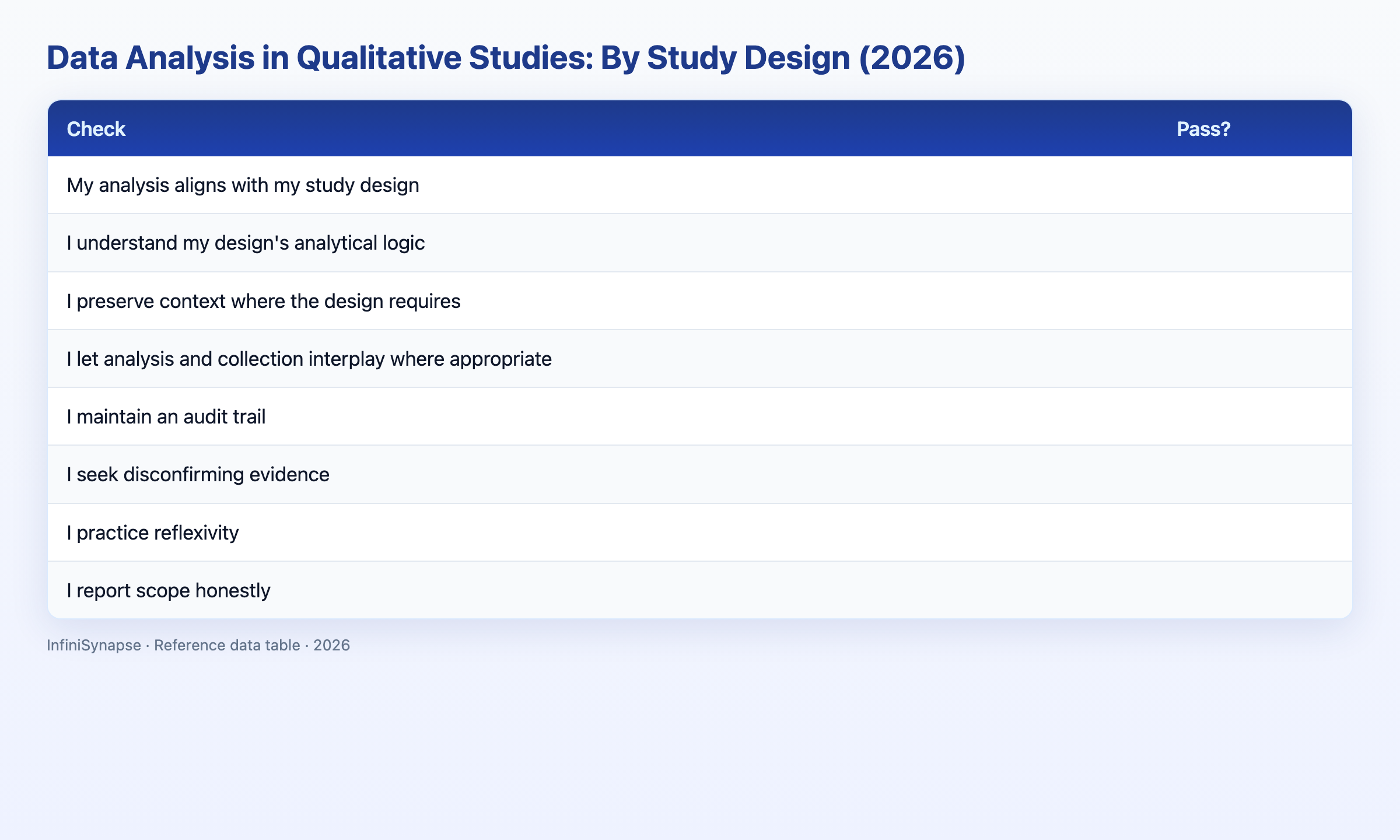
Analysis Scorecard
Assess your study analysis fit (1 point each):
| Check | Pass? |
|---|---|
| My analysis aligns with my study design | |
| I understand my design's analytical logic | |
| I preserve context where the design requires | |
| I let analysis and collection interplay where appropriate | |
| I maintain an audit trail | |
| I seek disconfirming evidence | |
| I practice reflexivity | |
| I report scope honestly |
6–8: design-appropriate rigor. 3–5: strengthen alignment. Below 3: revisit your design's logic.
Frequently Asked Questions
How does study design affect the analytical approach?
Study design affects data analysis in qualitative studies because each design embodies a particular way of understanding a question. A case study preserves context holistically, an ethnography interprets culture, a phenomenological study seeks essential experience, and grounded theory builds theory. The analytical approach must align with the design's logic, or the study is undermined.
What are the main qualitative study designs?
The main qualitative study designs are case study, which examines a bounded case in depth; ethnography, which interprets a culture from fieldwork; phenomenology, which captures the essence of a lived experience; and grounded theory, which builds explanatory theory from data. Each calls for a different emphasis in analysis.
Do different qualitative studies share rigor requirements?
Yes. Despite differing approaches, all forms of data analysis in qualitative studies share rigor requirements: systematic method, documented decisions, and guarding against bias. The criteria of credibility, transferability, dependability, and confirmability apply across designs, supported by audit trails, disconfirming evidence, reflexivity, and transparency about methods and scope.
Which software supports design-specific analysis best?
NVivo, MAXQDA, ATLAS.ti, and Dedoose all support coding and memoing, but none chooses your design for you. Pick based on collaboration needs, media types, and budget; then apply the analytical logic your design requires.
How does AI help without replacing the researcher?
AI-native tools help with data analysis in qualitative studies by transcribing interviews, performing initial coding, and surfacing patterns across large volumes of material, accelerating labor-intensive stages common to every design. The researcher provides the design-specific interpretation, while AI handles mechanical processing of textual and multi-modal data.
Conclusion
Data analysis in qualitative studies adapts to the study design—case study, ethnography, phenomenology, or grounded theory—each with its own analytical emphasis, while sharing common rigor requirements that keep findings credible. In 2026, AI-native tools accelerate transcription and first-pass coding while the researcher supplies the design-appropriate interpretation that peer review actually tests.
To see multi-modal analysis across documents and structured data, read what AI-native data analysis means and try the InfiniSynapse web app free on registration, no credit card required.