The Data Analysis Process: 6 Steps for 2026
By the InfiniSynapse Data Team · Last updated: 2026-07-08 · We build an AI-native data analysis platform; this guide lays out the process exactly as disciplined analysts follow it in practice.
Table of Contents
- TL;DR
- Why a Process Matters
- Step 1: Define the Question
- Step 2: Collect the Data
- Step 3: Clean the Data
- Step 4: Analyze
- Step 5: Interpret
- Step 6: Communicate
- How AI Changes the Process
- Adapting the Process to the Task
- The Process as a Loop
- Process Scorecard
- Frequently Asked Questions
- Conclusion
TL;DR
Direct answer: the data analysis process is a repeatable six-step sequence: define the question, collect the data, clean it, analyze it, interpret the results, and communicate the findings. Following the process deliberately, rather than improvising, is what separates reliable analysis from confident guessing.
Who this is for: anyone who wants a clear, repeatable data analysis process to follow.
What you'll learn: why a process matters, each of the six steps in depth, and how AI-native tools change the process.
This guide sits within the data analysis fundamentals hub; for the exploration phase, see exploratory data analysis.
For related depth in this pillar, see Data Analysis Techniques That Actually Work in 2026.
Why a Process Matters
Following a defined data analysis process matters because analysis without structure tends to wander, skip crucial steps, and produce unreliable results. The data analysis process provides a checklist that ensures you define a clear question before diving in, clean the data before trusting it, and interpret honestly before communicating. Each step guards against a specific way analysis goes wrong.
The value of the data analysis process is not rigidity but reliability. Experienced analysts internalize the process so thoroughly that it becomes second nature, freeing their attention for the judgment each step requires. The process, consistent with the disciplined approach described in the Wikipedia overview of data analysis, applies whether the task is a quick spreadsheet question or a complex investigation. Learning the data analysis process turns scattered technical skills into a coherent method that reliably produces trustworthy insight rather than lucky guesses.
Step 1: Define the Question
The data analysis process begins with defining a clear, specific question, because a vague question produces a useless answer. "Understand our customers" is not a question; "which customer segment has the highest repeat-purchase rate" is. The precision of the question at the start of the data analysis process shapes everything that follows, determining what data you need and what analysis to run. Dashboard-centric workflows sit within the broader Wikipedia business intelligence overview.
Defining the question well in the data analysis process also means clarifying why it matters and what decision it will inform. A question tied to a real decision keeps the analysis focused and ensures the result will be used. Analysts who rush past this first step of the data analysis process often produce technically competent work that answers the wrong question, wasting the entire effort. Time spent sharpening the question is the highest-leverage investment in the whole process.
Step 2: Collect the Data
The second step of the data analysis process is collecting the data needed to answer the question. This means identifying the relevant sources, whether databases, files, or applications, and gathering the data into a workable form. Often the data lives across several sources that must be combined, which is a common challenge in the data analysis process.
A key discipline in this step of the data analysis process is collecting the right data rather than all available data. More data is not always better; the data that bears on the question is what matters, and gathering irrelevant data adds noise and effort. Documenting where the data came from and any collection caveats is also part of a sound data analysis process, since these details affect how the results should be interpreted later. Good collection sets up the rest of the process for success.
Step 3: Clean the Data
Cleaning is the step of the data analysis process that consumes the most time and prevents the most errors. Raw data is messy: it contains duplicates, inconsistent formats, missing values, and outright mistakes. The cleaning step of the data analysis process resolves these so that the analysis rests on trustworthy input, because analyzing dirty data produces confident but wrong conclusions.
Effective cleaning in the data analysis process involves removing duplicates, standardizing inconsistent categories, fixing data types, and deciding deliberately how to handle missing values. Each decision should be documented, since how you clean the data shapes the results. Many analysts underestimate this step, but experienced practitioners know that most of the data analysis process is preparation, and that a rushed cleaning stage undermines everything built on top of it. Clean data is the foundation on which reliable analysis stands.
Step 4: Analyze
With clean data ready, the data analysis process moves to the analysis itself: examining the data to answer the question. This may involve calculating summaries, comparing groups, identifying trends, or applying statistical methods, depending on what the question requires. This is the step people picture when they think of the data analysis process, though it depends entirely on the preparation before it.
A principle of this step in the data analysis process is to match the method to the question rather than reaching for the most sophisticated technique. Often a simple comparison answers the question better than an elaborate model. Exploration, covered in exploratory data analysis, frequently precedes formal analysis within this step, helping you understand the data before drawing conclusions. The analysis step of the data analysis process is where patterns emerge, but its reliability depends wholly on the disciplined steps that came before. Enterprise adoption patterns in Google Cloud's AI overview mirror the shift from pilots to governed analytics.
Step 5: Interpret
Interpretation is the step of the data analysis process where results become meaning. A number by itself says nothing; interpretation decides what it implies for the question and whether it makes sense. This step of the data analysis process demands judgment: is the finding real or an artifact, does it answer the question, and what are its limitations?
Honest interpretation in the data analysis process means checking results against intuition and independent cuts, and resisting the temptation to overstate a finding. If a result surprises you, that is a cue to verify rather than to celebrate. Acknowledging what the data cannot say is as important as reporting what it can. This interpretive judgment is the part of the data analysis process that machines cannot fully replicate, and it is where the analyst's experience and skepticism add the most value to the entire endeavor.
Step 6: Communicate
The final step of the data analysis process is communicating the findings so others can act on them. Analysis that is never clearly explained changes no decision, so communication is not an afterthought but the culmination of the data analysis process. This means leading with the takeaway, choosing visuals that clarify, and stating what the finding implies for the decision at hand.
Effective communication in the data analysis process tailors the message to the audience, translating technical findings into plain language for non-technical stakeholders. Honesty about uncertainty and limitations builds trust. In many settings, the communication is what stakeholders actually experience of the entire data analysis process, so investing in a clear, decision-oriented message ensures the work's value is realized rather than lost. A brilliant analysis poorly communicated is a wasted analysis.
How AI Changes the Process
In 2026, AI-native tools are transforming how the data analysis process is executed, automating the mechanical steps while leaving the judgment-heavy ones to humans. An agent can now handle much of the collection, cleaning, and analysis, taking a defined question and carrying the data analysis process through to a result with an inspectable trail.
InfiniSynapse illustrates this. It is not an NLP2SQL box or a ChatBI widget but a system that behaves like a professional data analyst, connecting to sources with one-click authorization and running the data analysis process through InfiniSQL. The human still defines the question and interprets the result, but the mechanical middle of the data analysis process is automated, dramatically speeding recurring work. We explore the paradigm in what AI-native data analysis means, and the Stanford HAI AI Index documents this shift. The steps remain the same; how much a machine carries changes.
Adapting the Process to the Task
Although the six steps stay constant, how much effort each demands varies with the task, and adapting sensibly is a mark of experience. A quick, low-stakes question might spend only moments on each step, while a high-stakes analysis feeding a major decision warrants careful attention at every stage, especially cleaning and interpretation. The steps do not change, but their weight does, and forcing a heavy, formal treatment onto a trivial question wastes effort just as surely as rushing a consequential one invites error.
Adapting well means reading the stakes and the data honestly. When the data is clean and familiar, the cleaning step is light; when it is messy or new, cleaning dominates. When the question is exploratory, more time goes into examination; when it is confirmatory, interpretation and rigor matter most. Skilled analysts flex the emphasis across the six steps to fit the situation while never skipping a step entirely, since even a quick analysis benefits from a clear question and honest interpretation. This calibrated flexibility, rather than rigid uniformity, is what makes the sequence practical across the full range of real analytical work. The move toward augmented workflows, outlined in IBM's augmented analytics overview, frames how teams evaluate modern tooling.
The Process as a Loop
In practice the sequence is less a straight line than a loop, and embracing this makes analysis more effective. The interpretation step frequently raises new questions, sending you back to gather more data or run a different analysis. A finding might reveal that the original question was not quite right, prompting a refined question and another pass. This iterative character is normal and productive rather than a sign of failure.
Treating the sequence as a loop keeps analysis honest and thorough. Rather than forcing a single pass to a premature conclusion, a good analyst follows the questions the data raises, cycling through the relevant steps until the answer is genuinely solid. The discipline is to loop deliberately, with a clear reason for each new pass, rather than wandering aimlessly through endless reanalysis. Knowing when to stop, when the answer is solid enough for the decision at hand, is as important as knowing when to loop again. This balance between iteration and closure is a hallmark of mature analytical practice that comes with experience.
Process Scorecard
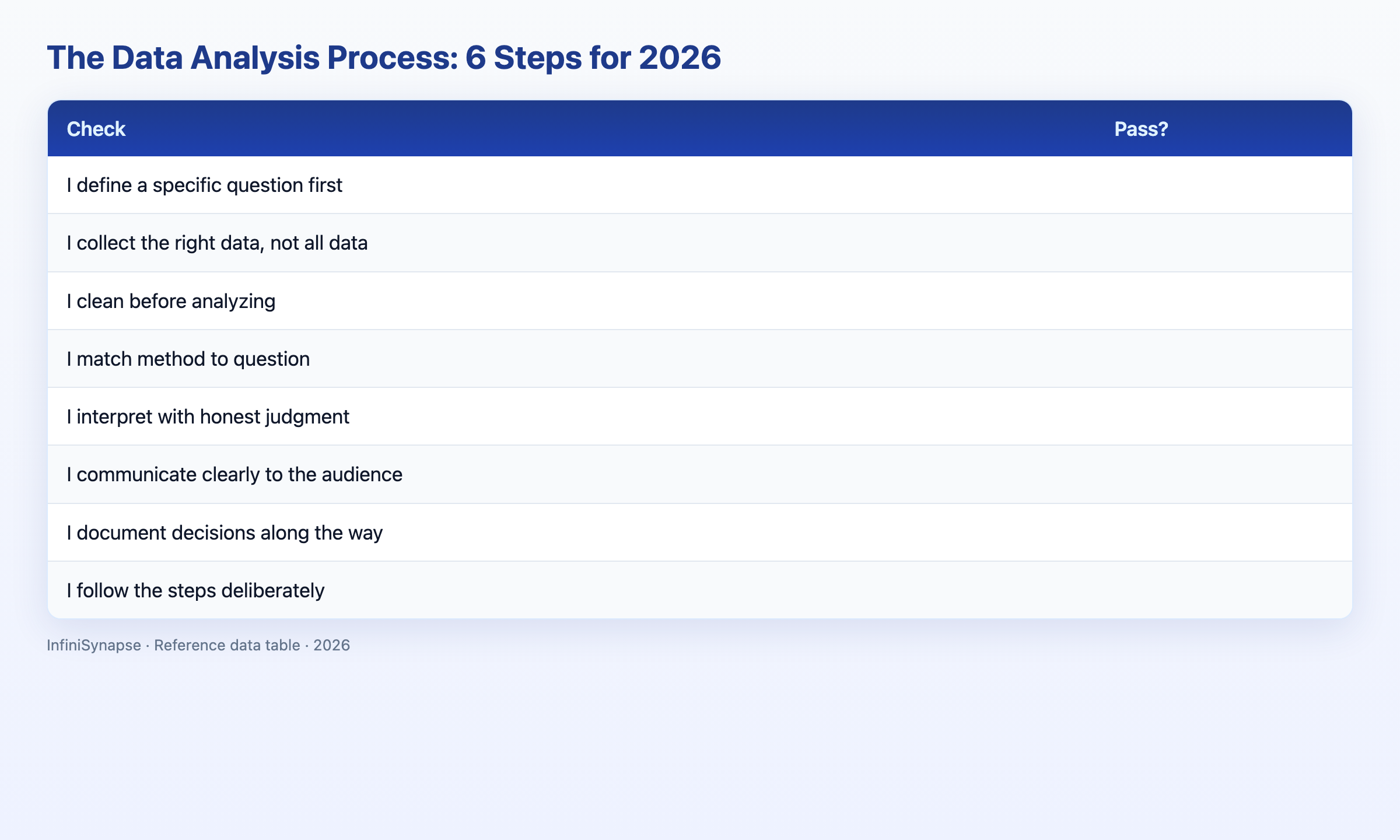
Assess your process discipline (1 point each):
| Check | Pass? |
|---|---|
| I define a specific question first | |
| I collect the right data, not all data | |
| I clean before analyzing | |
| I match method to question | |
| I interpret with honest judgment | |
| I communicate clearly to the audience | |
| I document decisions along the way | |
| I follow the steps deliberately |
6–8: disciplined process. 3–5: reinforce a step. Below 3: adopt the full sequence.
Frequently Asked Questions
What are the steps in the process?
The data analysis process has six steps: define the question, collect the relevant data, clean it into trustworthy form, analyze it with appropriate methods, interpret the results with honest judgment, and communicate the findings clearly. Following this sequence deliberately separates reliable analysis from improvised guessing.
Which step of the process takes the most time?
Cleaning typically takes the most time in the process. Raw data contains duplicates, inconsistent formats, missing values, and errors that must be resolved before analysis, since analyzing dirty data produces confident but wrong conclusions. Experienced analysts know most of the process is preparation rather than the analysis itself.
Why is defining the question the first step?
Defining the question is first because a vague question produces a useless answer and shapes everything that follows in the process. A specific question tied to a real decision determines what data to collect and what analysis to run, so time spent sharpening it is the highest-leverage investment in the whole process.
How is the analyze step different from interpret?
In the process, the analyze step examines the data to produce results, such as summaries or comparisons, while the interpret step decides what those results mean for the question and whether they make sense. Analysis produces numbers; interpretation turns them into meaning through judgment, checking whether findings are real and what they imply.
How do AI tools change the process?
AI-native tools automate the mechanical steps of the process, especially collection, cleaning, and analysis, by taking a defined question and carrying it through to a result with an inspectable trail. Humans still define the question and interpret the outcome, but the mechanical middle is automated, dramatically speeding recurring work.
Conclusion
The data analysis process is a repeatable six-step sequence, define, collect, clean, analyze, interpret, communicate, and following it deliberately is what makes analysis reliable rather than lucky. Each step guards against a specific failure, and in 2026 AI-native tools automate the mechanical steps while humans supply the question and judgment.
To see the process automated end to end, read the complete data analysis guide and what AI-native data analysis means, then try the InfiniSynapse web app free on registration.