Data Analysis of Qualitative Data: Step by Step (2026)
By the InfiniSynapse Data Team · Last updated: 2026-07-08 · We build an AI-native data analysis platform; this guide details the hands-on coding steps that turn raw text into themes.

Table of Contents
- TL;DR
- The Hands-On Process
- Step 1: Transcribe and Organize
- Step 2: Immerse and Familiarize
- Step 3: Initial Coding
- Step 4: Develop Themes
- Step 5: Interpret and Write Up
- How AI Accelerates It
- Avoiding Common Errors
- Scorecard
- Frequently Asked Questions
- Conclusion
TL;DR
Direct answer: the data analysis of qualitative data follows hands-on steps: transcribe and organize the material, immerse yourself to gain familiarity, code segments with meaning-capturing labels, develop themes from the codes, and interpret and write up the findings. Each step is systematic, which is what keeps the resulting themes defensible rather than arbitrary.
Who this is for: anyone learning the practical steps of the data analysis of qualitative data.
What you'll learn: the hands-on process across five concrete steps, and how AI accelerates it.
This guide sits within the advanced methods hub; for the methods overview, see qualitative data analysis.
For related depth in this pillar, see Data Analysis in Qualitative Research.
The Hands-On Process
The data analysis of qualitative data is best learned as a concrete, step-by-step process rather than an abstract idea. While methods vary, most share a common practical arc: prepare the material, become familiar with it, code it, build themes, and interpret. Following these steps gives the data analysis of qualitative data the systematic structure that makes its findings trustworthy.
This hands-on view complements the conceptual understanding of methods. Knowing that thematic analysis finds themes is useful, but the process becomes real only when you sit down with actual transcripts and work through the steps. The process, grounded in the disciplined approach described in the Wikipedia overview of data analysis, turns unstructured human input into defensible insight. The five steps below walk through the data analysis of qualitative data as it is actually done in practice.
Step 1: Transcribe and Organize
The data analysis of qualitative data begins with transcription and organization. Audio recordings must be transcribed into text, and all material, transcripts, notes, documents, organized so it can be systematically examined. This preparatory step is unglamorous but foundational, since disorganized or inaccurate material makes rigorous analysis impossible. Predictive workflows should be interpreted against the Wikipedia machine learning overview.
Good organization at this stage of the data analysis of qualitative data means consistent formatting, clear labeling of sources, and a system for keeping track of which data came from where. Accurate transcription matters because the analysis interprets the words, and errors in transcription become errors in interpretation. Investing care in transcribing and organizing sets the data analysis of qualitative data on solid ground, and skipping or rushing it creates problems that compound through every subsequent step of the process.
Step 2: Immerse and Familiarize
The second step of the data analysis of qualitative data is immersion: reading through the material repeatedly to become deeply familiar with it before coding. This familiarization builds the intimate knowledge of the data that good interpretation requires, letting the analyst notice nuances that a hurried reading would miss.
Immersion in the data analysis of qualitative data is not passive reading but active engagement, noting initial impressions, questions, and possible patterns without yet formally coding. This step primes the analyst for the systematic coding to follow, and it often surfaces the first sense of what the data contains. Researchers who skip immersion and rush to code unfamiliar material produce shallow results, which is why this step, though it seems like mere reading, is a genuine and essential part of the data analysis of qualitative data.
Step 3: Initial Coding
Coding is the heart of the data analysis of qualitative data, and it begins with initial coding. The analyst works through the material, labeling segments, a phrase, a sentence, a passage, with codes that capture their meaning. These initial codes stay close to the data, describing what is there rather than imposing preconceived categories.
Initial coding in the data analysis of qualitative data is systematic and thorough: the analyst codes the entire dataset, not just striking passages, ensuring the analysis reflects all the data. This can produce many codes at first, which is expected. The discipline of coding comprehensively is what distinguishes rigorous data analysis of qualitative data from cherry-picking quotes to support a preconception. This first coding pass creates the raw material, a coded dataset, from which themes will be built in the next step.
Step 4: Develop Themes
The fourth step of the data analysis of qualitative data develops themes from the initial codes. The analyst groups related codes into broader categories, then refines these into themes that meaningfully address the research question. This moves the analysis from many specific codes to a smaller number of coherent, higher-level patterns.
Developing themes in the data analysis of qualitative data is iterative: the analyst examines how codes cluster, tests whether candidate themes hold across the data, and revises them, sometimes merging, splitting, or discarding. A good theme is supported by substantial evidence across the dataset, not a single instance. This step is where the data analysis of qualitative data produces its main findings, and its iterative, evidence-checking character is what ensures the themes genuinely reflect the data rather than the analyst's expectations.
Step 5: Interpret and Write Up
The final step of the data analysis of qualitative data interprets the themes and writes up the findings. Interpretation connects the themes to the research question and to their broader meaning, explaining what the patterns reveal. Writing up presents the themes coherently, supported by representative quotes that let the data speak directly to the reader. Scripted analysis should follow Python documentation conventions for reproducibility and testable pipelines.
Honest interpretation in the data analysis of qualitative data acknowledges the study's scope and limitations, noting that findings describe those studied without automatically generalizing. Transparency about method, enough for others to follow the reasoning, completes rigorous write-up. This final step turns the coded, themed data into shareable knowledge, closing the arc from raw transcripts to defensible insight that others can understand, trust, and act upon.
Working through these steps repeatedly is what builds genuine skill. The first time, coding feels slow and themes feel elusive, but with practice the process becomes intuitive, and the discipline that once felt mechanical becomes second nature. Each study also teaches you where your own biases tend to intrude and how to guard against them. Like any craft, analyzing text well improves through doing, so the best way to master these steps is to apply them to a real project, learn from the friction, and refine your practice with each study you complete.
How AI Accelerates It
In 2026, AI-native tools accelerate the data analysis of qualitative data at its most labor-intensive steps. AI can transcribe recordings automatically, perform initial coding across large text volumes, and suggest candidate themes, compressing work that once took weeks into a fraction of the time while the analyst validates and interprets.
InfiniSynapse illustrates the relevant capability. It is not an NLP2SQL box or a ChatBI widget but a system that behaves like a professional data analyst, connecting to sources with one-click authorization and analyzing documents, audio, and video through InfiniSQL. For the data analysis of qualitative data, this can handle transcription and first-pass coding, leaving the nuanced theme development and interpretation to the analyst. We explore the paradigm in what AI-native data analysis means, and the Stanford HAI AI Index documents how these tools handle text at scale while the human judgment central to the data analysis of qualitative data guides the interpretation.
Avoiding Common Errors
Several errors recur in practice, and knowing them helps you avoid producing shallow or biased results. The most common is cherry-picking: selecting a few vivid quotes that support a preferred conclusion while ignoring the rest of the material. The antidote is comprehensive coding of the full dataset, which ensures the findings reflect all the evidence rather than a convenient subset. This discipline is what separates trustworthy interpretation from confirmation of what the analyst hoped to find.
A second error is coding too shallowly or inconsistently, applying labels casually so that the same idea gets different codes or different ideas share a code. Consistent, thoughtful coding, revisited and refined across passes, prevents this and keeps the resulting themes coherent. A related error is stopping at description without interpretation, listing what was said without explaining what it means for the research question. Good analysis moves beyond summarizing to genuine interpretation that answers the question. Query-first analysis aligns with concepts in the Wikipedia SQL overview.
A third error is overreaching in the conclusions, generalizing findings from a modest set of sources to a whole population as if the study were quantitative. Honest work states plainly that findings describe those studied and may not generalize, which strengthens rather than weakens credibility. A final error is neglecting to document decisions, leaving the analysis unreproducible and hard to defend. Maintaining an audit trail of how codes and themes were derived addresses this. Avoiding these errors, through comprehensive coding, consistent labeling, genuine interpretation, honest scope, and documentation, is what turns the mechanical steps into rigorous, defensible analysis that others can trust and build upon.
Scorecard
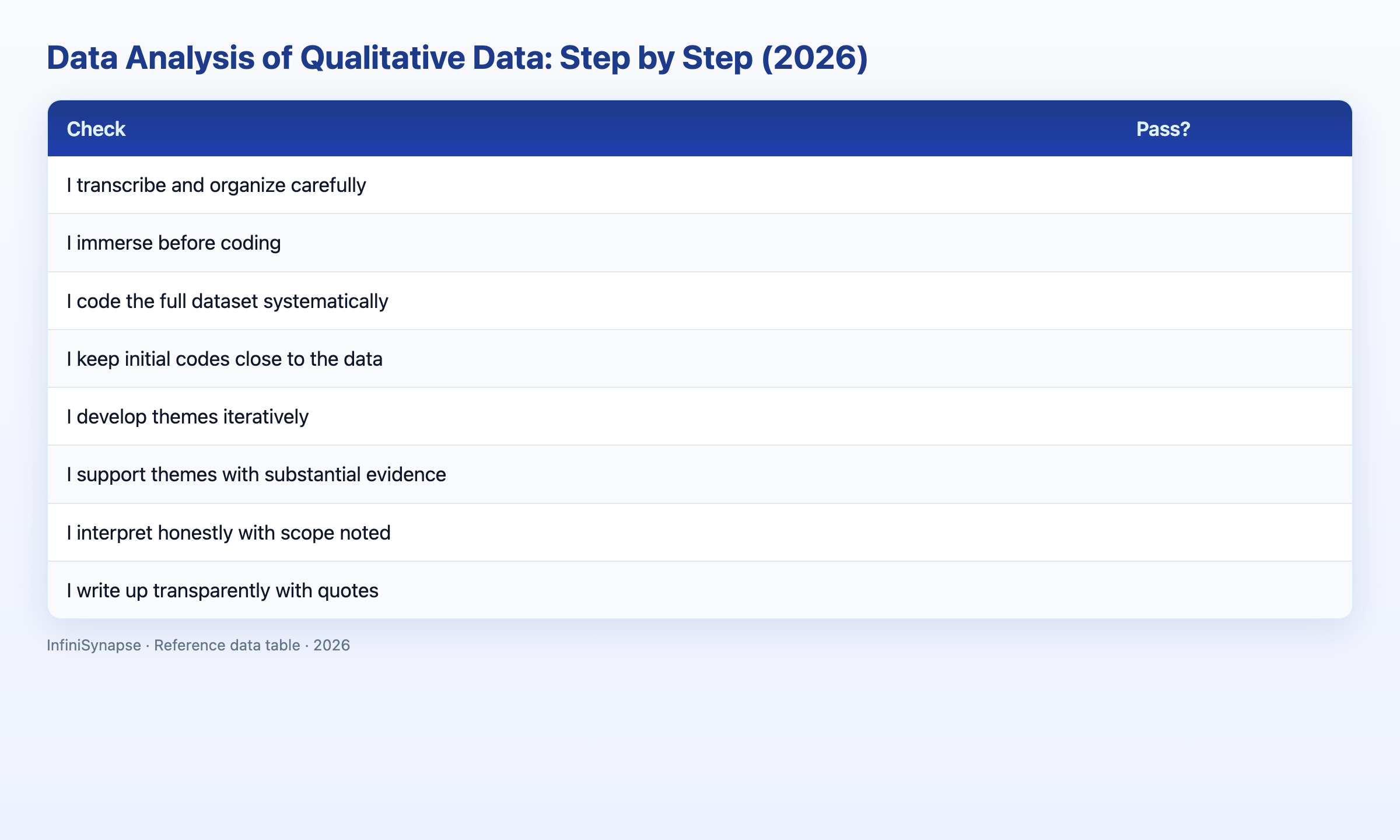
Assess your process (1 point each):
| Check | Pass? |
|---|---|
| I transcribe and organize carefully | |
| I immerse before coding | |
| I code the full dataset systematically | |
| I keep initial codes close to the data | |
| I develop themes iteratively | |
| I support themes with substantial evidence | |
| I interpret honestly with scope noted | |
| I write up transparently with quotes |
6–8: sound process. 3–5: strengthen a step. Below 3: follow the full sequence.
Frequently Asked Questions
What are the steps in the analysis of qualitative data?
The data analysis of qualitative data follows five steps: transcribe and organize the material, immerse yourself to gain familiarity, code segments with meaning-capturing labels, develop themes from the codes, and interpret and write up the findings. Each step is systematic, which keeps the resulting themes defensible rather than arbitrary.
How do you code qualitative data?
Coding in the data analysis of qualitative data means working through the material and labeling segments, phrases, sentences, or passages, with codes that capture their meaning, staying close to the data. You code the entire dataset systematically, not just striking passages, then group related codes into themes in a later step.
What is the difference between codes and themes?
In the data analysis of qualitative data, codes are specific labels applied to segments of data during initial coding, capturing what is there closely. Themes are broader patterns developed by grouping and refining related codes to address the research question. Coding produces many specific codes; theme development distills them into fewer coherent patterns.
How long does the analysis of qualitative data take?
The data analysis of qualitative data is traditionally labor-intensive, with transcription, comprehensive coding, and iterative theme development taking days to weeks depending on the volume of material. In 2026, AI-native tools compress the most labor-intensive steps, transcription and initial coding, into a fraction of the time while the analyst validates and interprets.
How does AI help analyze qualitative data?
AI-native tools accelerate the data analysis of qualitative data by transcribing recordings automatically, performing initial coding across large text volumes, and suggesting candidate themes. This compresses labor-intensive work while the analyst validates and handles the nuanced theme development and interpretation, keeping human judgment central to the interpretive parts of the process.
Conclusion
The data analysis of qualitative data follows five hands-on steps, transcribe and organize, immerse, code, develop themes, and interpret and write up, each systematic enough to keep the findings defensible. In 2026, AI-native tools compress the labor-intensive transcription and initial coding while the analyst supplies the interpretation the work depends on.
To see multi-modal analysis that handles text, audio, and structured data, read what AI-native data analysis means and try the InfiniSynapse web app free on registration, no credit card required.