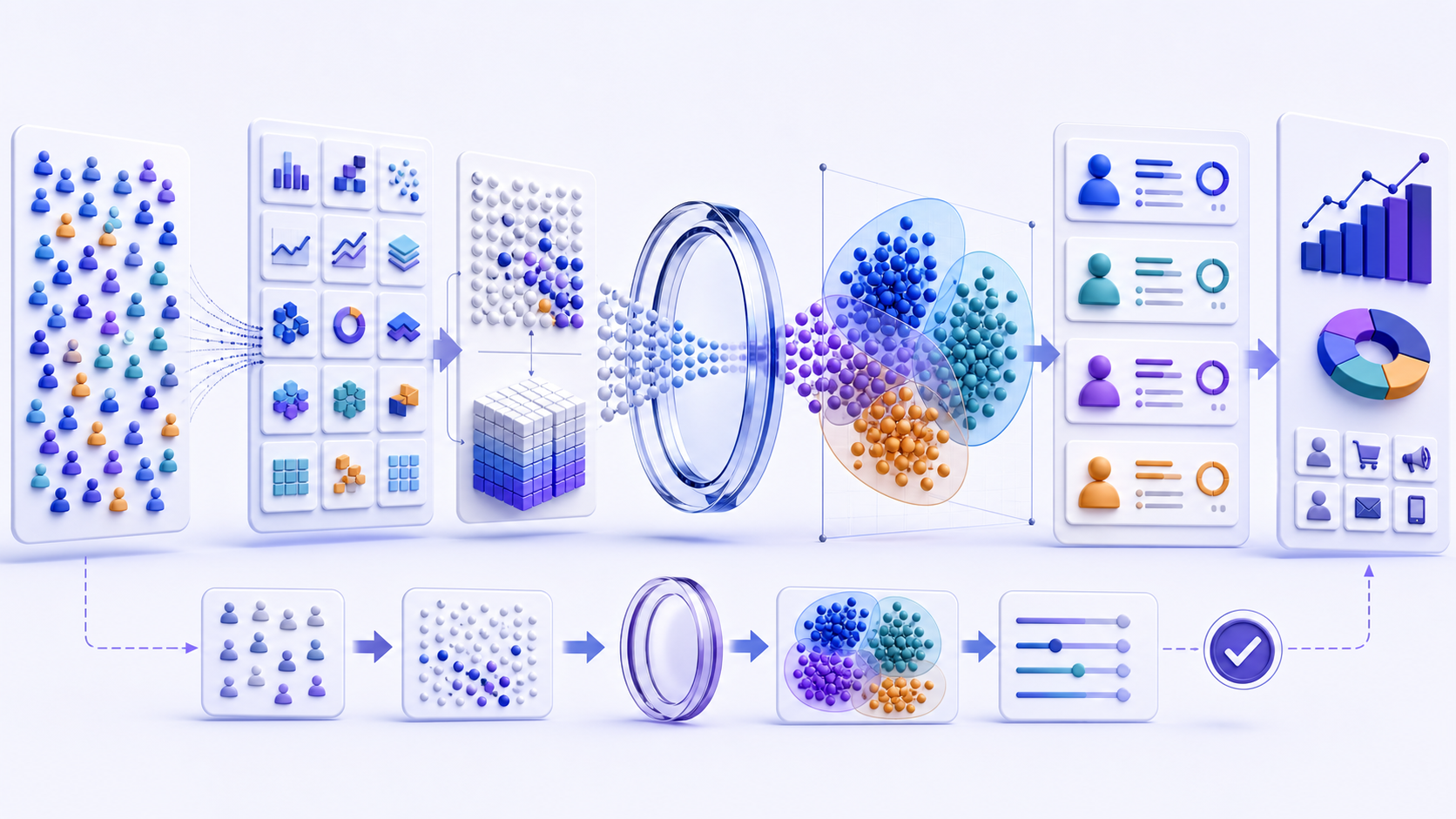
Customer segmentation analysis: the quick answer客户细分分析:快速回答
Customer segmentation analysis is the repeatable process of dividing customers into groups that share decision-relevant characteristics, behaviors, needs, lifecycle states, or value patterns, then testing whether those groups support different actions. A segment is useful only when a team can identify it consistently, reach it through an approved channel, take a meaningfully different action, and measure whether that action works.
客户细分分析是按照与决策相关的特征、行为、需求、生命周期状态或价值模式划分客户,并检验这些群组能否支持差异化行动的可复用流程。只有当团队能够稳定识别该群组、通过合规渠道触达、采取实质不同的行动,并衡量行动是否有效时,这个群组才真正有用。
The workflow is not “run a clustering algorithm and name the colors.” Start with a business decision, define the customer entity and observation window, prepare trustworthy variables, choose the simplest suitable method, profile and validate the groups, activate them in a controlled test, and monitor drift. Rule-based segments are often the best first version because stakeholders can understand and reproduce them. Statistical clustering becomes valuable when the structure is genuinely unknown and the data are sufficient.
正确流程并不是“运行一个聚类算法,然后给不同颜色命名”。你应先明确业务决策,再定义客户实体和观察窗口,准备可信变量,选择最简单且合适的方法,描述并验证各群组,通过受控实验激活,最后持续监测漂移。规则型细分往往是更好的第一版,因为利益相关者能够理解和复现;只有当数据结构确实未知且数据充分时,统计聚类才更有价值。
When customer segmentation helps—and when it does not客户细分何时有用,何时不该使用
Teams usually search for customer segmentation because one treatment no longer fits everyone. Marketing wants more relevant campaigns, product teams want to understand adoption patterns, sales wants account tiers, customer success wants service models, and finance wants a clearer view of value and retention. The common need is not a prettier profile; it is a defensible way to choose different actions.
团队通常在“一种做法无法适用于所有客户”时开始寻找客户细分方法。市场团队希望提升活动相关性,产品团队希望理解采用模式,销售团队需要账户分层,客户成功团队需要服务模型,财务团队希望更清楚地理解价值和留存。共同需求不是得到更漂亮的画像,而是用可辩护的方式选择不同的行动。
You have enough customers to treat groups differently, a stable identifier, observable differences tied to a decision, and a channel or product mechanism for acting on the result.
客户数量足以采用差异化策略,存在稳定标识符,有与决策相关的可观察差异,并且拥有可执行结果的渠道或产品机制。
The customer base is tiny, the real problem is missing product–market fit, no team can change treatment, IDs cannot be reconciled, or the proposed variables are not lawful or reliable.
客户基数很小、真正问题是尚未找到产品市场匹配、没有团队能改变服务方式、ID 无法统一,或拟使用变量不合法、不可靠。
Customer segmentation versus market segmentation: customer segmentation groups people or accounts already represented in your customer data. Market segmentation divides a broader potential market, including non-customers, often using research and external data. Segments versus personas: a segment is a measurable group definition; a persona is a narrative design or communication aid. A persona may summarize research about a segment, but the two are not interchangeable.
客户细分与市场细分:客户细分处理的是已经出现在客户数据中的个人或账户;市场细分则划分更广泛的潜在市场,其中包括非客户,通常依赖市场研究和外部数据。群组与用户画像:群组是可衡量的群体定义;用户画像是用于设计或沟通的叙事工具。画像可以总结某个群组的研究结论,但两者不能互换。
Prepare a customer-level data contract before analysis分析前先建立客户级数据契约
Most segmentation failures begin before modeling. A transaction table has one row per order, a product event table has one row per event, and a CRM may have one row per contact or account. If those grains are mixed without aggregation, frequent buyers or heavily instrumented users can appear multiple times and distort the result. Write a data contract that fixes the unit of analysis and the moment at which each variable is known.
大多数分群失败在建模之前就已发生。交易表可能每笔订单一行,产品事件表可能每个事件一行,CRM 可能每位联系人或每个账户一行。如果不先聚合就混合这些粒度,购买频繁或埋点密集的客户会重复出现并扭曲结果。应先编写数据契约,固定分析单位以及每个变量在何时可知。
| Contract item契约项目 | Decision to record需要记录的决定 | Failure it prevents可避免的问题 |
|---|---|---|
| Entity and key实体与主键 | Person, household, workspace, or account; one stable customer_id per row个人、家庭、工作区或账户;每行一个稳定 customer_id | Duplicate customers and B2B contact/account confusion客户重复,以及 B2B 联系人与账户混淆 |
| Population分析总体 | Eligibility date, markets, plans, and explicit exclusions such as employees or test accounts资格日期、市场、套餐,以及员工或测试账户等明确排除项 | Comparing groups that were never eligible for the same action比较本来就不适合同一行动的群体 |
| Observation window观察窗口 | For example, behavior in the 90 days before a fixed snapshot date例如固定快照日期之前 90 天的行为 | Leakage from future outcomes and inconsistent recency未来结果泄漏和时效口径不一致 |
| Features特征变量 | Definitions, units, missing-value meaning, allowed use, and transformation定义、单位、缺失含义、允许用途及转换方式 | Mixing revenue currencies, nulls, or proxies with incompatible meanings混用不同币种、空值或含义不兼容的代理变量 |
| Outcome and action结果与行动 | What decision changes, who owns it, and which metric will evaluate it要改变什么决策、由谁负责,以及用什么指标评估 | Descriptive clusters with no operational purpose只有描述、没有运营用途的群组 |
Useful inputs may include purchase recency and frequency, monetary value or margin, product usage, acquisition source, tenure, service interactions, contract characteristics, geography, consented profile data, and survey responses. Do not include every available column. Remove direct outcomes you are trying to predict, post-treatment variables, unstable IDs, free-text identifiers, and protected or sensitive attributes unless there is a clear lawful, necessary, and governed purpose.
有用输入可能包括最近购买时间、购买频率、消费金额或利润、产品使用、获客来源、客户年限、服务互动、合同特征、地理位置、经同意采集的资料和问卷回答。不要把所有可用列都塞进模型。应移除你正试图预测的直接结果、处理后变量、不稳定 ID、包含身份信息的自由文本,以及没有明确合法、必要且受治理用途的受保护或敏感属性。
Choose the customer segmentation model from the decision从业务决策出发选择客户细分模型
There is no universally best customer segmentation model. Choose the basis that changes the action. Demographic segmentation can support language or accessibility choices, yet age alone rarely explains product needs. Behavioral segmentation is strong when observed usage maps to an intervention. Needs-based work can reveal why customers choose a product, but it often requires surveys or interviews and careful sampling.
不存在普遍最优的客户细分模型。应选择真正能够改变行动的划分依据。人口统计细分可以支持语言或无障碍选择,但年龄本身很少能解释产品需求;当已观察到的使用行为可以对应干预方式时,行为细分更有优势;需求型细分能够解释客户为何选择某项产品,但通常需要问卷或访谈,并注意抽样质量。
| Model模型 | Best question最适合回答的问题 | Typical evidence常用证据 | Main caution主要注意事项 |
|---|---|---|---|
| Demographic / firmographic人口统计 / 企业属性 | Who or what kind of account is this?这是何种个人或账户? | Region, language, industry, company size, plan地区、语言、行业、公司规模、套餐 | Easy to measure but may not explain needs or behavior容易衡量,但未必能解释需求或行为 |
| Behavioral / lifecycle行为 / 生命周期 | What has the customer done, and where are they now?客户做过什么,目前处于哪个阶段? | Events, feature use, purchase state, support history事件、功能使用、购买状态、支持记录 | Instrumentation changes can move customers artificially埋点变化可能造成客户被动迁移 |
| RFM / value-basedRFM / 价值型 | Which customers are recent, frequent, or economically valuable?哪些客户更近期、更频繁或经济价值更高? | Recency, frequency, revenue, margin, cost-to-serve最近性、频率、收入、利润、服务成本 | Revenue is not profit; category and seasonality matter收入不等于利润,还要考虑品类与季节性 |
| Needs-based / psychographic需求型 / 心理特征 | Why does the customer choose, stay, or leave?客户为什么选择、留下或离开? | Interviews, surveys, jobs, attitudes, constraints访谈、问卷、任务、态度、约束 | Stated preference can differ from observed behavior表达偏好可能与实际行为不同 |
| Data-driven clustering数据驱动聚类 | What multivariate patterns exist without preset rules?在没有预设规则时,存在哪些多变量模式? | Scaled numeric or encoded categorical features标准化数值变量或编码后的类别变量 | Results depend on feature choice, scaling, distance, and k结果依赖特征、标准化、距离与聚类数 k |
Decision rule: begin with explicit rules when the business already knows the states that require different treatment. Use clustering to discover structure, not to make a simple lifecycle table look more scientific. Use supervised prediction when the actual question is “who is likely to churn or convert?”—that is a different task from descriptive segmentation.
选择原则:如果业务已经知道哪些状态需要不同处理,应先使用明确规则。聚类用于发现未知结构,不要用它让简单的生命周期表显得更“科学”。如果真正问题是“谁更可能流失或转化”,则应使用监督学习预测;这与描述性细分是不同任务。
How to do customer segmentation in seven repeatable steps如何用七个可复用步骤完成客户细分
- Define the decision and owner定义决策与负责人Write the choice that will change: onboarding sequence, account coverage, win-back offer, feature education, or research priority. Name the team that owns activation and the metric it can influence. “Understand customers” is too vague.写清要改变的选择,例如引导流程、账户覆盖、召回优惠、功能教育或研究优先级;明确负责激活的团队及其可影响指标。“理解客户”过于模糊。
- Fix the unit, population, and time固定单位、总体与时间Choose person or account, create a snapshot date, define eligibility, and aggregate every source to one row per entity. Keep the observation period separate from the later outcome period to prevent leakage.选择个人或账户作为单位,设定快照日期,定义资格条件,并把各数据源聚合为每个实体一行。观察期与后续结果期要分开,防止信息泄漏。
- Audit identity and data quality审计身份与数据质量Reconcile counts and totals back to source systems. Check duplicate IDs, impossible dates, currency and timezone differences, missingness, outliers, bot or employee activity, and whether a tracking release changed event volume.把数量和汇总值与源系统核对;检查重复 ID、异常日期、币种与时区差异、缺失、离群值、机器人或员工活动,以及埋点版本是否改变事件量。
- Engineer decision-relevant features构造与决策相关的特征Convert raw events into interpretable features such as active days, core actions completed, days since purchase, order frequency, margin, support intensity, tenure, or breadth of product adoption. Transform heavy-tailed values and scale features before distance-based models.把原始事件转换为可解释特征,例如活跃天数、核心动作完成数、距上次购买天数、订单频率、利润、支持强度、客户年限或产品采用广度。距离型模型前应处理长尾分布并进行标准化。
- Build a baseline, then candidate models先建基线,再建候选模型Create a simple rule-based baseline. If discovery is warranted, compare a small set of algorithms or k values using the same frozen dataset. Record preprocessing, random seed where applicable, and assignment logic so another analyst can reproduce the result.先创建简单的规则型基线。如果确有发现未知结构的必要,再在同一冻结数据集上比较少量算法或 k 值。记录预处理、适用时的随机种子和归属逻辑,让其他分析师可以复现。
- Profile and validate every segment描述并验证每个群组Give each segment a factual name based on observed differences, not a personality stereotype. Review size, feature distributions, uncertainty, separation, stability across samples and time, reachability, and whether the proposed action is genuinely different.根据已观察差异为群组命名,不要贴人格化标签。检查规模、特征分布、不确定性、分离度、跨样本和时间的稳定性、可触达性,以及拟采取行动是否确实不同。
- Activate with a holdout and monitor drift用对照组激活并监测漂移Send assignments to the destination only after privacy and operational review. Randomize an eligible holdout when possible, measure incremental outcomes and harms, record cost, then monitor segment size, membership movement, feature drift, and treatment performance on a schedule.只有通过隐私与运营审查后,才把群组归属发送到目标系统。条件允许时随机保留合格对照组,衡量增量结果与潜在损害,记录成本,并按计划监测群组规模、成员迁移、特征漂移和策略表现。
Version the result like a data product: `segment_definition_version`, snapshot date, model or ruleset version, feature dictionary, eligibility rule, and owner. Never silently overwrite historical assignments. Analysts need the ability to explain why a customer was assigned at a given time and to reconstruct the population used for a decision.
应像管理数据产品一样管理分群版本:记录 `segment_definition_version`、快照日期、模型或规则集版本、特征字典、资格规则和负责人。绝不能静默覆盖历史归属。分析师需要能够解释某位客户在某个时间为何被分到某组,并重建当时决策所使用的总体。
Customer segmentation example: an RFM and lifecycle baseline客户细分示例:RFM 与生命周期基线
Worked scenario: a subscription retailer freezes a June 30 customer snapshot and builds an analysis table with one row per eligible customer. The modeling brief names four candidate decisions—onboarding, replenishment, recognition, and win-back—and separates fields available before assignment from outcomes reserved for validation.
分析场景:某订阅零售商固定 6 月 30 日客户快照,并建立每位合格客户一行的分析表。建模简报列出新手引导、补货、客户认可和召回四项候选决策,同时把分群前可用字段与留作验证的结果字段分开。
Feature preparation produces recency, 365-day order frequency, gross-margin value, tenure, category breadth, and recent service-contact measures. Transformations are fitted within the training snapshot, market effects are reviewed explicitly, and raw values remain available beside standardized features so reviewers can trace every assignment.
特征准备阶段生成最近购买、365 天订单频率、毛利价值、客户年限、品类广度和近期服务联系等指标。所有转换只在训练快照中拟合,地区效应单独审查,并在标准化特征旁保留原始值,使审查者能够追溯每次归属。
| Illustrative segment假设群组 | Observable rule可观察规则 | Proposed action拟采取行动 | Validation question验证问题 |
|---|---|---|---|
| New, not activated新客户、未激活 | First order ≤30 days; no repeat order; low core-use signal首单不超过 30 天;尚未复购;核心使用信号低 | Education tied to the first successful use围绕首次成功使用提供教育 | Does education increase qualified repeat behavior versus holdout?相较对照组,教育是否提升合格复购行为? |
| Recent repeat customers近期复购客户 | High recency and frequency; moderate category breadth最近性和频率高;品类广度中等 | Relevant replenishment or adjacent-category test相关补货或相邻品类测试 | Is incremental margin positive after contact and discount cost?扣除触达和折扣成本后,增量毛利是否为正? |
| High-value established高价值成熟客户 | High frequency and margin; established tenure频率和毛利高;客户年限较长 | Recognition or service experiment, not an automatic discount开展认可或服务实验,而非自动打折 | Does the treatment improve retention without unnecessary subsidy?策略是否在不产生无谓补贴的情况下改善留存? |
| Previously active, now lapsed曾经活跃、当前流失 | Prior repeat behavior; recency beyond expected cycle过去有复购;最近性超过预期周期 | Research first; test a reason-specific win-back later先研究原因,再测试针对原因的召回 | Is lapse real, seasonal, or caused by measurement gaps?流失是真实、季节性,还是测量缺口造成? |
Candidate assignments are stress-tested before names are approved. Analysts compare market-level sizes, feature distributions, nearest-centroid distances, and membership changes under nearby thresholds. A small interview sample from the lapsed group is used only to challenge interpretations; it is not fed back into the model as an undocumented label.
候选归属在命名前先接受压力测试。分析人员比较各市场规模、特征分布、到最近中心的距离,以及相邻阈值下的成员变化。对流失群组的小规模访谈仅用于质疑解释,不会作为未记录标签重新写入模型。
How to validate customer segments before activation激活前如何验证客户群组
Validation starts by comparing candidate models on the same frozen feature matrix. Use separation measures such as the scikit-learn silhouette score only as diagnostics, then inspect stability across seeds, samples, time periods, and feature choices. Operational review must independently confirm that the resulting groups can be reached, governed, and tested.
验证应先在同一份冻结特征矩阵上比较候选模型。scikit-learn 轮廓系数等分离指标只能作为诊断,还要检查不同随机种子、样本、时期和特征选择下的稳定性。运营审查则独立确认群组能否触达、治理和测试。
- Reconciliation: customer counts, revenue, orders, and exclusions match trusted source totals within documented tolerances.
- 核对:客户数、收入、订单和排除项与可信源系统汇总值在记录的容差内一致。
- Stability: similar data or nearby thresholds produce recognizable groups; bootstrap samples or later snapshots do not completely rewrite membership.
- 稳定性:相似数据或相邻阈值能产生可识别群组;自助抽样或后续快照不会彻底改写成员归属。
- Coverage and reach: segment size is adequate for the intended action, and consented destination identifiers can be matched without silently dropping most members.
- 覆盖与触达:群组规模足以支持预定行动,并可用已获同意的目标标识符匹配,而不会静默丢失大多数成员。
- Fairness and safety: review outcomes and errors across relevant groups; do not infer or target sensitive traits merely because a proxy is available.
- 公平与安全:检查相关群体间的结果与错误;不要因为存在代理变量就推断或定向敏感特征。
- Incrementality: compare eligible treated customers with a randomized or otherwise defensible control. Pre/post movement alone may reflect seasonality, selection, or broader changes.
- 增量性:把接受策略的合格客户与随机或其他可辩护的对照组比较。单纯前后变化可能来自季节性、选择偏差或整体环境变化。
Common mistakes, limits, and privacy risks常见错误、局限与隐私风险
An elegant model cannot repair an undefined decision. Write the action and owner before choosing features or k.
精致模型无法修复模糊决策。选择特征或 k 之前,先写明行动和负责人。
One heavy user can contribute thousands of rows. Aggregate to the declared entity grain before modeling.
一名重度用户可能产生数千行。建模前必须聚合到声明的实体粒度。
Use factual labels such as “recent repeat buyers,” not personality claims the data cannot support.
使用“近期复购客户”等事实标签,不要用数据无法支持的人格判断。
High-value customers may respond anyway. A targeted group’s conversion rate does not reveal incremental impact without a comparison.
高价值客户本来就可能响应。没有对照,目标群组的转化率不能说明增量影响。
Operational complexity grows faster than insight. Merge groups when the action, message, owner, and measurement are identical.
运营复杂度可能比洞察增长得更快。如果行动、信息、负责人和测量都相同,就应合并群组。
Seasonality, pricing, tracking, and product changes can move distributions. Recompute and review on a documented cadence.
季节性、定价、埋点和产品变化都会改变分布。应按记录的周期重算与审查。
Model governance begins with a feature register: purpose, source, sensitivity, transformation, owner, retention rule, and permitted uses for every input. Consult the ICO profiling guidance where relevant, and document the jurisdiction-specific review applied to automated assignments.
模型治理应从特征登记表开始:逐项记录目的、来源、敏感性、转换、负责人、保存规则和允许用途。适用时参考ICO 画像分析指南,并记录自动归属所接受的具体司法辖区审查。
Consequential decisions require controls outside the segmentation pipeline: qualified legal and risk review, fairness testing, human intervention, appeal paths, and monitoring for unequal errors. For ordinary marketing use, enforce approved destinations, suppression rules, access limits, deletion propagation, and an expiry date for each assignment.
重大决策还需要分群管道之外的控制,包括合格的法律与风险审查、公平性测试、人工介入、申诉路径和不平等错误监测。普通营销用途也应限制获批目标系统,执行排除规则、访问限制、删除传递,并为每次归属设置失效日期。
Use InfiniSynapse for customer segmentation analysis使用 InfiniSynapse 开展客户细分分析
Use InfiniSynapse as a workspace for inspecting prepared customer tables, comparing rule-based baselines with candidate model outputs, and documenting assignment diagnostics across approved sources. Keep feature approval, model selection, production scoring, and activation authorization in the organization’s governed analytical process.
可把 InfiniSynapse 用作分析工作区,检查已准备的客户表,比较规则型基线与候选模型输出,并跨获批来源记录归属诊断。特征批准、模型选择、生产评分和激活授权仍应纳入组织受治理的分析流程。
Prepare a frozen modeling extract, feature dictionary, training and validation snapshots, baseline assignments, candidate parameters, protected holdout outcomes, and trusted totals. Ask first for grain, leakage, missingness, scaling, and outlier checks; only then compare assignments and stability.
请准备冻结的建模数据集、特征字典、训练与验证快照、基线归属、候选参数、受保护的留出结果及可信汇总。先检查粒度、泄漏、缺失、缩放和异常值,再比较归属与稳定性。
Open the InfiniSynapse AI Data Analyst打开 InfiniSynapse AI 数据分析工具Stage the analysis as reproducible artifacts: a quality report, versioned feature matrix, baseline comparison, candidate-model diagnostics, stability report, and assignment export. The final export should include customer_id, segment_id, model_version, snapshot_date, confidence or distance fields where appropriate, and an interpretable assignment reason.
应把分析分阶段保存为可复现产物:质量报告、版本化特征矩阵、基线比较、候选模型诊断、稳定性报告和归属导出。最终导出应包含 customer_id、segment_id、model_version、snapshot_date、适用时的置信度或距离字段,以及可解释的归属原因。
For related foundations, see InfiniSynapse’s data analysis techniques guide and the AI data analysis blog hub.
如需补充基础知识,可阅读 InfiniSynapse 的数据分析技术指南和AI 数据分析博客中心。
Customer segmentation FAQ客户细分常见问题
What is customer segmentation?
什么是客户细分?
In analytical work, customer segmentation is a reproducible assignment system that maps a defined population to versioned groups using documented features, rules, or models for a specified decision.
在分析工作中,客户细分是一套可复现的归属系统:针对明确总体,使用有文档的特征、规则或模型,把客户映射到服务特定决策的版本化群组。
What are the main types of customer segmentation?
客户细分的主要类型有哪些?
Analytical implementations usually use deterministic business rules, scored models such as RFM, supervised predictions, or unsupervised clustering. Demographic, behavioral, lifecycle, and needs variables are possible inputs rather than mutually exclusive algorithms.
分析实施通常采用确定性业务规则、RFM 等评分模型、监督式预测或无监督聚类。人口、行为、生命周期和需求变量属于可能的输入维度,并非互斥算法。
How many customer segments should you create?
应该创建多少个客户群组?
Compare several candidate counts against stability, minimum usable size, interpretability, and operational capacity. Select the simplest solution that preserves decision-relevant differences on validation data.
应针对稳定性、最小可用规模、可解释性和运营容量比较多个候选数量,并选择在验证数据上保留决策相关差异的最简单方案。
What data is needed for customer segmentation?
客户细分需要什么数据?
A modeling dataset needs a stable entity key, snapshot and observation windows, approved feature values available before assignment, explicit missing-value handling, eligibility flags, and separate outcomes for evaluation.
建模数据需要稳定实体键、快照与观察窗口、归属前可用的获批特征、明确的缺失值处理、资格标记,以及与建模分离的评估结果。
How do you know whether a customer segment is useful?
如何判断一个客户群组是否有用?
Review reproducibility, temporal and sampling stability, profile separation, assignment coverage, destination match rate, operating cost, and measured response to a controlled action. No single model score is sufficient.
应审查可复现性、时间与抽样稳定性、画像差异、归属覆盖、目标系统匹配率、运营成本,以及受控行动下的实测响应;任何单一模型评分都不充分。
Is customer segmentation the same as personalization?
客户细分等同于个性化吗?
No. A segmentation model produces shared group assignments at a snapshot. Personalization chooses content or treatment at delivery time and may use segment membership as only one governed input.
不等同。分群模型在某个快照产生共享群组归属;个性化在交付时选择内容或处理方式,群组归属最多只是其中一个受治理输入。
Official sources and a final implementation checklist权威来源与最终实施检查表
- Google Cloud’s guide to actionable customer segmentation models covers common data types, RFM, behavioral and psychographic models, and the need to begin with a goal.
- Google Cloud 的可执行客户细分模型指南介绍常见数据类型、RFM、行为与心理特征模型,并强调从目标开始。
- Google Analytics documentation for creating and managing audiences explains conditions, scopes, dynamic evaluation, sequences, and platform limits.
- Google Analytics 创建和管理受众的官方文档说明条件、范围、动态评估、序列和平台限制。
- ICO guidance on automated decision-making and profiling provides privacy and governance checklists; note that the ICO states this guidance is under review following the UK Data (Use and Access) Act 2025.
- ICO 关于自动化决策与画像分析的指南提供隐私和治理检查表;需注意 ICO 已说明该指南会因英国《2025 年数据(使用与访问)法》而接受审查。
- scikit-learn’s clustering performance evaluation documentation describes internal clustering measures and their limitations.
- scikit-learn 的聚类性能评估文档说明内部聚类指标及其局限。
Model-release checklist: frozen population and windows; reconciled source totals; approved feature register; leakage test passed; baseline retained; candidate parameters versioned; stability and subgroup diagnostics reviewed; assignment schema documented; destination match tested; holdout outcome protected; monitoring thresholds and rollback owner assigned.
模型发布检查:总体与窗口已冻结;源系统总额已对账;特征登记获批;泄漏测试通过;基线保留;候选参数版本化;稳定性与子群诊断已审查;归属结构已记录;目标匹配已测试;留出结果受保护;已指定监控阈值和回滚负责人。
Release the segmentation artifact only when another analyst can reconstruct its feature matrix, reproduce assignments, and explain changes from the previous version. Complexity earns its place only when validation shows a reliable improvement over the documented baseline.
只有当另一位分析人员能够重建特征矩阵、复现归属并解释相较上一版本的变化时,才发布分群产物。只有验证显示复杂方案相较有文档的基线实现可靠改善时,复杂度才有价值。