
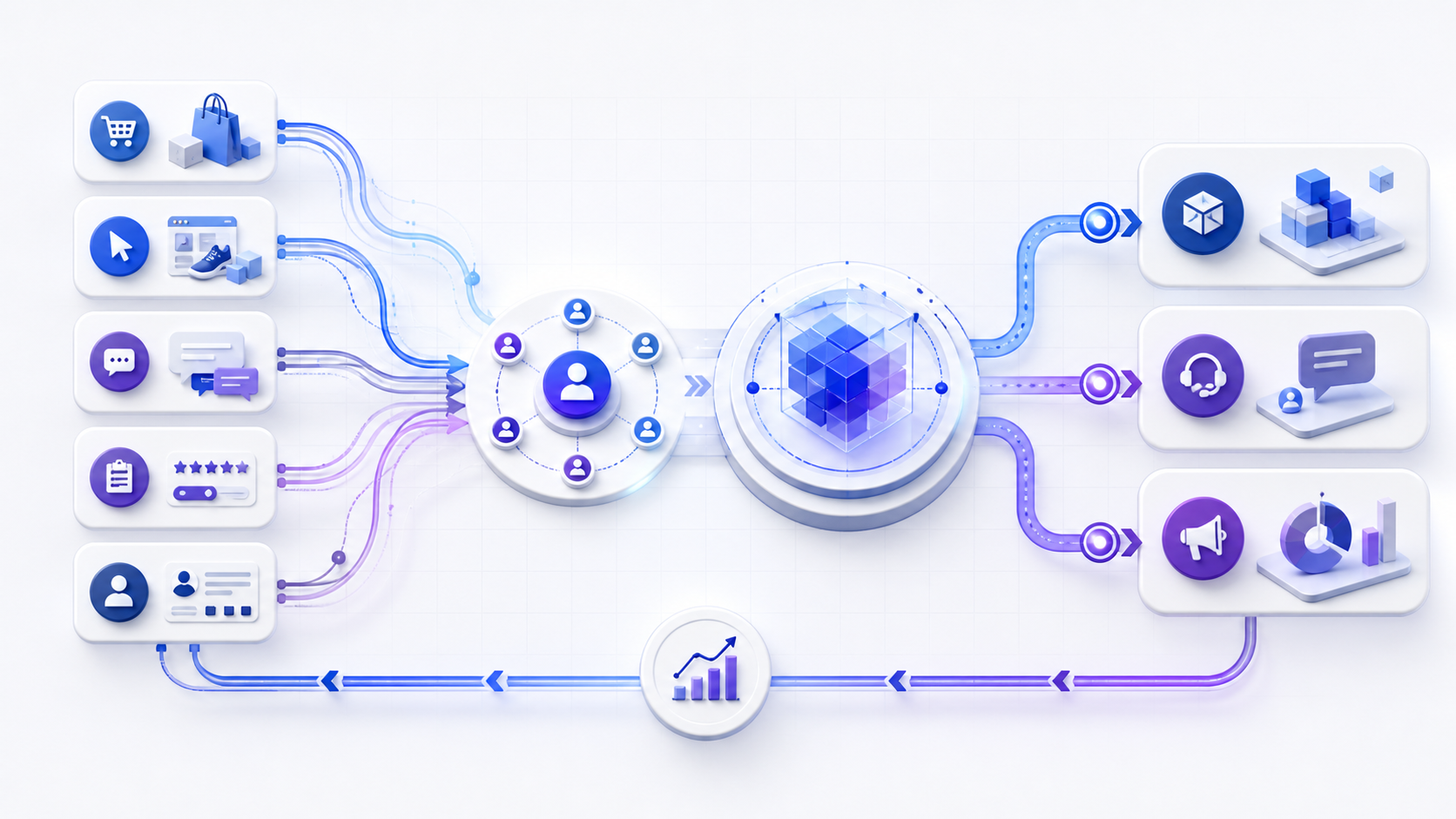
Customer intelligence is a governed evidence-to-decision practice客户智能是受治理的证据到决策实践
Customer intelligence is the repeatable practice of combining what customers do, buy, say, need, and experience to support a defined decision. It preserves the difference between recorded facts, customer statements, analytical inference, and tested causal effects. A useful output includes the question, population, sources, confidence, alternatives, owner, action, and follow-up measure.
客户智能是一套可复用实践,把客户做了什么、购买了什么、表达了什么、需要什么以及经历了什么结合起来,支持明确决策。它保留已记录事实、客户陈述、分析推断与经检验因果效应之间的差异。有效输出应包含问题、总体、来源、置信程度、替代解释、负责人、行动与后续指标。
A customer intelligence platform may support this practice, but the practice is broader than any product. Use the separate customer intelligence platform guide when the decision is whether to buy, pilot, or govern software.
客户智能平台可以支持这套实践,但客户智能本身比任何产品都更广泛。当问题是是否采购、试点或治理软件时,请阅读独立的客户智能平台指南。
Use customer intelligence for recurring questions with mixed evidence用客户智能回答需要多源证据的重复问题
The practice is valuable when no single system explains the decision. Product telemetry can show where adoption stops but not always why. Interviews can explain constraints but not population frequency. Transactions show realized value but may omit unmet demand. Service records reveal friction yet overrepresent customers who contact support. Customer intelligence triangulates these sources instead of treating one as the complete customer truth.
当没有单一系统能够解释决策时,客户智能尤其有价值。产品遥测可以显示采用在何处停止,却未必解释原因;访谈能够解释约束,但不能代表总体频率;交易显示已实现价值,却可能遗漏未满足需求;客服记录揭示摩擦,却过度代表主动联系支持的客户。客户智能通过多源交叉验证,而不是把某一来源当作完整客户真相。
Which needs and moments predict durable adoption rather than a short-lived conversion?
哪些需求与关键时刻能够预测持久采用,而不是短期转化?
Which friction matters most, for whom, and what change is feasible?
哪些摩擦最重要、影响谁,以及什么改变可行?
Give each source an explicit role and limitation明确每种来源的角色与限制
| Evidence证据 | What it contributes主要贡献 | Typical limitation常见限制 |
|---|---|---|
| Transactions交易 | Realized purchase, value, timing, product mix实际购买、价值、时间与产品组合 | Does not reveal rejected alternatives or unmet need不能揭示被放弃的选择或未满足需求 |
| Behavioral events行为事件 | Observed use, sequence, frequency, drop-off已观察使用、序列、频率与流失点 | Instrumentation and identity gaps埋点与身份缺口 |
| Support and feedback客服与反馈 | Problems, language, severity, resolution问题、语言、严重程度与解决情况 | Self-selection and inconsistent coding自选择偏差与编码不一致 |
| Research研究 | Motivation, context, alternatives, constraints动机、背景、替代方案与约束 | Sampling and stated-versus-observed gaps抽样及表达与行为之间的差距 |
Start with a decision brief before collecting more customer data收集更多客户数据前,先建立决策简报
Record the decision, owner, deadline, affected customer population, alternatives, current belief, evidence that would change the choice, privacy boundary, and action capacity. Then inventory what is already known. This avoids collecting surveys because a survey tool exists or requesting every warehouse column because it is available.
记录决策、负责人、期限、受影响客户总体、备选方案、当前判断、能够改变选择的证据、隐私边界与行动能力,然后盘点已有知识。这样可以避免因为有问卷工具就收集问卷,或因为仓库中有字段就请求所有列。
Minimum evidence rule: collect the smallest additional evidence that can discriminate among plausible decisions. More data is not automatically more customer understanding.
最小证据原则:只收集能够区分合理备选决策的最少补充证据。更多数据并不自动等于更理解客户。
Synthesize evidence without erasing disagreement综合证据,但不要抹去分歧
Use journey or service-blueprint mapping to connect stages and operational causes; cohort and segmentation analysis to locate where patterns concentrate; thematic analysis to organize qualitative evidence; opportunity mapping to compare needs and outcomes; and experiments to test whether a proposed intervention changes behavior. Keep contradictory cases and missing populations visible because they often reveal the boundary of an insight.
可使用旅程图或服务蓝图连接阶段与运营原因,用同期群和细分分析定位模式集中位置,用主题分析组织定性证据,用机会图比较需求与结果,并用实验检验拟议干预是否改变行为。应保留矛盾案例与缺失人群,因为它们往往揭示洞察的适用边界。
Quantification should follow a stable definition. Do not turn interview counts into population percentages, infer motivation directly from clicks, or treat sentiment scores as a substitute for the underlying themes and sampling process.
量化必须建立在稳定定义之上。不要把访谈计数转成人群比例,不要直接从点击推断动机,也不要用情感分数替代底层主题与抽样过程。
Assign ownership across research, analytics, operations, and decision makers在研究、分析、运营与决策者之间分配责任
Customer intelligence fails when insight production and decision ownership are separated. Researchers should document context and sampling; analysts should define populations, measures, and uncertainty; data owners should maintain provenance and permissions; operational teams should judge feasibility; and the decision owner should record the action and review date. A shared evidence repository supports memory, but it cannot replace these responsibilities.
当洞察生产与决策责任分离时,客户智能容易失败。研究人员应记录背景与抽样;分析师应定义总体、指标与不确定性;数据负责人应维护来源与权限;运营团队应判断可行性;决策负责人应记录行动与复审日期。共享证据库可以支持组织记忆,但不能替代这些责任。
Run a seven-step customer intelligence cycle运行七步客户智能循环
- Frame one recurring decision.界定一项重复决策。
- Map stakeholders, populations, and harms.映射利益相关者、总体与潜在伤害。
- Inventory existing evidence and its limits.盘点已有证据及其限制。
- Collect the smallest missing evidence.收集最少的缺失证据。
- Synthesize facts, statements, inference, and uncertainty separately.分别综合事实、陈述、推断与不确定性。
- Choose an action with a measurable learning plan.选择带有可衡量学习计划的行动。
- Review outcomes and update the evidence memory.复核结果并更新证据记忆。
A decision framework for stronger customer intelligence让客户智能更可靠的决策框架
A customer intelligence record should earn its place in an operating plan. Rate source coverage and lineage, the strength of the proposed explanation, relevance to a named customer group and decision, and whether the next action can produce new evidence. Store the four ratings with the record so later users can see why it was promoted, restricted, or retired.
客户智能记录需要证明自己值得进入运营计划。应评估来源覆盖与血缘、解释的可信程度、与明确客户群和决策的相关性,以及下一步能否产生新证据;并把四项结果与记录一起保存,让后续使用者理解它为何被采用、限制或淘汰。
Make confidence a field in the intelligence system. Label a signal as exploratory when it comes from a narrow feed, corroborated when independent sources agree, and operationally validated only when a prospective intervention or repeat observation supports it. Preserve the applicable segment, market, period, channel, and product version so the label cannot travel beyond its evidence.
把置信度设为客户智能系统中的正式字段。来自狭窄数据流的信号标为“探索性”,独立来源一致时标为“已佐证”,只有前瞻干预或重复观察支持后才标为“运营验证”。同时保留适用细分、市场、时期、渠道和产品版本,避免标签脱离证据边界传播。
Customer insights example: onboarding friction客户智能示例:新手引导摩擦
Illustrative intelligence cycle: the following organization, thresholds, and outcomes are fictional and demonstrate how a signal moves through monitoring, investigation, action, and review.
客户智能周期示例:以下组织、阈值与结果均为虚构,用于说明信号如何经过监测、调查、行动和复盘。
A collaboration service detects a recurring retention alert among new accounts that do not invite a teammate. Rather than treating the event correlation as an answer, the intelligence owner opens a case and connects onboarding feedback, permission-related support themes, account size, and the event sequence around role selection. The combined record points to small-team owners hesitating because role names suggest permanent administrative access.
某协作服务持续发现“未邀请同事的新账户”触发留存预警。客户智能负责人没有把事件相关性当作答案,而是建立调查事项,连接新手反馈、权限类客服主题、账户规模,以及角色选择前后的事件序列。合并记录显示,小团队所有者因角色名称暗示永久管理权限而犹豫。
| Layer层次 | Example output示例输出 | What remains uncertain仍不确定什么 |
|---|---|---|
| Observation观察 | Non-inviters revisit role help and mention unclear ownership in interviews.未邀请者反复查看角色帮助,并在访谈中提到所有权不清。 | Whether confusion causes lower retention or merely accompanies it.这种困惑究竟导致低留存,还是仅与其同时出现。 |
| Insight洞察 | For small-team owners, permanent-sounding role labels increase perceived risk at the moment collaboration should begin.对小团队所有者而言,听起来永久有效的角色标签,在应开始协作时提高了感知风险。 | The size of the affected segment and best corrective wording.受影响细分规模和最合适的修正文案。 |
| Test测试 | Explain permissions before invitation and offer a reversible default role.邀请前解释权限,并提供可逆的默认角色。 | Effect on invitations, setup completion, support contacts, and later access mistakes.对邀请、设置完成、客服联系及后续权限错误的影响。 |
The case owner tracks completed invitations among eligible accounts, while monitoring over-permissioning, support contacts, and downstream collaboration as guardrails. If invitations rise without sustained collaborative activity, the system records the intervention as a weak resolution, reopens the explanation, and routes the case back to research instead of declaring success.
事项负责人跟踪合格账户完成邀请的比例,并以过度授权、客服联系和后续协作作为护栏。如果邀请增加却没有形成持续协作,系统应把这次干预记为“弱解决”,重新开放解释并退回研究,而不是直接宣布成功。
Common mistakes, limits, and risks常见错误、限制与风险
Deduplicate recurring tickets and weight them by affected segment, job, behavior, and consequence before an issue enters the intelligence queue.
在问题进入客户智能队列前,应对重复工单去重,并结合受影响细分、任务、行为和后果评估其重要性。
Store recent examples, sequence, context, and trade-offs rather than answers elicited by describing the desired feature in the question.
应保存近期实例、过程、情境与取舍,而不是通过在问题中描述期望功能来诱导答案。
Cross-source intelligence needs declared match rules, confidence, purpose, and access boundaries; uncertain links must remain visible instead of silently becoming one person.
跨来源客户智能需要明确匹配规则、置信度、用途和访问边界;不确定连接必须保持可见,不能静默合并成同一个人。
Automated themes can organize large evidence streams, but the intelligence owner must review excerpts, conflicting cases, and source coverage before publishing a conclusion.
自动主题可以整理大规模证据流,但发布结论前,客户智能负责人必须复核原始片段、冲突案例和来源覆盖。
Monitor the blind spots of the intelligence feed itself. Prospect questions cannot be answered only from current customers; silence is not satisfaction; and cohorts with unequal exposure should not share one alert threshold. Track source and accessibility coverage by recruitment channel, language, device access, and digital skill so the people facing the most friction do not disappear from the operating view.
还要监测客户智能数据流本身的盲点。潜在客户问题不能只依赖现有客户,沉默不等于满意,暴露周期不同的同期群也不应共用一个预警阈值。应按招募渠道、语言、设备访问和数字技能记录来源与无障碍覆盖,避免摩擦最大的人群从运营视图中消失。
How to validate customer intelligence before acting采取行动前如何验证客户智能
Validate customer intelligence at three handoffs. At ingestion, reconcile records and source definitions. Before publication, review excerpts, missing segments, counterexamples, and alternative explanations. Before closing an intelligence case, require a prospective measure, reversible intervention, or experiment that could show the proposed action did not work.
客户智能应在三个交接点验证:摄取时核对记录与来源定义;发布前复核原始片段、缺失细分、反例和替代解释;关闭事项前,要求提供前瞻指标、可逆干预或能够证明行动无效的实验。
- Traceability: Can a reviewer move from each claim to the exact records, excerpts, filters, and version used?可追溯性:审查者能否从每项主张追到具体记录、原文、筛选条件和版本?
- Definition stability: Do customer, active, retained, complaint, and segment mean the same thing across sources?定义稳定性:客户、活跃、留存、投诉和细分在不同来源中是否含义一致?
- Coverage: Who is missing because they churned silently, declined research, used another channel, or cannot access the format?覆盖:哪些人因静默流失、拒绝研究、使用其他渠道或无法访问研究形式而缺失?
- Alternative explanations: What product, seasonal, channel, pricing, or measurement change could produce the same pattern?替代解释:哪些产品、季节、渠道、价格或测量变化也可能产生相同模式?
- Decision test: Is the next action bounded, owned, measurable, and safe to reverse if the hypothesis fails?决策测试:下一步是否边界清晰、有人负责、可测量,并能在假设失败时安全撤回?
Operate an intelligence registry with a statement, owner, affected population, evidence lineage, confidence, limitations, action, metrics, next review, and lifecycle state. Expiry and supersession rules should automatically surface stale records when the product, market, source coverage, or customer mix changes.
客户智能登记库应包含陈述、负责人、受影响人群、证据血缘、置信度、限制、行动、指标、下次复核和生命周期状态。当产品、市场、来源覆盖或客户结构变化时,过期与替代规则应自动提示陈旧记录。
Pilot a customer intelligence platform before rollout全面推广客户智能平台前先完成可验证试点
A useful pilot tests the operating system, not just whether a connector turns green. Time-box one decision and use a representative slice of data that includes duplicates, missing fields, late records, consent changes, ambiguous identities, multilingual feedback, and at least one source outage. Establish a trusted baseline outside the candidate platform. The team should then reproduce that baseline, investigate differences, create a reviewed insight, route a reversible action, and measure the outcome.
有用的试点要测试整套运行机制,而不只是连接器是否变绿。为一项决策设定有限周期,并使用具有代表性的数据切片,其中包括重复、字段缺失、迟到记录、同意状态变化、模糊身份、多语言反馈和至少一次来源中断。先在候选平台之外建立可信基线,然后要求团队在平台中复现基线、调查差异、形成经复核的洞察、执行可撤回行动,并测量结果。
- Freeze the test contract.冻结测试契约。 Record the decision, data snapshot, definitions, expected totals, permitted users, excluded uses, acceptance thresholds, timeline, and who can approve changes.记录决策、数据快照、定义、预期总数、获准用户、禁止用途、验收阈值、周期以及谁可以批准变更。
- Reconcile every stage.逐阶段对账。 Compare extracted, accepted, rejected, matched, analyzed, exported, and activated records. Explain differences instead of silently adjusting the denominator.比较抽取、接受、拒绝、匹配、分析、导出和执行的记录数。解释差异,不要悄然调整分母。
- Test evidence traceability.测试证据可追溯性。 Ask a reviewer who did not build the workflow to reproduce one segment, theme, score, and recommendation from source evidence and versioned logic.让没有搭建工作流的审查者,根据源证据和带版本逻辑复现一个细分、主题、分数和建议。
- Exercise failure and rollback.演练失败与回滚。 Change a schema, revoke consent, split a mistaken identity merge, pause an activation, restore a prior definition, and export the audit history.改变模式、撤回同意、拆分错误身份合并、暂停行动、恢复旧定义并导出审计历史。
- Review value and total cost.复盘价值与总成本。 Measure time saved, decisions improved, error handling, adoption, and outcome quality against implementation work, data engineering, governance, training, support, usage, and exit costs.把节省时间、改善决策、错误处理、采用情况和结果质量,与实施、数据工程、治理、培训、支持、使用量及退出成本一起评估。
Approve rollout only when blocking controls pass and remaining gaps have owners, dates, and safe workarounds. A pilot that produces an appealing dashboard but cannot reconcile records, honor deletion, expose evidence, or stop an action has demonstrated presentation—not readiness. Revisit the decision after a defined operating period because source systems, models, prices, team skills, and regulatory obligations change.
只有阻断性控制全部通过,且剩余缺口都有负责人、日期和安全替代方案时,才批准推广。一个只能产出漂亮仪表板,却无法对账、执行删除、展示证据或停止行动的试点,证明的只是展示能力,而不是上线准备度。还应在明确的运行周期后重新评估,因为源系统、模型、价格、团队技能和监管义务都会变化。
Use InfiniSynapse to analyze customer evidence across sources使用 InfiniSynapse 跨来源分析客户证据
InfiniSynapse is an AI Data Analyst for multi-source analysis; its public site does not present it as an all-in-one customer intelligence platform, CDP, CRM, consent manager, or customer engagement system. Public product information describes natural-language analysis across databases and multimodal sources such as documents, audio, and video. Within a customer intelligence architecture, that makes it a relevant analysis layer for comparing governed CRM or product data with permitted feedback files, interview notes, support records, or recordings. It should not be treated as a survey panel, participant recruiter, legal reviewer, identity-resolution authority, activation engine, or automatic source of causal truth.
InfiniSynapse 是用于多来源分析的 AI Data Analyst;其公开网站并未把它描述为一体化客户智能平台、CDP、CRM、同意管理器或客户互动系统。公开产品信息说明,它支持通过自然语言分析数据库以及文档、音频、视频等多模态来源。在客户智能架构中,它适合作为分析层,用于比较受治理的 CRM 或产品数据,与获准使用的反馈文件、访谈笔记、客服记录或录音。它不应被视为问卷样本库、参与者招募工具、法律审查者、身份解析权威、行动引擎或自动提供因果真相的系统。
Before opening the tool, prepare read-only governed sources or approved exports, the decision statement, time window, stable join keys, segment and metric definitions, access boundaries, and source reconciliation totals. Then use InfiniSynapse to explore cross-source evidence in natural language and review every resulting pattern or hypothesis before it informs platform selection or customer-facing action.
打开工具前,准备好受治理的只读来源或已批准导出、决策声明、时间窗口、稳定连接键、细分与指标定义、访问边界及源系统核对总数。随后可用 InfiniSynapse 通过自然语言探索跨来源证据,并在结果影响平台选型或面向客户的行动前,人工复核每个模式与假设。
Analyze prepared data with InfiniSynapse使用 InfiniSynapse 分析已准备的数据For upstream data governance, read the customer data management guide. For campaign, attribution, and acquisition questions, use the marketing data analysis playbook.
Customer intelligence FAQ客户智能常见问题
What is customer intelligence?
什么是客户智能?
Customer intelligence is the governed practice of combining behavioral, transactional, service, research, and market evidence to support a defined customer decision and learn from its outcome.
客户智能是一套受治理实践,结合行为、交易、服务、研究与市场证据,支持明确客户决策,并从行动结果中学习。
How is customer intelligence different from customer analytics?
客户智能与客户分析有什么区别?
Customer analytics emphasizes quantitative customer data and models. Customer intelligence is broader and may combine analytics with interviews, surveys, service evidence, market context, decision ownership, and action learning.
客户分析更强调量化客户数据与模型;客户智能范围更广,还可结合访谈、问卷、服务证据、市场背景、决策责任与行动学习。
Do you need a customer intelligence platform?
是否必须采用客户智能平台?
Not always. Teams can operate the practice with governed data, research repositories, analytics tools, and clear workflows. A platform is useful only when it closes a defined operational gap.
不一定。团队可以用受治理数据、研究资料库、分析工具与明确流程运行客户智能。只有当平台能弥补明确运营缺口时,才有必要引入。
How do you validate a customer insight?
如何验证客户洞察?
Trace it to sources, check population and sampling, compare contradictory evidence, state uncertainty and alternative explanations, and test the resulting action when causal impact matters.
应追溯来源,检查总体与抽样,比较矛盾证据,声明不确定性与替代解释;当涉及因果影响时,还要检验由洞察产生的行动。
Official sources and further reading权威来源与延伸阅读
These sources support the research, behavioral-data, and privacy practices used in this guide. They do not endorse InfiniSynapse.
以下来源支持本指南采用的研究、行为数据与隐私实践,但不代表它们认可 InfiniSynapse。