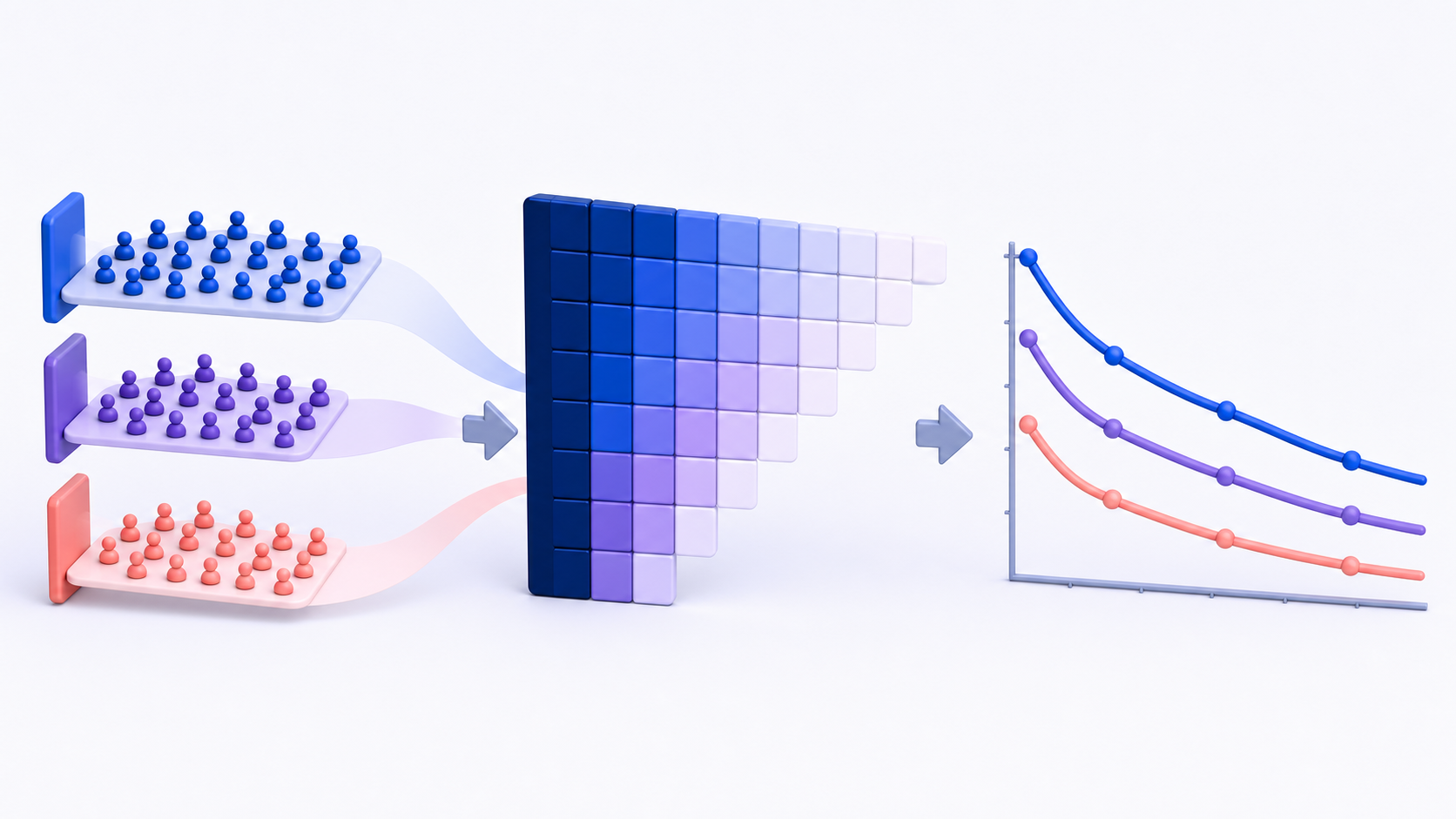
Cohort Analysis: The Quick AnswerCohort Analysis 快速回答
Cohort analysis compares groups of users who share a defined starting event or characteristic at the same elapsed age. Instead of asking whether total retention rose, it asks whether users acquired in one week, channel, plan, or behavior pattern returned more often than comparable users. The method separates changes in user mix and product age from real changes in behavior.
Cohort Analysis 会把具有同一初始事件或特征的用户分组,并在相同的使用时长上比较他们。它不只问整体留存是否上升,而是比较某一周、渠道、套餐或行为模式进入的用户,是否比可比用户更常回访。这样可以把用户结构变化和产品年龄差异,与真实行为变化区分开。
The usual output is a triangular cohort retention table. Rows are cohorts, columns are periods since entry, and each cell is the share of the original cohort that met a return condition. Read across a row to see one cohort decay or stabilize; read down a column to compare cohorts at the same age.
最常见的输出是三角形留存分群表:行表示分群,列表示进入后的第几个周期,单元格表示原始分群中满足回访条件的占比。横向阅读一行,可以观察一个分群的衰减或稳定;纵向阅读一列,可以在相同用户年龄上比较不同分群。
When Cohort Analysis Helps—and When It Does Not何时应该使用 Cohort Analysis,何时不适合
Use cohort analysis when an aggregate metric mixes users with different starting dates, acquisition sources, product experiences, or maturity. It is especially useful after onboarding changes, pricing changes, channel shifts, feature launches, or reliability incidents. The question should involve behavior through time: “Did the users exposed to the new onboarding return in Week 4?” is a cohort question; “How many users logged in yesterday?” is not.
当整体指标混合了不同进入时间、获客来源、产品体验或成熟度的用户时,应使用分群分析。它特别适合评估新手引导、定价、渠道、功能上线或可靠性事故后的变化。问题必须涉及时间中的行为:“接触新版引导的用户在第 4 周是否回访?”是分群问题;“昨天有多少用户登录?”则不是。
Retention, activation durability, repeat purchase, subscription survival, feature adoption persistence, revenue by customer age, or differences between behavioral cohorts.
留存、激活的持续性、复购、订阅存续、功能采用的持续性、按客户年龄计算的收入,以及行为分群之间的差异。
Real-time monitoring, one-off totals, questions with no meaningful start event, tiny cohorts, or claims of causality without an experiment.
实时监控、一次性总量、没有合理起始事件的问题、样本极小的分群,或在没有实验时声称因果关系。
Cohort analysis also differs from a medical cohort study. The shared word “cohort” means a defined group, but product cohort analysis is normally a retrospective behavioral comparison based on event data. It does not inherit the design, follow-up, or causal standards of epidemiological research.
产品分群分析也不同于医学队列研究。二者都用“cohort”表示一个定义明确的群体,但产品分析通常是基于事件数据的回顾性行为比较,不自动具备流行病学研究的设计、随访或因果标准。
Choose the Cohort Design That Matches the Question选择与问题匹配的 Cohort 分群设计
“Cohort” is not synonymous with “signup month.” Time-based acquisition cohorts are common because they make product age comparable, but the best membership rule depends on the decision. A cohort should represent a stable exposure, behavior, or attribute that can be reproduced from source data. If the rule changes whenever the chart is opened, the trend is not comparable.
“Cohort”并不等于“注册月份”。时间型获客分群很常见,因为它能让产品使用年龄可比;但最佳成员规则取决于要做的决策。一个分群应代表能够从源数据复现的稳定曝光、行为或属性。若每次打开图表时规则都变化,趋势便不可比较。
| Design设计 | Membership example成员示例 | Best question最适合回答 | Main caution主要注意 |
|---|---|---|---|
| Acquisition cohort | First signup week | Are newer users retaining better at the same age? | Channel and market mix may change across weeks |
| Activation cohort | First completed value event | Does reaching value earlier predict durable use? | Excludes users who never activate unless compared explicitly |
| Behavioral cohort | Used collaboration three times in seven days | Which behaviors are associated with later retention? | Association is not proof that the behavior caused retention |
| Exposure cohort | Saw version B after release | Did exposed users behave differently? | Exposure may be selected rather than randomized |
| Attribute cohort | Plan, platform, country, or account size | Which product context needs a different experience? | Attributes can change; choose entry-time or current value |
| Revenue cohort | First paid month | How does revenue evolve with customer age? | Expansion, contraction, and churn need separate interpretation |
| 获客分群 | 首次注册周 | 新用户在相同年龄上的留存是否改善? | 不同周的渠道和市场结构可能变化 |
| 激活分群 | 首次完成价值事件 | 更早获得价值是否与持续使用相关? | 除非明确比较,否则会排除从未激活者 |
| 行为分群 | 七天内使用协作功能三次 | 哪些行为与后续留存相关? | 相关性不能证明该行为导致留存 |
| 曝光分群 | 发布后看到 B 版本 | 被曝光用户的行为是否不同? | 曝光可能是选择性的,而非随机 |
| 属性分群 | 套餐、平台、国家或账户规模 | 哪种产品情境需要不同体验? | 属性会变化,应明确使用进入时还是当前值 |
| 收入分群 | 首次付费月份 | 收入如何随客户年龄变化? | 扩张、收缩和流失需要分别解释 |
Use one primary cohort dimension for the decision, then add only the smallest segmentation needed to test an explanation. Crossing signup week, channel, country, platform, plan, and feature use in one view creates sparse cells and invites story picking. Start broad, find a repeatable difference, and drill into one plausible driver at a time.
围绕决策选择一个主要分群维度,再只添加验证解释所需的最少切分。如果在一个视图中同时交叉注册周、渠道、国家、平台、套餐和功能使用,就会产生稀疏单元格并诱发挑选故事。应先从宽泛比较开始,找到可重复差异,再一次调查一个合理驱动因素。
Decide whether membership is fixed or dynamic. Acquisition and experiment-assignment cohorts are usually fixed at entry. A “highly engaged” behavioral cohort may be dynamic: users can enter or leave as their recent behavior changes. Dynamic membership is useful for operational targeting but can produce survivorship bias in historical analysis. Freeze membership at a defined observation point when the goal is to compare later outcomes.
还要决定成员资格是固定还是动态。获客和实验分配分群通常在进入时固定;“高互动”行为分群可能是动态的,用户会随着近期行为进入或离开。动态成员资格适合运营触达,但在历史分析中可能产生幸存者偏差。若目标是比较后续结果,应在明确观察点冻结成员资格。
Also choose the unit that can receive the product experience and the unit that carries value. A collaborative SaaS product may expose an individual user to onboarding while renewal happens at the account level. In that case, analyze user activation and account retention separately, then connect them with a declared rule. Mixing users in the numerator with accounts in the denominator creates a rate that has no coherent interpretation.
还要选择真正接收产品体验的单位,以及承载价值的单位。协作型 SaaS 可能由个人用户接触新手引导,但续费发生在账户层面。这时应分别分析用户激活和账户留存,再用明确规则连接两者。如果分子使用用户、分母使用账户,就会得到无法一致解释的比率。
Decision rule: use acquisition cohorts to compare product performance over calendar releases; behavioral cohorts to generate product hypotheses; exposure cohorts to audit launches; attribute cohorts to tailor experiences; and revenue cohorts to understand monetization through customer age.
选择规则:用获客分群比较不同发布周期的产品表现;用行为分群形成产品假设;用曝光分群审查上线影响;用属性分群定制体验;用收入分群理解客户生命周期中的变现。
Prepare the Data and Definitions First先准备数据并锁定定义
A trustworthy cohort table starts with an explicit analytical contract. Write down the entity, inclusion event, return event, time grain, timezone, observation window, filters, and denominator before writing SQL or opening a chart. If any definition changes between runs, label the result as a new metric version.
可信的分群表始于明确的分析契约。在写 SQL 或打开图表前,先记录分析实体、纳入事件、回访事件、时间粒度、时区、观察窗口、过滤条件和分母。若任一定义在不同运行之间发生变化,应把结果标记为新的指标版本。
| Element要素 | Decision需要决定 | Failure to avoid需要避免 |
|---|---|---|
| Entity | User, account, workspace, device, or order | Counting one person under several anonymous IDs |
| Inclusion event | Signup, first value event, purchase, or feature exposure | Using an event that can repeat without a first-occurrence rule |
| Return event | A meaningful action that signals renewed value | Calling background pings or passive page loads “retained” |
| Interval | Calendar day/week/month or rolling windows | Comparing definitions with different boundaries |
| Eligibility | Only cells whose full period has elapsed | Treating immature cells as zero |
| 分析实体 | 用户、账户、工作区、设备或订单 | 同一人被多个匿名 ID 重复计数 |
| 纳入事件 | 注册、首次价值事件、购买或功能曝光 | 使用可重复事件,却没有首次发生规则 |
| 回访事件 | 能代表再次获得价值的关键动作 | 把后台心跳或被动页面加载算作“留存” |
| 时间间隔 | 日历日/周/月或滚动窗口 | 比较边界定义不同的结果 |
| 成熟度 | 只计算完整周期已结束的单元格 | 把未成熟单元格当作零 |
At minimum, an event table needs a stable entity ID, event name, event timestamp, and relevant properties such as plan, platform, version, channel, or experiment assignment. Keep identity merges, bot exclusion, test accounts, deleted users, and late-arriving events documented. For B2B products, account-level retention may answer the business question better than user-level retention.
事件表至少需要稳定的实体 ID、事件名称、事件时间戳,以及套餐、平台、版本、渠道或实验分配等相关属性。身份合并、机器人排除、测试账户、已删除用户和迟到事件都应有记录。对 B2B 产品而言,账户级留存往往比用户级留存更贴近业务问题。
How to Perform Cohort Analysis Step by Step如何逐步执行 Cohort Analysis
- Tie the analysis to a decision.把分析绑定到决策。 State the change, population, expected behavior, period, and action. Example: decide whether to keep a new onboarding flow by comparing Week 4 core-action retention for eligible new users.明确变化、目标人群、预期行为、周期和动作。例如:通过比较符合条件的新用户第 4 周核心动作留存,决定是否保留新版引导。
- Choose the cohort key.选择分群键。 Acquisition cohorts group by first entry time; behavioral cohorts group by an action or sequence; attribute cohorts use plan, region, platform, or channel. Keep the membership rule reproducible.获客分群按首次进入时间分组;行为分群按动作或序列分组;属性分群按套餐、地区、平台或渠道分组。成员规则必须可复现。
- Define start and return events.定义起始与回访事件。 Use the first qualifying start per entity unless re-entry is deliberately part of the design. The return event should represent value, not mere presence.除非设计明确允许重新进入,否则每个实体只使用首次符合条件的起始事件。回访事件应代表价值,而不是单纯出现。
- Set time boundaries.设定时间边界。 Select daily, weekly, or monthly grain, then document timezone, week start, and whether periods are calendar-aligned or rolling. The choice can materially change who counts as retained.选择日、周或月粒度,并记录时区、每周起始日,以及使用日历对齐还是滚动窗口。这个选择会实质改变留存计数。
- Build an entity-period fact table.构建实体—周期事实表。 For each entity, derive cohort date, cohort size, elapsed period, and whether the return event occurred. Deduplicate at the entity-period level before aggregation.为每个实体计算分群日期、分群规模、经过周期以及回访事件是否发生。聚合前先在实体—周期层面去重。
- Calculate only mature cells.只计算已成熟单元格。 A cohort can contribute to Period N only after the complete period has elapsed. Keep incomplete cells null and label them; do not convert them to zero.只有完整的第 N 个周期结束后,该分群才能参与第 N 期计算。未完成单元格保持为空并明确标记,不能改成零。
- Validate, segment, and explain.验证、切分并解释。 Reconcile cohort sizes to source totals, inspect sample users, compare a second query or chart, then segment a meaningful change by version, channel, plan, or behavior. Treat explanations as hypotheses until tested.把分群规模与源数据总量核对,抽查具体用户,用第二个查询或图表复核,再按版本、渠道、套餐或行为切分显著变化。在验证之前,解释都只是待检验假设。
This sequence follows the broader InfiniSynapse six-step data analysis process: define, collect, clean, analyze, interpret, and communicate. Cohort analysis is the method inside that process, not a substitute for the surrounding checks.
这个顺序遵循 InfiniSynapse 六步数据分析流程:定义、收集、清洗、分析、解释和沟通。分群分析是流程中的方法,不能替代前后的检查。
Calculate a Cohort Retention Table Correctly正确计算 Cohort 留存表
For fixed-period retention, use a fixed denominator:
固定周期留存使用固定分母:
Retention at period N = distinct original cohort members who perform the return event in period N ÷ original cohort size × 100%
第 N 期留存率 = 第 N 期完成回访事件的原始分群去重成员数 ÷ 原始分群规模 × 100%
Other valid definitions answer different questions. “Return on or after” measures whether a user came back in Period N or any later eligible period. Rolling retention compares activity relative to a prior period. Revenue retention uses cohort revenue rather than entity counts and can exceed 100% when expansion outweighs contraction. Never place these measures in one chart without clear labels.
其他定义回答不同问题。“第 N 期或之后回访”衡量用户是否在第 N 期或更晚的合格周期回来;滚动留存相对于前一周期比较活动;收入留存用分群收入替代实体数,当扩张超过收缩时可能高于 100%。这些指标不能在没有清晰标签的情况下混在一张图里。
The numbers above are a hypothetical example, not an InfiniSynapse customer benchmark. A result of 35% has no universal “good” interpretation. Compare it with the same product, entity, event definition, and age across prior cohorts or a pre-registered experiment.
以上数字是假设示例,不是 InfiniSynapse 客户基准。35% 没有通用的“好”或“坏”解释。应在同一产品、实体、事件定义和用户年龄下,与历史分群或预先注册的实验进行比较。
Worked Example: Read Across Rows and Down Columns具体示例:横向读行,纵向读列
Suppose a project-management product changes onboarding before the March 18 signup cohort. The return event is completing a collaborative project action at least once in the specified week. All values below are hypothetical.
假设一个项目管理产品在 3 月 18 日注册分群之前修改了新手引导。回访事件定义为在指定周内至少完成一次协作项目动作。以下数值均为假设示例。
| Signup cohort注册分群 | Users用户数 | Week 0第 0 周 | Week 1第 1 周 | Week 2第 2 周 | Week 4第 4 周 |
|---|---|---|---|---|---|
| Mar 4 | 480 | 100% | 44% | 35% | 28% |
| Mar 11 | 510 | 100% | 43% | 34% | 29% |
| Mar 18 | 495 | 100% | 51% | 43% | 37% |
| Mar 25 | 525 | 100% | 52% | 44% | — |
Across the March 18 row, retention declines from 100% to 37%; that is normal attrition, not automatically a failure. Down the Week 2 column, the post-change cohorts are about nine to ten percentage points higher than earlier cohorts. That pattern is consistent with improvement, but it does not prove onboarding caused it. Channel mix, plan mix, seasonality, instrumentation, or another release may differ. The March 25 Week 4 cell is blank because that cohort is not yet mature.
横向看 3 月 18 日这一行,留存从 100% 降到 37%;这是常见衰减,不自动等于失败。纵向看第 2 周这一列,变更后的分群比之前高约 9–10 个百分点,这与改善一致,但不能证明是引导造成的。渠道、套餐、季节性、埋点或其他版本也可能发生变化。3 月 25 日的第 4 周为空,因为该分群尚未成熟。
A sound next step is to reproduce the lift within comparable channels and platforms, inspect event quality, and examine the experiment assignment if one exists. Then pair the quantitative result with session evidence, support themes, or interviews to understand why users returned.
可靠的下一步是在可比渠道和平台内复现提升,检查事件质量,并在存在实验分配时核对实验。随后把定量结果与会话证据、支持问题主题或访谈结合,理解用户为何回访。
Interpret Curves, Cohorts, and Comparisons如何解读曲线、分群与比较
Investigate activation, expectation mismatch, setup friction, and whether the return event occurs too late for the chosen interval.
检查激活、预期错配、设置摩擦,以及回访事件是否相对于所选周期发生得太晚。
A stable returning group may exist. Confirm that activity is meaningful and not automation, billing, or background events.
可能存在稳定回访群体。确认活动代表真实价值,而不是自动化、计费或后台事件。
Check simultaneous product, acquisition, pricing, and instrumentation changes before attributing the improvement.
归因前检查同期的产品、获客、定价和埋点变化。
Confirm comparable eligibility and sample size, then investigate the experience or behavior that differs.
先确认资格规则和样本量可比,再调查不同的体验或行为。
Compare absolute percentage-point change as well as relative change. Moving from 20% to 25% is a five-point increase and a 25% relative increase. Report the denominator and uncertainty, especially for small cohorts. A smooth curve from a small sample can be less trustworthy than a noisy curve from a large sample.
应同时报告绝对百分点变化和相对变化。从 20% 上升到 25%,是增加 5 个百分点,也是相对提高 25%。特别在小样本中,要报告分母和不确定性。小样本的平滑曲线可能比大样本的波动曲线更不可靠。
Cohort analysis is descriptive. It can identify when a difference appeared and which groups carry it. It cannot, by itself, distinguish treatment effect from selection, seasonality, survivorship, or measurement change. Use randomized experiments where practical; otherwise document confounders and treat the explanation as inference.
分群分析本质上是描述性的。它能指出差异何时出现、由哪些群体承载,但不能单独区分处理效应、选择偏差、季节性、幸存者偏差或测量变化。可行时使用随机实验;否则记录混杂因素,并明确把解释标记为推断。
Common Cohort Analysis Mistakes and Validation Checks常见分群分析错误与验证检查
| Mistake错误 | Why it misleads为何误导 | Check检查方法 |
|---|---|---|
| Any-event retention | Noise counts as value | Audit sampled return events and choose a core action |
| Repeated cohort entry | One entity appears in several start cohorts | Enforce first qualifying start or label re-entry analysis |
| Immature cells as zero | New cohorts look artificially weak | Require complete exposure and keep incomplete cells null |
| Identity fragmentation | Anonymous and authenticated IDs split one person | Test merge logic and compare user/account totals |
| Changing event semantics | Apparent lift may be instrumentation | Review event contracts and version release dates |
| Survivorship filtering | Deleted or churned entities disappear from history | Build from historical event facts, not current-state users only |
| 任意事件留存 | 噪声被当成价值 | 抽查回访事件,并选择核心价值动作 |
| 重复进入分群 | 同一实体出现在多个起始分群 | 强制首次合格起点,或明确标记重新进入分析 |
| 未成熟单元格记零 | 新分群看起来被人为压低 | 要求完整暴露,未完成单元格保持为空 |
| 身份碎片化 | 匿名与登录 ID 把同一人拆开 | 测试合并逻辑,并核对用户/账户总量 |
| 事件语义变化 | 表面提升可能只是埋点变化 | 检查事件契约和版本发布日期 |
| 幸存者过滤 | 已删除或流失实体从历史中消失 | 从历史事件事实构建,而不是只使用当前用户表 |
Minimum validation: reconcile total eligible entities; verify a handful of entity timelines manually; check cohort membership uniqueness; compare event counts before and after releases; test timezone edges; confirm blank immature periods; rerun with a second implementation; and save the query, definitions, run date, and source tables.
最低验证要求:核对所有合格实体总数;手工验证少量实体时间线;检查分群成员唯一性;比较版本前后事件计数;测试时区边界;确认未成熟周期为空;用第二种实现复算;保存查询、定义、运行日期和源表。
Run a Verifiable Cohort Workflow with Your Event Data使用事件数据执行可验证的 Cohort 工作流
Before opening the tool, prepare the source table name, stable entity ID, start event, return event, timestamps, timezone, cohort grain, eligibility rule, and the decision you need to make. InfiniSynapse's visible product workflow supports connecting databases and other data sources for natural-language, multi-source analysis. It is not presented here as a dedicated cohort calculator.
打开工具前,请准备源表名称、稳定实体 ID、起始事件、回访事件、时间戳、时区、分群粒度、成熟度规则和需要做出的决策。InfiniSynapse 当前可见产品工作流支持连接数据库及其他数据源,进行自然语言和多源联合分析;本页不会把它描述成一个专用 Cohort 计算器。
Ask it to produce the entity-period logic, cohort sizes, retention table, maturity flags, and validation totals, then inspect the generated logic and sample rows before accepting a conclusion. Keep human judgment for metric definition, confounders, and the final product action.
可以要求它生成实体—周期逻辑、分群规模、留存表、成熟度标记和验证总量,再检查生成逻辑与样本行,之后才接受结论。指标定义、混杂因素和最终产品行动仍需由人判断。
Analyze event data with InfiniSynapse使用 InfiniSynapse 分析事件数据Turn a Cohort Signal into a Testable Product Decision把 Cohort 信号转化为可验证的产品决策
A retention lift becomes useful only when it changes what the team does. Write a short decision record with five fields: observed pattern, data quality status, plausible explanations, disconfirming evidence, and next action. For example: “Week 2 core-action retention rose nine points after onboarding changed; instrumentation and channel mix are stable; the leading hypothesis is earlier project creation; users who skipped project creation did not improve; run an experiment that moves project creation earlier.”
只有当留存提升改变团队行动时,它才真正有用。建议用五个字段写一份简短决策记录:观察到的模式、数据质量状态、合理解释、反证以及下一步行动。例如:“新版引导后第 2 周核心动作留存提高 9 个百分点;埋点与渠道结构稳定;主要假设是更早创建项目;跳过项目创建的用户没有改善;下一步实验将项目创建提前。”
Before acting, challenge the signal with at least three counter-checks. First, rerun the metric using a nearby but meaningful return event: a real improvement should often appear in related value behavior, not only one fragile event. Second, compare eligible users within stable channels, platforms, plans, and regions. Third, check whether the difference persists across several mature cohorts rather than one unusually strong row. Do not keep slicing until a preferred answer appears; predefine the most credible checks.
行动前至少用三类反向检查挑战这个信号。第一,使用相近但同样有意义的回访事件复算;真实改善通常会出现在相关价值行为中,而不只出现在一个脆弱事件。第二,在稳定的渠道、平台、套餐和地区内比较合格用户。第三,确认差异是否持续出现在多个已成熟分群,而不是单独一行异常强势。不要不断切分直到出现偏好的答案,应预先定义最可信的检查。
Use when counts, timing, or event semantics changed. Fix the contract and backfill only when the reconstruction is defensible.
当计数、时间或事件语义变化时使用。修复事件契约;只有在可合理重建时才回填。
Use when a specific experience plausibly drives the pattern. Randomize eligible users and keep cohort definitions fixed.
当某个具体体验可能驱动模式时使用。对合格用户随机分配,并固定分群定义。
Use when timing is clear but mechanism is not. Review sessions, support themes, or interviews from the affected cohorts.
当时间模式清楚但机制不明时使用。查看受影响分群的会话、支持主题或访谈。
Use when cohorts are immature, too small, or confounded. State what maturity or sample threshold will trigger review.
当分群未成熟、过小或混杂严重时使用。明确达到何种成熟度或样本阈值后再复查。
Define success using the same entity, start event, return event, interval, eligibility rule, and reporting age used in the baseline. Add guardrails for conversion, reliability, support burden, or revenue when a retention improvement could hide harm elsewhere. If the test result is inconclusive, report the uncertainty; do not reinterpret a different cohort age after seeing the data.
成功标准应沿用基线相同的实体、起始事件、回访事件、时间间隔、成熟度规则和报告年龄。当留存改善可能掩盖其他伤害时,加入转化、可靠性、支持负担或收入护栏。如果实验结论不确定,应如实报告不确定性,而不是看到数据后改用其他分群年龄解释。
Best Practices and the Next Decision最佳实践与下一步决策
- Start with a value event. Retention should indicate the user received value again, not merely opened the product.从价值事件开始。留存应表示用户再次获得价值,而不是仅打开产品。
- Match cadence to natural use. Daily analysis can make a monthly workflow look unhealthy; monthly analysis can hide early consumer-product failure.粒度匹配自然使用频率。日粒度会让月度工作流看起来异常;月粒度又可能掩盖消费产品的早期失败。
- Keep definitions versioned. Store entity, events, filters, window rules, and query versions beside the chart.版本化保存定义。在图表旁保存实体、事件、过滤器、窗口规则和查询版本。
- Pair tables with curves and counts. Percentages support comparison; counts reveal stability; curves reveal shape.同时使用表格、曲线和计数。百分比用于比较,计数显示稳定性,曲线呈现形态。
- End with a falsifiable next step. Specify the experiment, instrumentation check, segment investigation, or product decision triggered by the evidence.以可证伪的下一步结束。明确证据触发的实验、埋点检查、分群调查或产品决策。
For broader method discipline, browse the Data Analysis Fundamentals guides. For available product entry points, use the InfiniSynapse tool directory.
如需更完整的方法规范,可浏览 数据分析基础指南;如需查看当前产品入口,可使用 InfiniSynapse 工具目录。
Frequently Asked Questions常见问题
What is cohort analysis in simple terms?
用简单的话说,什么是 Cohort Analysis?
It groups users who share a starting event or characteristic and compares their behavior at the same elapsed age, so aggregate growth does not hide changes in retention or value.
它把具有相同起始事件或特征的用户分组,并在相同经过时长上比较行为,从而避免整体增长掩盖留存或价值变化。
How do you calculate cohort retention?
如何计算分群留存率?
For fixed-period retention, divide distinct original cohort members who perform the return event in Period N by the original cohort size, then multiply by 100.
对固定周期留存,用第 N 期完成回访事件的原始分群去重成员数除以原始分群规模,再乘以 100。
Which cohort interval should I use?
应该使用哪种分群时间间隔?
Match the product's natural usage cycle and decision cadence: daily for frequent use, weekly for many consumer products, and monthly for lower-frequency or B2B workflows.
应匹配产品的自然使用周期和决策节奏:高频使用可按日,许多消费产品按周,低频或 B2B 工作流通常按月。
Why is a cohort table triangular?
为什么分群表是三角形?
Newer cohorts have not existed long enough to reach later periods. Those cells are immature rather than zero and should remain blank or explicitly marked incomplete.
较新的分群尚未经历足够时间,无法到达更晚周期。这些单元格是未成熟而不是零,应保持为空或明确标记未完成。
Does cohort analysis prove what caused a retention change?
分群分析能证明留存变化的原因吗?
No. It shows patterns and timing, but causal claims require a controlled experiment or stronger causal design. Use qualitative evidence and event-level investigation to form explanations.
不能。它揭示模式与时间,但因果结论需要受控实验或更强的因果设计。应结合定性证据和事件级调查形成解释。
Official Sources and Further Reading官方来源与延伸阅读
- Google Analytics: GA4 cohort explorationGoogle Analytics:GA4 分群探索官方说明 — inclusion, return criteria, granularity, and product limits.纳入条件、回访条件、粒度和产品限制。
- Adobe Analytics: cohort table overviewAdobe Analytics:分群表概览 — retention, churn, rolling, latency, and dimension cohorts.留存、流失、滚动、延迟和维度分群。
- Amplitude: how time works in retention analysisAmplitude:留存分析中的时间定义 — rolling versus strict calendar periods and retention types.滚动周期、严格日历周期和不同留存类型。