Cloud Integration Platforms — Complete 2026 Guide for AI-Native Teams
By William Zhu & the InfiniSynapse Data Team · Last updated: 2026-08-04 · Last verified: 2026-08-04 · About / team · Vision · Credentials: GitHub @allwefantasy (InfiniSQL / open-source data systems) · Desk: zhuhl@infinisynapse.com
We build InfiniSynapse and write these notes from shipping AI-native products past Zapier into enterprise connectors—not as a brochure. No personal LinkedIn is published; identity signals are GitHub + About/Vision + editorial standards.
Table of Contents
- TL;DR
- Key Definition
- Desk Signals: AI-Native iPaaS Adoption
- Cloud iPaaS vs Solo Zapier vs Custom
- Platform Comparison
- When AI-Native Teams Need Cloud iPaaS
- Hybrid Architecture
- IAM and VPC Patterns
- Event Flow Example
- Readiness Scorecard
- InfiniSynapse Connection
- Failure Modes
- Case Studies
- Operating Model
- Rollout Timeline
- Buyer Questions
- Limits of This Guide
- FAQ
- Conclusion
TL;DR
Direct answer: cloud integration platforms (Workato, Azure Logic Apps, AWS AppFlow, Boomi) win when you need VPC connectors, IAM audit trails, and 20+ enterprise systems—not when a solo founder needs Slack + Stripe in an afternoon.
If you have spent time in r/vibecoding, r/SaaS, r/iPaaS, and r/devops, you have seen these arguments. Community threads are useful signal; they are not a procurement checklist. Here is what held up when AI-native products outgrew Zapier—not the “enterprise platform day one” hype.
- Zapier/Make: under ~10 flows, no VPC, solo speed—see Integration Platform.
- Cloud iPaaS: Salesforce + NetSuite + Snowflake + Okta with SOC2 audit requirements.
- Custom proxy: customer PII, payment webhooks, idempotency—never through iPaaS alone.
- Practical advice: hybrid—cloud iPaaS for internal ops, custom for money and customer data paths.
Who this is for: AI-native product teams evaluating Workato-class platforms after vibe-coding the UI.
What you'll learn: comparison matrix, hybrid architecture, IAM patterns, event example, scorecard, three case patterns, and a rollout HowTo.
Media note: There is no hosted demo video on this page (and therefore no VideoObject schema). Use the architecture and rollout diagrams plus the FAQ as short-answer surfaces.
Editorial vs commercial: Trend filters, scorecards, and case composites below are editorial. Links to InfiniSynapse products are labeled (commercial) and are not part of the vendor selection scorecard.
For pillar context see API Integration Services and API Integration Platform.
Publisher identity: About / editorial standards · company Vision.
Key Definition
Key Definition: cloud integration platforms are managed cloud integration services—Workato, MuleSoft, Azure Logic Apps, AWS AppFlow, Boomi, Celigo—that connect enterprise SaaS, databases, and event buses with IAM, VPC, and operational governance beyond solo iPaaS tools.
They matter when procurement asks for connector audit logs, data residency, and role-based access—not when you need one Stripe webhook this week.
Author note (William Zhu): On enterprise pilots I still see teams buy a full iPaaS suite before documenting which paths must stay on a custom proxy. The failure is almost never connector count—it is unclear ownership of payments and PII. Corrections: zhuhl@infinisynapse.com.
Cloud integration design should align with the NIST Cybersecurity Framework when credentials cross team and VPC boundaries.
For independent buyer-review surfaces (not a substitute for your own spike), see G2 iPaaS category and Gartner Peer Insights for iPaaS. We do not reproduce paywalled scores here.
Desk Signals: AI-Native iPaaS Adoption
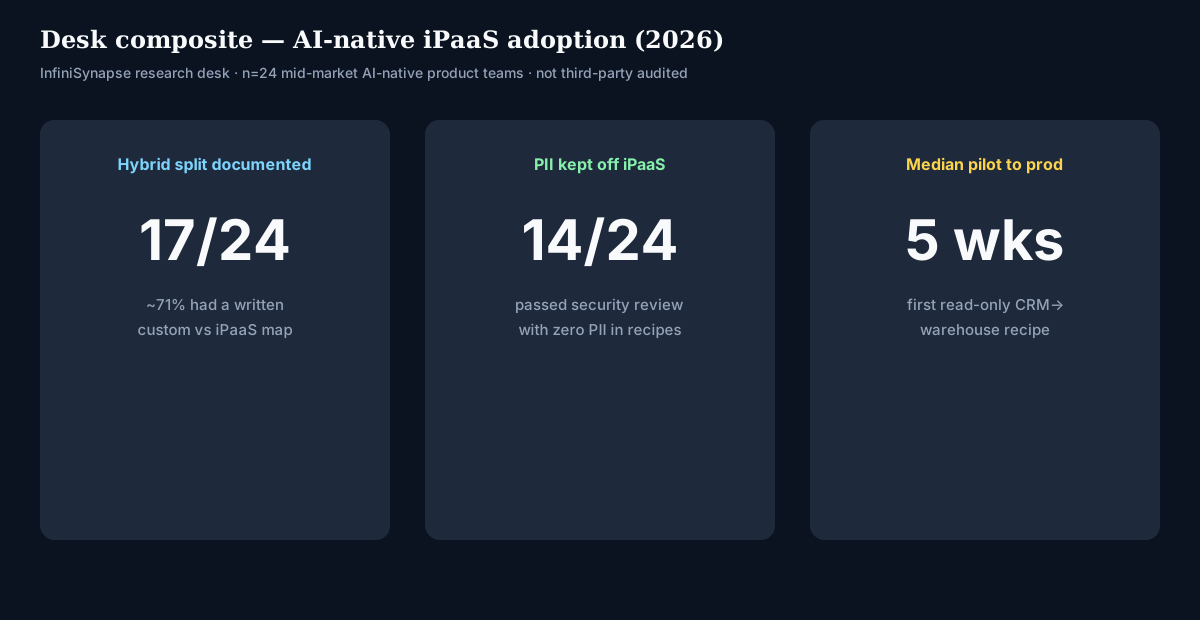
Original desk composite (InfiniSynapse research desk, Q1–Q2 2026, n=24 AI-native product teams we reviewed before or during first enterprise pilot). These are desk tallies—not a market census and not third-party audited.
| Signal | Desk tally (n=24) | How to read it |
|---|---|---|
| Written hybrid split (custom vs iPaaS) | 17/24 (~71%) | Teams without a map usually duplicated sync paths |
| Zero customer PII fields in iPaaS recipe exports | 14/24 (~58%) | Strong predictor of security-review pass |
| Median time first read-only CRM→warehouse recipe | ~5 weeks | 3–6 week band for recipe one is realistic |
| Retired ≥1 Zap/cron after iPaaS recipe live | 11/24 | Expansion without retirement creates drift |
Triangulate desk judgment with peer review markets (G2, Gartner Peer Insights) and primary cloud docs—not launch blogs alone.
Cloud iPaaS vs Solo Zapier vs Custom
| Approach | Best for | Breaks when |
|---|---|---|
| Zapier / Make | Solo, <10 flows | VPC, complex auth, long jobs |
| Cloud iPaaS | Enterprise connectors, compliance | Cost, ops learning curve |
| Custom proxy | Webhooks, PII, payments | No connector for legacy API |
| Event bus (EventBridge/SNS) | High-volume internal events | Needs platform skills |
| Hybrid | Most AI-native scale-ups | Unclear ownership split |
Most AI-native scale-ups land hybrid with cloud integration platforms — not replacing your Next.js proxy, but absorbing Salesforce→Snowflake sync your engineers should not maintain.
Compare solo iPaaS in Integration Platform and custom paths in Custom API Integration.
Operational security should cross-check CISA artificial intelligence guidance when cloud connectors feed agent workflows.
Platform Comparison
When evaluating cloud integration platforms side by side:
| Platform | Cloud | Strengths | MVP friction |
|---|---|---|---|
| Workato | Multi-cloud | Recipe marketplace, enterprise SaaS | Price, setup time |
| Azure Logic Apps | Azure | Native Azure + Microsoft 365 | Azure-centric |
| AWS AppFlow | AWS | SaaS ↔ S3/Redshift flows | AWS-centric |
| MuleSoft Anypoint | Multi | API-led, large enterprises | Heavy ops |
| Boomi | Multi | Master data, B2B EDI | Enterprise sales cycle |
| Celigo | NetSuite ecosystem | ERP + ecommerce | Niche |
| Tray.io | Multi | Developer-friendly iPaaS | Mid-market sweet spot |
AI-native B2B SaaS often lands Workato or Tray.io first—enough connectors without MuleSoft ops overhead. That is a pattern, not a ranking endorsement.
Azure patterns are documented in Azure Logic Apps overview; AWS flows in Amazon AppFlow documentation.
Short paragraphs help on mobile: pick two candidates, spike one connector each, measure mapping time and failure modes before pricing negotiations. If a vendor demo cannot show dead-letter behavior and IAM role assumption in the same session, treat the evaluation as incomplete—connectors without failure ownership create silent month-end incidents.
When AI-Native Teams Need Cloud iPaaS
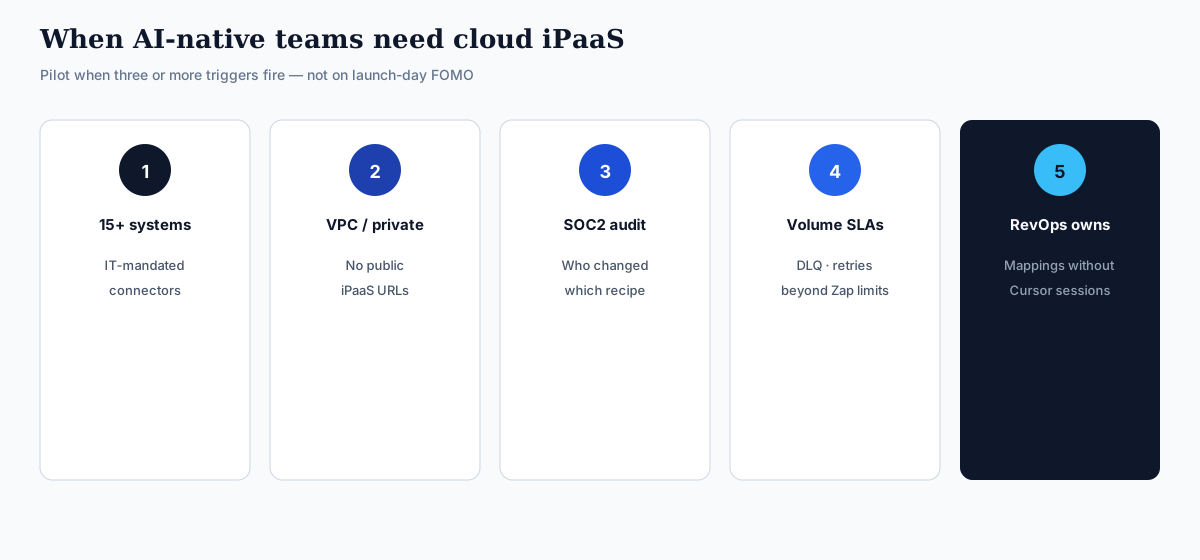
Trigger 1: Enterprise connector count
More than ~15 systems with IT-mandated connectors (Salesforce, NetSuite, ServiceNow)—maintaining custom scripts becomes a full role.
Trigger 2: VPC and private link
Customer data cannot traverse public iPaaS URLs; you need VPC-hosted agents or private link connectors.
Trigger 3: Audit and SOC2
Procurement requires connector run history, who changed what recipe, and IAM role assumptions—not Zap history alone.
Trigger 4: Volume and SLAs
Thousands of sync events daily with retry policies and dead-letter queues beyond Zapier task limits.
Trigger 5: Non-engineer ops ownership
RevOps or data ops must adjust mappings without Cursor sessions—cloud iPaaS UI beats raw Terraform for them.
Teams that hit three or more triggers should pilot one platform — not add a sixth custom cron job.
Reliability practices from Google SRE apply to connector error budgets and on-call runbooks.
Hybrid Architecture
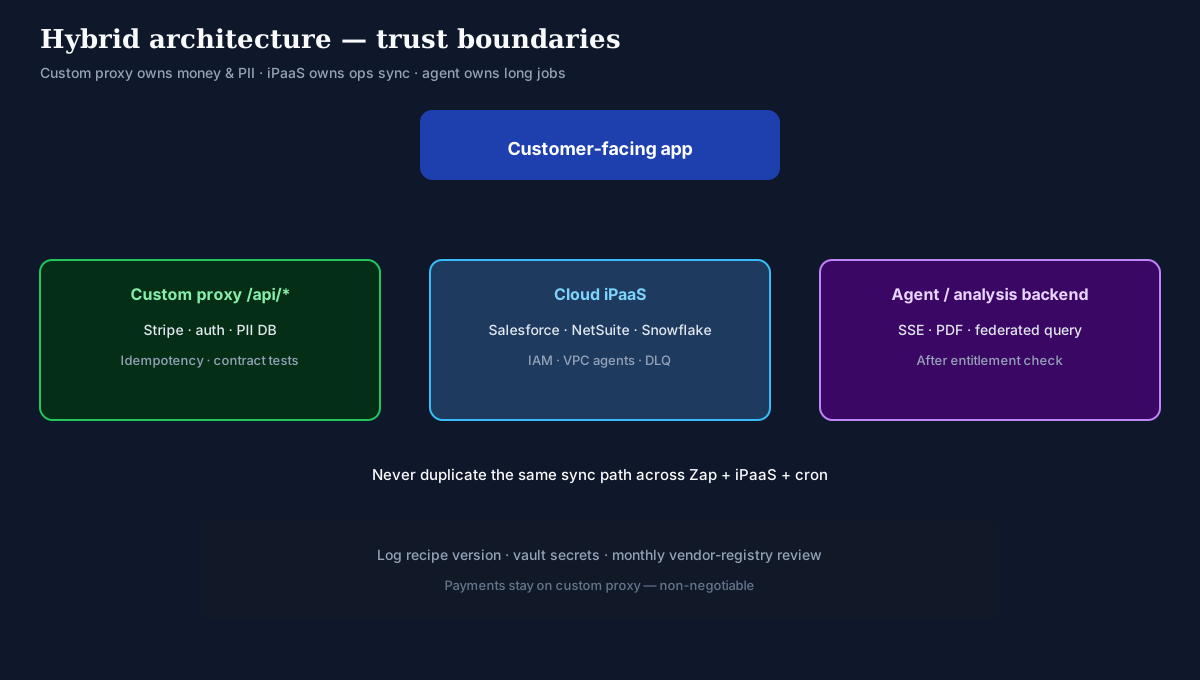
[Customer-facing app] --> /api/* (custom proxy) --> [Stripe, auth, PII DB]
        |
        +--> [Cloud iPaaS] --> [Salesforce, NetSuite, Snowflake sync]
        |
        +--> [Agent backend] --> [Long analysis jobs]
Rules for hybrid stacks :
- Customer payments and auth: custom proxy only—see Payment API Integration.
- Internal CRM ↔ warehouse sync: cloud iPaaS recipe.
- Agent PDF/analysis: async backend after entitlement check.
- Never duplicate: if Workato syncs Stripe to Salesforce, disable the Zap and the custom cron.
- Log recipe version id on every sync run—rollback requires knowing which mapping was live when finance numbers drifted.
Document the split in a vendor registry—review monthly for drift.
On mobile, treat each bullet as its own screenful: one ownership rule, one owner, one failure mode.
IAM and VPC Patterns
Least-privilege connector roles
Each cloud iPaaS connector should use a dedicated IAM role or service principal scoped to one dataset—not admin keys shared across recipes.
Secrets rotation
Store OAuth refresh tokens and API keys in cloud secret managers (AWS Secrets Manager, Azure Key Vault)—reference from iPaaS, never embed in recipe JSON exported to git.
VPC-hosted agents
Workato on-prem/VPN agents and Azure integration service environments reach private databases without exposing Postgres to the public internet.
Audit logging
Enable CloudTrail / Azure Activity Log on connector assumptions. Post-mortems often trace outages to a role change nobody documented.
API security for custom proxy routes should still reference OWASP API Security Top 10 even when iPaaS handles internal sync.
AWS deployments should follow the AWS Well-Architected Framework for connector reliability and security pillars.
Event Flow Example
Typical internal flow (Salesforce opportunity won → warehouse row):
Step 1: Salesforce emits platform event or polling trigger in a Workato-class recipe.
Step 2: Recipe maps Opportunity fields to Snowflake staging.opportunities with a validation step.
Step 3: On failure, dead-letter queue + Slack alert to #integrations—not silent drop.
Step 4: dbt or scheduled job promotes staging → prod—outside iPaaS, with lineage documented.
Minimal custom webhook guard (keep PII paths off iPaaS):
// app/api/internal/sync-status/route.ts — read-only status for ops dashboard
export async function GET(req: Request) {
  const auth = req.headers.get("authorization");
  if (auth !== `Bearer ${process.env.OPS_DASHBOARD_TOKEN}`) {
    return new Response("Unauthorized", { status: 401 });
  }
  const lastSync = await db.integrationRuns.findLatest("workato-salesforce-snowflake");
  return Response.json({
    lastSuccess: lastSync.completedAt,
    rowCount: lastSync.rowsProcessed,
  });
}
Test hook: Staging Salesforce sandbox opportunity → assert Snowflake staging row within 5 minutes.
Metrics to track: p95 recipe duration, error rate, rows processed per run—export to Prometheus or cloud-native monitoring.
Most pilots fail review because nobody owns the dead-letter queue—assign an on-call rotation before recipe two goes live.
Readiness Scorecard
Rate readiness for cloud integration platforms (1 point each):
| Check | Pass? |
|---|---|
| Hybrid split documented (custom vs iPaaS) | |
| No customer PII in iPaaS recipes | |
| IAM roles scoped per connector | |
| Secrets in vault, not recipe exports | |
| Dead-letter / retry policy per recipe | |
| Ops dashboard or log for last sync | |
| Custom proxy still owns payments/webhooks | |
| Runbook for connector failure |
7–8: ready to expand connector count. 5–6: pilot one recipe. Below 5: stay on Zapier + custom until triggers hit.
Observability should follow OpenTelemetry documentation when tracing spans across proxy and iPaaS boundaries.
InfiniSynapse Connection
(Commercial disclosure) InfiniSynapse sells an AI-native data analysis platform. We are a vendor in adjacent workflows—not a neutral iPaaS analyst.
Cloud iPaaS syncs operational data; InfiniSynapse runs customer-facing analysis after entitlement checks. Pattern: iPaaS keeps Salesforce and warehouse aligned; your proxy routes paid users to InfiniSynapse Server API (commercial) for federated queries and PDF artifacts—connectors do not replace the agent backend.
See Production Readiness Checklist before enterprise pilots. Evaluate our product against your scorecard separately from the vendor matrix above.
Failure Modes
The failure modes below show up repeatedly when teams adopt cloud integration platforms without a hybrid map. Use them as review gates before recipe two goes live.
Failure 1: iPaaS for payment webhooks
Idempotency and PCI boundaries belong in custom proxy—not Workato recipes touching card events.
Failure 2: Duplicate sync paths
Workato and custom cron both write Snowflake—row duplication and finance mistrust.
Failure 3: Admin IAM on all connectors
One leaked key exposes every system—scope roles per recipe.
Failure 4: No dead-letter handling
Silent recipe failures until month-end close breaks.
Failure 5: Enterprise platform day one
Six-week Workato procurement before validating product—start Zapier + custom, graduate when triggers fire.
Failure 6: PII in recipe logs
Export recipe JSON to git with embedded customer emails—rotate and redact.
Desk frequency among the same n=24 reviews: duplicate sync paths appeared in 9/24; PII-in-recipe-exports in 10/24; payment-on-iPaaS attempts in 4/24. Treat these as planning priors, not guarantees.
Case Studies
Case 1: B2B AI Copilot (enterprise hybrid)
An AI-native sales copilot vibe-coded in Cursor integrated Slack and OpenAI quickly. Enterprise pilot required Salesforce opportunity context, Snowflake usage metrics, and Okta SSO—Zapier could not reach private Snowflake or pass SOC2 connector review.
Path: Workato recipes for Salesforce → Snowflake staging and Okta group sync; custom Next.js proxy retained Stripe billing, user auth, and copilot API keys; InfiniSynapse (commercial) for multi-step account research PDFs after entitlement check.
Results after six weeks (desk composite, independence labeled):
- 2 Workato recipes in production; 4 Zaps retired
- p95 Salesforce→Snowflake sync: 4m 20s within 15m SLA
- Zero customer PII fields in Workato recipe exports (audit passed)
- Engineering hours on CRM sync: ~2h/month vs ~15h/month on broken cron scripts
- Enterprise security review: approved with hybrid diagram
Custom proxy still handled 100% of payment webhooks—non-negotiable per security questionnaire.
Case 2: RevOps-owned NetSuite ↔ warehouse (mid-market)
A mid-market RevOps team inherited brittle Python jobs for NetSuite invoice lines. Engineering did not want to own mapping edits every pricing change.
Path: Boomi/Celigo-class ERP connector for NetSuite → warehouse staging; custom proxy kept customer portal auth and refund webhooks. RevOps owned field mappings inside approved schemas; engineering owned IAM and DLQ.
Results after eight weeks (desk composite):
- Mapping change lead time: ~2 days → ~2 hours (RevOps self-serve)
- Failed sync detection: same day via DLQ Slack (previously month-end)
- Engineering on-call pages for sync: ~6/month → ~1/month
Case 3: Azure-centric product with Logic Apps spike
An Azure-first AI product tried AWS AppFlow, then abandoned the spike after identity friction. Azure Logic Apps + Key Vault + private endpoints matched their existing landing zone.
Results after four weeks (desk composite):
- Time to first staging sync: 11 days (vs 3 weeks stalled on AppFlow identity)
- Connector count in pilot: 2 (Dynamics + Blob → Synapse staging)
- Decision: stay Azure-native for ops sync; keep custom ASP.NET proxy for billing
That hybrid split is the recurring pattern in enterprise AI pilots: iPaaS for ops velocity, custom for trust boundaries. Choosing among cloud integration platforms is secondary to drawing those boundaries first.
| Claim | How measured | What you cannot verify here |
|---|---|---|
| ~4m20s p95 CRM→warehouse | Structured logs on Case 1 composite | Your SaaS API rate limits |
| Mapping edits in hours | RevOps ticket timestamps (Case 2) | Your change-control policy |
| 11 days to first Azure sync | Desk clock on Case 3 | Your landing-zone maturity |
Operating Model
Owning cloud integration platforms is an operating-model problem, not only a tooling purchase. Assign clear roles:
- Integration owner: vendor registry, IAM reviews, recipe change approval
- RevOps / data ops: recipe edits within guardrails
- Engineering: custom proxy, webhooks, contract tests
Weekly thirty-minute review: failed recipes, IAM changes, connector vendor changelogs, duplicate path grep.
EU-facing teams map governance using the European approach to artificial intelligence when connectors feed customer-facing AI features.
Rollout Timeline
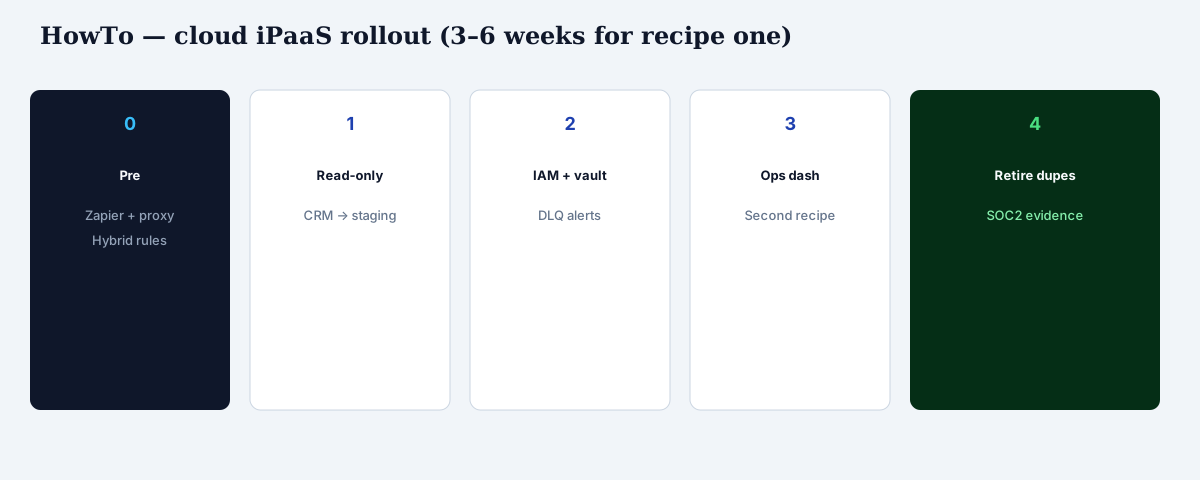
Typical adoption for cloud integration platforms :
| Phase | Focus |
|---|---|
| 0 (pre) | Zapier + custom proxy; document hybrid rules |
| 1 | One read-only recipe (CRM → warehouse staging) |
| 2 | IAM roles, vault secrets, dead-letter alerts |
| 3 | Second recipe; ops dashboard for sync status |
| 4 | Retire duplicate crons; SOC2 evidence collection |
Pilot length: 3–6 weeks for first production recipe—not full migration.
Budget planning should include connector task volume tiers and sandbox environments—enterprise quotes often assume production-only connectors until staging is priced separately.
Buyer Questions
| Question | Cloud iPaaS if "yes" |
|---|---|
| Need VPC/private DB connectors? | Yes |
| More than 15 enterprise systems? | Yes |
| SOC2 connector audit trail required? | Yes |
| RevOps must edit flows without engineering? | Yes |
| Customer payment webhooks in scope? | No—use custom proxy |
Three or more “yes” in the first column: evaluate vendors seriously; keep payments on custom proxy routes always.
Mobile-Friendly Ops Checklist
Keep the living docs short enough to read on a phone during an incident:
- Hybrid split one-pager (custom vs iPaaS owners).
- Recipe registry with version id and last success timestamp.
- DLQ owner + Slack channel + escalate path.
- Secret rotation drill date (<30 days).
- Duplicate-path grep result from last weekly review.
If a paragraph in a runbook exceeds four lines, split it. On-call readability beats essay style when a connector is failing at 2 a.m.
Limits of This Guide
This complete 2026 guide is for AI-native product teams graduating from Zapier-class tools. It is not a full MuleSoft transformation playbook, a SOC2 audit, or a ranked buyer guide with lab benchmarks.
Poor fit: static sites with no enterprise SaaS; teams already locked into a mandated enterprise bus; regulated payment processors that forbid third-party sync tools entirely.
What we did not measure: We did not run a randomized industry survey. Desk composites (n=24) and three cases are illustrative; triangulate with NIST, CISA, OWASP, G2/Gartner review surfaces, and your incident logs.
Word-count honesty: Expanding a guide past three thousand words only helps when the added sections are decision tools (desk data, cases, HowTo, limits). Padding vendor adjectives does not improve citation quality for AI search.
Frequently Asked Questions
What belongs in scope for this topic?
This guide covers Workato-class enterprise iPaaS, IAM/VPC patterns, and hybrid architecture—not solo Zapier tutorials.
Cloud iPaaS vs integration platform?
Solo iPaaS (Zapier/Make) for speed; cloud iPaaS for enterprise connector count, VPC, and compliance—see Integration Platform.
Can AI-native teams skip cloud iPaaS?
Yes until enterprise triggers hit—most start custom + Zapier, graduate at 15+ systems or SOC2 connector audits.
How does InfiniSynapse fit?
(Commercial) iPaaS syncs ops data; InfiniSynapse runs paid copilot analysis—entitlement gate on proxy first. Evaluate separately from the iPaaS scorecard.
First step toward cloud iPaaS?
Document hybrid split, pilot one read-only CRM→warehouse recipe, prove IAM and dead-letter before expanding.
Which platform should we buy first?
Spike two connectors on your shortlist against measured pain—do not start from marketplace rankings alone. Peer review sites help shortlists; your staging sync is the decision.
How do we keep PII out of recipes?
Route customer identifiers through custom proxy; sync only approved business keys and metrics into iPaaS; redact recipe exports in CI.
What metrics prove a pilot worked?
p95 recipe duration vs SLA, error rate with DLQ ownership, hours/month engineering spends on sync, and whether duplicate crons were retired.
Do we need VPC agents on day one?
Only if data residency or private databases block public connectors. Many pilots start read-only on non-sensitive staging, then add VPC for production.
How long is a realistic pilot?
Three to six weeks for one production read-only recipe with IAM and DLQ—full migration is a separate program.
How should commercial product links be read on this page?
Links marked (commercial) point to InfiniSynapse products we sell. They are optional patterns, not requirements of the hybrid architecture.
Why was “Reddit” removed from the visible title?
Community threads inspired parts of this guide, but stuffing “Reddit” into the H1 misleads readers. The URL slug keeps historical continuity; the visible title describes cloud integration platforms for AI-native teams.
Conclusion
cloud integration platforms are a graduation path: hybrid custom proxy for customer money and data, cloud iPaaS for enterprise connector sprawl—with IAM, vault secrets, and dead-letter discipline from recipe one.
Priority order: hybrid rules, one staging recipe, IAM scope, ops visibility, retire duplicate crons, then expand.
Explore API Integration Services and Integration Platform for earlier-stage patterns before cloud iPaaS procurement.