ChatBI Alternative: Metrics Q&A Ceiling
Author / credentials: By William Zhu & the InfiniSynapse Data Team. William Zhu is InfiniSynapse cofounder; public engineering trail on GitHub @allwefantasy (InfiniSQL and open-source data systems). Desk work: scoring ChatBI metric-Q&A ceilings against multi-source agentic pilots (n=9 composite). No personal LinkedIn; identity signals are GitHub + About / team + Vision + editorial standards. Third-party category anchors (not endorsements): Dremio, Tableau Conference 2026 agentic analytics announcements, Spider 2.0 / Jin et al.
Disclosure / COI: Published by InfiniSynapse (agentic analytics). Comparison rules apply to any vendor — including us. We do not invent third-party analyst scorecards or conference speaker credits.
Version / marker: 2026-05-21 · 2026-08-11 Core points / Dataset / mentions / FAQ anchors / table caption; keyword agentic analytics vs. traditional bi tools. Marker: DESK-CBA-20260811A.
- Target frame: agentic analytics vs. traditional bi tools — keep ChatBI for known KPIs; add agents for plan-execute why-questions.
- ChatBI tools answer natural language questions against pre-built BI metrics and dashboards. "What was revenue last month?" — instant. They depend on a semantic layer: someone has already defined the metric, modeled the data, and built the dashboard. Within that boundary, they work.
- Agentic alternatives deploy AI agents that plan multi-step analytical workflows — retrieving business context via LLM-Native RAG, querying across Snowflake, PostgreSQL, MongoDB, and files in one session, incorporating unstructured data, verifying results, and delivering charts, explanations, and recommended actions.
- The practical difference: ChatBI answers metric questions the BI model already knows. A ChatBI alternative answers analytical questions the BI model was never designed to handle. If your questions regularly cross data sources, involve unstructured data, or require multi-step reasoning, you've already outgrown ChatBI.
- Frame: In agentic analytics vs. traditional bi tools, keep ChatBI for known KPI lookups; add agents when questions need plan-execute reasoning across sources.
- Ceiling: Traditional BI / ChatBI cannot federate unmodeled databases, pull tribal definitions from a knowledge base, or fold PDFs and transcripts into the same answer path.
- Proof bar: Prefer pilots that time why-questions (ticket baseline vs agent run) over demo screenshots of a single metric chart.
- Stack choice: Complementary, not rip-and-replace — dashboards stay authoritative for Monday KPIs; agents cover the analytical long tail.
- Deploy constraint: Regulated estates should decide SaaS vs private/on-prem before natural-language demos look identical.
What ChatBI does well
ChatBI is a conversational analytics interface that translates natural language questions into metric answers from a pre-built BI semantic layer. It bridges the gap between business users and dashboards by letting people type questions like "show me revenue by region for Q3" and getting a chart back — without writing SQL or navigating a dashboard menu.
ChatBI (conversational business intelligence) maps natural language to pre-built metrics in a BI semantic layer. It is optimized for operational “what is the number?” questions inside a modeled warehouse—not for multi-step why-analysis.
Agentic analytics uses AI agents to plan, retrieve context, query across connected sources (including unstructured files), verify, and deliver a finished analysis. In agentic analytics vs. traditional bi tools, this is the plan-execute side of the stack.
ChatBI tools emerged to solve a real problem: most business users can't write SQL, and they shouldn't have to. By building a semantic layer — defining metrics, modeling relationships, and curating datasets — ChatBI lets anyone ask "what was last month's revenue?" or "which channel had the highest conversion rate?" and get an answer in seconds, without a data team ticket.
Tools in this category include ThoughtSpot Sage, Power BI Copilot, Tableau Ask Data, and Sigma Computing — the traditional-BI / ChatBI side of the comparison. They share a common architecture: the LLM translates natural language against pre-defined metrics, but it does not plan, verify, or discover.
Where ChatBI works well
- Questions are operational metric checks: "What is revenue today?" "Which channel had the highest conversion rate?" "Show me the sales trend for product X."
- The metrics have been pre-defined and modeled in your BI semantic layer, and the definitions are unambiguous.
- You need a number or a chart from an existing dashboard, not an analytical explanation.
- Your user base is business users monitoring known KPIs — not analysts investigating open-ended questions.
Where ChatBI falls short
- The semantic model is always incomplete. Business questions routinely touch data outside the BI model. When they do, ChatBI either fails or gives a partial answer with no indication that something is missing.
- Single-source only — and only BI-modeled data. ChatBI answers questions against data that has been extracted, transformed, and loaded into the analytics layer. When a question spans Snowflake, MongoDB, a PDF forecast, and a call transcript database, ChatBI cannot federate across those sources.
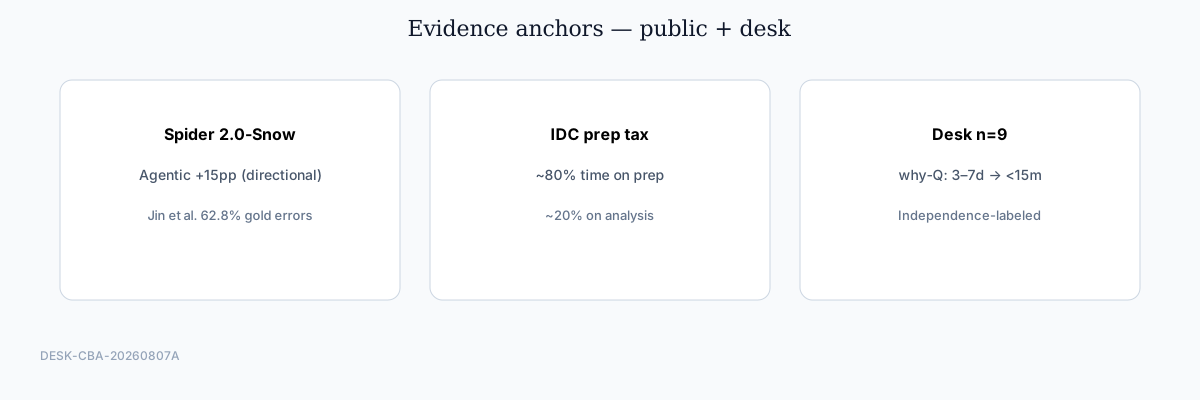
- No self-verification. The LLM generates a metric lookup and returns the value. When the metric definition is wrong, the answer is wrong — and ChatBI has no mechanism to detect it. On the Spider 2.0 enterprise benchmark, non-agentic Text-to-SQL approaches (DIN-SQL, DAIL-SQL) built on GPT-4o achieved only 0–6% execution accuracy with real-world schemas exceeding 3,000 columns. On the Spider 2.0-Snow leaderboard, agentic architectures outperform non-agentic baselines by 15+ percentage points — driven entirely by the agent's ability to plan, retrieve schemas, and iterate (Spider 2.0-Snow, Feb 2026). Note: published benchmark scores are directional. Jin et al. (Jan 2026) identified a 62.8% annotation error rate in Spider 2.0's gold-SQL examples, meaning leaderboard rankings can shift by ±9 positions after correction.
- Unstructured data is invisible. PDFs, call transcripts, Excel reports, and planning documents contain context that ChatBI cannot incorporate into analysis. A ChatBI tool answers metric questions from modeled data — it answers the "what" while ignoring the "why."
The ChatBI ceiling: 5 things metrics Q&A can't do
ChatBI is not broken. It is scoped to operational metric monitoring. The problems begin when users ask questions that cross the boundary from "what is the number?" to "why is the number what it is, and what should we do about it?"
1. Plan multi-step analysis
ChatBI answers one question at a time against a known metric. Real analysis is a sequence: define the metric → identify data sources → retrieve business context → decompose into sub-questions → execute → cross-reference → verify → synthesize findings. When a VP asks "why is华东区 repeat purchase rate dropping?", answering requires querying Snowflake (the metric trend), Zendesk (support tickets in the same period), analyzing review sentiment, searching for competitor activity in the region, and correlating the findings. ChatBI can answer step 1. It cannot orchestrate steps 1–5 — and it cannot connect the dots between them.
2. Query across data sources that aren't in the BI model
ChatBI answers questions against BI-modeled data — the data that has been extracted, transformed, and loaded into the analytics layer. But enterprise questions rarely confine themselves to modeled data. "Compare Tmall and JD.com sales by customer phone number, then cross-reference with the CSV of real names from the CRM team" spans two e-commerce platforms and a file — none of which may exist in the BI model. Each new data source requires a new modeling project before ChatBI can touch it. In practice, most sources never get modeled, and most cross-source questions never get asked.
3. Retrieve business context beyond the semantic layer
A BI semantic layer defines what "revenue" means and which column it maps to. It does not define why华东区 calculates repeat purchase differently from华北区, or that the Q4 definition of "active user" changed from 30-day to 28-day. This tribal knowledge lives in data dictionaries, analyst notebooks, Slack threads, and Confluence pages — none of which is part of the BI model. Without a knowledge base retrieval mechanism, ChatBI answers using the LLM's generic understanding of what words mean — not your company's specific definition.
4. Incorporate unstructured data
ChatBI works on structured data: tables, columns, rows. But enterprise analysis lives in structured and unstructured data together. The customer call recording that explains why they churned. The quarterly planning PDF that defines this year's strategic priorities. The spreadsheet the finance team uses for ad-hoc modeling. None of this is in the BI semantic layer. Gartner estimates that 80% of enterprise data is unstructured — PDFs, emails, call transcripts, documents — and less than 30% of it is actively analyzed (Magic Quadrant for Document Management, Dec 2024). Note: "enterprise data" here encompasses all organizational information, not only analytical datasets. A ChatBI tool that only answers metric questions from modeled data is excluding the majority of enterprise information from the analytical process.
5. Produce a finished analysis deliverable
ChatBI returns a metric value or a dashboard chart. A finished analysis returns: the metric trend with context, correlated findings from multiple sources, an explanation of contributing factors, and recommended actions. The gap between "revenue is down 12%" and "revenue is down 12% due to three factors: (1) competitor launched a 20% discount in Shanghai, (2) delivery delays caused a 67% spike in support tickets, (3) negative review sentiment doubled — recommend reviewing logistics partner and considering targeted retention campaign" is the gap between a metrics Q&A tool and a professional data analyst. ChatBI doesn't bridge it.
Question: "Why did our华东区 repeat purchase rate drop 12% last quarter?"
ChatBI result: Returns the metric trend chart from the dashboard. Shows the 12% dip. User can see that it dropped. Cannot answer why unless a "reason for drop" metric has been pre-modeled. User files a data engineering ticket. Data engineer pulls data from Snowflake, Zendesk, and the reviews database. Analyst correlates findings manually. 3–7 days later: the answer arrives.
Same question. AI agent retrieves the company's "repeat purchase rate" definition from the knowledge base. Plans a 5-step analysis: (1) query Snowflake for the metric trend by region and channel, (2) query Zendesk for华东区 support ticket volume and categories, (3) analyze review sentiment from MongoDB, (4) web search for competitor activity in Shanghai, (5) cross-reference all findings.
Result: Complete cross-source analysis in under 3 minutes. A chart showing the trend, a written explanation with three contributing factors and evidence for each, and a recommended action plan. Sources cited. No ticket filed.
What a ChatBI alternative needs to do
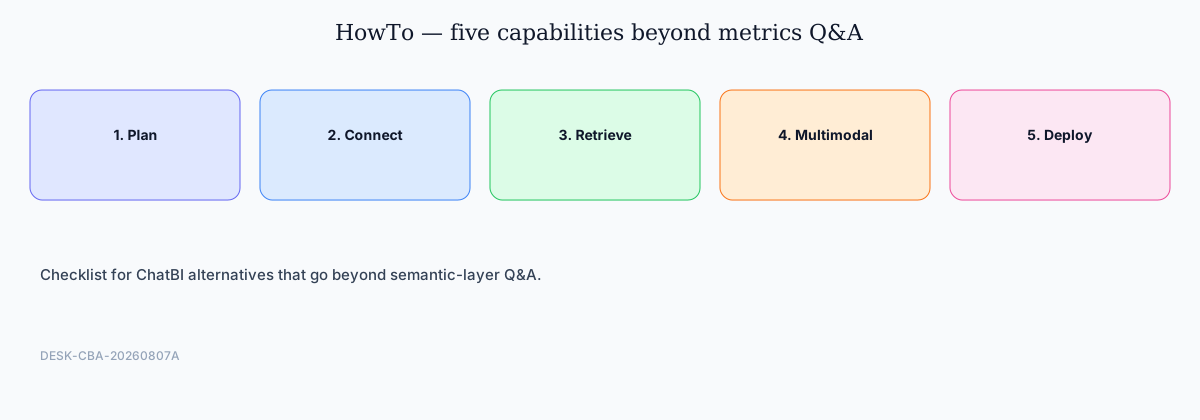
Moving from ChatBI to an agentic alternative is not about getting better metric answers — it's about answering questions that metrics alone cannot answer. A credible ChatBI alternative should address five capabilities that go beyond the BI semantic layer:
1. Plan before executing. Complex analysis follows a plan: define the metric → identify relevant sources → retrieve context → decompose into steps → execute → verify → synthesize. The system should propose an analysis plan, let the user review and adjust it, then execute all steps in sequence. This replaces single-turn Q&A with structured analytical reasoning — the difference between answering one metric question and completing an analysis.
2. Connect to data directly, not through the BI model. The ChatBI alternative should query databases through native drivers (Snowflake, PostgreSQL, MySQL, MongoDB, SQL Server, Oracle, ClickHouse), discover schemas at query time, and work with data that has not been pre-modeled. Questions can touch any connected source without waiting for a data engineer to build a pipeline first. The BI layer becomes optional, not required.
3. Retrieve business context from knowledge, not just the semantic layer. Instead of depending on a pre-built metric definition for every term, the system should use LLM-Native RAG to retrieve data dictionaries, business rules, historical analysis cases, and domain documentation from a knowledge base at query time. This means the system learns your company's specific definition of "churn" or "active user" from documentation you've already written — and gets it right even when the metric hasn't been formally modeled in a BI tool.
4. Work with structured and unstructured data together. Enterprise analysis draws from databases, PDFs, call transcripts, spreadsheets, and web pages. A ChatBI alternative must query across all of these in one session — correlating the structured metric from Snowflake with the unstructured explanation from the quarterly planning document and the competitor activity from web search.
5. Deploy where your data lives. Most ChatBI tools are cloud SaaS — your data must be in their cloud. An enterprise ChatBI alternative should support private cloud, on-premises, and air-gapped deployment. For regulated industries (financial services, healthcare, defense), this is non-negotiable: the analysis engine runs where the data lives, and no data leaves the controlled environment.
ChatBI vs agentic alternative: head-to-head comparison
Here is how agentic analytics vs. traditional bi tools compare across the dimensions that determine which questions a tool can answer:
| Dimension | ChatBI | Agentic ChatBI Alternative |
|---|---|---|
| Architecture | LLM → semantic model → metric → dashboard | AI agent → plan → federated queries → multi-source → verify → iterate |
| Core task | Answer metric questions against BI-modeled data | Plan and execute multi-step business analysis |
| Interaction model | Single-turn metric Q&A | Plan → Review → Execute → Verify → Deliver |
| Data scope | BI-modeled data only (pre-defined metrics, curated datasets) | Any connected database, file, document, or web source |
| Business context | Pre-built semantic layer (metric → column mapping) | Knowledge base + LLM-Native RAG + schema discovery (dynamic, not pre-modeled) |
| Cross-source queries | No (BI-modeled data is already consolidated) | Yes — native drivers for Snowflake, PostgreSQL, MongoDB, MySQL, etc. |
| Unstructured data | Not supported | PDFs, call transcripts, spreadsheets, web pages |
| External knowledge | None | Web search for competitive, market, and industry context |
| Analysis planning | None (single-question, single-response) | Multi-step plan generation with user review and adjustment |
| Result verification | None — wrong metric definition = wrong answer, silently | Distribution checks, semantic validation, cross-source consistency verification |
| Output | Metric value, chart from dashboard | Charts, narrative explanation, contributing factors, recommended actions, exportable reports |
| Deployment | Cloud SaaS | Cloud + native desktop + on-premises for air-gapped environments |
| Best for | "What is our revenue today?" — operational metric monitoring | "Why did华东区 repeat purchase drop, and what should we do?" — analytical reasoning |
Dataset license: CC BY 4.0. Attribution to InfiniSynapse Data Team required. Comparison cells are evaluation summaries—not a census or SLA.
If your team's analytical backlog is mostly operational metric checks against a well-modeled data warehouse, ChatBI is the simpler choice in the agentic analytics vs. traditional bi tools tradeoff. If it includes cross-source questions that currently take days of manual data plumbing, you need a ChatBI alternative.
The architecture gap: metric Q&A vs plan-execute analysis
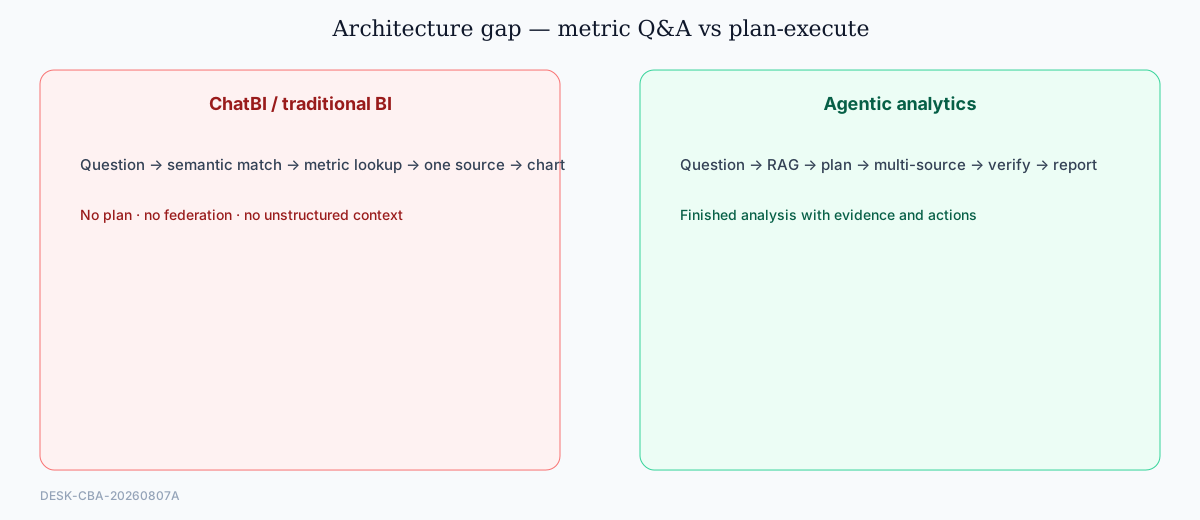
The difference between ChatBI and an agentic alternative is visible in the architecture. ChatBI adds a natural language interface on top of a BI stack — every question routes through the pre-built semantic layer. The agentic alternative adds an AI reasoning layer that sits beside the BI stack — connecting to the same databases but following a different path: plan, retrieve context, execute across sources, verify, and deliver.
ChatBI Architecture
Agentic Alternative Architecture
When ChatBI is enough (and when to move on)
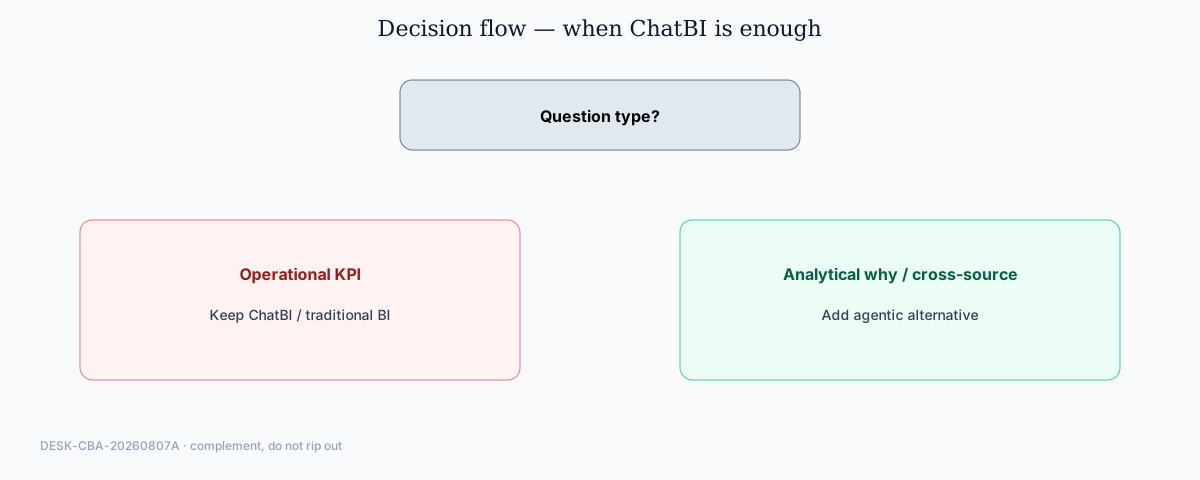
ChatBI is not the wrong tool. It is the right tool for a specific class of questions. The decision in agentic analytics vs. traditional bi tools is not about replacing ChatBI — it's about expanding the set of questions your organization can answer without a data engineering ticket.
ChatBI is enough when:
- All analytical data lives in a single, well-governed data warehouse with a maintained semantic model.
- Questions are operational metric checks: "What is revenue today?" "Which channel had the highest conversion rate?"
- Metrics have been pre-defined and modeled in your BI semantic layer, and definitions are unambiguous.
- You need a number or a chart from an existing dashboard, not an analytical explanation.
- Cloud-only deployment is acceptable for your security requirements.
If all five conditions are true, ChatBI will serve your team well. The tools are mature, the vendors are established, and the learning curve is manageable.
You need a ChatBI alternative when:
- Your questions are analytical, not just operational: "Why did X happen?" not just "What is X?"
- Analytical questions routinely span 2+ data sources. Mid-size enterprises typically run 50–200 data systems; large enterprises manage 200–1,000+ (Scalytics, 2024). If manual cross-source work consumes more than 20% of analyst time, you've crossed the threshold.
- You need the AI to plan the analysis path, not just look up a pre-defined metric. If the analysis plan has branches ("if X, then check Y; otherwise compare Z"), you need an agent, not a translator.
- Metric definitions are company-specific and contextual — they live in knowledge bases and data dictionaries, not just the BI semantic layer.
- Your questions involve unstructured data (call transcripts, PDFs, spreadsheets) that BI tools cannot model.
- Analysts spend more time retrieving and cleaning data than interpreting it. IDC research finds that 80% of analysts' time goes to data preparation, leaving only 20% for actual analysis (Stewart Bond, IDC, Oct 2023). This figure varies by industry; regulated sectors with legacy systems often exceed 80%.
- Your security or compliance requirements mandate on-premises or air-gapped deployment. Data cannot leave your infrastructure for an external LLM API.
Rule of thumb: if cross-source questions currently go unasked because the manual effort is prohibitive, a ChatBI alternative will pay for itself in the first quarter.
In practice, the two tools complement each other. Your BI stack — including ChatBI — handles operational metric monitoring for the questions your organization asks every day. The agentic alternative handles the analytical long tail: the questions that currently take 3–7 days of manual work because they span sources, require context, and demand multi-step reasoning. Each tool does what the other cannot.
Dashboard-style queries against your primary warehouse don't need an agent. Continue using ChatBI for self-service metric access while the agentic alternative handles cross-source, multi-modal, and complex reasoning tasks.
Connect your secondary databases and document sources. Start with the cross-source questions your team currently handles manually — those are your highest-ROI use cases. Platforms like InfiniSynapse connect to multiple data sources with one-click authorization, no data migration required.
As your team gains confidence in agentic workflows, bring in unstructured data sources: quarterly PDFs, call transcripts, Excel reports. The agent handles extraction, structuring, and cross-referencing automatically. Questions that were previously unaskable become routine.
Ready to go beyond metric Q&A?
Connect your databases and knowledge base. Ask a cross-source analytical question. Get charts, explanations, and recommended actions — not just a metric from a dashboard.
Try Online Now →FAQ
The best ChatBI alternative depends on what you need beyond metric Q&A. ChatBI tools answer pre-built metric questions against BI-modeled data. If your questions go beyond "what was last quarter's revenue?" to "why did华东区 repeat purchase drop, and what should we do about it?" — spanning multiple data sources, unstructured data, and external context — you need an agentic analytics platform. Agentic platforms plan multi-step analysis, retrieve business context, query across databases and files, verify results, and produce finished reports — the full analysis lifecycle that ChatBI does not cover.
Five things: (1) Plan multi-step analysis rather than single-turn metric Q&A. (2) Query across multiple data sources — Snowflake, PostgreSQL, MongoDB, files — in one session, not just BI-modeled data. (3) Retrieve business context from knowledge bases and data dictionaries, so metric definitions are company-specific, not LLM-guessed. (4) Incorporate unstructured data — PDFs, call transcripts, spreadsheets — alongside structured databases. (5) Produce finished analysis deliverables — charts, written explanations, and recommended actions — not just a number or a chart on a dashboard.
No. An agentic ChatBI alternative connects to your existing databases directly — not through the BI semantic layer. It discovers schemas at query time, retrieves business definitions from your knowledge base, and queries Snowflake, PostgreSQL, and other sources through native drivers. Your existing BI dashboards and models remain in place. The ChatBI alternative adds a parallel analysis path for questions that BI was never designed to answer, without requiring you to migrate, rebuild, or replace your BI investment.
No. ChatBI tools serve operational metric monitoring — "what is revenue today?" and "which channel is underperforming?" — against pre-modeled data. A ChatBI alternative serves the analytical long tail: open-ended questions that span sources, require business context, involve unstructured data, and need multi-step reasoning. They are complementary tools. You keep your BI stack for dashboards and metric monitoring. You add an agentic platform for the questions that currently require a data engineering ticket and 3-7 days of manual analysis.
Instead of requiring a pre-built BI semantic layer, an agentic ChatBI alternative uses LLM-Native RAG to retrieve business context at query time — data dictionaries, metric definitions, historical analysis cases, and schema documentation — from your knowledge base. This means the system learns your company's specific definition of "churn" or "active user" from documentation you've already written, rather than requiring a data engineer to model every metric in a BI tool before a question can be asked. The knowledge base becomes the semantic layer — continuously updated, not pre-modeled.
Yes. While most ChatBI tools are cloud-only SaaS, enterprise-grade agentic analytics platforms support private cloud, on-premises, and air-gapped deployment. All data processing — including the LLM-Native RAG engine — runs within your infrastructure. No data ever leaves your network. Native desktop applications for Windows and macOS work offline after initial setup, making agentic analytics viable for defense, financial services, healthcare, and government use cases where data sovereignty is non-negotiable. This is a critical differentiator for regulated enterprises evaluating ChatBI alternatives.
About this guide
Last updated / verified: 2026-08-11 · Published: 2026-05-21 · Marker DESK-CBA-20260811A
Reporting by: William Zhu. About: editorial-standards#about.
Methodology: Comparison grounded in public ChatBI/agentic architecture docs plus Spider 2.0, Jin et al., IDC, and Gartner citations. Desk composite (n=9 ChatBI→agent pilots, Q1–Q2 2026): why-questions that previously took 3–7 days of tickets often completed in under 15 minutes once federated sources and a knowledge base were connected — independence-labeled, not a SLA.
Desk protocol: For each pilot we logged (1) the metric-check pack that stayed on ChatBI, (2) the why-question set that previously required tickets, (3) connectors authorized on day one, and (4) whether a metric dictionary existed in the knowledge base before the first agent run. Time-to-answer is measured from question submission to a reviewable narrative with cited sources—not from chart render alone. Failed federated steps are kept in the same log as successful ones so accuracy claims cannot hide retries.
Independence note: Vendor marketing often collapses “conversational BI” and “agentic analytics” into one slide. This guide keeps the architectures separate on purpose: linear semantic-layer lookup versus plan-execute-verify loops. Where a vendor product name appears, treat it as an example of a pattern, not a ranked recommendation. Re-run the same why-question pack after gold-SQL benchmark corrections land, because Spider 2.0 leaderboard ranks can move when annotations are fixed.
Conflict of interest: Published by InfiniSynapse. This page frames agentic analytics vs. traditional bi tools as a complementary stack decision, not a forced rip-and-replace. Verify vendor claims independently.
Update cadence: Reviewed quarterly. dateModified advances when architecture guidance, citations, or HowTo steps change.
Stewardship notes for reviewers
When shortlisting vendors, record the exact question set used in the pilot (metric checks versus why-questions), which connectors were authorized, whether the knowledge base included metric dictionaries, and who signed the non-goals list. Keep a ticket-log baseline for the same why-questions before the pilot so time-to-answer claims stay auditable.
Re-verify Spider 2.0 and vendor feature claims each quarter: gold-SQL annotation corrections can move leaderboard ranks, and ChatBI product names change faster than architecture diagrams. Prefer publishing a dated changelog row over silent edits to comparison cells.
For regulated estates, attach the deployment constraint (SaaS-only versus private cloud or air-gapped) to the decision memo before demos begin. Deployment fit is independent of natural-language quality and often decides the stack even when metric Q&A demos look identical.
Archive fit memos beside executive charts so auditors can replay provenance without a separate deep dive. Revisit access scopes whenever project membership changes, and log failed federated queries next to the plan step that triggered them. Document which BI dashboards remain authoritative for Monday operational KPIs so agent outputs are not mistaken for metric-store replacements.
Capture sample-row policies used during schema discovery so privacy reviewers can approve the same protocol next quarter. Keep a one-page RACI for who approves agent-generated actions that affect customer communications. Reviewers should also note whether the pilot included unstructured sources (PDFs, transcripts) because that is where ChatBI and agentic platforms diverge fastest.
References & Further Reading
- Gartner (Dec 2024) — Magic Quadrant for Analytics and BI Platforms. Market Guide for analytics platform category definitions and vendor landscape. gartner.com
- ThoughtSpot (Feb 2026) — "ThoughtSpot Launches Agentic Data Prep to Accelerate AI Readiness With Next-Generation Analyst Studio." thoughtspot.com
- Tableau (May 2026) — Agentic Analytics Platform announcement at Tableau Conference 2026. salesforce.com
- Spider 2.0 Benchmark — Enterprise Text-to-SQL evaluation with 632 real-world problems across Snowflake, BigQuery, and DuckDB. spider2-sql.github.io
- Jin et al. (Jan 2026) — "Pervasive Annotation Errors Break Text-to-SQL Benchmarks and Leaderboards." Documents 62.8% annotation error rate in Spider 2.0 gold-SQL examples. arxiv.org/abs/2601.08778
- IDC (Oct 2023) — Stewart Bond, "Accelerating Time to Value in Modern Data Environments." Reports 80% of analyst time spent on data preparation vs. 20% on analysis. semarchy.com (summary)
- Dremio — "Agentic Analytics vs Traditional BI Tools." Architectural comparison from a data platform vendor. dremio.com. Our page: agentic analytics vs. traditional bi tools.
- AtScale — "AI vs BI: Differences, What Changed, and Why Semantics Became Critical." Semantic layer evolution from BI to AI era. atscale.com
- Tray.ai (Dec 2024) — "State of AI Agent Development." 42% of enterprises require 8+ data sources for AI agent deployment. tray.ai