
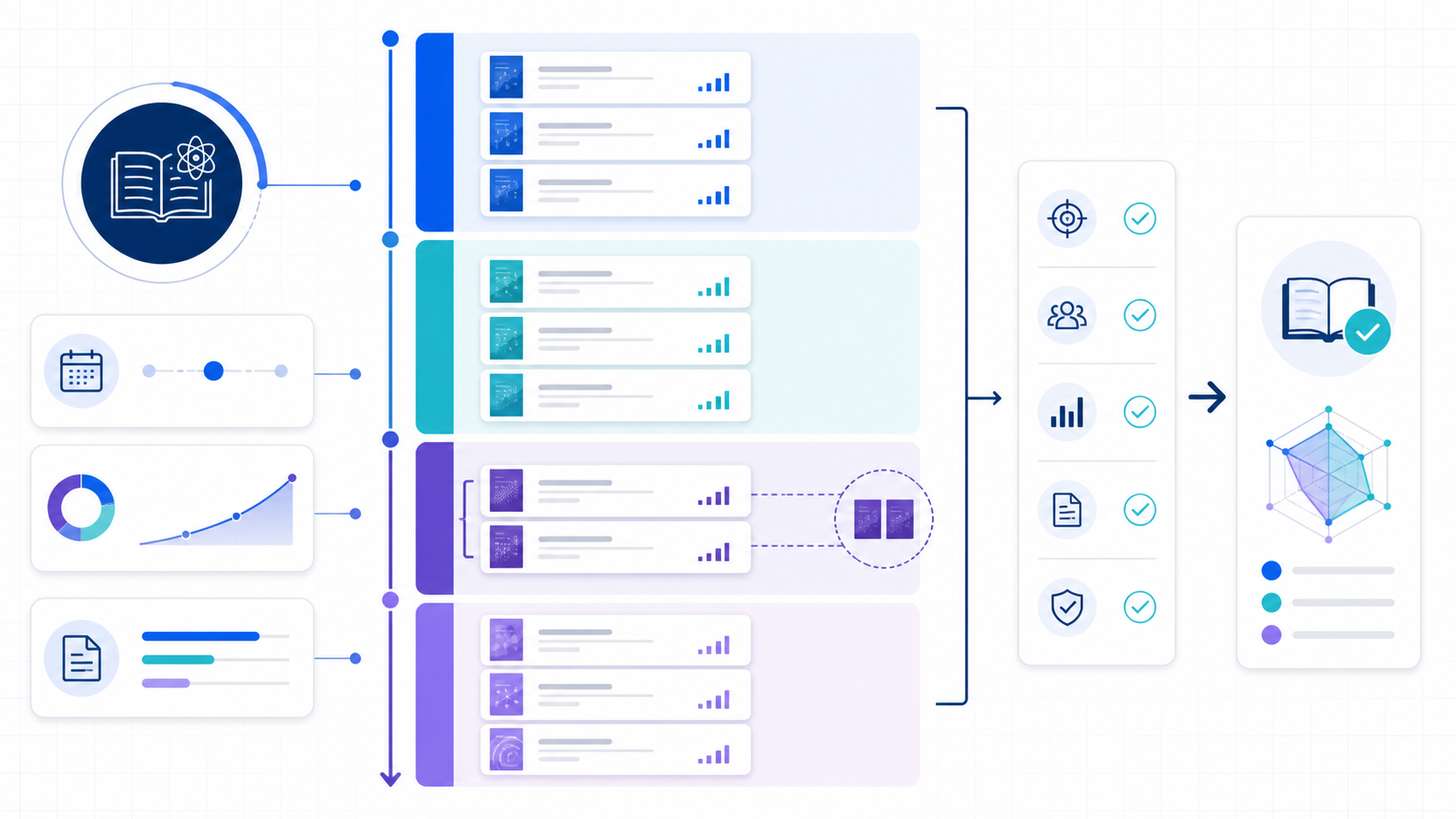
What Are Q1 Journals?什么是Q1期刊?
Q1 journals are journals assigned to the first Journal Impact Factor quartile within a specified Journal Citation Reports category and metric year. The designation is relative: it depends on rank, category size, tied ranks and the annual JCR snapshot. A journal can be Q1 in one category and Q2 in another, and its quartile can change between years.
Q1期刊是指在指定Journal Citation Reports类别和指标年份中,被分配到Journal Impact Factor第一分区的期刊。该标签是相对位置,取决于排名、类别规模、并列排名与年度JCR快照。同一本期刊可能在一个类别为Q1、另一个类别为Q2,并可能随年份变化。
To reproduce a quartile decision, record the journal identity, JCR category, metric year, rank, category size, and displayed quartile together. Use the Journal Impact Factor guide for the wider metric and journal-selection context, the JCR impact factor check tool to verify the official JIF record, and the good impact factor worksheet to judge whether the position is strong and useful for a specific manuscript.
要重现一次分区判断,应同时记录期刊身份、JCR类别、指标年份、排名、类别规模和显示的分区。可通过Journal Impact Factor指南了解更广的指标与选刊背景,使用JCR Impact Factor核验工具确认官方JIF记录,并通过Good Impact Factor工作表判断该位置是否强且适合具体稿件。
Q1 is not a certification that every article is high quality, a promise of acceptance, or proof that the journal is the best target. It is one category-level position for a named metric year. Preserve those qualifiers whenever you report it.
Q1不是每篇文章高质量的认证,不承诺录用,也不能证明期刊一定是最佳目标。它只是某一指标年份内的一个类别级位置,报告时必须保留这些限定条件。
Build the Q1 Source Record Before Calculating计算前建立Q1来源记录
A standalone “Q1” badge cannot be audited. Open the official JCR journal profile when access is available and capture enough information to identify the exact journal, category and year. A publisher page may help locate a claim, but it should not replace the official record.
孤立的“Q1”徽章无法审计。在具备访问权限时打开JCR正式期刊档案,并保存足以确定准确期刊、类别和年份的信息。出版社页面可以帮助定位声明,但不能替代正式记录。
Record every category assigned to the journal, not only the most favorable result. Also distinguish edition year from metric year. Clarivate's 2026 JCR release reports 2025 data; “2026 JCR” and “2025 JIF quartile” therefore describe different parts of the same record.
应记录期刊被分配的每个类别,而不是只记录最有利结果。还要区分版本年份与指标年份。Clarivate的2026 JCR发布报告2025年数据,因此“2026 JCR”与“2025 JIF分区”描述同一记录的不同部分。
JCR Quartile Formula for Q1 JournalsQ1期刊的JCR分区公式
Clarivate describes a longstanding value called Z. For a given category, divide the journal's JIF rank position by the number of journals in that category. A smaller Z indicates a higher relative position. The official displayed quartile remains the reporting source; the formula is useful for understanding and auditing the boundary.
Clarivate使用一个长期采用的Z值。对于指定类别,用期刊JIF排名除以该类别期刊数量。Z越小,相对位置越高。正式报告仍以官方显示分区为来源,公式用于理解和审计边界。
For a fictional category of 100 journals, rank 25 gives Z = 25 ÷ 100 = 0.25 and falls in Q1. Rank 26 gives 0.26 and falls in Q2. For a category of 38 journals, rank 9 gives approximately 0.237 and falls in Q1, while rank 10 gives approximately 0.263 and falls in Q2. The boundary depends on both rank and category size.
在一个虚构的100本期刊类别中,第25名的Z=25÷100=0.25,属于Q1;第26名为0.26,属于Q2。在一个38本期刊类别中,第9名约为0.237,属于Q1;第10名约为0.263,属于Q2。边界同时取决于排名和类别规模。
Do not assume that the first quartile always contains exactly one quarter of journal titles. JCR uses rank positions and preserves tied ranks. Because tied journals cannot be split across quartiles, a quartile may contain more or fewer titles than a simple four-way title count suggests.
不要假设第一分区一定包含准确四分之一的期刊标题。JCR使用排名位置并保留并列排名。由于并列期刊不能跨分区拆开,一个分区实际包含的标题数量可能多于或少于简单四等分结果。
Handle Tied JIF Ranks at the Q1 Boundary处理Q1边界上的JIF并列排名
JCR uses sparse ranking for tied JIF values within a category. Journals with the same displayed JIF share the same rank; the next lower value skips the occupied positions. Clarivate states that journals tied in the same category share the same rank and quartile.
JCR对同一类别中的并列JIF使用稀疏排名。相同显示JIF的期刊共享同一排名,下一个较低值会跳过被占用位置。Clarivate说明,同一类别中并列的期刊共享相同排名和分区。
| Journal group期刊组 | Rank排名 | Category size类别规模 | Z | Result结果 |
|---|---|---|---|---|
| Journal A期刊A | 24 | 100 | 0.24 | Q1 |
| Journals B, C and D share a JIF期刊B、C、D共享JIF | 25 | 100 | 0.25 | All Q1全部Q1 |
| Journal E, next lower JIF下一较低JIF的期刊E | 28 | 100 | 0.28 | Q2 |
The example is fictional, but the logic matters. Ranks 26 and 27 are skipped after three journals share rank 25. The three tied journals remain together in Q1, so the first quartile contains more than 25 titles. This is why a copied spreadsheet that simply divides a sorted title list into four equal blocks can disagree with JCR.
示例虽为虚构,但逻辑很重要。三本期刊共享第25名后,第26与27名被跳过;三本并列期刊一起保留在Q1,因此第一分区包含超过25个标题。这就是把排序后的标题列表简单等分为四块可能与JCR不一致的原因。
If your reconstruction differs, check the displayed precision, tied group, exact category membership, metric year and whether you used the official rank. Do not silently override the JCR quartile with a home-made value.
如果重建结果不同,应检查显示精度、并列组、准确类别成员、指标年份以及是否使用官方排名。不要用自制数值静默替换JCR分区。
A Journal Can Be Q1 in One Category and Q2 in Another同一期刊可以在一个类别为Q1、另一个为Q2
A journal has one JIF for a metric year but can be assigned to multiple JCR categories. Each category produces its own rank, denominator, Z value and quartile. Reporting only “the journal is Q1” removes information needed to understand the claim.
期刊在一个指标年份只有一个JIF,但可以被分配到多个JCR类别。每个类别产生独立排名、分母、Z值与分区。只写“该刊是Q1”会删除理解声明所需的信息。
| Category类别 | Rank / total排名/总数 | Z | Quartile分区 | Manuscript relevance稿件相关性 |
|---|---|---|---|---|
| Category Alpha类别Alpha | 18 / 100 | 0.18 | Q1 | High高 |
| Category Beta类别Beta | 34 / 100 | 0.34 | Q2 | Mixed混合 |
| Category Gamma类别Gamma | 9 / 30 | 0.30 | Q2 | Low低 |
The correct report is “Q1 in Category Alpha and Q2 in Categories Beta and Gamma for the specified metric year.” For submission decisions, explain which category represents the intended research community. Do not select the Q1 label merely because it is more attractive when the manuscript belongs mainly to another category.
正确报告应是“在指定指标年份中,类别Alpha为Q1,类别Beta与Gamma为Q2”。投稿决策还要解释哪个类别代表目标研究群体。不要因为Q1更有吸引力,就在稿件主要属于另一类别时只选择Q1标签。
Category assignments and rankings can change across releases. Save the dated source record and refresh it before submission, assessment or reporting. A historical Q1 result remains historical evidence, not a permanent status.
类别分配与排名可能随版本变化。投稿、评价或报告前应保存带日期来源并刷新记录。历史Q1结果只是历史证据,不是永久状态。
Reusable Q1 Journals Verification Worksheet可复用的Q1期刊核验工作表
Complete one row set per journal, category and metric year. If a field is missing, label it “unknown” instead of assuming the claim is valid. Keep official evidence beside every manual calculation.
每本期刊、每个类别和每个指标年份分别填写一组记录。如果字段缺失,应标为“未知”,不要假定声明有效。每次手工计算旁都应保留官方证据。
| Field字段 | Recorded value记录值 | Verification action核验动作 |
|---|---|---|
| Journal title and ISSN刊名与ISSN | Enter journal title and ISSN填写刊名与ISSN | Match official identity匹配官方身份 |
| JCR edition / metric yearJCR版本/指标年份 | Enter edition / year填写版本/年份 | Keep labels separate区分两个标签 |
| Category name类别名称 | Enter category name填写类别名称 | Repeat for every category为每个类别重复填写 |
| Rank / journals in category排名/类别期刊数量 | Enter rank / journal count填写排名/期刊数量 | Use the same record使用同一记录 |
| Z calculation / official quartileZ计算/官方分区 | Enter Z result / official quartile填写Z值/官方分区 | Explain any mismatch解释任何不一致 |
| Tied-rank note并列排名说明 | None, or describe the tie无,或说明并列情况 | Do not split tied journals不要拆分并列期刊 |
| Source URL / access date / status来源URL/访问日期/状态 | Enter source, date and status填写来源、日期与状态 | Official / claim only / unknown官方/仅声明/未知 |
Write the conclusion with its conditions: “Officially verified as Q1 in Category Alpha for the 2025 metric year; Q2 in Category Beta; Category Alpha is the relevant comparison for this manuscript.” A complete sentence is more useful than a badge because it preserves evidence, scope and time.
结论应带上条件:“经官方核验,2025指标年份在类别Alpha为Q1,在类别Beta为Q2;类别Alpha是本稿件的相关比较背景。”完整句子比徽章更有用,因为它保留证据、范围与时间。
Interpret Q1 as One Journal-Level Signal把Q1解释为一个期刊级信号
Q1 answers a relative ranking question inside a category. It does not measure the quality of a particular article, author or institution. It also does not describe acceptance rate, review speed, editorial care, reproducibility, fees, access rights or scope fit. Clarivate recommends contextual, multidimensional journal evaluation rather than relying on one number or band.
Q1回答类别内部的相对排名问题,不衡量特定文章、作者或机构质量,也不描述录用率、评审速度、编辑质量、可重复性、费用、访问权或范围适配。Clarivate建议进行情境化、多维期刊评价,而不是依赖一个数字或区间。
- Review the trend: note whether quartile and percentile are stable or fluctuate near a boundary.查看趋势:记录分区与百分位是稳定,还是在边界附近波动。
- Inspect citation distribution: journal averages may be driven by a small group of highly cited items.检查引文分布:期刊平均值可能由少数高被引项目驱动。
- Use complementary indicators: JCI and descriptive profile fields answer different questions and may provide field-normalized context.使用互补指标:JCI与描述性档案字段回答不同问题,并可提供学科规范化背景。
- Verify journal integrity: a Q1 claim does not eliminate the need to confirm official identity, policies and editorial ownership.核验期刊诚信:Q1声明不能消除核对官方身份、政策与编辑所有权的需要。
DORA advises against using journal-based metrics as substitutes for the quality of individual research or researchers. If a committee requires quartile data, report the category, year and source, and pair the metric with direct evidence about the work being assessed.
DORA反对把期刊级指标作为单项研究或研究者质量的替代。如果委员会要求分区数据,应报告类别、年份与来源,并把指标与被评价工作本身的直接证据结合。
Use Q1 Evidence in a Journal-Selection Workflow在选刊流程中使用Q1证据
After verifying the quartile, evaluate whether the journal is a realistic target. Compare aims and scope, recent article types, audience, indexing, peer-review policy, editorial ownership, fees and waivers, open-access licence, data and ethics policies, correction history and timing evidence. A non-Q1 journal with excellent fit may be more useful than a Q1 journal outside the manuscript's scope.
核验分区后,还应评价期刊是否为现实目标。比较宗旨与范围、近期文章类型、读者、收录、同行评审政策、编辑所有权、费用与减免、开放获取许可、数据与伦理政策、更正历史及时间证据。高度适配的非Q1期刊可能比超出稿件范围的Q1期刊更有用。
Use Journal Fit Navigator to place the verified category record beside the manuscript profile and other candidate evidence. Check every decision against official sources before submission.
可使用投刊罗盘把已核验类别记录与稿件档案及其他候选证据放在一起。投稿前应对照官方来源检查每项决定。
Prepare the manuscript title, abstract and article type; exact candidate identities; dated JCR category records; scope pages; fees; policy links; and unresolved questions. Journal Fit Navigator organizes the evidence. It does not replace JCR, Web of Science, Scopus or journal websites and does not predict acceptance.
准备稿件题目、摘要与文章类型、准确候选身份、带日期JCR类别记录、范围页面、费用、政策链接与未解决问题。投刊罗盘用于组织证据,但不会替代JCR、Web of Science、Scopus或期刊官网,也不会预测录用。
Save the worksheet with the submission record and refresh it when a new metric year appears. Do not carry an old Q1 label forward without its year and category.
把工作表与投稿记录一起保存,并在新指标年份出现时刷新。不要在缺少年份与类别的情况下沿用旧Q1标签。
Q1 Journals FAQQ1期刊常见问题
It is assigned to the first JIF quartile for a specified JCR category and metric year. The label is category- and year-specific, not permanent.
它在指定JCR类别和指标年份中被分配到JIF第一分区。该标签取决于类别和年份,并非永久属性。
Divide the journal's category rank by the number of journals in that category. Q1 applies when Z is greater than 0 and no more than 0.25, subject to official tied-rank handling.
用期刊类别排名除以该类别期刊数量。Z大于0且不超过0.25时属于Q1,同时应遵循官方并列排名处理。
Yes. Multiple categories produce separate ranks and quartiles, so the journal may be Q1 in one and Q2 in another for the same metric year.
可以。多个类别分别产生排名与分区,因此同一指标年份中,该刊可在一个类别为Q1、另一个为Q2。
Not always by title count. Tied JIF ranks cannot be split across quartiles, so actual quartile title counts can differ from a simple equal division.
按标题数量不一定准确。并列JIF排名不能跨分区拆开,因此实际分区标题数可能不同于简单等分。
No. Q1 describes category position. Scope, article type, audience, peer review, indexing, fees, access model, policies, integrity and manuscript fit still require checks.
不是。Q1描述类别位置,范围、文章类型、读者、同行评审、收录、费用、访问模式、政策、诚信与稿件适配仍需核验。