
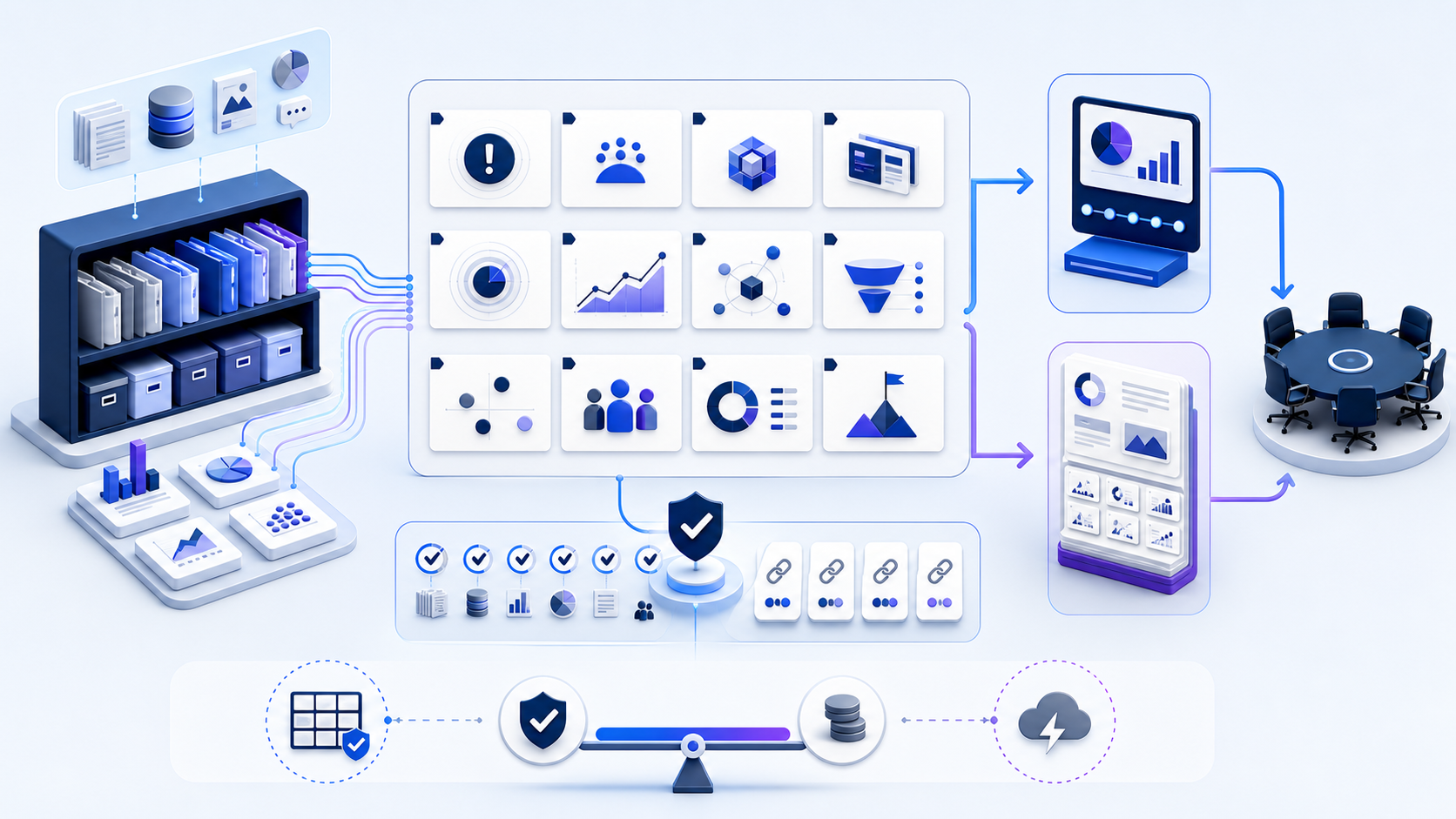
Quick answer: use a pitch deck template as an evidence map快速答案:把 Pitch Deck Template 用作证据地图
A useful pitch deck template is a concise sequence that helps a specific investor understand the company, customer problem, solution, market, product, traction, business model, go-to-market plan, competition, team, capital plan, and funding ask. Start with the decision and audience, not the colors. For every slide, write one claim, attach the evidence and source date, state material assumptions, identify the owner, and link the diligence artifact that supports it. Build a pared-back live deck and a self-explanatory reading deck, then reconcile every number, label confidential information, test accessibility, inspect hidden data, and export verified PPTX and PDF copies.
有用的 Pitch Deck Template 是一套简洁顺序,帮助特定投资人理解公司、客户问题、解决方案、市场、产品、牵引力、商业模式、获客路径、竞争、团队、资金计划与融资请求。应从决策和受众开始,而不是从颜色开始。每一页只写一个主张,附证据与来源日期,说明重要假设,标明责任人,并连接支持该主张的尽调材料。制作精简演讲版和可独立阅读版,再统一全部数字、标记机密信息、测试无障碍、检查隐藏数据,并导出已验证的 PPTX 与 PDF。
The template organizes communication; it does not establish truth or predict funding. A polished slide cannot substitute for customer evidence, reconciled financials, credible market logic, a responsible forecast, or clear risks. Treat the deck as the top layer of a traceable evidence system rather than a one-off design file.
模板组织沟通,但不能证明事实或预测融资。精美幻灯片不能替代客户证据、对账后的财务数据、可信市场逻辑、负责任预测或明确风险。应把融资材料视为可追溯证据系统的顶层,而不是一次性设计文件。
Define the investor decision before choosing a layout选择版式前先定义投资决策
Write a one-page brief before opening presentation software. Name the round or conversation, target investor type, sector and stage fit, meeting format, sending channel, expected decision, confidentiality level, date cutoff, and accountable owner. A first-contact seed deck, a strategic-partner presentation, a lender package, and a board financing discussion are not interchangeable. The same company may need different emphasis, evidence depth, terminology, and distribution controls.
打开演示软件前先写一页简报,明确轮次或沟通类型、目标投资人类型、行业与阶段匹配、会议方式、发送渠道、预期决策、机密级别、数据截止日与责任人。首次接触的种子轮材料、战略合作演示、贷款资料和董事会融资讨论不能互换。同一公司也可能需要不同重点、证据深度、术语和分发控制。
Who will read it, what mandate do they have, and what prior context can you assume?
谁会阅读、对方有什么授权、可以假设哪些前置信息?
Is the next step an introduction, first meeting, partner review, diligence request, or term discussion?
下一步是引荐、首次会议、合伙人评审、尽调请求还是条款讨论?
What cutoff applies to revenue, users, pipeline, market, headcount, cash, and forecast?
收入、用户、管线、市场、人员、现金与预测使用哪个截止日?
Can it be forwarded, downloaded, printed, or shared outside the named group?
能否转发、下载、打印或分享给具名群体以外的人?
Build a decision sequence, not a fixed slide ritual构建决策顺序,而不是固定仪式
Most investor deck templates contain similar subjects, but the best order depends on the company’s strongest evidence and the reader’s questions. A common sequence is context or problem → customer → solution and product → why now → market → traction → business model → go-to-market → competition → team → plan and ask. A company with unusually strong traction may surface it early. A scientific venture may need technical validation before market detail. Reordering is acceptable when the logic remains explicit.
多数投资人模板包含相似主题,但最佳顺序取决于公司的最强证据和读者问题。常见顺序是背景或问题 → 客户 → 方案与产品 → 时机 → 市场 → 牵引力 → 商业模式 → 获客 → 竞争 → 团队 → 计划与请求。牵引力特别强的公司可提前展示;科学型企业可能先讲技术验证再讲市场。只要逻辑明确,重新排序完全合理。
Write the argument in plain sentences before designing slides. Each sentence should connect to the next: because this problem is costly and urgent for this customer, this product changes the workflow; because adoption and economics show a credible pattern, this team can use this amount of capital to reach these defined milestones. If that chain cannot be stated without vague adjectives, the evidence is not ready for design.
设计幻灯片前先用普通句子写出论证。每句话都应连接下一句:因为这个问题对这类客户代价高且紧迫,所以该产品改变工作流;因为采用情况与经济性呈现可信模式,所以这支团队可以使用这笔资金达到这些明确里程碑。如果离开模糊形容词后无法说清链条,证据就还不适合进入设计。
Map each pitch deck slide to a question and proof把每张融资幻灯片映射到问题和证据
| Slide页面 | Decision question决策问题 | Minimum evidence最低证据 | Common failure常见失败 |
|---|---|---|---|
| Company and one-line thesis公司与一句话论点 | What does the company do, for whom, and why does it matter?公司为谁做什么,为什么重要? | Specific customer, action, outcome, stage, contact具体客户、动作、结果、阶段、联系方式 | Mission language with no concrete object or verb只有使命口号,没有具体对象和动词 |
| Problem and customer问题与客户 | Whose workflow fails, how often, and with what consequence?谁的工作流在哪里失败、频率和后果是什么? | Research, interviews, behavior, costs, current workaround研究、访谈、行为、成本、当前替代方案 | Universal claims supported by anecdotes用个例支持普遍主张 |
| Solution and product方案与产品 | How does the workflow change and what is proven today?工作流如何改变,目前证明了什么? | Real flow, capability boundary, adoption or test evidence真实流程、能力边界、采用或测试证据 | Future roadmap presented as shipped product把未来路线图当作已交付产品 |
| Market and why now市场与时机 | Which reachable market exists and why is the timing credible?可触达市场是什么,为什么时机可信? | Segment definition, bottom-up drivers, sources, dates, constraints细分定义、自下而上驱动、来源、日期、约束 | Large top-down total with no serviceable path只有巨大的自上而下总量,没有服务路径 |
| Traction牵引力 | What behavior indicates demand, retention, or progress?哪些行为显示需求、留存或进展? | Defined metric, cohort, period, source, denominator, comparison定义清楚的指标、群组、周期、来源、分母与比较 | Cumulative vanity metrics without quality or denominator只有累计虚荣指标,没有质量或分母 |
| Economics and go-to-market经济性与获客 | How does value become revenue and repeatable acquisition?价值如何变成收入和可重复获客? | Pricing logic, sales motion, conversion, cycle, cost, retention定价逻辑、销售路径、转化、周期、成本与留存 | Forecast treated as historical fact把预测当作历史事实 |
| Competition竞争 | What do customers use now and why can this company win?客户现在用什么,公司为何可能胜出? | Alternatives, switching criteria, evidence, limits, response替代方案、切换标准、证据、限制与应对 | A matrix designed so only the company can score well专门设计成只有自己高分的矩阵 |
| Team, plan, and ask团队、计划与请求 | Why this team, how much capital, for what milestones and runway?为什么是这支团队,需要多少资金达到哪些里程碑和现金周期? | Relevant evidence, ownership, hiring gaps, uses, timing, assumptions相关证据、责任、招聘缺口、用途、时间与假设 | Generic biographies or a round number with no operating bridge泛化履历,或没有经营桥接的整数请求 |
Write a title slide another person can repeat让别人能够复述标题页
Use the company name, one concrete sentence, the relevant round or context, contact, and date. The sentence should identify the customer, the action or product category, and the outcome without claiming unsupported superiority. “Automates reconciliation for multi-entity finance teams” is testable; “reinventing the future of finance” is not. If the deck travels asynchronously, add enough context to identify what is current and who owns follow-up.
使用公司名称、一句具体陈述、相关轮次或背景、联系方式和日期。这句话应识别客户、动作或产品类别与结果,不声称无证据的优越性。“为多实体财务团队自动化对账”可以验证;“重塑金融未来”不能验证。若材料会异步传播,应提供足够背景说明当前版本与跟进责任人。
Do not place customer logos, partner marks, regulated certifications, or media quotes on the cover unless use is authorized and the relationship is described accurately. A visual association can imply endorsement even when the words do not.
未经授权且未准确描述关系,不要在封面放客户、合作伙伴、监管认证或媒体引用标志。即使文字没有这样说,视觉关联也可能暗示背书。
Define the problem with a bounded customer and consequence用有边界的客户与后果定义问题
Name the user, buyer, beneficiary, process, trigger, frequency, baseline, consequence, and current workaround. Separate a customer complaint from measured behavior and a market hypothesis from validated demand. If interviews support the slide, record sample, recruitment method, dates, questions, exclusions, and whether quotations are authorized. If operational data supports it, define the source, period, denominator, and known missingness.
明确用户、购买者、受益者、流程、触发条件、频率、基线、后果与当前替代方案。区分客户抱怨与测量行为,也区分市场假设与已验证需求。若幻灯片依赖访谈,应记录样本、招募方法、日期、问题、排除项与引用授权;若依赖运营数据,应定义来源、周期、分母和已知缺失。
Avoid manufacturing urgency with an extreme anecdote. Show the distribution where possible: how many customers experience the issue, under what conditions, and how severe it is. Explain who does not have the problem. Boundaries make the thesis more credible and help the investor test market fit.
不要用极端个例制造紧迫感。可行时展示分布:多少客户在什么条件下遇到问题,严重程度如何,并说明哪些人没有这个问题。边界会让论点更可信,也帮助投资人检验市场匹配。
Show the changed workflow and the product boundary展示改变后的工作流与产品边界
Use a short before-and-after flow, real product evidence, and an explicit capability boundary. Show what input enters, what the product does, who reviews, what output leaves, and where human or system dependencies remain. Label demonstrations, prototypes, pilots, beta capabilities, contracted roadmap, and generally available features accurately. Screenshots should use authorized, sanitized data and remain readable at presentation distance.
使用简短前后流程、真实产品证据和明确能力边界。展示输入是什么、产品做什么、谁复核、输出是什么,以及仍有哪些人员或系统依赖。准确标记演示、原型、试点、测试能力、合同路线图与正式可用功能。截图应使用获授权脱敏数据,并能在演讲距离阅读。
Connect features to evidence of customer value. A capability list says what exists; it does not show adoption, outcome, willingness to pay, retention, or defensibility. Do not convert a laboratory benchmark or one design partner’s result into a universal performance claim.
把功能连接到客户价值证据。能力清单只说明存在什么,不能说明采用、结果、付费意愿、留存或防御性。不要把实验室基准或一个设计伙伴的结果转成普遍性能主张。
Build a market slide from reachable units从可触达单位构建市场页
Define geography, segment, buyer, use case, price basis, adoption constraint, and date. A bottom-up model might multiply eligible accounts by an evidence-based annual contract value and realistic serviceability assumptions. Reconcile it with credible external sources without presenting a third-party forecast as company truth. Separate total theoretical demand, the segment the company can serve, and the near-term market it can reach through the stated go-to-market motion.
定义地区、细分、购买者、用例、价格基础、采用约束与日期。自下而上模型可以用合格账户数乘以有证据的年合同价值和现实可服务假设。用可信外部来源核对,但不要把第三方预测当作公司事实。区分理论总需求、公司可服务细分与通过当前获客路径近期可触达市场。
Show formulas, assumptions, source links, update dates, currency, and sensitivity. Avoid adding incompatible reports or claiming every employee, company, or transaction as a buyer. A smaller transparent model is more useful than an enormous number nobody can reproduce.
展示公式、假设、来源链接、更新日期、币种与敏感性。不要相加不兼容报告,也不要把每个员工、公司或交易都当作购买者。一个较小但透明的模型,比无法复现的巨大数字更有用。
Present traction with definitions and denominators用定义与分母展示牵引力
Choose measures that test the thesis: active use, retention, cohort behavior, paid conversion, revenue quality, expansion, sales cycle, renewal, gross margin, implementation time, or another stage-appropriate signal. For every chart, show metric definition, unit, time interval, population, denominator, source system, cutoff, exclusions, and whether values are audited, booked, contracted, invoiced, collected, or forecast.
选择检验论点的指标:活跃使用、留存、群组行为、付费转化、收入质量、扩张、销售周期、续约、毛利、实施时间或其他适合阶段的信号。每张图应说明指标定义、单位、时间间隔、群体、分母、来源系统、截止日、排除项,以及数据是审计、入账、签约、开票、收款还是预测。
Do not mix cumulative accounts with active customers, bookings with recognized revenue, pipeline with contracts, or pilots with paid production. Mark methodology changes and restate historical comparisons when necessary. A transparent weak period with an explanation is more credible than a chart engineered to hide it.
不要混合累计账户与活跃客户、签约额与确认收入、管线与合同、试点与付费生产。标记方法变化,并在必要时重述历史比较。有解释的透明弱势周期,比专门隐藏它的图表更可信。
Connect pricing, acquisition, delivery, and retention连接定价、获客、交付与留存
Explain who pays, for what unit, at what frequency, under which contract, and what costs scale with delivery. Show observed pricing separately from planned pricing. Connect the sales motion to lead source, qualification, conversion, cycle length, implementation, support, renewal, and expansion. If unit economics are immature, state what is measured and what remains an assumption instead of fabricating precision.
说明谁付费、按什么单位、什么频率、使用什么合同,以及哪些成本随交付增长。把已观察定价与计划定价分开。将销售路径连接到线索来源、资格、转化、周期、实施、支持、续约和扩张。若单位经济性尚不成熟,应说明已测量什么、哪些仍是假设,而不是制造精确。
A channel name is not a go-to-market plan. State the target account, buyer, trigger, message, route, owner, capacity, funnel assumption, constraint, experiment, and decision rule. Explain how capital changes the bottleneck rather than merely increasing activity.
渠道名称不是获客计划。应说明目标账户、购买者、触发、信息、路径、责任人、容量、漏斗假设、约束、实验与决策规则,并解释资金如何改变瓶颈,而不只是增加活动。
Compare alternatives using customer decision criteria使用客户决策标准比较替代方案
Include direct competitors, adjacent tools, internal workarounds, services, spreadsheets, manual labor, and doing nothing. Define criteria from customer decisions—workflow fit, switching cost, implementation, trust, performance, integration, governance, total cost, or another evidenced dimension. Cite sources and dates. Explain where the company is weaker and how competitors may respond.
包括直接竞争者、相邻工具、内部替代、服务、电子表格、人工流程与不采取行动。标准应来自客户决策,例如工作流匹配、切换成本、实施、信任、性能、集成、治理、总成本或其他有证据维度,并标注来源与日期。说明公司较弱之处以及竞争者可能如何应对。
Avoid a two-axis chart chosen after the fact so the company appears alone in the desirable corner. Do not use competitor logos without checking permitted use, and do not state private competitor metrics as fact. A competition slide should demonstrate market understanding, not contempt.
避免事后选择两个坐标轴,只为让公司独占理想角落。使用竞争者标志前应检查许可,不要把竞争者私有指标当作事实。竞争页应证明市场理解,而不是表达轻视。
Show why the current team can execute the next plan说明当前团队为何能执行下一阶段计划
Connect each person to the company’s specific technical, commercial, regulatory, operational, or customer risk. Use accurate current roles, relevant achievements, availability, ownership, and gaps. Distinguish employees, founders, contractors, advisors, board members, and investors. Confirm that every name, photograph, employer reference, credential, and affiliation is authorized and current.
把每个人连接到公司的具体技术、商业、监管、运营或客户风险。使用准确当前职务、相关成绩、可投入程度、责任与缺口。区分员工、创始人、承包商、顾问、董事和投资人,并确认每个姓名、照片、雇主引用、资质与关联均获授权且为最新。
Do not fill the slide with prestige signals unrelated to the next milestones. Identify the missing capability and hiring sequence. An honest gap with a funded plan is more useful than implying a complete team when critical roles are vacant.
不要用与下一里程碑无关的声望信号填满页面。应识别缺失能力和招聘顺序。有资金支持的诚实缺口,比关键岗位空缺却暗示团队完整更有用。
Bridge the funding ask to milestones and assumptions把融资请求桥接到里程碑与假设
State the amount or range only when authorized, the instrument or round context where appropriate, use categories, timing, operating assumptions, milestone definitions, runway method, and what changes if the round is smaller or later. Reconcile use of funds with the hiring plan, product plan, go-to-market capacity, cash forecast, existing commitments, and risk register. The deck should not present legal terms beyond approved counsel-reviewed language.
仅在获授权时说明金额或区间,并在适当时说明工具或轮次背景、用途类别、时间、经营假设、里程碑定义、现金周期方法,以及融资更小或更晚时的变化。资金用途应与招聘计划、产品计划、获客容量、现金预测、现有承诺和风险登记对账。未经律师批准的法律条款不应出现在材料中。
Separate the company’s operational plan from investor return claims. Do not promise a valuation, exit, multiple, timeline, or outcome. For a private offering, work with qualified legal and financial professionals and provide required information through the appropriate process; a pitch deck template is not an offering document.
把公司运营计划与投资回报主张分开,不要承诺估值、退出、倍数、时间或结果。私募发行应与合格法律和财务专业人士合作,并通过适当流程提供必需信息;Pitch Deck Template 不是发行文件。
Create separate live and asynchronous versions分别制作演讲版与异步阅读版
A live deck supports a speaker: large type, one idea per slide, limited detail, intentional reveal, and appendix material for questions. An asynchronous deck must explain itself without narration: definitions, sources, dates, short caveats, contact, and enough context to avoid misinterpretation. Do not force one file to perform both jobs by shrinking paragraphs onto a projection slide.
演讲版支持讲述者:大字号、每页一个想法、细节有限、有意呈现,并用附录回答问题。异步阅读版必须无需讲解也能理解:包含定义、来源、日期、简短限制、联系方式与足够上下文。不要靠把段落缩小到投影页上,强迫一个文件同时完成两种任务。
Maintain a shared claim registry so both versions use the same metric definitions and cutoff. Assign a version ID and owner, archive superseded copies, and make sure follow-up materials refer to the correct deck. The two files may differ in density, but they must not contradict each other.
维护共享主张登记,让两个版本使用相同指标定义与截止日。分配版本 ID 和责任人,归档被替代副本,确保后续材料引用正确版本。两个文件可以密度不同,但不能相互矛盾。
Create a claim and evidence ledger behind the deck在材料背后建立主张与证据台账
| Field字段 | Required record必需记录 | Release test发布测试 |
|---|---|---|
| Claim主张 | Exact sentence, slide, audience, materiality准确句子、页面、受众与重要性 | Does the visual say more than the qualified wording?视觉是否暗示超出限定文字? |
| Metric指标 | Definition, formula, unit, population, denominator, interval, cutoff定义、公式、单位、群体、分母、区间与截止日 | Can another owner reproduce the value?其他责任人能否复现? |
| Source来源 | System, report, URL, query, owner, retrieval date, version系统、报告、URL、查询、责任人、检索日与版本 | Is it authoritative, accessible, and current?是否权威、可访问且最新? |
| Status状态 | Historical, current, contracted, pipeline, forecast, scenario, target历史、当前、签约、管线、预测、情景或目标 | Is status visible on the slide?状态是否在页面可见? |
| Caveat限制 | Missingness, exclusions, uncertainty, sensitivity, conflict, dependency缺失、排除、不确定、敏感性、冲突与依赖 | Could omission change the reader’s decision?省略是否会改变读者决策? |
Design for comprehension, not decoration为理解而设计,而不是装饰
Use a consistent grid, readable type, strong contrast, predictable hierarchy, restrained color, and one visual purpose per slide. Charts need titles that state the insight, labeled axes, units, time range, source, and accessible color choices. Tables need meaningful headers and selective detail. Product screenshots need crops, scale, and annotations that remain legible. Avoid stock imagery that implies customers, locations, or outcomes that are not real.
使用一致网格、可读字号、强对比、可预测层级、克制色彩和每页一个视觉目的。图表需要说明洞察的标题、标注坐标、单位、时间范围、来源与无障碍配色;表格需要有意义的表头和选择性细节;产品截图要裁切、缩放并标注,仍能清楚阅读。避免使用暗示并不存在客户、地点或结果的图库图片。
Use PowerPoint’s accessibility checker, real reading order, meaningful alt text, unique slide titles, adequate contrast, and captions or transcripts for media. Do not place essential evidence only in color, animation, hover, or speaker notes. Test the exported PDF because reading order, links, fonts, and alt text can change.
使用 PowerPoint 无障碍检查器、真实阅读顺序、有意义替代文本、唯一幻灯片标题、足够对比以及媒体字幕或转录。不要把必要证据只放在颜色、动画、悬停或演讲者备注中。还要测试导出 PDF,因为阅读顺序、链接、字体与替代文本可能改变。
Inspect sensitive and hidden data before sending发送前检查敏感与隐藏数据
Classify customer names, logos, contracts, personal data, employee information, financial details, security architecture, source code, pricing, pipeline, cap table, legal matters, and unpublished strategy. Confirm permission and minimum necessary disclosure. Use placeholders or aggregated values when detail is unnecessary. Remove comments, hidden slides, speaker notes, cropped image areas, embedded files, document properties, personal information, revision history, and stale links unless intentionally included.
对客户姓名与标志、合同、个人数据、员工信息、财务明细、安全架构、源代码、定价、管线、股权表、法律事项和未公开战略进行分类。确认授权并遵循最小必要披露。不需要细节时使用占位符或聚合值。除非有意包含,否则删除批注、隐藏页、演讲者备注、图片裁切区域、嵌入文件、文档属性、个人信息、修订历史与过期链接。
Decide whether to share PPTX, PDF, controlled link, data-room artifact, or screen presentation. Set access, expiration, download, forwarding, watermark, and revocation according to policy. Security controls reduce risk but cannot prevent every recipient from capturing or redistributing material they can view.
根据政策决定分享 PPTX、PDF、受控链接、数据室材料还是屏幕演示,并设置访问、到期、下载、转发、水印与撤销。安全控制可以降低风险,但无法阻止所有接收者截取或重新分发其可见内容。
Label historical results, forecasts, and scenarios correctly正确标记历史结果、预测与情景
Keep actual, booked, contracted, pipeline, forecast, target, and scenario values distinct. Reconcile historical figures to the governing financial records, name the currency and accounting basis, document model versions, and show material assumptions behind revenue, cost, hiring, margin, cash, and runway. Use ranges or sensitivities when precision is not justified. Obtain accountable finance and legal review before external release.
区分实际、入账、签约、管线、预测、目标与情景值。把历史数字与治理财务记录对账,说明币种与会计基础,记录模型版本,并展示收入、成本、招聘、利润率、现金与现金周期的重要假设。精确度没有依据时使用区间或敏感性,并在外发前获得责任财务与法律复核。
Boundary: This workflow explains communication and verification. It is not legal, tax, accounting, valuation, securities, or investment advice, and it does not replace offering documents, diligence, or professional review.
边界:本工作流说明沟通与核验,不是法律、税务、会计、估值、证券或投资建议,也不能替代发行文件、尽调或专业复核。
Build the investor presentation in nine controlled passes通过九轮受控制作投资人演示
- 1Brief: define audience, decision, stage, meeting mode, cutoff, owner, and sharing policy.简报:定义受众、决策、阶段、会议方式、截止日、责任人与分享政策。
- 2Thesis: write the full argument in plain sentences and list unresolved questions.论点:用普通句子写出完整论证,并列出未解决问题。
- 3Evidence: build the claim ledger, reconcile metrics, and flag unsupported assertions.证据:建立主张台账、统一指标并标记无支持断言。
- 4Storyboard: assign one decision question and one lead claim to each slide.故事板:为每页分配一个决策问题和一个主主张。
- 5Draft: write headlines, evidence, caveats, sources, and appendix links before styling.草稿:先写标题、证据、限制、来源与附录链接,再做样式。
- 6Design: apply the grid, hierarchy, charts, images, accessibility, and responsive reading tests.设计:应用网格、层级、图表、图片、无障碍与响应式阅读测试。
- 7Review: obtain product, sales, finance, legal, security, privacy, and executive signoff as applicable.复核:按需获得产品、销售、财务、法律、安全、隐私与管理层批准。
- 8Export: inspect hidden data, embed or substitute fonts, verify links, and render PPTX and PDF.导出:检查隐藏数据、嵌入或替换字体、验证链接并渲染 PPTX 与 PDF。
- 9Release: version, archive, distribute through the approved route, and log feedback and updates.发布:版本化、归档、通过获准路径分发,并记录反馈与更新。
Draft the pitch narrative in structured Markdown first先用结构化 Markdown 起草融资叙事
Markdown can help a team separate argument and evidence from visual styling. Use headings for slide questions, short paragraphs for claims, lists for proof and caveats, and tables for the metric ledger. Review the narrative in plain text before spending time on presentation layout. This makes missing transitions, duplicate claims, unsupported numbers, and excessive detail easier to see.
Markdown 可以帮助团队把论证与证据同视觉样式分开。使用标题表示页面问题,短段落表示主张,列表表示证据与限制,表格表示指标台账。在投入演示版式前先审阅纯文本叙事,更容易发现缺失过渡、重复主张、无支持数字与过度细节。
The InfiniSynapse Markdown to Word tool can turn sanitized structured notes into an editable DOCX review document. Use it for internal narrative review and evidence comments before building the final pitch deck. It does not create an investor-ready PPTX, validate claims, conduct financial or legal review, or determine a fundraising outcome.
InfiniSynapse Markdown 转 Word 工具可把脱敏结构化笔记转换为可编辑 DOCX 审阅文档,用于制作最终融资材料前的内部叙事审阅和证据批注。它不会创建可直接发给投资人的 PPTX,也不会验证主张、完成财务或法律复核,更不会决定融资结果。
Turn a sanitized Markdown outline into a Word review draft把脱敏 Markdown 大纲转为 Word 审阅草稿
Use the tool to review the evidence narrative with collaborators before committing it to slide design.
在投入幻灯片设计前,使用该工具与协作者审阅证据叙事。
Open Markdown to Word打开 Markdown 转 WordUse this pitch deck template release checklist使用这份 Pitch Deck Template 发布检查表
| Area领域 | Required checks必查项目 | Stop when停止条件 |
|---|---|---|
| Narrative叙事 | Audience, decision, one-line thesis, slide sequence, next step, appendix受众、决策、一句话论点、页面顺序、下一步、附录 | A reader cannot explain the company, evidence, or ask读者无法解释公司、证据或请求 |
| Evidence证据 | Definitions, sources, cutoff, status, units, denominators, assumptions, caveats, owner定义、来源、截止日、状态、单位、分母、假设、限制、责任人 | A material claim cannot be reproduced or qualified重要主张无法复现或限定 |
| Governance治理 | Customer/logo permission, finance reconciliation, legal/privacy/security review, confidentiality客户与标志许可、财务对账、法律隐私安全复核、机密级别 | Authorization, ownership, or disclosure boundary is unclear授权、责任或披露边界不明确 |
| Delivery交付 | PPTX/PDF rendering, fonts, links, notes, hidden data, alt text, reading order, access, versionPPTX/PDF 渲染、字体、链接、备注、隐藏数据、替代文本、阅读顺序、访问、版本 | The recipient view is untested, inaccessible, stale, or overshared接收视图未经测试、不无障碍、过期或过度分享 |
Questions about using a pitch deck template使用 Pitch Deck Template 的常见问题
Most decks address the company thesis, customer problem, solution and product, timing, market, traction, business model, go-to-market, competition, team, plan, and ask. Order and depth should follow the company’s stage, evidence, audience, and next decision rather than a rigid universal sequence.
多数材料会涵盖公司论点、客户问题、方案与产品、时机、市场、牵引力、商业模式、获客、竞争、团队、计划与请求。顺序和深度应跟随公司阶段、证据、受众与下一决策,而不是固定通用顺序。
Use the fewest slides that communicate the decision-ready argument without hiding material evidence. A concise core deck with a targeted appendix is often easier to navigate than an arbitrary limit or a long master presentation. Test both the live and asynchronous reading experience.
使用最少页面表达可决策论证,同时不隐藏重要证据。简洁核心材料加定向附录,通常比任意页数限制或很长主演示更易导航。应分别测试演讲和异步阅读体验。
Include stage-appropriate, authorized projections when they help explain the operating plan and capital needs. Label them clearly, show material assumptions and sensitivities, reconcile historical data, and obtain accountable finance and legal review. Never present forecasts as certain results.
当预测有助于解释经营计划和资金需求时,可纳入适合阶段且获授权的预测。应清楚标记,展示重要假设与敏感性,对账历史数据并获得责任财务与法律复核,绝不能把预测当作保证结果。
Usually maintain two controlled views of one evidence system: a visually concise live deck and a self-explanatory reading deck. They can differ in density, but definitions, metrics, cutoff dates, claims, and version ownership must remain consistent.
通常应维护同一证据系统的两个受控视图:视觉精简演讲版与可独立理解的阅读版。密度可以不同,但定义、指标、截止日、主张和版本责任必须一致。
A template can improve organization, completeness, and review, but it cannot establish product-market fit, validate claims, predict investor decisions, or determine whether a meeting, valuation, term sheet, or funding will occur. Outcomes depend on the business, evidence, market, team, fit, process, and external conditions.
模板可以改善组织、完整性和复核,但不能建立产品市场匹配、验证主张、预测投资人决策,也不能保证会议、估值、条款或融资。结果取决于业务、证据、市场、团队、匹配、流程与外部条件。
Authoritative sources for pitch deck planning and delivery融资材料规划与交付的权威资料
- GOV.UK: Investor pitch template英国政府:投资人推介模板
- British Business Bank: How to put together an investment deck英国商业银行:如何制作投资材料
- U.S. Small Business Administration: Market research and competitive analysis美国小企业管理局:市场研究与竞争分析
- U.S. Small Business Administration: Write your business plan美国小企业管理局:编写商业计划
- Microsoft Support: Make PowerPoint presentations accessibleMicrosoft 支持:让 PowerPoint 演示无障碍
- Microsoft Support: Inspect and remove hidden dataMicrosoft 支持:检查并删除隐藏数据
- SEC Investor.gov: Private placement definition美国 SEC Investor.gov:私募定义