
Build a business presentation around a decision and action围绕决策与行动构建 Business Presentation
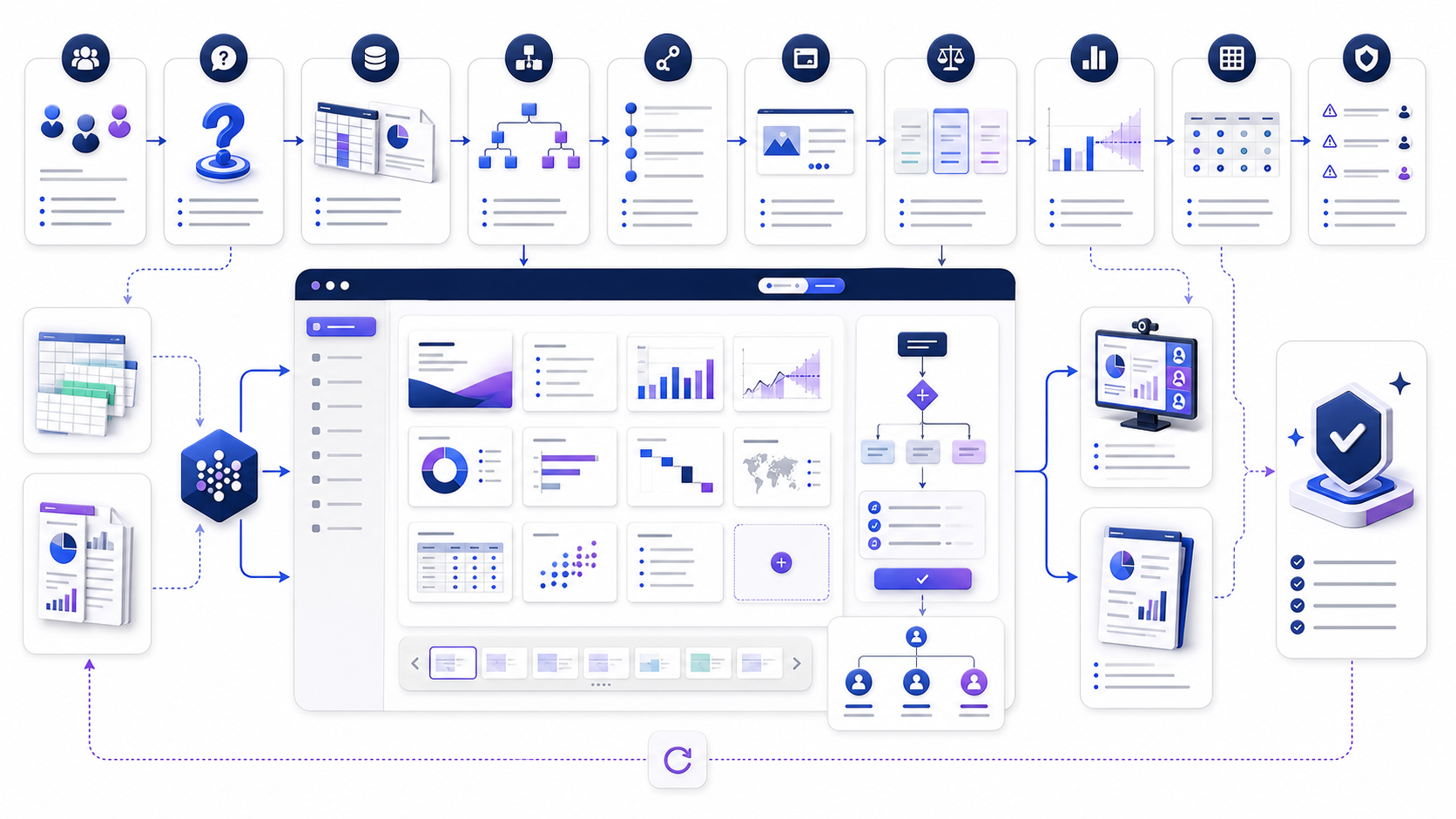
A useful business presentation helps a defined audience make a defined decision and act on it. Start with the meeting purpose, decision owner, affected stakeholders, deadline, constraints, and success or safety criteria. Reconcile the evidence before designing slides. Structure the story as bottom line → situation → evidence and causes → alternatives → recommendation → economics → risks → implementation → decision and next actions. Use descriptive slide titles, honest charts, explicit assumptions, and accountable owners.
有用的 Business Presentation 帮助明确受众做出明确决策并采取行动。先定义会议目的、决策负责人、受影响相关方、期限、约束与成功或安全标准,再在设计页面前统一证据。故事可组织为结论 → 现状 → 证据与原因 → 备选方案 → 建议 → 经济性 → 风险 → 实施 → 决策与下一步,并使用描述性标题、诚实图表、明确假设和责任人。
The presentation organizes a decision; it does not create evidence or guarantee agreement. A polished deck cannot make an unsupported forecast reliable, turn correlation into causation, remove trade-offs, authorize spending, or replace finance, legal, security, privacy, accessibility, or operational review.
演示文稿组织决策,但不会创造证据或保证共识。精美材料不能让无支持预测变得可靠,不能把相关性变成因果关系,不能消除权衡或授权支出,也不能替代财务、法律、安全、隐私、无障碍或运营复核。
Make the presentation decision-ready, not merely professional-looking让演示可用于决策,而不只是看起来专业
Name the decision, action, or shared understanding the meeting must produce.
明确会议必须产生的决策、行动或共同理解。
Define sources, periods, populations, units, denominators, assumptions, and limits.
定义来源、周期、群体、单位、分母、假设与限制。
Show viable alternatives, evaluation criteria, trade-offs, dependencies, and a recommendation.
展示可行选项、评价标准、权衡、依赖与建议。
Assign owners, deadlines, resources, checkpoints, escalation, and outcome measures.
分配负责人、期限、资源、检查点、升级与结果指标。
“Professional” should mean clear, traceable, accessible, and controlled—not decorative, dense, or full of management vocabulary. A sparse slide with an unsupported claim is still weak. A detailed appendix with reproducible definitions can be more valuable than an impressive animation.
“专业”应意味着清晰、可追溯、无障碍和受控,而不是装饰多、信息密或充满管理术语。稀疏页面如果包含无支持主张仍然薄弱;包含可复现定义的详细附录,可能比醒目动画更有价值。
Write the business presentation brief before opening PowerPoint打开 PowerPoint 前先写 Business Presentation 简报
| Brief field简报字段 | Question to answer需要回答的问题 | Failure to avoid需要避免的失败 |
|---|---|---|
| Audience受众 | Who decides, advises, implements, funds, or is affected?谁决策、建议、实施、出资或受影响? | One generic deck for incompatible audiences用一份通用材料面对不兼容受众 |
| Decision决策 | What exactly must be approved, rejected, selected, changed, or learned?具体要批准、拒绝、选择、改变或了解什么? | A meeting with no decision boundary会议没有决策边界 |
| Context背景 | What do participants already know and what changed?参与者已知什么,发生了什么变化? | Repeating background while hiding the new issue重复背景却隐藏新问题 |
| Evidence cutoff证据截止日 | Which source version and period govern every material number?哪个来源版本与周期控制所有重要数字? | Mixing current, historical, forecast, and target values混合当前、历史、预测与目标值 |
| Constraints约束 | What policy, budget, capacity, timing, legal, security, or dependency limits apply?有哪些政策、预算、能力、时间、法律、安全或依赖限制? | Recommending an option that cannot be implemented建议无法实施的选项 |
| Meeting mode会议方式 | Is this live, remote, hybrid, read-ahead, or asynchronous approval?是现场、远程、混合、会前阅读还是异步批准? | Designing only for the author’s laptop只为作者电脑设计 |
Digital.gov plain-language guidance recommends writing for the audience, stating purpose and bottom line, and organizing information in a logical order. Apply those principles to the brief and every slide: what does this audience need to know now to make the intended decision?
Digital.gov 的简明语言指南建议面向受众写作,先说明目的与结论,并以逻辑顺序组织信息。应把这些原则应用于简报和每张页面:这个受众现在需要知道什么,才能做出预期决策?
Choose a structure that matches the business meeting选择匹配业务会议的结构
| Meeting会议 | Primary question核心问题 | Typical spine常见主线 |
|---|---|---|
| Executive recommendation管理层建议 | Which option should we choose and why now?应选择哪个方案,为什么是现在? | Decision → evidence → alternatives → recommendation → risk → action决策 → 证据 → 选项 → 建议 → 风险 → 行动 |
| Quarterly business review季度业务复盘 | What changed, why, and what must change next?发生了什么、为什么、下一步必须改变什么? | Goals → results → drivers → variances → learning → commitments目标 → 结果 → 驱动 → 偏差 → 学习 → 承诺 |
| Business proposal业务提案 | Should the recipient adopt, fund, buy, or partner?接收者是否应采用、出资、购买或合作? | Need → evidence → approach → value → terms → proof → next step需求 → 证据 → 方法 → 价值 → 条件 → 证明 → 下一步 |
| Operational review运营评审 | Is the system performing safely and what intervention is required?系统是否安全运行,需要什么干预? | Baseline → performance → incidents → causes → controls → owners基线 → 表现 → 事件 → 原因 → 控制 → 负责人 |
| Strategy presentation战略演示 | Where will we play, how will we win, and what will we stop?在哪里竞争、如何取胜、停止什么? | Context → choices → capabilities → portfolio → resource shifts → tests背景 → 选择 → 能力 → 组合 → 资源变化 → 验证 |
| Status update状态更新 | Are outcomes, scope, time, cost, quality, and risk on track?结果、范围、时间、成本、质量与风险是否正常? | Commitment → current state → variance → blockers → decisions → next period承诺 → 当前状态 → 偏差 → 阻碍 → 决策 → 下一周期 |
Write the decision question in one bounded sentence用一个有边界句子写出决策问题
Name the decision owner, action, object, scope, deadline, alternatives, material constraints, and approval threshold. “Should we approve phase one of the service migration for the named business units by the stated date, within the authorized budget and risk limits?” is testable. “How should we transform the business?” is too broad for one presentation.
明确决策负责人、动作、对象、范围、期限、备选方案、重要约束与批准门槛。“是否应在规定日期前、授权预算与风险限制内,批准具名业务单元的服务迁移第一阶段?”可以检验;“我们应如何转型业务?”对一份演示来说过于宽泛。
Separate exploratory learning from approval. If leadership is only diagnosing the situation, do not force a recommendation unsupported by evidence. If approval is needed, disclose what remains uncertain, which assumptions are decision-critical, and what conditions would trigger a pause, reversal, or further study.
区分探索学习与批准。如果管理层只是在诊断现状,不要强迫形成无证据建议。如果需要批准,应披露仍不确定的内容、哪些假设对决策关键,以及什么条件会触发暂停、撤回或进一步研究。
Build an evidence ledger before designing business slides设计业务页面前先建立证据台账
| Claim主张 | Required record所需记录 | Review question复核问题 |
|---|---|---|
| Performance绩效 | Metric definition, source, owner, period, population, unit, denominator指标定义、来源、责任人、周期、群体、单位、分母 | Can another reviewer reproduce the value?另一位审阅者能否复现该值? |
| Cause原因 | Competing explanations, method, comparison, confounders, limits竞争解释、方法、比较、混杂与限制 | Is this cause, association, sequence, or hypothesis?这是因果、关联、顺序还是假设? |
| Benefit收益 | Baseline, mechanism, affected volume, adoption, timing, uncertainty基线、机制、受影响量、采用、时间与不确定性 | Is the value observed, estimated, forecast, or targeted?数值是观察、估计、预测还是目标? |
| Cost成本 | Scope, currency, date, one-time and recurring items, opportunity cost范围、币种、日期、一次性与经常性项目、机会成本 | Which material costs are excluded?排除了哪些重要成本? |
| Risk风险 | Event, cause, consequence, likelihood, exposure, control, owner事件、原因、后果、可能性、暴露、控制与责任人 | What evidence would change the risk judgment?什么证据会改变风险判断? |
Mark evidence status: verified, reconciled, provisional, estimated, forecast, target, anecdotal, disputed, or unavailable. Record source links and cutoff dates outside the visual canvas when necessary, but keep enough attribution on the slide that recipients can understand what governs the claim.
标记证据状态:已验证、已对账、暂定、估计、预测、目标、个例、有争议或不可用。必要时把来源链接与截止日放在视觉画布之外,但页面上仍应保留足够归属,使接收者知道什么控制该主张。
Build a logical argument before building slide layouts构建页面版式前先建立逻辑论证
Write the full argument in plain sentences. A common pattern is: because the current state differs from the agreed baseline in these material ways, and the evidence supports these mechanisms rather than the main alternatives, the organization should choose this bounded option, subject to these costs, risks, dependencies, controls, and stop conditions. The requested decision is this, owned by these people, by this date.
先用普通句子写出完整论证。常见模式是:因为当前状态在这些重要方面偏离约定基线,而且证据更支持这些机制而不是主要替代解释,所以组织应选择这个有边界方案,并受这些成本、风险、依赖、控制与停止条件约束;请求的决策是这个,由这些人在该日期前负责。
Test the chain for missing transitions. Does the problem lead to the proposed action? Does the recommendation address the measured cause? Do projected benefits follow from adoption and capacity assumptions? Does the implementation plan mitigate the named risks? If the chain relies on “obviously,” “best-in-class,” or “transformative,” replace the adjective with evidence or remove it.
检查逻辑链是否缺少过渡:问题是否导向建议行动,建议是否解决测量原因,预测收益是否来自采用与能力假设,实施计划是否缓解具名风险?如果链条依赖“显然”“行业最佳”或“变革性”,应以证据替代形容词或删除。
Write the executive summary as a decision record把执行摘要写成决策记录
An executive summary slide should stand on its own. State the requested decision, recommendation, two or three decisive reasons, material cost or resource requirement, principal risk, implementation owner, first milestone, and decision deadline. Label provisional values and unresolved dependencies. Link the evidence appendix or source record for participants who need depth.
执行摘要页应能独立理解。说明请求的决策、建议、两到三个决定性理由、重要成本或资源要求、主要风险、实施负责人、首个里程碑与决策期限,标记暂定数值和未解决依赖,并为需要细节的参与者连接证据附录或来源记录。
Useful test: after reading only the executive summary, can the decision owner explain what is being requested, why, on what evidence, at what cost, with what risk, and what happens next?
有效测试:只阅读执行摘要后,决策负责人能否解释请求什么、为什么、依据什么证据、成本与风险是什么,以及下一步发生什么?
Define the current state against an agreed baseline根据约定基线定义当前状态
Describe the population, process, geography, product, customer segment, time interval, and operating conditions. Compare the current state with a relevant target, prior period, control, plan, forecast, service level, or external benchmark. Explain why that comparator is valid and where it is not comparable. Show the distribution or segments when an average hides material variation.
描述群体、流程、地区、产品、客户细分、时间间隔和运行条件。把当前状态与相关目标、上一周期、对照、计划、预测、服务水平或外部基准比较,并解释比较对象为何有效以及哪里不可比。当平均值隐藏重要差异时,应展示分布或细分。
Separate the symptom from the consequence. A slower cycle time is a measured condition; delayed customer onboarding, missed revenue, increased manual effort, or safety exposure may be consequences. Do not monetize every consequence without a defensible mechanism, affected volume, time horizon, and attribution boundary.
区分症状与后果。周期时间变慢是测量状态;客户上线延迟、收入损失、人工增加或安全暴露可能是后果。没有可辩护机制、受影响量、时间范围和归属边界时,不要把每个后果都货币化。
Show the analysis path and competing explanations展示分析路径与竞争解释
Map the system: actors, inputs, outputs, dependencies, incentives, queues, delays, feedback, policies, technology, and known changes. List plausible explanations before selecting a favorite. Use appropriate descriptive summaries, segmentation, process analysis, controlled comparisons, qualitative coding, experiments, or causal methods. Look for outliers and cases that contradict the preferred explanation.
绘制系统:参与者、输入、输出、依赖、激励、队列、延迟、反馈、政策、技术与已知变化。在选择偏好解释前列出合理解释,使用合适的描述汇总、细分、流程分析、受控比较、定性编码、实验或因果方法,并寻找异常点与反驳偏好解释的案例。
Label the evidence level. Sequence does not prove cause; correlation does not identify a mechanism; a customer quote does not estimate prevalence; and one successful pilot does not prove general scalability. Present unresolved explanations and the practical test that would distinguish them.
标记证据等级。先后顺序不能证明原因,相关性不能识别机制,客户引用不能估计普遍性,一个成功试点也不能证明普遍扩展。应展示未解决解释,以及能够区分它们的实际测试。
Compare viable alternatives using explicit criteria使用明确标准比较可行备选方案
Include the current course, delay or staged learning, process change, technology change, build, buy, partner, outsource, and stop options when they are genuinely viable. Define evaluation criteria before scoring: outcome, time, total cost, capacity, reversibility, evidence strength, risk, compliance, accessibility, operational burden, strategic fit, and dependency exposure.
在确实可行时,纳入维持现状、延期或分阶段学习、流程改变、技术改变、自建、购买、合作、外包与停止等方案。评分前定义评价标准:结果、时间、总成本、能力、可逆性、证据强度、风险、合规、无障碍、运营负担、战略匹配与依赖暴露。
| Option field选项字段 | What to disclose需要披露的内容 |
|---|---|
| Scope范围 | Included and excluded users, processes, regions, systems, and time纳入与排除的用户、流程、地区、系统与时间 |
| Mechanism机制 | How the option changes the system and produces the proposed outcome方案如何改变系统并产生拟议结果 |
| Evidence证据 | Observed, tested, external, estimated, forecast, or assumption观察、测试、外部、估计、预测或假设 |
| Trade-offs权衡 | Benefits forgone, harms introduced, switching costs, and lock-in放弃的收益、引入的损害、切换成本与锁定 |
| Failure conditions失败条件 | What would make the option infeasible, unsafe, or uneconomic什么会使方案不可行、不安全或不经济 |
Do not design the matrix so the preferred option wins by construction. Publish criteria, weights, scoring rules, evidence, sensitivity, and reviewer disagreement when scoring is material. A qualitative comparison can be more honest than invented precision.
不要专门设计矩阵使偏好方案必胜。当评分重要时,公布标准、权重、评分规则、证据、敏感性与审阅者分歧。定性比较可能比虚构精确分数更诚实。
Write a bounded recommendation with conditions编写带条件的有边界建议
State the selected option, scope, accountable owner, sequence, resource envelope, start date, first decision gate, evidence required at that gate, and stop or rollback conditions. Explain why it is preferred under the published criteria and which stakeholder concerns remain. If the evidence supports only a pilot, recommend a pilot rather than universal rollout.
说明选定方案、范围、责任人、顺序、资源边界、开始日期、首个决策门槛、该门槛所需证据以及停止或回滚条件。解释为什么该方案在已公布标准下更优,以及哪些相关方关注仍未解决。如果证据只支持试点,就建议试点而不是全面推广。
Separate the recommendation from approval. The author can recommend; the designated authority approves. Record required finance, legal, privacy, security, accessibility, procurement, workforce, and operational reviews. Do not describe a recommendation as “approved” until the accountable decision and conditions are documented.
区分建议与批准。作者可以提出建议,指定权力方负责批准。记录所需财务、法律、隐私、安全、无障碍、采购、人员与运营复核。在责任决策及条件被记录前,不要把建议描述为“已批准”。
Present costs, benefits, and forecasts without false precision展示成本、收益与预测时避免虚假精确
Separate historical actuals, committed amounts, estimates, forecasts, targets, and scenarios. Name currency, tax treatment where relevant, price date, discounting approach, time horizon, scope, owner, and source. Include one-time implementation, recurring operation, migration, integration, training, change, governance, support, decommissioning, contingency, and opportunity costs when material.
区分历史实际、已承诺金额、估计、预测、目标与情景。说明币种、相关税务处理、价格日期、折现方式、时间范围、范围、责任人与来源。在重要时纳入一次性实施、经常性运营、迁移、集成、培训、变更、治理、支持、退役、应急与机会成本。
For benefits, show baseline, affected population or volume, causal mechanism, adoption, ramp, capacity, persistence, attribution, and uncertainty. Provide downside and sensitivity views for decision-critical assumptions. Do not convert every hour “saved” into cash unless capacity actually changes and the accounting treatment is valid.
对收益展示基线、受影响群体或量、因果机制、采用、爬坡、能力、持续性、归属与不确定性,并对决策关键假设提供下行情景与敏感性。除非能力确实变化且会计处理有效,不要把每个“节省小时”都转换成现金。
Turn the risk slide into a control plan把风险页转化为控制计划
| Field字段 | Required detail所需细节 |
|---|---|
| Risk statement风险陈述 | Because of this cause, this uncertain event may affect this objective through this consequence由于这个原因,该不确定事件可能通过这个后果影响该目标 |
| Exposure暴露 | Likelihood, impact, affected population, duration, detectability, and confidence可能性、影响、受影响群体、时长、可检测性与信心 |
| Controls控制 | Preventive, detective, corrective, recovery, owner, evidence, and residual risk预防、检测、纠正、恢复、责任人、证据与剩余风险 |
| Trigger触发条件 | Observable threshold that causes escalation, pause, rollback, or decision review触发升级、暂停、回滚或决策复核的可观察门槛 |
| Assumption假设 | Owner, evidence, expiry, sensitivity, validation method, and consequence if false责任人、证据、到期、敏感性、验证方法与错误后果 |
Do not use a decorative red-amber-green heat map without definitions. The same color can mean different exposure across functions, and color alone is inaccessible. Show labels, criteria, evidence dates, residual risk, and accountable acceptance. Keep opportunities distinct from threats unless the scoring model explicitly handles both.
不要使用没有定义的装饰性红黄绿热图。相同颜色在不同职能可能代表不同暴露,且只使用颜色不无障碍。应展示标签、标准、证据日期、剩余风险与责任接受,并把机会与威胁分开,除非评分模型明确处理两者。
Translate the recommendation into owners and gates把建议转化为负责人和门槛
Map workstreams, deliverables, dependencies, decision rights, owners, contributors, resources, milestones, acceptance criteria, metrics, risks, and escalation. Use outcome milestones rather than activity labels: “validated data migration for the pilot population with agreed reconciliation tolerance” is more testable than “migration phase complete.”
绘制工作流、交付物、依赖、决策权、负责人、贡献者、资源、里程碑、验收标准、指标、风险与升级。使用结果里程碑而不是活动标签:“在约定对账容差内完成试点群体数据迁移验证”比“迁移阶段完成”更可检验。
Separate commitment from aspiration. Confirm who has accepted each action, what capacity is available, which prerequisites are controlled outside the team, and what happens when a dependency slips. Publish the first reporting date and review cadence. A roadmap without ownership and evidence gates is an illustration, not an implementation plan.
区分承诺与愿望。确认谁已接受每项行动、有哪些可用能力、哪些前置条件由团队外控制,以及依赖延期时怎么办。公布首次报告日期与复核节奏。没有责任与证据门槛的路线图只是插图,不是实施计划。
Use business charts to answer a decision question使用业务图表回答决策问题
| Question问题 | Possible visual可能视觉 | Integrity checks诚信检查 |
|---|---|---|
| How did a measure change over time?指标如何随时间变化? | Line or column chart with target and event annotations带目标与事件标注的折线或柱形图 | Stable definition, interval, missing periods, inflation, seasonality, axis稳定定义、间隔、缺失周期、通胀、季节与坐标轴 |
| How do categories compare?类别如何比较? | Sorted bar, dot plot, or compact table排序条形、点图或紧凑表格 | Same denominator, comparable periods, clear zero and units相同分母、可比周期、清楚零点与单位 |
| Where does a process lose time or quality?流程在哪里损失时间或质量? | Flow, funnel, queue, control chart, or stage table流程、漏斗、队列、控制图或阶段表 | Cohort consistency, rework, censoring, definition changes群组一致性、返工、删失与定义变化 |
| Which assumptions drive the result?哪些假设驱动结果? | Sensitivity range, scenario table, or tornado chart敏感区间、情景表或龙卷风图 | Plausible bounds, correlation, nonlinearity, model version合理边界、相关、非线性与模型版本 |
| How are options evaluated?如何评价选项? | Criteria table with evidence and trade-offs含证据与权衡的标准表 | Published criteria, weights, uncertainty, sensitivity, disagreement公布标准、权重、不确定性、敏感性与分歧 |
Write a claim title, show the source and cutoff, label units and denominators, disclose exclusions, and include uncertainty when material. Do not truncate axes to exaggerate change, combine incompatible series, hide poor periods, use area for values that require precise comparison, or present a decorative dashboard with no decision path.
使用主张式标题,展示来源与截止日,标记单位与分母,披露排除项,并在重要时显示不确定性。不要通过截断坐标轴夸大变化、组合不兼容系列、隐藏弱势周期、用面积表示需要精确比较的数值,或呈现没有决策路径的装饰仪表板。
Build a quarterly business review around variance and learning围绕偏差与学习构建季度业务复盘
A quarterly business review should compare commitments with outcomes, not merely list activity. For each objective, show the agreed definition and target, actual result, variance, confidence, main mechanisms, external changes, decisions already made, unresolved blockers, and next commitment. Keep cumulative totals separate from period flow and pipeline separate from contracted or recognized results.
季度业务复盘应比较承诺与结果,而不是只列活动。每个目标都应展示约定定义与目标、实际结果、偏差、信心、主要机制、外部变化、已做决策、未解决阻碍与下一承诺。区分累计总量与周期流量,也区分管线与签约或确认结果。
Include what did not work and what changed in the model, process, or plan. Record methodology changes so historical series remain interpretable. Avoid changing a target after the period without showing the original commitment, approved revision, reason, and date.
纳入未奏效的内容,以及模型、流程或计划发生的变化。记录方法变化,使历史系列仍可解释。不要在周期结束后修改目标而不展示原始承诺、批准修订、原因与日期。
Create live and read-ahead views from one evidence system从同一证据系统创建演讲版与阅读版
A live deck supports a presenter: fewer words, larger visuals, deliberate reveals, and clear discussion pauses. A read-ahead or asynchronous deck must explain context, definitions, methods, caveats, sources, and navigation without narration. Build both from one governed claim ledger so numbers, terminology, dates, and decisions do not diverge.
演讲版服务于演讲者:文字更少、视觉更大、揭示更有意图、讨论停顿更清楚。会前阅读或异步版本必须在没有讲解时说明背景、定义、方法、限制、来源与导航。两者应来自同一治理主张台账,避免数字、术语、日期与决策分叉。
Label the version and intended use. Do not email the live deck and assume it is self-explanatory. Conversely, do not project a dense read-ahead document and read it aloud. Provide an accessible follow-up artifact, decision record, and source appendix appropriate to the audience.
标记版本与预期用途。不要通过邮件发送演讲版并假设它能独立理解,也不要投影密集阅读文档逐字朗读。应按受众提供无障碍跟进材料、决策记录与来源附录。
Make the business presentation accessible by design从设计阶段让 Business Presentation 无障碍
Microsoft recommends unique slide titles, logical reading order, meaningful alt text, sufficient contrast, non-color cues, readable text, descriptive links, simple tables, captions, and accessibility testing. Use built-in layouts where suitable and verify reading order after moving objects. Decorative elements should not clutter the accessibility tree.
Microsoft 建议使用唯一幻灯片标题、逻辑阅读顺序、有意义替代文本、充分对比、非颜色提示、可读文字、描述性链接、简单表格、字幕与无障碍测试。合适时使用内置版式,并在移动对象后重新检查阅读顺序。装饰元素不应干扰无障碍树。
Test keyboard navigation and the assistive technologies relevant to participants. Provide an accessible alternative when the presentation format cannot communicate the full content. GOV.UK guidance emphasizes publishing usable document structures and alternatives rather than assuming a visual file works for everyone.
使用键盘导航与参与者相关辅助技术测试。当演示格式无法传达完整内容时,提供无障碍替代。GOV.UK 指南强调发布可用文档结构和替代形式,而不是假设视觉文件适合所有人。
Review the business presentation in controlled passes分轮受控复核业务演示
- 1Decision review: confirm audience, authority, question, scope, deadline, and success criteria.决策复核:确认受众、权限、问题、范围、期限与成功标准。
- 2Evidence review: reconcile definitions, sources, dates, units, denominators, assumptions, and limits.证据复核:统一定义、来源、日期、单位、分母、假设与限制。
- 3Logic review: test the argument, competing explanations, options, trade-offs, and conditions.逻辑复核:检验论证、竞争解释、选项、权衡与条件。
- 4Functional review: obtain finance, legal, procurement, privacy, security, accessibility, HR, and operations input as needed.职能复核:按需获得财务、法律、采购、隐私、安全、无障碍、人力与运营意见。
- 5Visual review: inspect hierarchy, text, charts, tables, images, contrast, sources, and appendix links.视觉复核:检查层级、文字、图表、表格、图片、对比、来源与附录链接。
- 6Delivery review: test the real room, device, browser, remote platform, audio, fonts, media, and fallback.交付复核:测试真实房间、设备、浏览器、远程平台、音频、字体、媒体与备用。
- 7Release review: inspect notes, comments, hidden data, permissions, version, expiry, archive, and owners.发布复核:检查备注、评论、隐藏数据、权限、版本、到期、归档与责任人。
Run the final meeting from the release copy, not the author’s working file. Capture decisions, conditions, dissent, actions, owners, deadlines, dependencies, and follow-up measures. Update the decision record after the meeting without silently rewriting the evidence that participants saw.
使用发布副本进行最终会议,而不是作者工作文件。记录决策、条件、异议、行动、负责人、期限、依赖与跟进指标。会后更新决策记录,但不要静默改写参与者看到的证据。
Draft the business argument in structured Markdown使用结构化 Markdown 起草业务论证
Markdown helps teams review logic before visual styling. Use headings for decision questions, paragraphs for claims, lists for evidence and caveats, and tables for the source ledger, option comparison, risk register, and action matrix. Review the plain-text sequence with decision owners and subject-matter reviewers before building slides.
Markdown 帮助团队在视觉样式前审阅逻辑。使用标题表示决策问题,段落表示主张,列表表示证据与限制,表格表示来源台账、选项比较、风险登记与行动矩阵。在制作页面前,与决策负责人和主题专家审阅纯文本顺序。
The InfiniSynapse Markdown to Word tool can turn sanitized structured notes into an editable DOCX review draft. Use it to gather comments and approvals on the argument before slide design. It does not create a finished PowerPoint, validate evidence, approve a decision, or guarantee a business outcome.
InfiniSynapse Markdown 转 Word 工具可把脱敏结构化笔记转换为可编辑 DOCX 审阅草稿,在页面设计前收集对论证的评论与批准。它不会创建完成的 PowerPoint、验证证据、批准决策或保证业务结果。
Turn a sanitized business outline into a Word review draft把脱敏业务大纲转为 Word 审阅草稿
Review the decision logic, evidence, alternatives, risks, and actions with collaborators before committing them to slide design.
投入页面设计前,与协作者审阅决策逻辑、证据、选项、风险与行动。
Open Markdown to Word打开 Markdown 转 WordUse this business presentation checklist before delivery交付前使用这份 Business Presentation 检查表
| Gate门槛 | Required checks必查项目 | Stop when停止条件 |
|---|---|---|
| Decision决策 | Audience, authority, question, scope, deadline, criteria, requested action受众、权限、问题、范围、期限、标准与请求行动 | Participants cannot explain what must be decided参与者无法解释必须决定什么 |
| Evidence证据 | Definitions, sources, cutoff, units, denominators, status, assumptions, limits定义、来源、截止日、单位、分母、状态、假设与限制 | A material claim cannot be reproduced or qualified重要主张无法复现或限定 |
| Choice选择 | Alternatives, criteria, trade-offs, recommendation, conditions, dissent选项、标准、权衡、建议、条件与异议 | The preferred option wins through hidden criteria偏好方案通过隐藏标准获胜 |
| Action行动 | Owners, resources, milestones, dependencies, controls, triggers, measures负责人、资源、里程碑、依赖、控制、触发与指标 | No accountable owner accepts the next step没有责任人接受下一步 |
| Accessibility无障碍 | Titles, reading order, alt text, contrast, links, tables, captions, alternatives标题、阅读顺序、替代文本、对比、链接、表格、字幕与替代 | The intended audience cannot use the artifact目标受众无法使用材料 |
| Release发布 | Approvals, notes, hidden data, links, fonts, media, device test, permissions, version批准、备注、隐藏数据、链接、字体、媒体、设备测试、权限与版本 | The delivered copy or route remains untested交付副本或路径仍未经测试 |
Questions about creating a business presentation创建 Business Presentation 的常见问题
Include the audience and decision, bottom line, current state and baseline, evidence and causes, viable alternatives, recommendation, costs and benefits, risks and assumptions, implementation owners, requested decision, and next actions. Depth and order should follow the meeting purpose.
应包含受众与决策、结论、当前状态与基线、证据与原因、可行选项、建议、成本与收益、风险与假设、实施负责人、请求决策与下一行动。深度和顺序应跟随会议目的。
State the purpose, decision or action required, scope, and bottom line early. Then explain the decisive evidence and what changed. Do not spend the opening repeating history that participants already know unless it changes the decision context.
尽早说明目的、所需决策或行动、范围与结论,再解释决定性证据及发生的变化。除非历史改变决策背景,不要在开场重复参与者已知内容。
There is no universal slide count. Use the fewest slides that support the decision without hiding material evidence, trade-offs, risks, or implementation detail. Keep a concise core story and a traceable appendix, and test live and read-ahead versions separately.
没有通用页数。使用最少页面支持决策,同时不隐藏重要证据、权衡、风险或实施细节。保持简洁核心故事与可追溯附录,并分别测试演讲版和阅读版。
Lead with the decision, recommendation, decisive evidence, material economics, risk, and action. Use claim-based titles, disclose assumptions, separate appendix detail, and make ownership explicit. Executive-friendly does not mean removing uncertainty or negative evidence.
先展示决策、建议、决定性证据、重要经济性、风险与行动,使用主张式标题,披露假设,把细节放入附录并明确责任。适合管理层不等于删除不确定性或负面证据。
No. A strong presentation can improve clarity, traceability, accessibility, and follow-up, but it cannot create evidence, remove trade-offs, authorize resources, predict stakeholder decisions, or guarantee approval, funding, adoption, revenue, savings, or another outcome.
不能。优秀演示可以改善清晰度、可追溯性、无障碍与跟进,但不能创造证据、消除权衡、授权资源、预测相关方决策,也不能保证批准、资金、采用、收入、节省或其他结果。
Authoritative sources for business presentation planning业务演示规划的权威资料
- Digital.gov: Write for the readerDigital.gov:面向读者写作
- Digital.gov: Organize informationDigital.gov:组织信息
- Digital.gov: Use headings for understandingDigital.gov:使用标题帮助理解
- Microsoft Support: Make PowerPoint presentations accessibleMicrosoft 支持:让 PowerPoint 演示无障碍
- Microsoft Support: Create slides with an accessible reading orderMicrosoft 支持:创建无障碍阅读顺序
- GOV.UK: Publishing accessible documentsGOV.UK:发布无障碍文档
- CDC: Preparing accessible PowerPoint presentationsCDC:准备无障碍 PowerPoint 演示
- Microsoft Support: Inspect and remove hidden dataMicrosoft 支持:检查并删除隐藏数据