Direct answer直接回答
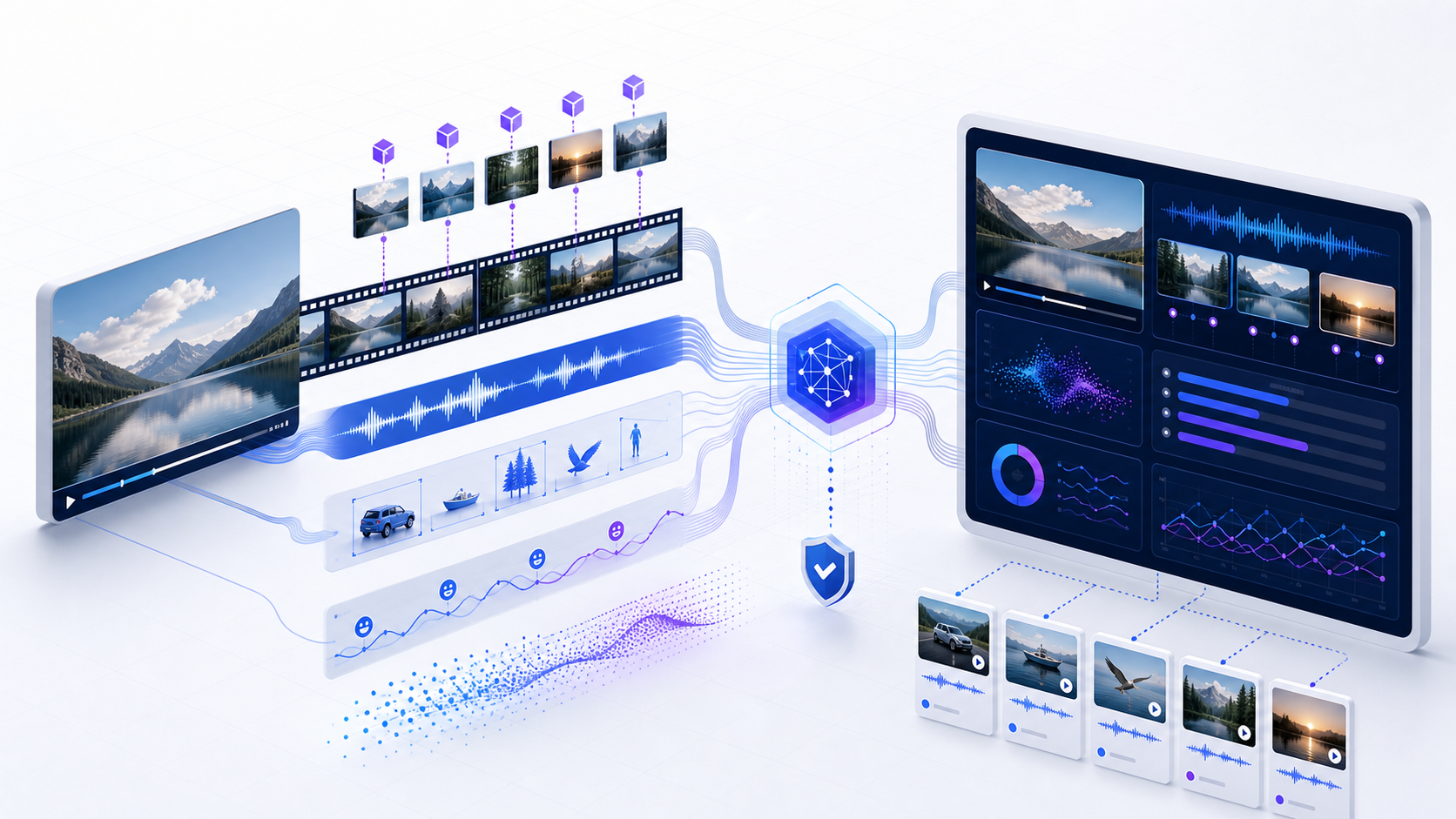
AI video analysis uses machine-assisted methods to examine speech, scenes, objects, events, and timing, then organizes the findings for a defined business or research question. Start with authorized video files, a decision question, expected evidence granularity, and privacy or retention constraints; the working deliverable is an inspectable analysis with findings linked to source moments, uncertainty notes, and reviewable artifacts.
AI 视频分析利用机器辅助方法检查语音、场景、对象、事件与时间关系,并围绕明确的业务或研究问题组织结果。 开始前应准备获授权的视频文件、决策问题、证据粒度和隐私或保留要求;工作结果应形成结论关联来源时刻、标注不确定性并保留可复核材料的分析。
Choose the step you need选择你需要的步骤
Start with the four core steps below, then continue into the deeper checks that match your task.
先完成下面四个核心步骤,再根据任务需要继续查看后续深度检查。
Translate the business question into observable video evidence把业务问题转换为可观察的视频证据
AI video analysis should begin with an observable question. “Was the training effective?” is too broad; “Which required steps were demonstrated, skipped, or performed out of order?” can be checked against scenes and speech. Define the unit of analysis—a clip, event, speaker turn, slide, or full recording—and state which evidence channels matter. Speech may explain intent, while the screen shows whether an action occurred. Sentiment or causal labels should not be requested when the recording cannot support them.
AI 视频分析应从可观察问题开始。“培训是否有效”过于宽泛,而“哪些规定步骤得到演示、被跳过或顺序错误”可以结合画面与语音检查。还要定义分析单位,是片段、事件、说话轮次、幻灯片还是整段录像,并说明需要哪些证据通道。语音可能解释意图,屏幕则显示动作是否发生;当录像不足以支撑情绪或因果判断时,不应要求系统强行给出标签。
Plan transcript, scene, and temporal analysis separately分别规划文字稿、场景与时间关系分析
Treat transcript, visual frames, audio characteristics, and timing as complementary layers. A transcript can locate claims and names but misses silent demonstrations. Sampled frames can reveal slides and objects but may miss a brief action between samples. Audio can reveal pauses or overlap but does not identify why they occurred. Build an extraction plan that matches the event speed and required precision, then join findings through shared time ranges. This prevents a text-only result from being presented as analysis of the entire video.
文字稿、视觉帧、音频特征与时间关系应被视为互补层。文字稿能定位观点和姓名,却看不到无声演示;抽样帧能识别幻灯片与物体,但可能漏掉两次采样之间的短动作;音频能发现停顿或重叠,却不能自动解释原因。应根据事件速度和所需精度制定提取计划,再用共享时间范围连接不同发现,避免把纯文本结果包装成对整个视频的分析。
Require an evidence record for every material finding为每个重要发现建立证据记录
A reviewable record includes finding, source file, start and end time, evidence type, observed detail, interpretation, confidence note, and reviewer status. Keep observation and inference in separate fields: “the user paused for twelve seconds before clicking” is observable; “the user was confused” is an interpretation requiring additional support. For people-related findings, document the legitimate purpose, minimize identity data, and restrict access. A polished dashboard without replayable evidence is unsuitable for consequential decisions.
可复核记录应包含发现、来源文件、开始与结束时间、证据类型、观察细节、解释、置信说明与复核状态。观察和推断必须分栏:“用户点击前停顿十二秒”可观察,“用户感到困惑”则是需要更多支撑的解释。涉及个人时,应记录正当目的、减少身份数据并限制访问。没有可回放证据的精美仪表盘,不适合用于重要决策。
Run a failure-focused pilot before scaling规模化前先做面向失败的试点
Test representative recordings with multiple speakers, domain terminology, screen sharing, camera cuts, and uneven audio. Create a small human-reviewed reference set and score event detection, temporal boundaries, transcript details, unsupported inferences, and correction time. Report failures by condition rather than averaging them into one accuracy number. If results will affect employees, students, customers, or public claims, establish an appeal or correction route. Expand volume only after reviewers can reproduce findings and identify where the system is likely to fail.
试点样本应覆盖多人说话、专业术语、屏幕共享、镜头切换与音质不均。建立一组经人工复核的参考材料,分别评估事件识别、时间边界、文字稿细节、无依据推断和修正耗时。失败应按条件报告,而不是压缩成一个平均准确率。若结果会影响员工、学生、客户或公开陈述,还应建立申诉或纠正路径。只有复核者能够复现发现并了解系统易错条件后,才适合扩大处理量。
Translate the decision into observable events把决策问题转换成可观察事件
Begin with a decision question that can be answered from recorded evidence. Replace broad requests such as analyze engagement with observable definitions: a participant asks a question, pauses for more than a chosen interval, abandons a task, repeats an action, or reaches a defined screen state. Write inclusion and exclusion examples before selecting a model. If hesitation includes silence caused by network delay, results will be misleading; if a safety event requires an object to cross a boundary, the boundary and time window must be explicit. This operational definition becomes the contract between analysts, reviewers, and the system.
Break the question into evidence fields: event, actor, start and end time, transcript context, visible objects, scene state, confidence, and review status. Decide which fields can be machine-proposed and which require human confirmation. Test the definition on several clips with different speakers, camera angles, lighting, and editing styles. Review disagreements to refine the rule rather than immediately tuning a threshold. A system cannot make an ambiguous business question precise on its own; it will merely make one interpretation repeatable. Precision begins with defining what a reviewer should be able to see or hear.
首先把决策问题改写为能够从录像证据回答的问题。不要只说“分析参与度”,而应定义可观察事件,例如参与者提出问题、停顿超过设定时长、放弃任务、重复操作,或到达某个明确界面状态。选择模型前先写出纳入与排除示例。如果“犹豫”把网络延迟造成的沉默也算进去,结果就会误导;如果安全事件要求某个物体越过边界,就必须明确边界与时间窗口。这个操作定义是分析人员、复核者和系统之间的共同约定。
再把问题拆成证据字段:事件、主体、开始与结束时间、文字稿上下文、可见对象、场景状态、置信度和复核状态。确定哪些字段可以由机器提出,哪些必须人工确认。使用不同说话人、机位、光线和剪辑风格的片段测试定义,并通过分歧修正规则,而不是立即调整阈值。系统无法自行把模糊的业务问题变准确,只会让其中一种解释被重复执行。真正的精确性始于定义复核者应该能够看到或听到什么。
Analyze speech, scenes, and time as separate layers分别分析语音、场景与时间关系
Treat the transcript, audio, frames, and temporal sequence as related but distinct evidence. Transcript analysis can identify terms and speaker positions, yet it misses an unspoken demonstration. Frame analysis can detect a visible state, but a single image may hide whether it occurred before or after an instruction. Audio cues may reveal alarms or overlap that captions omit. Build one timeline that references each layer without flattening them into a single confidence score. A finding should name which layer supports it and whether another layer contradicts or fails to confirm it.
Alignment errors deserve their own tests. Caption timing can drift, screen recordings may contain cuts, and variable frame rates can shift exported coordinates. Select anchor moments that are easy to identify in several layers, such as a spoken countdown paired with a visible change, and measure offsets around the beginning, middle, and end. Preserve original time and derived time when clips are trimmed. If the analysis uses sampled frames, record the sampling rate and explain which brief events might be missed. Temporal grounding is what turns a list of detections into an account of what happened.
应把文字稿、音频、画面帧与时间序列视为相互关联但彼此独立的证据。文字分析能识别术语与说话人立场,却可能漏掉未被说出的演示;单帧可以显示某个状态,却不能说明它发生在指令之前还是之后;音频还可能包含字幕没有记录的警报或重叠语音。应建立一条能够引用各层证据的时间线,而不是把所有信息压成一个置信分数。每项发现都应说明由哪一层支持,以及其他层是否反驳或无法确认。
对齐误差需要单独测试。字幕时间可能漂移,录屏可能包含剪切,可变帧率也会改变导出坐标。应选择在多层中都容易识别的锚点,例如口头倒计时与可见变化同时发生,并在开头、中间和结尾测量偏移。剪辑片段时同时保留原始时间与派生时间;使用抽帧分析时记录采样率,并说明哪些短暂事件可能被漏掉。时间定位使检测列表真正成为对事件过程的说明。
Design a representative pilot before scaling扩展前先设计有代表性的试点
A useful pilot contains ordinary cases, difficult cases, and cases where the correct answer is no event. Select material across duration, resolution, language, number of speakers, camera motion, lighting, editing style, and domain terminology. Keep a holdout set that is not used while refining prompts or rules. For each required output, define an acceptance measure such as event recall, boundary error, unsupported finding rate, reviewer correction time, or agreement between reviewers. Overall accuracy is rarely enough because a system can score well by succeeding on many easy frames while missing the brief event that matters.
Run the complete operational path, not only model inference. Measure upload and preprocessing time, failed files, review workload, export quality, permission handling, and whether findings can be reproduced from stored references. Examine errors by category: missed speech, wrong speaker, visual confusion, timing drift, unsupported interpretation, or interface failure. Decide which failures can be corrected with better inputs and which reveal a limit of the approach. Scaling should depend on the cost of reviewed output, not the speed of unreviewed detection. A pilot is successful when it reveals where the workflow must slow down.
有效试点应包含普通案例、困难案例,以及正确答案是“没有事件”的案例。材料要覆盖不同时长、分辨率、语言、说话人数、镜头运动、光线、剪辑方式与领域术语,并保留一组在调整提示或规则时不使用的留出样本。对每类必要输出设定验收指标,例如事件召回、边界误差、无依据发现率、复核修正时间,或复核者之间的一致程度。仅看总体准确率通常不够,因为系统可能在大量简单画面上表现良好,却漏掉真正重要的短暂事件。
试点必须运行完整操作链,而不只是模型推理。测量上传和预处理时间、失败文件、复核工作量、导出质量、权限处理,以及发现能否根据保存的引用重新复现。按类型分析错误:漏掉语音、说话人错误、视觉混淆、时间漂移、无依据解释或界面故障。判断哪些问题可以通过更好的输入修复,哪些反映方法本身的限制。扩展规模应依据经过复核的结果成本,而不是未经复核的检测速度。好的试点会清楚指出流程应在哪里减速。
Set review rules for sensitive findings为敏感发现设置复核规则
Video can contain faces, voices, locations, health information, workplace behavior, and other data that affects people. Define the lawful purpose, minimum necessary input, access roles, retention period, and deletion path before processing. Separate technical detection from consequential interpretation. A visible facial movement is not a reliable diagnosis of emotion; a pause does not establish intent; correlation across a small set of recordings does not establish cause. Prohibit outputs that exceed the evidence and route sensitive findings to qualified reviewers who understand both the domain and the limitations of the method.
Create escalation levels. Low-risk navigation labels may be sampled, while allegations, identity matches, safety incidents, or employment-related conclusions require complete review and independent confirmation. Record the source range, reviewer, correction, uncertainty, and downstream use for each escalated item. Allow reviewers to reject the task when the video quality, consent, or requested inference is unsuitable. Monitor whether errors concentrate on particular languages, environments, or groups, and suspend use where performance is not defensible. Governance is part of analysis quality because an accurate timestamp can still support an inappropriate conclusion.
视频可能包含人脸、声音、位置、健康信息、工作行为以及其他会影响个人的数据。处理前应明确合法目的、最少必要输入、访问角色、保留期限和删除路径。必须区分技术检测与具有后果的解释:可见面部动作不能可靠诊断情绪,停顿不能证明意图,小规模录像中的相关性也不能证明因果。应禁止超出证据的输出,并把敏感发现交给同时理解领域知识与方法限制的合格复核者。
可以建立升级等级。低风险导航标签可以抽样,而指控、身份匹配、安全事件或就业相关结论必须完整复核并独立确认。每个升级事项都记录来源区间、复核人、修正、不确定性与下游用途。当视频质量、同意状态或请求推断不合适时,复核者应有权拒绝任务。持续检查错误是否集中在特定语言、环境或群体,并在表现无法合理辩护时暂停使用。治理本身就是分析质量的一部分,因为准确的时间码仍可能被用于不恰当的结论。
Store findings as evidence records, not prose alone把发现保存为证据记录,而不只是段落
A reviewable result needs structured records beneath the narrative. Each material finding should include a stable identifier, source file and version, original time range, transcript excerpt, visual or audio evidence type, observed detail, interpretation, confidence basis, reviewer status, and links to corrections. Keep observed detail separate from interpretation so a reviewer can accept one and reject the other. If a report says a participant abandoned a task, the underlying record should show the last completed action, the stopping point, and the rule used to classify abandonment.
Exports should preserve those fields. A polished PDF is useful for reading but insufficient as the only artifact when findings will be filtered, compared, or updated. Use a table or structured file alongside the narrative and retain the mapping to source time after clips are created. Test whether another reviewer can reconstruct a sample finding without access to the analyst's memory. If corrections are made, update every dependent chart and summary or mark them stale. Evidence records reduce the chance that a convenient sentence outlives the conditions that made it reasonable.
可复核结果需要在叙述下方保留结构化记录。每项重要发现应包含稳定标识、来源文件与版本、原始时间范围、文字稿片段、视觉或音频证据类型、观察到的细节、解释、置信依据、复核状态和修正链接。观察与解释必须分开,使复核者可以接受前者而拒绝后者。如果报告说参与者放弃任务,底层记录应显示最后完成的动作、停止位置,以及判定“放弃”的规则。
导出时也要保留这些字段。精美 PDF 便于阅读,但当发现需要筛选、比较或更新时,不能成为唯一材料。应同时提供表格或结构化文件,并在创建片段后继续保留与原始时间的映射。测试另一位复核者能否在不了解分析者思路的情况下复现抽样发现。发生修正时,应更新所有依赖的图表与摘要,或明确标记为过期。证据记录可以避免一句方便引用的话脱离使它成立的条件而长期流传。
Worked example具体示例
A training team comparing five support-call recordings can ask where customers hesitate, but it should require quoted transcript context and timestamped playback evidence before treating a pattern as a policy issue.
培训团队比较五段支持通话录像时,可以分析客户在哪些环节犹豫,但必须要求文字稿上下文和带时间码的回放证据,之后才能把模式视为流程问题。
Before handoff, preserve the source identity, current edit, language, access date, and every time reference needed to reproduce the example. Outputs are probabilistic. Faces, actions, sentiment, and causal claims require careful validation, and sensitive video may need local or private deployment controls.
交付前应保留来源标识、当前剪辑版本、语言、访问日期,以及复现实例所需的时间信息。页面输出用于支持理解与整理,重要原话、数字、人物、边界和解释仍需返回原视频检查。
Define acceptance for this deliverable为这项交付物设定验收条件
Define evidence before choosing a tool. Review the result against the intended audience and the declared task of evaluating AI systems that analyze visual, audio, and transcript evidence together. Confirm that the chosen structure preserves the distinctions the reader must act on, rather than simply shortening the recording. Mark missing source material and uncertainty openly. A reviewer should be able to identify which items came directly from speech or visuals, which were reorganized, and which are interpretations.
选择工具前先定义证据。应围绕目标读者以及“评估同时分析画面、音频和文字稿证据的 AI 系统”这一具体任务验收结果。检查结构是否保留读者行动所需的关键区分,而不是只把录像缩短;来源缺失与不确定性必须显式标记。复核者应能分辨哪些内容直接来自语音或画面、哪些经过重组、哪些属于解释。
Use a small handoff record containing source, purpose, output version, correction notes, tested links or time ranges, reviewer, and unresolved items. Review every name, number, quotation, formula, instruction, commitment, and people-related conclusion that could cause harm if wrong. Lower-risk descriptive material may be sampled, but the sampling rule should be written down. A result is accepted because it is fit for this declared use, not because its language sounds confident.
交接记录至少应包含来源、用途、输出版本、修正说明、已测试链接或时间范围、复核人和未解决事项。姓名、数字、引语、公式、指令、承诺以及涉及个人且出错会造成影响的结论都应逐项检查;低风险描述可以抽样,但抽样规则要写明。结果被验收是因为适合当前用途,而不是因为语言显得自信。
Try the complete video-learning workflow with 先鉴 Peek使用先鉴 Peek 体验完整视频学习工作流
Prepare a public video you are allowed to analyze and write down what you want to learn. 先鉴 Peek can help assess the video's learning value, surface a concise summary, organize a timestamped viewing route, and turn useful material into notes. Review important claims against the original video before relying on them.
请准备可公开访问且允许分析的视频,并写清学习目标。先鉴 Peek 可帮助判断视频学习价值、提炼精华摘要、整理可跳转的时间码观看路线,并把有用内容形成笔记。依赖重要结论前,仍应返回原视频复核。
Questions about this task本任务常见问题
What is the first step in AI video analysis?
AI 视频分析的第一步是什么?
Define an observable question, the unit of analysis, and the speech, visual, audio, or temporal evidence needed to answer it.
先定义可观察问题、分析单位,以及回答问题所需的语音、视觉、音频或时间证据。
Is transcript analysis the same as video analysis?
文字稿分析等于视频分析吗?
No. A transcript covers spoken language; video analysis may also require scenes, actions, slides, objects, timing, and audio events.
不等于。文字稿覆盖口语内容,视频分析还可能需要场景、动作、幻灯片、物体、时间关系与音频事件。
How should an AI finding be stored?
AI 分析结果应该怎样保存?
Keep the observation, interpretation, source time range, evidence type, uncertainty, and review status in separate fields.
应分别保存观察、解释、来源时间范围、证据类型、不确定性与复核状态。
Can video analysis be used for decisions about people?
视频分析能用于涉及个人的决策吗?
Only with a legitimate purpose, proportionate data handling, careful validation, human review, and an appropriate correction or appeal route.
只有在目的正当、数据处理适度、验证充分、有人复核且具备纠正或申诉路径时才可谨慎使用。
References and usage limits参考资料与使用边界
- NIST AI Risk Management FrameworkNIST AI Risk Management Framework
- YouTube Terms of ServiceYouTube 服务条款
- InfiniSynapse documentation: connect data sources and knowledge basesInfiniSynapse 文档:连接数据源与知识库
Interfaces, caption availability, and platform behavior can change. Verify the current watch page and official guidance before relying on a procedure.
界面、字幕可用性与平台行为可能变化。依赖具体流程前,应检查当前观看页面与官方说明。