
Medication management: quick answer用药管理:快速回答
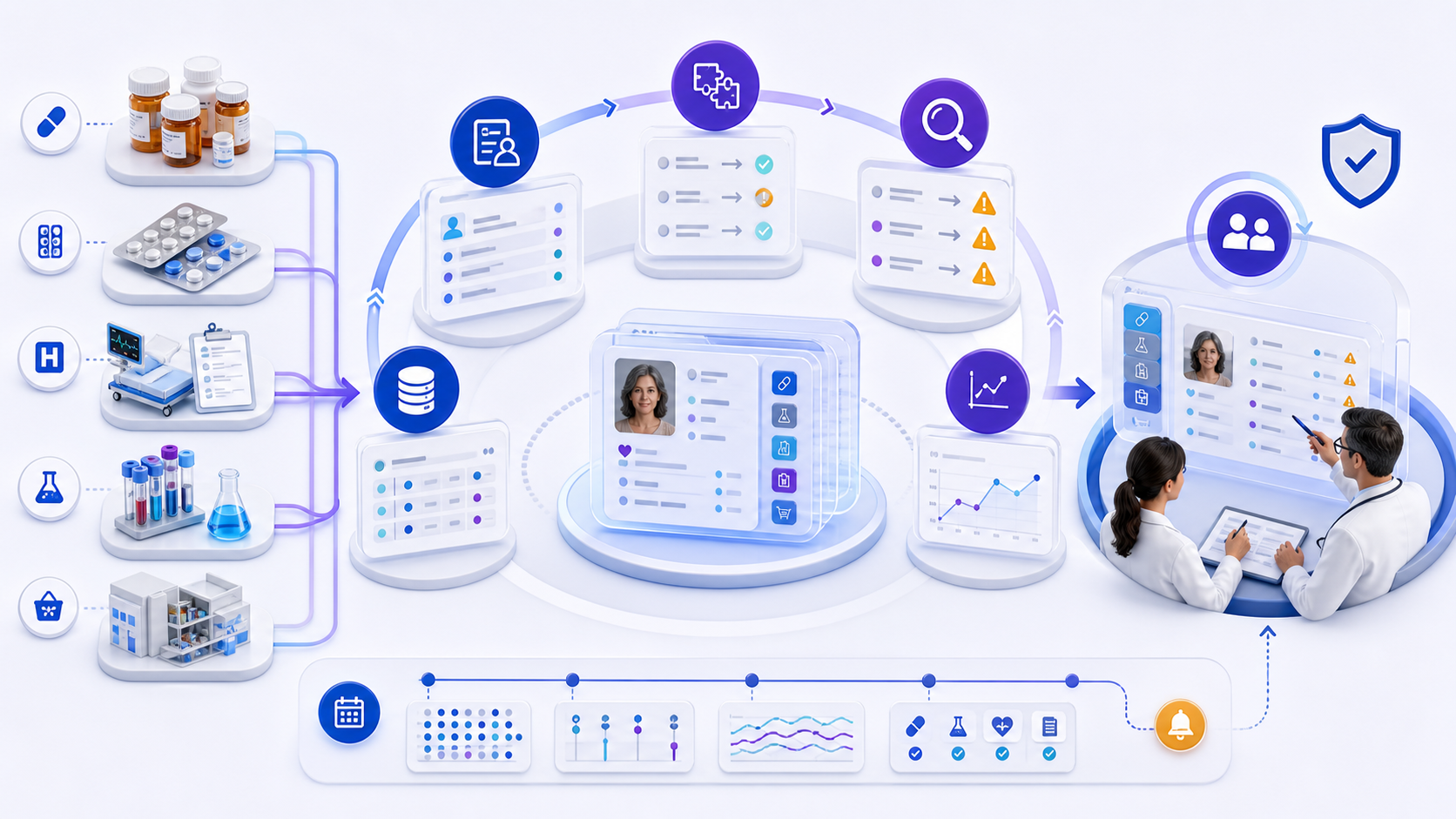
Medication management is the continuous, person-centered process of building an accurate medication record, confirming what is intended and actually used, reviewing effectiveness and safety, monitoring change over time, and assigning every action to a qualified professional. It connects prescribing, reconciliation, dispensing, administration, adherence support, monitoring, communication, and follow-up. It is broader than keeping a medication list and broader than a one-time review.
A reliable workflow makes the sources, dates, uncertainties, discrepancies, clinical questions, reviewer, and disposition visible. Data tools can help organize records, align timelines, find missing or conflicting entries, and surface patterns for review. They cannot decide that an individual should stop, start, replace, or change the dose of a medicine. Interaction findings, risk estimates, diagnoses, and treatment decisions require a physician, pharmacist, or other appropriately qualified professional who has the complete clinical context.
用药管理是一项持续、以患者为中心的过程:建立准确的用药记录,确认医嘱意图与实际使用情况,复核有效性和安全性,持续监测变化,并把每项行动交给合格专业人员负责。它连接处方、用药核对、调配、给药、依从性支持、监测、沟通和随访,其范围大于维护一张药品清单,也大于一次性的药物复核。
可靠的工作流会清楚展示来源、日期、不确定性、差异、临床问题、复核者和处置结果。数据工具可以帮助整理记录、对齐时间线、发现缺失或冲突,并提示需要复核的模式;但工具不能决定某位患者是否应停药、启药、换药或调整剂量。药物相互作用、风险估计、诊断和治疗决定必须由掌握完整临床背景的医生、药师或其他相应资质人员确认。
What medication management includesMedication Management 包含什么
Medication management can be viewed at two connected levels. At the individual level, it helps a person and their care team understand every prescription medicine, nonprescription product, vitamin, supplement, and relevant as-needed product; why it is used; how it is taken; whether it is helping; what monitoring is required; and what questions remain. At the system level, it covers the lifecycle through prescribing and ordering, order communication, dispensing, administration, documentation, monitoring, reconciliation, and reporting. A safe program must connect both levels because a technically correct order can still fail when the record is incomplete, the person cannot follow the regimen, a transition is poorly communicated, or follow-up never occurs.
The central deliverable is not merely a list. It is a current, source-attributed and time-aware account of medication use, plus a review trail. Each entry should distinguish an active prescription from a historical or discontinued item; an order from an administration; an intended schedule from reported behavior; and a suspected reaction from a verified allergy or adverse drug reaction. The record should also show who supplied the information, when it was observed, how conflicts were resolved, and which professional accepted the final interpretation.
Medication management is related to, but not identical with, medication therapy management, medicines optimization, adherence support, pharmacy inventory management, or medication administration. Those services may sit inside a broader cross-setting workflow for organizing evidence and professional review, while their exact scope varies by care setting and jurisdiction. Local law, professional scope, formulary rules, institutional policy, and the patient’s goals still control clinical decisions.
For focused prevention practices, high-risk situations, incident learning, and communication safeguards, continue with the medication safety guide用药安全指南.
Keep medication information complete enough, current enough, and interpretable enough for safe professional decisions.
Organization and analysis support judgment; they do not create an independent prescription, diagnosis, or treatment plan.
可以从两个相互连接的层面理解用药管理。对个体而言,它帮助患者和照护团队了解全部处方药、非处方药、维生素、补充剂及相关按需用药:为何使用、如何使用、是否达到目标、需要哪些监测、还有哪些问题未解决。对医疗系统而言,它覆盖处方与医嘱、医嘱沟通、调配、给药、记录、监测、核对和报告的完整生命周期。安全的管理必须连接这两个层面,因为即使医嘱在技术上正确,只要记录不完整、患者无法执行方案、转诊交接沟通失败或随访没有发生,仍可能出现风险。
核心交付物不只是一张清单,而是一份当前、带来源、具有时间语义的实际用药记录,以及完整复核轨迹。每个条目要区分当前处方、历史或已停用项目;区分医嘱、实际给药和患者自述;区分计划频次与实际行为;区分疑似反应、已确认过敏和其他药品不良反应。记录还应说明资料由谁提供、何时观察、冲突如何解决,以及哪位专业人员接受了最终解释。
用药管理与药物治疗管理、药物优化、依从性支持、药房库存管理和给药管理有关,但并不完全等同。这些服务可能纳入跨场景的证据整理与专业复核工作流,具体范围会随照护场景和司法辖区而变化。临床决定仍由当地法律、专业执业范围、药品目录、机构制度和患者目标共同约束。
关于预防措施、高风险场景、事件学习和沟通防护,可继续阅读medication safety guide用药安全指南。
让用药资料在完整性、时效性和可解释性方面足以支持安全的专业判断。
整理和分析用于辅助判断,不能独立形成处方、诊断或治疗计划。
Roles, settings, and professional responsibility角色、场景与专业责任
Medication management is distributed work. The patient or caregiver contributes the lived record: what is actually taken, what was stopped, missed doses, practical barriers, affordability, swallowing difficulty, side effects, preferences, and use of products obtained outside the main health system. Prescribers define indications, goals, treatment intent, and follow-up. Pharmacists verify medication identity, formulation, supply, duplication, interaction information, administration practicality, and medication-related problems within their scope. Nurses and care workers may administer medicines, observe responses, document refusals or omissions, and escalate changes. Health information and data teams preserve identity, provenance, terminology, access, and longitudinal continuity.
No single source or role is automatically complete. An electronic health record may contain discontinued orders that look active. A dispensing feed may show supply without proving ingestion. An administration record may show that a dose was given but not why a long-term regimen changed. A patient-held list may be current but omit strength or prescriber. Claims can reveal fills across organizations but usually lack the clinical reason for change. The workflow should therefore treat each source as evidence with a defined meaning, not as an unquestionable truth.
The review owner must be explicit at each stage. Administrative or analytical staff can collect documents, normalize fields, flag contradictions, and prepare questions, but they should not resolve a clinical conflict outside their role. A physician or qualified prescriber may decide whether a medicine remains indicated. A pharmacist may conduct medication review or recommend an intervention according to local scope and collaboration arrangements. Urgent concerns must follow the organization’s escalation procedure rather than waiting for a routine data review.
Common settings include primary care, specialist clinics, hospital admission and discharge, emergency care, community pharmacy, home health, long-term care, behavioral health, and transitions between them. The same core record can support all settings, but the acceptable time window, review depth, and responsible professional differ. A discharge reconciliation may need completion before the patient leaves; a longitudinal population review may use a scheduled cycle; an emergency presentation may prioritize immediately relevant medicines, allergies, last doses, and high-risk conditions.
用药管理是一项分布式协作。患者或照护者提供真实生活中的记录:实际服用了什么、哪些已经停止、是否漏服、存在哪些执行障碍、费用问题、吞咽困难、不良反应、个人偏好,以及是否使用了主医疗系统之外获得的产品。处方者明确适应证、目标、治疗意图和随访计划。药师在执业范围内核验药品身份、剂型、供应、重复用药、相互作用信息、给药可行性和其他药物相关问题。护士和照护人员可能负责给药、观察反应、记录拒绝或遗漏,并升级异常变化。健康信息与数据团队负责身份、来源、术语、访问权限和纵向连续性。
任何单一来源或角色都不会天然完整。电子病历可能保留看似仍在使用的已停医嘱;调配记录能证明药品被发出,却不能证明患者已经服用;给药记录能说明某次剂量确实给予,却未必说明长期方案为何改变;患者自带清单可能最新,却缺少规格或处方者;理赔数据可以发现跨机构取药,但通常缺少改变治疗的临床理由。因此,应把每个来源视为具有明确语义的证据,而不是不可质疑的真相。
每一阶段都必须明确复核责任人。行政或分析人员可以收集文档、规范字段、标记矛盾并准备问题,但不能在职责范围之外解决临床冲突。医生或合格处方者负责判断药物是否仍有适应证;药师可以依据当地执业范围和协作安排开展药物复核或提出干预建议。紧急问题必须进入机构既定的升级流程,不能等待常规数据复核。
常见场景包括基层医疗、专科门诊、住院入院与出院、急诊、社区药房、居家照护、长期照护、精神心理健康服务及其相互交接。核心记录可以复用,但可接受的时间窗口、复核深度和责任人不同。出院核对可能必须在患者离院前完成;纵向人群复核可以按周期进行;急诊场景则通常优先关注立即相关的药物、过敏、最近一次剂量和高风险状况。
Build a source-attributed medication history建立带来源的用药史
A medication history asks what the person has actually used over time, not simply what one system currently labels as active. Begin with all prescribed medicines, over-the-counter products, vitamins, supplements, herbal products, injections, inhalers, patches, creams, eye or ear preparations, and relevant intermittent or as-needed products. For each item, capture the generic and brand name when available, ingredient, strength, dose, route, formulation, frequency, indication, prescriber or source, start date, stop date, last dose, current status, adherence pattern, observed benefit, suspected adverse effects, and monitoring requirements. Record uncertainty rather than converting an estimate into a fact.
Use at least two sources when the consequences of error are important. Sources may include a patient or caregiver interview, medication containers, a patient-held list, an electronic medication list, dispensing history, pharmacy communication, discharge documentation, specialist letters, administration records, claims, and monitoring results. Reconcile identifiers before merging. A product name may represent different strengths or formulations; a changed prescription may coexist with an older refill; and a combination product may be duplicated by its individual ingredients.
Time is essential. “Current” should have an as-of date. A start or stop date may be exact, approximate, inferred, or unknown, and the record should say which. Separate order date, dispense date, administration date, reported-use period, and verification date. These events answer different questions. If a person reports taking half a tablet while the latest order says one tablet, preserve both statements, mark the discrepancy, and route it for professional confirmation instead of silently choosing one.
High-quality history taking also asks about behavior and context without blame. Explore difficulty opening packaging, remembering schedules, obtaining refills, paying for medicines, swallowing, using devices, understanding instructions, and fitting treatment into meals, work, sleep, or cultural practices. These observations may explain gaps, but they do not justify changing the plan without review. The detailed field-level method is covered in the related medication history guide.
Continue with the dedicated medication history workflow用药史整理方法 when the task is to construct or repair the longitudinal list itself.
用药史要回答患者在一段时间内实际使用过什么,而不是简单复制某个系统当前标记为“有效”的项目。首先收集全部处方药、非处方药、维生素、补充剂、草药制品、注射剂、吸入剂、贴剂、外用制剂、眼耳制剂以及相关间歇或按需用药。每个条目尽量记录通用名和商品名、成分、规格、单次剂量、途径、剂型、频次、适应证、处方者或来源、开始与停止时间、最近一次剂量、当前状态、依从性模式、观察到的获益、疑似不良反应和监测要求。不确定的信息应明确标记,不能把估计值改写成事实。
当错误后果较严重时,应尽量使用至少两个来源。来源可以包括患者或照护者访谈、药品容器、患者自带清单、电子用药清单、调配记录、药房沟通、出院材料、专科信件、给药记录、理赔数据和监测结果。合并前先核对身份。相同药名可能对应不同规格或剂型;新处方可能与旧补药记录并存;复方制剂还可能与单独成分形成重复。
时间信息至关重要。“当前用药”必须带有截至日期。启停日期可能是精确、近似、推断或未知,记录中应说明其性质。医嘱日期、调配日期、给药日期、患者自述使用区间和核验日期要分别保存,因为它们回答不同问题。如果患者称实际服用半片,而最新医嘱记录为一片,应同时保留两种陈述、标记差异并交由专业人员确认,不能在后台静默选择其一。
高质量用药史还应以非指责方式了解行为和环境,例如是否难以打开包装、记住时间、取得续方、承担费用、吞咽药物、使用装置、理解说明,或把方案安排进饮食、工作、睡眠和文化习惯。此类观察有助于解释记录差异,但不能未经复核就改变治疗计划。如任务重点是构建或修复纵向清单,可继续查阅相关用药史专题页。
继续阅读medication history workflow用药史整理方法,了解字段级收集和时间线整理方法。
Medication reconciliation across transitions跨照护阶段进行用药核对
Medication reconciliation is a defined component of medication management. It compares the best available pre-transition medication history with new orders or the planned post-transition regimen, identifies every difference, and determines whether each difference is intentional, documented, clinically appropriate, and communicated. It is especially important at admission, internal transfer, discharge, referral, change of prescriber, and return to community care. A copied list is not reconciliation; the work is the comparison, explanation, resolution, and accountable handoff.
Use a side-by-side view that preserves both states. For every medicine, compare ingredient, strength, dose, route, formulation, frequency, indication, status, and timing. Classify a difference as an intentional start, stop, substitution, dose change, route change, temporary hold, formulary substitution, duplicate, omission, unexplained continuation, or uncertain item. Avoid classifying a difference solely from text similarity. A generic substitution may be equivalent; a similar-looking product may not be; and a route or formulation change may materially alter use.
Intent must be traceable. Record the clinician or source supporting the change, the date, the reason when available, any monitoring or follow-up, and how the patient or next care team was informed. If the reason is not available, label it unresolved and assign follow-up. Do not infer that a missing discharge item was intentionally stopped, or that a medication appearing on an old list should automatically continue. The professional reviewer must decide after considering diagnoses, current observations, laboratory results, goals, allergies, procedures, and other relevant context.
Completion should be measured by resolved discrepancies, not by whether a form was opened. Useful process checks include the percentage of transitions with a documented source history, time from transition to reconciliation, unresolved high-priority discrepancies, communication to the next setting, patient understanding, and correction of the longitudinal record. Metrics require clearly defined denominators and should not be interpreted as proof of clinical benefit without appropriate evaluation.
The focused medication reconciliation process用药核对流程 provides a detailed transition checklist and discrepancy framework.
用药核对是用药管理中界定明确的一部分。它把照护阶段转换前可获得的最佳用药史,与新的医嘱或转换后的计划方案逐项比较,识别全部差异,并判断每项差异是否有意、是否记录、临床上是否适当,以及是否已经沟通。入院、院内转科、出院、转诊、更换处方者和回归社区照护时尤其重要。复制一张清单不等于核对;真正的工作是比较、解释、解决并完成有责任人的交接。
应使用同时保留前后状态的并排视图。每种药都比较成分、规格、剂量、途径、剂型、频次、适应证、状态和时间。差异可以分类为有意启用、停用、替代、剂量改变、途径改变、暂时暂停、目录替代、重复、遗漏、不明原因继续或尚不确定。不能只凭文本相似度分类:通用名替代可能等效,名称相似的产品未必等效,途径或剂型变化也可能实质改变使用方式。
意图必须可以追溯。记录支持变更的医生或其他来源、日期、可获得的理由、监测或随访计划,以及患者或下一照护团队如何获知。如果理由暂时不可得,应标记为未解决并分配后续责任。不能推断出院清单中缺失的药物一定是有意停用,也不能让旧清单中的项目自动延续。专业复核者需要结合诊断、当前观察、检验结果、目标、过敏、操作和其他相关背景作出判断。
完成度应以差异是否解决衡量,而不是表单是否打开。可用的过程检查包括:有来源用药史的转诊比例、从转换到核对的时间、尚未解决的高优先级差异、是否传递给下一场景、患者是否理解以及纵向记录是否修正。所有指标都需要清楚分母,且不能在缺少适当评估时把过程指标解释为临床获益证明。
专题medication reconciliation process用药核对流程提供更详细的转诊检查表和差异分类方法。
Interpret drug interaction information safely安全解释药物相互作用信息
Interaction checking is a screening step, not an independent treatment decision. A result may describe a potential drug–drug, drug–disease, drug–food, drug–laboratory, or duplicate-therapy concern. Its significance depends on the exact ingredients, formulation, dose, route, timing, duration, indication, organ function, laboratory context, age, pregnancy status where relevant, comorbidities, previous response, and monitoring plan. A database severity label summarizes a rule or evidence classification; it does not fully represent the person’s situation.
Prepare a complete and current list before screening. Include prescribed and nonprescription products, supplements, recently stopped medicines with lingering effects, allergies or reactions, relevant laboratory results, diagnoses, and the actual use pattern. Normalize ingredients and combination products so the same active substance is not counted twice under different names. Preserve the source and version of the interaction knowledge used, because databases differ and recommendations change.
Review findings in a queue that separates evidence from disposition. Show the interacting items, type of concern, evidence source, mechanism or practical explanation when available, patient-specific modifiers, existing safeguards, unanswered questions, and responsible reviewer. The reviewer may determine that a finding is not applicable, already monitored, clinically accepted for a documented reason, or requires follow-up. The data workflow should record that disposition without converting it into a generic instruction for other patients.
Never use a checker result alone to stop a medicine, skip a dose, substitute a product, or change timing or dose. Some abrupt changes can themselves cause harm, and the risk of untreated disease may exceed the interaction concern. Urgent symptoms or suspected serious reactions should follow local emergency and clinical escalation procedures. The drug interaction checker safety guide药物相互作用检查器安全指南 explains how to prepare a list and discuss a result with a doctor or pharmacist.
相互作用检查属于筛查步骤,不能独立形成治疗决定。结果可能涉及药物—药物、药物—疾病、药物—食物、药物—检验或重复治疗问题。其临床意义取决于具体成分、剂型、剂量、途径、时间、疗程、适应证、器官功能、检验背景、年龄、相关情况下的妊娠状态、合并疾病、既往反应和监测计划。数据库中的严重程度标签只是对规则或证据的概括,不能完整代表某位患者的实际状况。
筛查前必须准备完整且当前的清单,包括处方药、非处方药、补充剂、可能仍有持续作用的近期停用药、过敏或反应、相关检验、诊断和真实使用模式。需要规范化成分和复方制剂,避免同一活性成分以不同名称被重复计算。还应保留所用相互作用知识库的来源和版本,因为数据库之间可能不同,建议也会更新。
复核队列应把证据与处置分开。展示涉及的药物、问题类型、证据来源、可获得的机制或实用解释、患者特异修饰因素、已有防护措施、未解决问题和责任人。专业人员可能判断某提示不适用、已经受到监测、因明确临床理由而被接受,或确实需要进一步处理。数据工作流应记录这一处置,但不能把个体处置改写成适用于其他人的通用指令。
绝不能仅凭检查器结果自行停药、漏服、替换产品或改变时间与剂量。有些突然改变本身可能造成伤害,未治疗疾病的风险也可能高于相互作用问题。出现紧急症状或疑似严重反应时,应遵循当地急诊和临床升级流程。drug interaction checker safety guide药物相互作用检查器安全指南说明如何准备资料并与医生或药师讨论检查结果。
Create a longitudinal medication and medical record summary形成纵向用药与医疗记录摘要
A concise record summary helps a reviewer see why a regimen exists and how it changed. Begin with the active problems and treatment goals relevant to medication use, then align key medication events with encounters, procedures, laboratory and imaging results, physiological observations, allergies or reactions, and documented decisions. Preserve the difference between event time and documentation time. A late note may explain an earlier change; displaying it only by note date can make the sequence misleading.
Use layers rather than compressing everything into one paragraph. The first layer can show the current medication state, urgent unresolved questions, allergies, recent major changes, and required monitoring. A second layer can provide the longitudinal timeline. A third can link each claim to source records. This design helps a professional scan quickly while retaining the ability to verify. Every summary statement should be traceable to one or more sources or explicitly labeled as patient-reported, inferred, or pending confirmation.
Do not hide disagreement in a polished narrative. If two records conflict on dose or stop date, state the conflict, show both sources, and identify who must resolve it. Do not turn absence of data into evidence that an event did not occur. Do not copy every historic diagnosis into the medication context unless it helps explain an indication, contraindication, risk modifier, or monitoring need. A concise summary is selective, but its selection rules must be visible.
Useful quality checks include source-link completeness, coverage of the requested time window, correct medication status, preservation of units and reference ranges, unresolved discrepancies, reviewer confirmation, and whether a second qualified reader reaches the same understanding. The dedicated medical record summary guide病历摘要指南 provides a source-linked timeline method.
简明记录摘要帮助复核者理解某套方案为何存在以及如何变化。先列出与用药相关的当前问题和治疗目标,再把关键用药事件与就诊、操作、检验和影像结果、生理观察、过敏或反应以及已记录决定对齐。必须区分事件发生时间和文档记录时间;一份延迟完成的病程记录可能解释更早的变化,如果只按记录日期展示,顺序就会被误导。
应使用分层结构,而不是把全部信息压缩成一个长段落。第一层展示当前用药状态、紧急未决问题、过敏、近期重大变化和监测要求;第二层提供纵向时间线;第三层把每项陈述连接到原始记录。这样既便于专业人员快速浏览,也保留核验能力。每句摘要都应追溯到一个或多个来源,或者明确标为患者自述、分析推断或待确认。
不要用流畅叙述掩盖分歧。如果两个记录对剂量或停用日期存在冲突,应展示冲突、列出双方来源并说明由谁解决。没有数据不能被解释为事件没有发生。历史诊断也不应全部复制进用药背景,除非它有助于解释适应证、禁忌、风险修饰因素或监测需求。摘要可以选择信息,但选择规则必须可见。
质量检查可包括来源链接完整性、目标时间窗口覆盖、用药状态准确性、单位与参考范围保留、未解决差异、复核确认,以及第二位合格读者能否得出相同理解。专题medical record summary guide病历摘要指南提供带来源时间线的详细方法。
Clinical and patient analytics for medication management用药管理中的临床与患者分析
Analytics can support medication management at individual, service, and population levels, but the question and unit of analysis must be explicit. At the individual level, a timeline may help a reviewer relate medication changes to laboratory values, symptoms, encounters, adherence observations, or outcomes. At the service level, teams may examine reconciliation completion, unresolved discrepancies, monitoring follow-up, refill processes, or alert burden. At the population level, governed analysis may identify groups needing record review or outreach. None of these outputs proves a medication caused an outcome without an appropriate design and professional interpretation.
Clinical analytics focuses on clinically meaningful care processes and outcomes: whether monitoring occurred, how treatment pathways vary, or where safety-relevant gaps appear. Patient analytics focuses on patient-level attributes, utilization, needs, and outcomes for a defined population. Patient journey analytics examines sequences across touchpoints, such as referral, consultation, pharmacy, discharge, and follow-up, to locate delay, dropout, duplication, or handoff failure. These lenses can use overlapping data, but they answer different questions and should not be collapsed into one undifferentiated dashboard.
Before analysis, define the population, index event, observation window, exposure logic, outcome, exclusions, and data cutoff. Separate prescribed, dispensed, administered, and reported use. Control immortal-time and look-ahead errors when time matters. Explain missingness, coding change, incomplete outside-system data, and whether a refill proxy can reasonably support the intended question. When comparing groups, show counts and denominators, baseline differences, and sensitivity checks. When reporting trends, state whether changes may reflect documentation or workflow changes rather than clinical change.
Use the clinical analytics guide临床分析指南 for care-process and outcome questions, the patient analytics framework患者数据分析框架 for patient-level cohort work, and the patient journey analytics method患者旅程分析方法 for cross-touchpoint sequences. Each page preserves its own audience, data model, and decision boundary.
分析可以在个体、服务和人群层面支持用药管理,但必须明确问题和分析单位。在个体层面,时间线可帮助复核者把用药变化与检验、症状、就诊、依从性观察或结果联系起来;在服务层面,团队可以分析核对完成、未解决差异、监测随访、续方流程或警报负担;在人群层面,受治理的分析可以识别需要记录复核或外展的人群。若缺少适当研究设计和专业解释,这些输出都不能证明某种药物导致了某个结果。
临床分析关注具有临床意义的照护过程和结果,例如监测是否发生、治疗路径如何变化、何处出现安全相关缺口。患者数据分析关注定义人群的患者级属性、利用、需求和结果。患者旅程分析研究转诊、就诊、药房、出院和随访等接触点之间的序列,用于定位延迟、流失、重复或交接失败。这些视角可能使用重叠数据,但回答的问题不同,不能压缩成一个没有明确目的的仪表板。
分析前应定义人群、索引事件、观察窗口、暴露逻辑、结果、排除规则和数据截止时间。处方、调配、实际给药和患者自述使用必须分开。涉及时间时,要控制不朽时间偏倚和前视数据错误。解释缺失、编码变化、系统外数据不完整,以及续方代理指标是否适合当前问题。比较组别时同时展示数量、分母、基线差异和敏感性检查;报告趋势时说明变化是否可能来自记录或流程改变,而不是临床变化。
照护过程和结果问题可查阅clinical analytics guide临床分析指南;患者级队列工作可查阅patient analytics framework患者数据分析框架;跨接触点序列可查阅patient journey analytics method患者旅程分析方法。每个专题都保留自己的受众、数据模型和决策边界。
Integrate EHR, pharmacy, laboratory, and document data整合 EHR、药房、检验与文档数据
Medication management rarely lives in one system. Relevant evidence may be distributed across EHR medication orders, medication administration records, community and hospital pharmacy feeds, dispensing or claims data, laboratory systems, clinical notes, discharge documents, patient portals, device records, and external organizations. Integration must preserve identity, event time, status, terminology, units, provenance, and access controls. Moving fields into one warehouse does not make them clinically equivalent.
Start with a source contract. For each feed, document what event it represents, when the event occurred, when the record was created and received, how corrections appear, which identifiers are used, how deleted or entered-in-error items are represented, what code systems and units apply, and which periods or facilities are covered. Medication data needs ingredient, product, strength, form, route, dose, frequency, status, reason, and linkage to orders or administrations where available. Normalize only after retaining the original value and source.
Identity matching deserves separate governance. A duplicate patient can split one history; an incorrect merge can attach another person’s medicine. Use approved matching rules, confidence levels, manual review for ambiguous cases, and an audit trail for merges and unmerges. Do not expose direct identifiers in an analytical workspace unless they are necessary, authorized, and protected. Access should follow role, purpose, minimum necessary use, and applicable privacy and retention requirements.
Healthcare data integration addresses the broader enterprise architecture spanning clinical, operational, claims, registry, device, financial, and other sources. Clinical data integration concentrates on making clinical concepts—including medications, allergies, conditions, observations, procedures, and notes—semantically consistent and usable in a particular care workflow. The difference matters because reliable transport alone does not guarantee correct clinical meaning.
For enterprise transport, governance, and interoperability, use the healthcare data integration guide医疗数据集成指南. For clinical terminology, status, negation, time, and provenance in a care workflow, use the clinical data integration guide临床数据集成指南.
用药管理几乎从不只存在于一个系统。相关证据可能分布在 EHR 用药医嘱、给药记录、社区与医院药房数据、调配或理赔数据、检验系统、临床笔记、出院文档、患者门户、设备记录和外部机构中。整合必须保留身份、事件时间、状态、术语、单位、来源和访问控制。把字段移动到同一个数据仓库,并不会让它们自动具有相同临床含义。
首先建立来源合同。对每个数据流说明它代表什么事件、事件何时发生、记录何时创建和接收、修订如何呈现、使用什么身份标识、删除或错误录入如何表示、采用哪些编码和单位,以及覆盖哪些时间和机构。用药数据在可获得时应包含成分、产品、规格、剂型、途径、剂量、频次、状态、理由,以及与医嘱或给药的连接。规范化前必须保留原始值和来源。
身份匹配需要独立治理。重复患者身份会拆散同一份用药史,错误合并则可能把另一个人的药物附到当前记录。应使用获批匹配规则、置信等级、对模糊情况的人工复核,以及合并和解除合并的审计轨迹。分析工作区只有在必要、获批且受到保护时才能显示直接身份信息;访问应遵循角色、目的、最小必要使用及适用的隐私和保留要求。
医疗数据集成关注覆盖临床、运营、理赔、登记、设备和财务等来源的企业级架构;临床数据集成则专注于让药物、过敏、疾病、观察、操作和文档等临床概念在特定照护工作流中保持语义一致并可用。两者差异重要,因为可靠传输并不保证临床含义正确。
企业级传输、治理和互操作可查阅healthcare data integration guide医疗数据集成指南;照护工作流中的临床术语、状态、否定、时间和来源可查阅clinical data integration guide临床数据集成指南。
Decision support, early warning, and prediction boundaries决策支持、早期预警与预测边界
Clinical decision support can place medication information at a useful point in workflow: a reconciliation task at admission, an allergy or interaction warning during ordering, a monitoring reminder after a relevant result, or a follow-up queue after discharge. A useful tool presents the right evidence, for the right person, in the right format, through the right channel, at the right time. It should show provenance, logic, uncertainty, and the action owner. More alerts do not necessarily create safer care; low-specificity or poorly timed alerts can add burden and be ignored.
Early warning scores and predictive models may use physiological, laboratory, utilization, medication, or other variables to estimate deterioration or future events. They answer different questions from medication reconciliation. Before use, define the prediction time, outcome, horizon, eligible population, exclusions, threshold, calibration, subgroup performance, missing-data behavior, and response pathway. Prevent leakage from information that would not have been available at the decision time. Validate the model in the intended setting and monitor changes in data and workflow after deployment.
A model estimate is not a diagnosis, and an alert is not an order. Display what data contributed, when it was measured, whether it may be stale, and which limitations apply. Give professionals a way to inspect source information, document disagreement, record disposition, and escalate. If no one owns the action or the service cannot respond within the required time, adding a risk signal may create false reassurance or unmanageable queues.
Evaluate tools with representative cases, including missing values, conflicting lists, unusual formulations, boundary values, duplicate records, late results, and cases that should not trigger. Measure sensitivity and specificity where appropriate, but also measure alert burden, response time, overrides, reasons for disagreement, unresolved items, workflow delay, and downstream corrections. Use the clinical decision support tools evaluation临床决策支持工具评估, early warning score guide早期预警评分指南, and predictive analytics validation guide医疗预测分析验证指南 for their materially different methods.
临床决策支持可以在合适的工作节点呈现用药信息,例如入院时创建核对任务、开立医嘱时提示过敏或相互作用、相关检验后提醒监测,或出院后形成随访队列。有效工具应在正确时间,通过正确渠道,以正确格式向正确角色提供正确证据,并展示来源、逻辑、不确定性和行动责任人。增加警报数量并不必然带来更安全的照护;特异性不足或时机不当的警报会增加负担并被忽略。
早期预警评分和预测模型可能使用生理、检验、利用、用药等变量估计恶化或未来事件,但它们回答的问题与用药核对不同。使用前要定义预测时点、结果、时间范围、适用人群、排除条件、阈值、校准、亚组表现、缺失数据行为和响应路径,防止使用在决策时点尚不可得的信息造成数据泄漏。模型应在预定场景验证,并在部署后持续监测数据和工作流变化。
模型估计不是诊断,警报也不是医嘱。界面应说明哪些数据参与、何时测量、是否可能过时以及有哪些限制。专业人员需要能够查看来源、记录不同意见、保存处置并进行升级。如果没有行动责任人,或服务无法在要求时间内响应,增加风险信号反而可能造成错误安心或无法处理的队列。
工具测试应包含缺失值、冲突清单、少见剂型、边界值、重复记录、延迟结果和本不应触发的病例。除适用情况下的敏感度和特异度外,还要衡量警报负担、响应时间、人工否决、分歧原因、未解决项目、流程延迟和后续纠错。不同方法请分别参考clinical decision support tools evaluation临床决策支持工具评估、early warning score guide早期预警评分指南和predictive analytics validation guide医疗预测分析验证指南。
A repeatable medication management workflow可重复执行的用药管理流程
- Define the purpose and review owner.
State the care setting, patient or population, decision to support, time available, and qualified professional responsible for final review. Identify what would make the workflow urgent, routine, or out of scope.
- Collect the best available evidence.
Gather patient or caregiver reports, medication containers, orders, dispensing and administration records, discharge documents, laboratory context, allergies, diagnoses, and relevant notes. Record source, event time, update time, and confidence.
- Normalize without erasing the source.
Align ingredients, products, strength, dose, units, route, formulation, frequency, status, and terminology. Keep original values beside normalized values and version the mappings.
- Build the longitudinal medication history.
Separate current, historical, stopped, held, planned, and uncertain items. Distinguish orders, supplies, administrations, and reported use. Place changes beside the relevant clinical events and monitoring data.
- Reconcile at the decision point.
Compare the prior history with the intended new regimen. Classify every difference, identify its source and reason, and assign unresolved discrepancies for professional review.
- Screen for reviewable concerns.
Surface possible interactions, duplicate ingredients, allergy conflicts, missing monitoring, unusual changes, and inconsistent instructions. Present evidence and patient-specific context; do not convert flags into autonomous recommendations.
- Conduct shared professional review.
The qualified clinician or pharmacist evaluates indication, effectiveness, safety, practicality, goals, preferences, and the complete clinical context. The patient or caregiver contributes experience and questions. Record the conclusion and responsible person.
- Communicate an accountable plan.
Update the official record, explain what changed and what remains unresolved, provide an understandable current list, define monitoring and follow-up, and send the information to the next care setting through approved channels.
- Verify, monitor, and correct.
Check that required data and actions were completed, monitor new results and reported experience, capture corrections, review overrides and delays, and repeat the cycle after relevant transitions or changes.
- 明确目的与复核责任人。
写清照护场景、患者或人群、要支持的决定、可用时间,以及最终复核的合格专业人员;说明哪些情况属于紧急、常规或超出范围。
- 收集最佳可得证据。
汇总患者或照护者自述、药品容器、医嘱、调配和给药记录、出院材料、检验背景、过敏、诊断和相关笔记,并记录来源、事件时间、更新时间和可信程度。
- 规范化但不抹去来源。
对齐成分、产品、规格、剂量、单位、途径、剂型、频次、状态和术语;在规范值旁保留原始值,并对映射进行版本管理。
- 建立纵向用药史。
区分当前、历史、已停、暂停、计划和不确定项目,区分医嘱、供应、实际给药和患者自述,并把变化与相关临床事件和监测数据对齐。
- 在决策节点进行核对。
比较既往用药史与新的计划方案,对每项差异分类,确认其来源和理由,并把未解决差异分配给专业人员复核。
- 筛查需要复核的问题。
提示可能的相互作用、重复成分、过敏冲突、缺失监测、异常变化和指示不一致;展示证据与患者背景,但不能把提示转成自动建议。
- 开展共同专业复核。
合格医生或药师结合适应证、有效性、安全性、可执行性、目标、偏好和完整临床背景进行判断;患者或照护者提供体验与问题;记录结论和责任人。
- 沟通具有责任归属的计划。
更新正式记录,说明发生了什么变化、还有什么未解决,提供易理解的当前清单,定义监测与随访,并通过获批渠道传递给下一照护场景。
- 验证、监测并纠错。
检查必需数据和行动是否完成,监测新结果与患者体验,记录修正,复核否决和延迟,并在相关转诊或变化后重复循环。
Medication management decision and validation framework用药管理判断与验证框架
| Domain | Question for review | Evidence to retain | Do not assume |
|---|---|---|---|
| Identity and scope | Is this the correct person, encounter, and time window? | Approved identifiers, source coverage, as-of date | Matching names mean matching people |
| Medication identity | Are ingredient, product, strength, form, and route clear? | Original label, normalized code, mapping version | Similar names or codes are equivalent |
| Use status | Was it ordered, dispensed, administered, reported, held, or stopped? | Status, event type, dates, source, confidence | An active order proves current use |
| Purpose and outcome | What goal or indication is documented, and what has been observed? | Clinical note, treatment goal, monitoring timeline | Temporal association proves effect |
| Safety context | Are allergies, reactions, interactions, conditions, and monitoring available? | Source evidence, knowledge version, reviewer disposition | A severity label is an individual instruction |
| Transition | Is each difference intentional, documented, resolved, and communicated? | Before/after lists, reason, reviewer, handoff record | Missing means intentionally stopped |
| Action and follow-up | Who owns the next action, by when, and how will completion be verified? | Named role, due date, status, escalation path | A displayed alert guarantees action |
Use the table as a review aid, not a scoring instrument. The importance of each domain depends on the decision and the possible consequence of error. Define acceptance criteria before applying automation. For safety-relevant fields, sample the underlying records and have an appropriate professional confirm clinical meaning. For data transformations, reproduce results from versioned inputs and mappings. For workflow acceptance, verify that the right person receives the result in time and can inspect its evidence.
| 领域 | 复核问题 | 应保留的证据 | 不能默认 |
|---|---|---|---|
| 身份与范围 | 是否为正确患者、就诊和时间窗口? | 获批身份标识、来源覆盖、截至日期 | 姓名相同就是同一人 |
| 药品身份 | 成分、产品、规格、剂型和途径是否清楚? | 原始标签、规范编码、映射版本 | 名称或编码相似就等效 |
| 使用状态 | 属于医嘱、调配、给药、自述、暂停还是停用? | 状态、事件类型、日期、来源、可信程度 | 有效医嘱证明当前正在使用 |
| 目的与结果 | 记录了什么目标或适应证,观察到什么? | 临床记录、治疗目标、监测时间线 | 时间相关就证明药物效果 |
| 安全背景 | 过敏、反应、相互作用、疾病和监测是否可得? | 来源证据、知识版本、复核处置 | 严重程度标签就是个体指令 |
| 转诊交接 | 每项差异是否有意、已记录、已解决并已沟通? | 前后清单、理由、复核者、交接记录 | 缺失就代表有意停用 |
| 行动与随访 | 谁在何时负责下一行动,如何确认完成? | 责任角色、截止时间、状态、升级路径 | 警报显示就保证有人行动 |
该表用于辅助复核,不是评分工具。每个领域的重要性取决于当前决定以及错误可能造成的后果。使用自动化前要定义验收标准;安全相关字段需要抽样核对原始记录,并由相应专业人员确认临床含义;数据转换需要从版本化输入和映射中复现;工作流验收则要确认正确的人能够及时收到结果并查看证据。
Worked example: an accountable transition review示例:一次有责任归属的转诊复核
Hypothetical example only: an adult is discharged after a hospital stay and will be followed by primary care and a community pharmacy. The hospital order list, administration record, discharge summary, community dispensing history, patient-held list, and recent laboratory results do not perfectly agree. One product appears under a brand name in the patient list and as two ingredients in the EHR. A medicine present before admission is absent from the draft discharge list. Another has a different frequency in the dispensing history. These are data observations, not proof that any prescription is wrong.
The coordinator first verifies identity and the time window, then preserves each source rather than overwriting it. The analyst normalizes ingredients, strength, form, route, and frequency, while retaining original text. The system groups possible duplicates and displays before/after lists. It labels the absent medicine as an unresolved omission rather than “stopped,” because no documented reason is available. It labels the frequency difference as conflicting evidence. A potential interaction appears, along with the source knowledge version and relevant laboratory context.
The pharmacist and prescribing clinician review indication, documented decisions, actual administration, patient report, current laboratory information, and planned monitoring. They determine the final status within their professional roles, document reasons, and define any follow-up. The patient receives an understandable current list and knows whom to contact with questions. The primary care team receives the reconciled record, unresolved items, monitoring plan, and source links. The data team records which mappings and rules were used.
Validation asks more than whether the final list exists. A second reviewer should be able to trace each material statement to a source, see why differences were classified, identify who accepted the final state, and confirm that handoff and follow-up occurred. If later evidence corrects a source or decision, the record should preserve the previous version, show the correction, and identify any downstream summary or analysis that needs revision.
以下仅为假设工作流示例:一位成年患者住院后出院,将由基层医疗和社区药房继续随访。医院医嘱、给药记录、出院摘要、社区调配历史、患者自带清单和近期检验并不完全一致。一个产品在患者清单中使用商品名,在 EHR 中却表现为两个成分;入院前的一种药没有出现在出院清单草稿中;另一种药在调配记录中显示不同频次。这些都是数据观察,不能证明任何处方一定错误。
协调人员先核验身份和时间窗口,并保留每个来源而不是相互覆盖。分析人员规范化成分、规格、剂型、途径和频次,同时保留原始文本。系统聚合可能重复项目并并排展示前后清单。由于没有可用的书面理由,缺失药物被标为“未解决遗漏”,而不是直接标成“已停”;频次差异被标为冲突证据。系统还展示一项潜在相互作用、知识来源版本和相关检验背景。
药师和处方医生结合适应证、已记录决定、实际给药、患者自述、当前检验和计划监测进行复核,在各自专业职责内确定最终状态、记录理由并定义随访。患者获得易理解的当前清单,并知道有问题时联系谁。基层团队收到核对后的记录、未解决项目、监测计划和来源链接。数据团队同时记录使用了哪些映射与规则。
验证不能只看最终清单是否存在。第二位复核者应能追溯每项重要陈述、理解差异为何这样分类、确认谁接受了最终状态,并核验交接和随访确实发生。若后续证据修正来源或决定,记录应保留旧版本、展示修正,并指出哪些下游摘要或分析需要更新。
Implementation, governance, and continuous verification实施、治理与持续验证
Begin implementation with one bounded use case rather than a universal medication platform. Define the care setting, target population, decision point, source systems, review owner, expected response time, and consequences of error. Document what the workflow will and will not do. A discharge reconciliation queue, for example, has different data latency and escalation needs from a retrospective population review. Pilot with representative records before expanding scope.
Create a data dictionary and source register. Define every critical field, allowed values, units, terminology, event-time meaning, status transitions, provenance, update behavior, and known limitations. Version mapping tables and calculation rules. Include test cases for duplicates, combination products, entered-in-error orders, late corrections, missing strengths, ambiguous routes, patient-reported medicines, temporary holds, conflicting sources, and records outside the expected time window. Retain expected results and the professional explanation for each safety-relevant test.
Separate technical, semantic, clinical, and workflow validation. Technical validation confirms files, messages, transformations, and queries run. Semantic validation confirms codes, units, status, and time mean what the workflow assumes. Clinical validation asks whether the information is appropriate for the decision and whether exceptions are visible. Workflow validation checks timeliness, responsibility, communication, burden, and whether action can be completed. A pipeline can pass technical tests while failing the other three.
Govern access and changes. Use role-based authorization, minimum necessary data, secure transfer and storage, retention rules, audit logs, correction procedures, and review of downstream impact. A terminology update, source-system change, new formulary, altered documentation workflow, or interface revision can change results without changing analytical code. Monitor source volume, missingness, mapping failures, identity conflicts, data latency, rule triggers, manual overrides, unresolved reviews, response time, correction rate, and user-reported problems.
Measure outcomes against the original purpose. Process measures may include completion, time to reconciliation, unresolved discrepancies, follow-up completion, and source-link coverage. Safety or clinical outcome evaluation requires an appropriate design and should not be inferred from process improvement alone. Review performance by relevant setting and subgroup, investigate unexpected differences, and document limitations. Avoid targets that encourage superficial completion, such as closing a task without resolving the evidence conflict.
Plan for failure and rollback. If a source feed stops, a mapping becomes unreliable, or the review queue exceeds capacity, define how results are blocked, labeled, or routed. Maintain a change log and the ability to identify affected outputs. Notify responsible teams when prior summaries or decisions may need re-review. Test downtime and manual procedures. The safest workflow is not the one that never reports problems; it is the one that makes problems visible, contains their impact, and supports accountable correction.
实施时先选择一个边界清楚的使用场景,而不是直接建设包罗万象的用药平台。定义照护场景、目标人群、决策节点、来源系统、复核责任人、预期响应时间和错误后果,并写清流程会做什么、不会做什么。例如,出院核对队列与回顾性人群复核具有不同的数据延迟和升级要求。扩大范围前应使用具有代表性的记录进行试点。
建立数据字典和来源登记表。定义每个关键字段、允许值、单位、术语、事件时间含义、状态转换、来源、更新方式和已知限制,并对映射表和计算规则进行版本管理。测试病例应包括重复记录、复方制剂、错误录入医嘱、延迟修订、缺失规格、模糊途径、患者自述药物、暂时暂停、来源冲突和超出预期时间窗口的记录。每个安全相关病例都应保留预期结果和专业解释。
技术、语义、临床和工作流验证必须分开。技术验证确认文件、消息、转换和查询可以运行;语义验证确认编码、单位、状态和时间符合假设;临床验证判断信息是否适合当前决定,以及例外是否可见;工作流验证检查时效、责任、沟通、负担和行动是否能够完成。一条数据管道可能通过技术测试,却在其他三个层面失败。
需要治理访问与变更。采用基于角色的授权、最小必要数据、安全传输与存储、保留规则、审计日志、纠错流程和下游影响评估。术语更新、来源系统变化、新药品目录、记录流程改变或界面修订,都可能在分析代码未变的情况下改变结果。持续监测来源数量、缺失、映射失败、身份冲突、数据延迟、规则触发、人工否决、未解决复核、响应时间、纠错率和使用者报告的问题。
结果衡量必须回到原始目的。过程指标可以包括完成率、核对用时、未解决差异、随访完成和来源链接覆盖;安全或临床结果需要适当评估设计,不能从过程改善直接推断。应按相关场景和亚组复核表现,调查意外差异并记录限制。避免鼓励表面完成的目标,例如在证据冲突未解决时只关闭任务。
还要为失败和回滚制定计划。如果来源数据停止、映射失去可靠性或复核队列超过容量,应规定结果如何被阻断、标记或转交。维护变更日志并能识别受影响输出;当既往摘要或决定可能需要重新复核时通知责任团队;测试停机和人工流程。安全的工作流不是从不报告问题,而是能让问题可见、限制影响并支持有责任归属的纠正。
Prepare a professional review workspace with 医数智析使用医数智析准备专业复核工作区
Prepare medication lists and containers, discharge or visit documents, relevant history, laboratory results, symptoms or observations, and the dates and sources for each item. 医数智析 can help organize these materials into a longitudinal record, expose missing or conflicting information, and make cross-time patterns easier to review in a professional workbench. Confirm sensitive-data authorization before upload and remove unnecessary identifiers when policy requires it.
The output remains a data-organization and trend-review aid. A doctor, pharmacist, or other qualified professional must verify medication identity, clinical meaning, interaction findings, risk signals, diagnosis, and any treatment-related conclusion. Do not use the tool output as an instruction to stop, start, substitute, or change the dose of a medicine.
View the 医数智析 medication-record workflow Open the 医数智析 experience请准备用药清单与药品容器、出院或就诊文档、相关病史、检验结果、症状或观察,以及每项资料的日期和来源。医数智析可以帮助把这些材料整理为纵向记录,提示缺失或冲突信息,并在专业工作台中更容易复核跨时间模式。上传前应确认敏感数据处理获得授权,并在制度要求时移除不必要身份信息。
输出仍然只是数据整理和趋势复核辅助。药品身份、临床意义、相互作用提示、风险信号、诊断和任何治疗相关结论,都必须由医生、药师或其他合格专业人员确认。不得把工具输出作为自行停药、启药、替换药物或调整剂量的指令。
查看医数智析用药记录工作流 打开医数智析实际体验Common failures and safety boundaries常见失败与安全边界
Common failures include an incomplete history, unverified patient identity, copied-forward inactive medicines, duplicate ingredients hidden by brand names, order status confused with actual use, missing start or stop dates, event time confused with documentation time, units or routes lost during normalization, outside-system medicines omitted, patient-reported information presented as verified, and discrepancies closed without a documented reason. Analytical failures include ambiguous denominators, look-ahead leakage, treating refill data as ingestion, treating association as causation, and hiding missingness behind a single score.
Workflow failures are equally important: no named reviewer, alerts sent to someone who cannot act, unclear escalation, excessive queue burden, inaccessible source records, corrections that do not propagate, and handoffs that update one system but not the patient or next team. Automation can repeat an error at scale. A well-designed workflow therefore favors traceability, human review, exceptions, and rollback over a polished but opaque answer.
Data organization, trend recognition, discrepancy detection, and software output support professional decisions but do not provide individualized medical advice. Drug interactions, adverse-effect concerns, risk predictions, diagnoses, and treatment conclusions must be reviewed by an appropriately qualified healthcare professional with access to the complete clinical context. Do not stop, start, replace, split, crush, reschedule, or change the dose of a medicine based only on a software output. Seek urgent care through local services for emergencies or serious symptoms.
常见失败包括用药史不完整、患者身份未核验、已停药物被沿用、商品名掩盖重复成分、把医嘱状态当成实际使用、缺少启停日期、混淆事件时间与记录时间、规范化时丢失单位或途径、遗漏系统外药物、把患者自述写成已验证事实,以及在没有书面理由时关闭差异。分析失败还包括分母模糊、使用未来信息造成泄漏、把续方数据等同于服药、把相关性当成因果,以及用一个评分掩盖缺失。
工作流失败同样重要,例如没有明确复核者、警报发送给无法行动的人、升级路径不清、队列负担过大、无法查看原始来源、修正没有传播到下游,以及只更新一个系统却没有告知患者或下一团队。自动化可能大规模重复错误,因此良好工作流应优先保证可追溯、人工复核、例外处理和回滚,而不是给出流畅但不透明的答案。
数据整理、趋势识别、差异发现和软件输出只用于支持专业决策,不提供个体化医疗建议。药物相互作用、不良反应问题、风险预测、诊断和治疗结论必须由能够查看完整临床背景的相应资质医疗专业人员审核。不得仅依据软件输出自行停药、启药、换药、掰开或碾碎药物、改变服用时间或调整剂量。发生紧急情况或严重症状时,应通过当地急救和医疗服务及时就医。
Medication management FAQ用药管理常见问题
Medication management is the ongoing lifecycle that includes history, prescribing, supply, administration, monitoring, safety review, communication, and follow-up. Medication reconciliation is a focused comparison at a transition or decision point that explains and resolves differences between medication states.
Include all relevant prescription and nonprescription products, ingredients, strength, dose, route, formulation, frequency, indication, prescriber or source, start and stop dates, status, actual-use information, allergies or reactions, monitoring, provenance, uncertainty, discrepancies, reviewer, and follow-up.
No. Software can organize data and surface possible concerns, but it cannot independently account for the full clinical context. A qualified physician, pharmacist, or other authorized professional must review any treatment-related conclusion. Do not change a medicine based only on a software output.
Review timing depends on the person, medicines, care setting, monitoring requirements, and local policy. Review is commonly triggered by admission, transfer, discharge, a new prescription, a reported reaction, a meaningful health change, an abnormal relevant result, adherence difficulty, or an identified discrepancy.
Trace important statements to source records, test identity and medication mappings, preserve event time and status, sample normal and exceptional cases, confirm clinical meaning with qualified reviewers, verify that actions and handoffs occur, and monitor corrections, overrides, delays, and unresolved work.
用药管理是持续生命周期,包含用药史、处方、供应、给药、监测、安全复核、沟通和随访。用药核对则是在转诊或决策节点比较不同用药状态,对差异进行解释和解决。
应包括全部相关处方药和非处方产品、成分、规格、剂量、途径、剂型、频次、适应证、处方者或来源、启停日期、状态、实际使用、过敏或反应、监测、来源、不确定性、差异、复核者和随访。
不能。软件可以整理数据并提示潜在问题,但无法独立覆盖完整临床背景。任何治疗相关结论必须由医生、药师或其他获授权专业人员复核,不能只依据软件输出改变药物。
复核时间取决于患者、药物、照护场景、监测要求和当地制度。常见触发包括入院、转科、出院、新处方、患者报告反应、健康状况明显变化、相关异常结果、执行困难或发现记录差异。
把重要陈述追溯到原始记录,测试身份和药物映射,保留事件时间与状态,抽查普通和例外病例,由合格专业人员确认临床含义,核验行动与交接是否发生,并监测修正、否决、延迟和未解决工作。
Official sources and review responsibility权威来源与复核责任
Implementation should use current organizational policy, local law, professional scope, and primary sources. The references below support the broad process and safety principles; they do not replace patient-specific review.
- AHRQ medication management strategy for patient and family engagement
- WHO Medication Without Harm initiative and medication-safety resources
- NHS England structured medication reviews and medicines optimisation
- Medicare medication therapy management and safety-management information
- 医数智析 official gallery description
实施时应采用机构最新制度、当地法律、专业执业范围和第一方资料。下列来源支持广义流程与安全原则,但不能替代针对个体患者的专业复核。