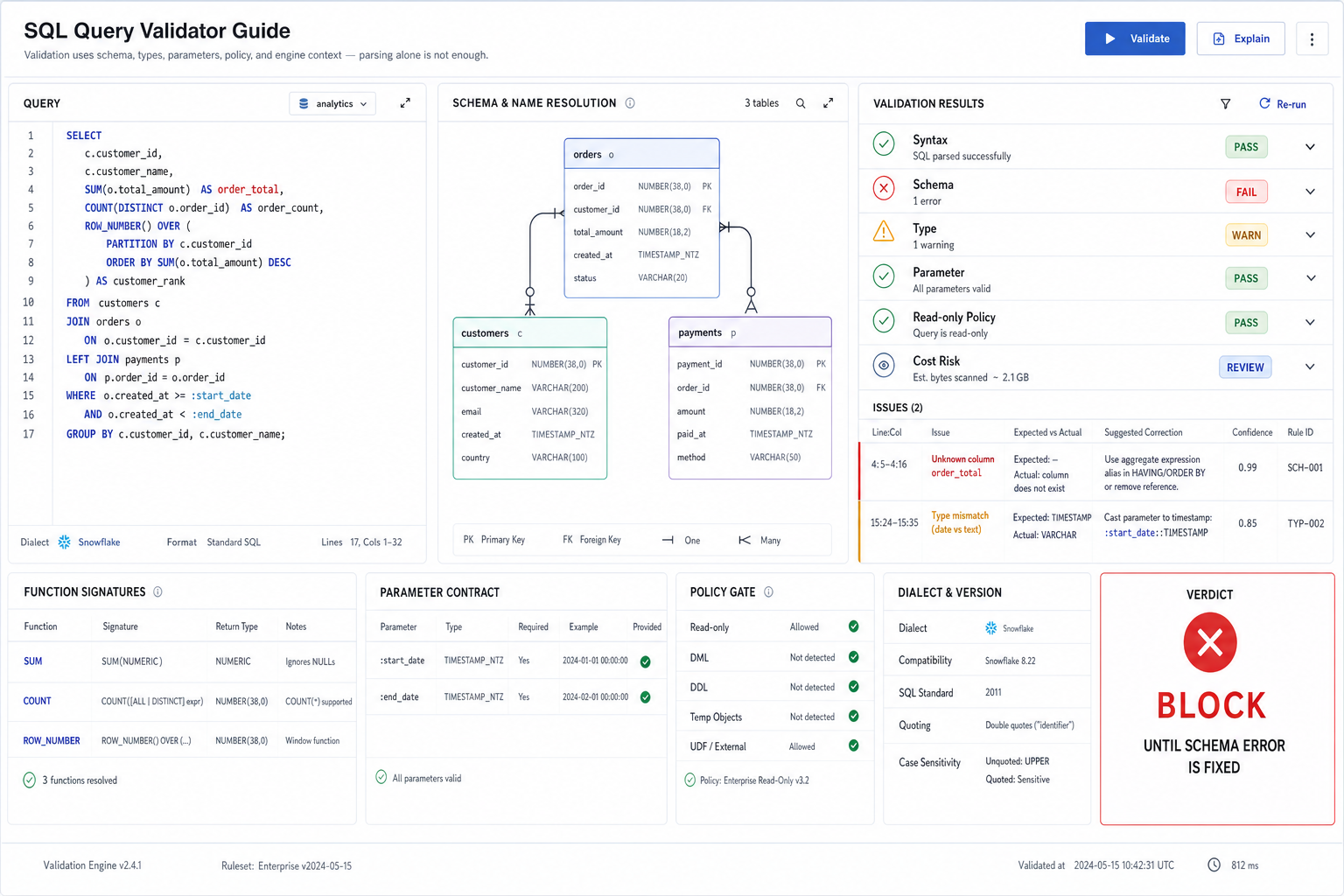
What is an SQL query validator?
An SQL query validator checks whether a statement is usable under a declared database context before the statement is allowed to run. It may parse the target dialect, resolve tables and columns against a schema snapshot, infer expression types, verify function and operator signatures, match parameters, apply grouping and scope rules, classify the statement, enforce read-only or data-access policy, and request a controlled plan estimate. A credible verdict says exactly which of those checks ran and which evidence they used.
Validation is not one universal green check. “Parsed,” “bound,” “type-checked,” “policy-approved,” “authorized,” and “safe to execute” are different claims. A browser-only tool can offer valuable structural and offline semantic checks, yet it should not imply live catalog, privilege, planner, or runtime knowledge unless those systems were actually consulted. The useful output is therefore a layered result, not a vague label.
Define validation as a stack of evidence
Start by naming the strongest conclusion each layer can support. Syntax validation recognizes structure. Binding connects identifiers to catalog objects. Type analysis checks whether expressions and signatures are coherent. Contract validation checks parameters and expected outputs. Policy validation compares the operation with organizational rules. Engine validation asks a real database to prepare or plan under a controlled identity. Runtime validation observes execution. Skipping a layer is acceptable when the result records that limitation.
| Layer | Required context | Can prove | Cannot prove alone |
|---|---|---|---|
| Lexical and syntax | Text, dialect, version, parser flags | Recognized statement structure and syntax diagnostics | Object existence, types, access, cost, result correctness |
| Name binding | Catalog snapshot, search path, current database, case rules | Which relation, column, function, or alias each name denotes | Current privileges or future schema state |
| Semantic and type | Bound tree, type system, coercion and signature registry | Compatible expressions, aggregates, groups, windows, outputs | Data quality, business correctness, performance |
| Policy and authorization | Identity, role model, statement policy, data classification | Modeled permission and policy compatibility | Undocumented grants, row filters, runtime side effects |
| Prepare or plan | Controlled connection, current metadata, planner settings | Engine acceptance and a plan under that captured context | Exact future latency, rows, locks, or resource use |
PostgreSQL’s official parser-stage documentation illustrates this boundary: raw parsing uses structural rules, while the later transformation process performs catalog-backed semantic interpretation and adds actual data-type information. A validator should preserve that distinction instead of branding every parse result as semantically valid.
Capture the complete validation input contract
The SQL string is only one input. Reproducible validation also needs the target product and version, database and namespace context, schema snapshot identity, search path, quoting and case behavior, timezone and locale where relevant, parameter names and types, current role or modeled identity, policy bundle, function registry, feature flags, and validation engine version. Without these fields, the same query can produce different verdicts while both runs appear identical.
| Contract field | Example | Why it changes the verdict |
|---|---|---|
| Dialect and engine version | Snowflake 8.22, PostgreSQL 18, GoogleSQL | Keywords, syntax, functions, casts, and features evolve |
| Catalog snapshot | catalog-2026-07-24T08:00Z, hash 7f3… | Tables, columns, views, types, and signatures change |
| Namespace context | database=analytics, search_path=reporting,public | Unqualified names may bind to different objects |
| Parameter contract | :start_date TIMESTAMP required; :region STRING optional | Unknown parameters affect types, overloads, and predicates |
| Policy identity | service=report-builder, role=analyst_readonly | Allowed objects and operations depend on the principal |
| Validation mode | offline-strict, connected-prepare, connected-explain | Each mode has different evidence and side-effect exposure |
Hash immutable inputs and attach those hashes to the result. If the schema is filtered for security, label it as a filtered snapshot rather than a complete catalog. If the validator substitutes templates before parsing, retain a source map from the expanded SQL back to the original editor ranges so every diagnostic remains actionable.
Run a deterministic validation workflow
A reliable pipeline should stop or degrade explicitly when prerequisites are missing. Do not continue from a recovered syntax tree into high-confidence semantic analysis without marking the affected subtree. Do not use a stale catalog silently. Do not query a production database merely because an offline check is inconclusive. Make the transition between layers visible and require a deliberate policy decision for connected checks.
Record SQL hash, dialect, metadata, parameters, identity, policy, and mode.
Reject unsupported statements or mark recovered ranges as uncertain.
Resolve scopes, aliases, relations, columns, functions, and correlated references.
Check types, coercions, aggregates, groups, windows, and output shape.
Verify parameters, expected columns, statement class, and data policy.
Optionally prepare or explain in a controlled, time-bounded environment.
Return issues, skipped checks, versions, confidence, and final policy decision.
Treat warnings and unknowns as first-class outcomes. A strict CI gate may block on any unresolved schema object. An interactive editor may allow continued drafting while clearly showing that output type and policy checks are provisional. Both are legitimate when the mode and consequences are explicit.
Do not confuse a parser result with a validator verdict
A parser can tell you that SELECT order_total FROM orders follows the grammar. It cannot know whether order_total exists, whether it is visible in the current scope, whether the user can read it, or whether the intended column is actually total_amount. That difference explains why “online SQL validator” tools vary so much: some are syntax checkers, some bundle a schema-aware compiler, and some send the query to a live engine.
| Claim shown in UI | Minimum evidence | Safer wording when evidence is absent |
|---|---|---|
| “Valid SQL” | Declared dialect plus successful grammar and semantic checks | “Syntax recognized for PostgreSQL 18” |
| “Column exists” | Bound against an identified schema snapshot | “Column not verifiable without schema metadata” |
| “Safe query” | Defined threat model, policy checks, identity, and execution controls | “No blocked statement type detected by policy v3” |
| “Fast query” | Current plan and representative runtime evidence | “No static high-risk pattern; plan not evaluated” |
Expose the parser output as one panel in the validator rather than hiding it. Statement count, dialect, recovered nodes, unsupported constructs, and source ranges help reviewers understand why later checks were skipped or downgraded. The parser page explains tree construction in depth; this guide begins where a structurally recognized tree must acquire database meaning.
Design a schema snapshot that is accurate enough to bind
A list of table names is not a schema contract. Binding usually needs catalog, database, schema, relation kind, columns in order, canonical and display names, data types with precision and nullability, generated status, keys, views, function and operator signatures, user-defined types, and visibility rules. For cross-database systems, include remote object semantics and whether a reference is resolved locally, through a linked catalog, or only at runtime.
| Metadata object | Fields to preserve | Common shortcut that fails |
|---|---|---|
| Relation | Fully qualified identity, kind, temporary scope, owner, version | Storing only an unqualified display name |
| Column | Ordinal, exact name, type, nullability, generated and hidden flags | Flattening every type to string, number, or date |
| Function and operator | Namespace, overloads, argument modes, variadic rules, return inference | Checking only whether a function name exists |
| View or model | Exposed columns, lineage boundary, security mode, freshness | Assuming view columns always match source tables |
| Snapshot envelope | Source, captured time, engine version, filters, hash, expiry | Using a cache with no observable age or provenance |
Prefer immutable snapshots for CI and review so the same commit receives the same verdict. For interactive work, refresh metadata predictably and show age in the UI. If the tool cannot access a protected object, distinguish “not present in supplied metadata” from “does not exist.” That wording prevents a filtered catalog from producing a false factual claim.
Resolve identifiers through scopes, aliases, and namespaces
Name resolution is not a global string lookup. A validator must construct scopes for statements, query blocks, common table expressions, derived tables, lateral inputs, joins, subqueries, correlated references, projections, grouping, windows, and procedural blocks when supported. It must then apply the target dialect’s visibility and precedence rules. A projection alias may be visible in ORDER BY but not in WHERE; an unqualified column may become ambiguous after a join; a CTE may shadow a catalog relation.
| Case | Validator question | Diagnostic evidence |
|---|---|---|
| Unqualified column | Which visible inputs expose this exact name? | Candidate relations, scope, case-folded and quoted forms |
| Qualified reference | Is the qualifier an alias, CTE, schema, table, or correlation name? | Resolution path and shadowed alternatives |
| Correlated subquery | Which outer scopes are visible, and at what depth? | Owning scope ID, correlation depth, bound object |
| Wildcard expansion | Which columns and order result from * or alias.*? | Snapshot version, expanded columns, hidden exclusions |
| CTE recursion | When is the CTE name visible and do anchor and recursive outputs align? | Column arity, inferred types, recursion position, dialect rule |
Return the bound object’s stable identity rather than only its display text. Stable IDs support lineage, policy, refactoring, and cache invalidation. When resolution fails, report the visible candidates and why each was rejected; “unknown column” without scope evidence is often too weak to fix the query confidently.
Validate quoted identifiers and case behavior exactly
Identifier handling is a frequent source of false validation. Engines fold unquoted names differently, preserve quoted spellings, support different quote characters, and apply distinct rules to database, schema, table, column, function, and alias names. A metadata extractor may return display casing that is not equivalent to the spelling required in SQL. Normalize for comparison only according to the target dialect, while preserving raw spelling and quote state for diagnostics and rewriting.
| Check | Record | Failure example |
|---|---|---|
| Raw token | Exact characters and source range | Formatter removes quotes required for a mixed-case column |
| Quote semantics | Quote kind, escape rule, resulting identifier value | Backticks accepted under the wrong dialect |
| Folded lookup key | Dialect-specific comparison representation | Validator lowercases a name that the engine uppercases |
| Canonical object identity | Catalog-native stable ID and exact stored name | Two visually similar names collapse into one cache entry |
Include Unicode confusable and normalization fixtures when identifiers can contain non-ASCII text. A validator need not ban every unusual identifier, but it should avoid silently changing identity and can raise a policy warning for visually confusable names in security-sensitive environments.
Infer expression types without inventing certainty
Type validation begins after names are bound. Every literal, column, parameter, operator, function call, conditional branch, aggregate, window expression, cast, subquery, array, struct, JSON access, interval, and set operation contributes constraints. The validator must model the target engine’s exact type families, precision and scale rules, nullability, collation, timezone semantics, implicit conversions, common-supertype selection, overload ranking, and unknown-literal behavior. A generic “number” and “string” model produces attractive but misleading results.
| Expression | Constraints to solve | Useful diagnostic |
|---|---|---|
amount + tax | Numeric compatibility, precision, scale, nullable result | “DECIMAL(18,2) + FLOAT requires a lossy common type” |
created_at > :start_date | Timestamp family, timezone, parameter type, coercion direction | “Expected TIMESTAMP_NTZ; parameter contract declares VARCHAR” |
CASE WHEN … THEN a ELSE b END | Boolean condition and a common output type for all branches | List the incompatible branches and inferred alternatives |
id IN (subquery) | Subquery arity, comparable types, null semantics | “Left side is INT64; subquery returns STRUCT” |
UNION ALL | Equal column count, per-position common types, output names | Identify the exact branch, position, and incompatible types |
Represent unresolved types explicitly. If a parameter has no declared type and context permits several overloads, return an ambiguity rather than selecting one arbitrarily. If metadata omits a user-defined type, mark dependent expressions unknown and continue only where sound. Unknown is evidence about the validation boundary, not an implementation embarrassment to hide.
Resolve function and operator signatures by dialect
A function name existing in a catalog does not make a call valid. Validation must consider namespace visibility, built-in versus user-defined precedence, argument count, named arguments, defaults, variadic parameters, generic variables, coercion costs, aggregate and window capability, ordering clauses inside calls, filter support, determinism metadata where policy uses it, and return-type inference. Operators require the same rigor because many engines implement them through typed signatures or overload tables.
| Signature evidence | Validation decision | Do not reduce it to |
|---|---|---|
| Exact argument types | Prefer an exact overload before coercible alternatives | Matching only function name and argument count |
| Generic constraints | Unify related arguments and infer the result type | Replacing every generic variable with ANY |
| Aggregate/window flags | Permit OVER, FILTER, or internal ordering only when supported | Treating every callable name as a scalar function |
| Namespace and search path | Select visible candidates in dialect-defined order | A global case-insensitive dictionary |
| Coercion ranking | Choose only when one candidate is strictly preferable | Silently casting arguments until one call fits |
Version the signature registry with the engine release and schema snapshot. When validation uses a curated offline registry, identify unsupported extensions and user-defined functions separately. A precise “function body unavailable; signature validated only” is more useful than pretending to assess behavior that the validator cannot observe.
Model NULL, boolean, and comparison semantics
SQL predicates do not behave like ordinary two-valued application conditions. Comparisons involving NULL commonly produce UNKNOWN; WHERE keeps TRUE rows; NOT IN can become UNKNOWN when its set contains NULL; outer joins introduce nullable columns; aggregate functions differ in their treatment of NULL; and dialects vary in null-safe comparison operators and boolean coercion. A validator should at least infer nullability and flag constructs whose result can be surprising or violate a declared non-null output contract.
| Pattern | Semantic check | Possible guidance |
|---|---|---|
x = NULL | Comparison yields UNKNOWN rather than testing nullness | Use the dialect’s IS NULL predicate |
x NOT IN (subquery) | Can the subquery return NULL? | Consider a null-safe anti-join or NOT EXISTS after review |
Outer-joined column in WHERE | Does the predicate reject null-extended rows? | Explain that the filter may collapse outer-join behavior |
COUNT(column) | Nullable input values are excluded | Contrast with COUNT(*) and state intended population |
CASE without ELSE | Unmatched rows produce NULL | Reflect nullable output or require an explicit default |
Semantic warnings should be configurable. A query can be technically valid while intentionally relying on three-valued logic. The validator’s role is to connect the pattern to evidence—input nullability, join type, output contract, and dialect—not to replace every nuanced construct automatically.
Validate parameters as typed data, never pasted SQL
Collect every parameter reference from the bound tree and reconcile it with a declared contract. Check naming style, position, duplicates, required versus optional status, data type, array or struct shape, nullability, allowed range, timezone, and whether the client API supports that parameter form. Values should remain separate from SQL structure. Parameters generally substitute expressions, not identifiers such as table or column names; dynamic identifiers require a controlled mapping from an application-level choice to an allow-listed SQL fragment.
| Parameter check | Blocking condition | Evidence to return |
|---|---|---|
| Completeness | Required SQL parameter missing from the contract | Reference ranges and nearest declared names |
| Unused declaration | Policy-dependent; often warning, sometimes deployment error | Declared parameter, owner, default, and expected query |
| Type compatibility | No safe target-dialect conversion exists | Expected type, declared type, coercion path, lossy flag |
| Placeholder mode | Named and positional modes are mixed when the API forbids it | All placeholder kinds and source positions |
| Identifier substitution | Untrusted value is intended to replace table, column, order direction, or SQL clause | Structural position and required allow-list contract |
Google Cloud’s official BigQuery parameterized-query documentation states that query parameters can substitute expressions but cannot replace identifiers, column names, table names, or other query parts. The OWASP SQL Injection Prevention Cheat Sheet likewise recommends prepared statements with parameterized queries as a primary defense. Validation should reinforce that boundary, not promise to sanitize string concatenation after the fact.
Check grouping, aggregate, and query-block legality
Aggregate validation is dialect-sensitive and scope-sensitive. A validator must classify aggregate calls, identify the owning query block, distinguish grouped and ungrouped expressions, enforce restrictions on nested aggregates, determine whether functional-dependency exceptions apply, validate HAVING, and keep aggregate scope separate from window scope. Textual equality is insufficient because semantically equivalent expressions can differ in formatting, aliases, casts, or normalized tree shape.
| Rule family | Required model | Typical issue |
|---|---|---|
| Projection legality | Grouped expressions, aggregate expressions, dialect dependency rules | Selected column is neither grouped nor aggregated |
| Aggregate nesting | Call classification and query-block ownership | Aggregate contains another aggregate in the same level |
| HAVING scope | Name visibility, alias rules, grouping state | Alias accepted by the validator but not by the target dialect |
| Set operations | Per-branch output count, types, names, ordering ownership | ORDER BY binds to a branch instead of the compound result |
When suggesting a fix, do not automatically add every selected column to GROUP BY. That can change granularity and business meaning. Explain the violated rule, show the affected expression, and offer alternatives such as aggregating it, removing it, changing the grain, or moving logic to another query block for human review.
Validate window functions as ordered analytical contracts
A window expression combines a function signature with partitioning, ordering, framing, named-window inheritance, and query-stage rules. Validation should determine whether the function supports OVER, whether an order is required or merely advisable, whether the frame unit is legal, whether frame boundaries are type-compatible and ordered, whether exclusions are supported, and whether nested window expressions occur in forbidden positions. It should also distinguish syntactic legality from deterministic analytical intent.
| Window check | Structural verdict | Intent warning |
|---|---|---|
ROW_NUMBER() OVER () | May be legal in the selected dialect | No ordering means row assignment may be nondeterministic |
| RANGE frame on text order key | Check dialect frame and offset compatibility | Peer grouping may differ from expected row counts |
| Named-window override | Apply inheritance and forbidden-redefinition rules | Inherited ordering may be overlooked in review |
Window result in WHERE | Reject if the query stage cannot see window outputs | Suggest a dialect-supported qualification clause or outer query |
A good validator displays the fully resolved window specification, including inherited components, because the written call may not contain the complete contract. For ranking and offset functions, surface absent tie-breakers as review findings rather than syntax errors. This preserves the difference between invalid SQL and valid SQL whose results may vary across runs.
Validate the result shape consumed downstream
Many query failures occur after the database accepts the SQL because the application expects a different result. Derive the ordered output schema: name, stable expression identity, data type, precision, scale, timezone, collation where relevant, nullability, duplicate-name status, and lineage confidence. Compare it with a declared consumer contract for a dashboard, API, model, export, or scheduled job. Wildcards and schema drift make this check especially valuable.
| Output rule | Blocking example | Change-management evidence |
|---|---|---|
| Arity and order | Consumer expects 6 columns; query returns 7 or reorders keys | Old and new ordered schemas with expression sources |
| Names | Required alias removed or two outputs share one name | Alias source, dialect naming rule, duplicate positions |
| Types | Decimal becomes floating point or timestamp loses timezone | Inference path and compatible consumer migrations |
| Nullability | Outer join or CASE makes a required field nullable | Nullability cause and affected row conditions |
| Wildcard stability | New source column silently changes an exported schema | Snapshot diff and exact wildcard expansion |
Treat an output contract as a versioned interface, not a formatting preference. A query can be semantically valid for the database yet incompatible with its consumer. Returning both verdicts—database-valid and consumer-contract-failed—helps the owner choose the right fix instead of weakening the SQL checks.
Classify every statement before applying policy
A “read-only SQL” policy cannot be implemented by checking whether the text starts with SELECT. SQL dialects include data-changing common table expressions, SELECT forms that create or export data, function calls with side effects, administrative statements, procedural blocks, transaction controls, session changes, external functions, temporary objects, locking clauses, and vendor-specific commands. Classify the parsed and bound operation semantically, including nested statements and invoked routines, then evaluate the declared policy.
| Policy dimension | Possible classes | Evidence required |
|---|---|---|
| Data effect | Read, insert, update, delete, merge, truncate, load, unload | Top-level and nested operation nodes plus called routines |
| Schema effect | Create, alter, drop, rename, grant, revoke | Object targets, temporary status, ownership impact |
| Session effect | Set variable, use database, role change, transaction control | Statement sequence and resulting context transitions |
| External effect | Network UDF, file export, notification, remote query | Bound function metadata and destination classification |
| Concurrency effect | Locking read, explicit lock, isolation or timeout change | Clause semantics and current transaction context |
Policy results should include a stable rule ID, action, severity, reason, matched node, affected object, and policy version. If a function’s side-effect classification is unknown, a strict read-only gate should return unknown or block according to policy, not assume purity merely because the call appears inside a projection.
Evaluate sensitive-data and purpose restrictions
Once columns are bound, a validator can join them with data-classification and purpose metadata. Rules may prohibit direct access to restricted columns, require aggregation above a minimum group size, disallow exports, require approved filters, block combinations that increase re-identification risk, restrict joins across regions, or require a masked view. These are organizational rules, not inherent SQL validity, so the output must identify the policy authority and version.
| Policy pattern | Static evidence | Residual uncertainty |
|---|---|---|
| Restricted column | Bound stable column ID and classification tag | Dynamic SQL or routine internals may hide access |
| Required filter | Predicate tree references approved tenant or date constraint | A syntactic filter may not enforce the intended population |
| Minimum aggregation | Group keys, aggregate outputs, and threshold predicate | Actual group size is data-dependent |
| Regional boundary | Object location metadata and cross-source join graph | Execution service may move or cache data differently |
| Export restriction | Statement class, target URI, file format, classified lineage | Destination access controls require separate verification |
Do not log sensitive literals, credentials, or full protected queries merely to prove a policy match. Store minimal structured evidence, redact values, encrypt necessary artifacts, apply retention limits, and separate the validator’s metadata permissions from any ability to read table contents.
Validate statement sequences and changing session state
A multi-statement script cannot always be validated as independent statements. Earlier commands can create temporary tables, define variables, change databases or schemas, set roles, alter session flags, start transactions, create routines, or affect later name and type resolution. Build a state transition model that applies only supported effects. If a statement’s effect is not modeled, invalidate or downgrade the later checks that depend on it rather than continuing with stale context.
| State transition | Validator action | Stop condition |
|---|---|---|
| Create temporary table | Add a scoped relation using the validated output schema | Source query or table definition cannot be typed |
| Change database/schema | Update namespace context for subsequent statements | Requested namespace absent from supplied metadata |
| Set variable | Track declared type and constant value only if policy permits | Dynamic expression affects parsing or object identity |
| Transaction command | Track nesting model, mode, read-only flag, and savepoints | Dialect-specific transaction semantics are unsupported |
| Dynamic SQL | Validate constant fragments separately when safely recoverable | Runtime construction determines statement structure |
Report results per statement and for the script as a whole. A script-level pass requires every required statement check to pass under the modeled transition sequence. One early unknown can make many later statements unverifiable; collapsing that chain into a single error loses the causal evidence needed to fix it.
Use prepare or compile checks in a controlled environment
When offline semantics are insufficient, a validator can ask the target engine to parse and semantically analyze a statement without intentionally running it. The exact mechanism differs by engine and driver: a prepare operation, dry run, compile endpoint, describe call, or explain request may perform different amounts of work. Document the chosen mechanism and test its side-effect boundary rather than assuming every command named “prepare” or “explain” is harmless.
| Control | Required design | Failure prevented |
|---|---|---|
| Dedicated identity | Least privilege, no write grants, scoped metadata access | Validation endpoint becomes a privileged SQL proxy |
| Statement allow-list | Offline classification before any engine request | DDL, DML, session, export, or administrative side effects |
| Resource bounds | Timeout, concurrency cap, statement length, planner limits | Pathological parse or planning workload exhausts service capacity |
| Network boundary | Fixed destinations, private routing, certificate validation | User-controlled connection targets enable SSRF or exfiltration |
| Audit envelope | Redacted SQL hash, identity, engine, mode, duration, verdict | Untraceable decisions or sensitive query leakage |
PostgreSQL’s official extended-query protocol overview distinguishes parse, bind, and execute steps and describes a prepared statement as the result of parsing and semantic analysis. That is useful evidence, but it remains specific to the captured connection context and does not by itself prove policy approval, low cost, or correct business results.
Treat plan analysis as a risk estimate, not a promise
A valid query can still scan excessive data, create a cross join, spill memory, amplify rows, repartition large inputs, miss pruning, call an expensive remote function, hold locks, or produce an unbounded result. Static checks can identify structural risk signals. A controlled planner can add estimated rows, bytes, cost, partitions, join strategies, and operators. Neither source guarantees actual runtime because statistics, parameters, caches, concurrency, configuration, adaptive behavior, and data distribution change.
| Risk signal | Static evidence | Planner evidence |
|---|---|---|
| Unconstrained large source | No recognized partition, tenant, or date predicate | Estimated bytes or partitions scanned |
| Join amplification | Missing condition, non-key relation, many-to-many path | Estimated input and output cardinality per join |
| Global sort/window | Ordering with no partition or prior reduction | Sort volume, distribution, spill or memory indicators |
| Unbounded output | Interactive context with no limit or aggregation | Estimated result rows and transfer size |
| Remote or external function | Bound call metadata indicates external behavior | Often incomplete; require explicit policy review |
Record plan time, catalog and statistics version where available, bound parameter assumptions, planner settings, and whether the explain mechanism can execute code. Use policy thresholds as review triggers rather than universal truths. “Estimated 2.1 GB scanned exceeds this workspace’s 500 MB review threshold” is defensible; “this query is slow” is not.
Make the no-execution boundary observable and testable
A validation product should state whether SQL remains in the browser, is sent to an application server, reaches a database, or is shared with a third-party model. “We do not execute SQL” is incomplete if the service still uploads confidential text, expands macros with secrets, calls remote metadata endpoints, or invokes engine operations with side effects. Draw a data-flow diagram, inventory every processor, and test the boundary with canary statements and audit logs.
| Mode | SQL destination | Evidence and disclosure |
|---|---|---|
| Local-only | Browser or desktop process | Network test, content-security controls, local asset inventory |
| Server semantic | Validator API with metadata snapshot | Transport encryption, retention, logging, region, processor list |
| Connected prepare | Controlled target database | Identity, statement allow-list, timeout, audit record, no-write proof |
| Model-assisted explanation | AI provider or internal model service | Redaction, processor terms, model retention, opt-in boundary |
For this page’s linked NL2SQL tester, use sanitized SQL and avoid credentials, secrets, personal data, or sensitive literals unless the tool’s deployed privacy and processing terms explicitly authorize them. Validation should reduce operational risk, not create a new channel for exposing query text.
Return diagnostics that support a defensible fix
A useful validation error is a structured record, not a red underline and generic message. Include a stable rule ID, validation layer, severity, blocking status, exact source range, primary message, affected object identity, expected and actual evidence, related ranges, dialect and engine version, metadata snapshot, parameter and identity context where safe, suggested actions, confidence, and links to relevant documentation. Keep machine-readable fields separate from localized presentation text.
| Field | Example | Why it matters |
|---|---|---|
| Rule and layer | SCH-001 / name-binding | Supports suppression, ownership, trend analysis, and documentation |
| Primary range | line 4, columns 5–16 | Lets an editor highlight the exact failing token or expression |
| Expected versus actual | Expected TIMESTAMP; declared parameter is VARCHAR | Explains the semantic contradiction rather than only the symptom |
| Evidence envelope | PostgreSQL 18, catalog C-81, policy P-12 | Makes the result reproducible and comparable after changes |
| Confidence and unknowns | High; no recovery; function body not inspected | Prevents a partial check from appearing conclusive |
| Suggested action | Declare parameter TIMESTAMP or cast explicitly after intent review | Offers options without silently changing business meaning |
Use related ranges for ambiguous columns, mismatched set-operation branches, conflicting aliases, and parameter declarations. Preserve source maps through template expansion and formatting. If a range refers to generated SQL, show both the generated location and the nearest original source location; otherwise the user may “fix” a file that is overwritten on the next build.
Separate validity, confidence, severity, and policy action
One severity scale cannot express every validation dimension. A schema error can be high confidence and blocking. A missing tie-breaker can be high confidence but only advisory. An unknown function body can be low-confidence policy risk and block in a strict workspace. Model at least four axes: factual status, confidence, impact severity, and policy action. The final verdict is a policy decision computed from issue evidence, skipped checks, and mode requirements.
| Axis | Suggested values | Example |
|---|---|---|
| Check status | Pass, fail, warning, unknown, skipped, not applicable | Schema binding failed for one identifier |
| Confidence | High, medium, low with evidence reason | High because snapshot identity and exact scope are known |
| Impact severity | Info, low, medium, high, critical | Potential destructive statement is critical |
| Policy action | Allow, allow with notice, require review, block | Unknown cost requires review in production deployment |
Do not translate “unknown” into pass. A gate can allow unknowns in drafting mode and block them in deployment mode, but the underlying evidence status should stay unchanged. This separation lets teams tune policy without rewriting the semantic analyzer or corrupting historical metrics.
Suggest corrections without silently rewriting intent
Automated fixes are safest when the transformation has one clear meaning and preserves a documented contract. Adding a missing comma, correcting an unambiguous identifier selected by the user, or inserting an explicit cast already implied by the parameter contract may be reviewable. Changing join type, adding filters, altering aggregation grain, selecting a different table, replacing NULL semantics, or adding a limit can change business meaning and should be presented as alternatives with impact explanations.
| Fix class | Automation level | Required evidence |
|---|---|---|
| Pure syntax repair | Offer patch; apply only with user confirmation | Single recovery path and unchanged parse structure around edit |
| Identifier correction | Show ranked candidates; require selection | Scope-visible candidates, edit distance, type and lineage match |
| Explicit type conversion | Offer when target type is contractually known | Coercion safety, timezone, precision, and failure behavior |
| Semantic rewrite | Explain alternatives; do not auto-apply | Owner decision, expected population, grain, and test cases |
| Policy remediation | Link to approved object or workflow | Policy authority, approved alternatives, exception process |
Every proposed patch should be generated from source ranges, previewed as a diff, revalidated from the beginning, and rejected if the original evidence snapshot has changed. Never apply a later-stage fix to a tree produced with syntax recovery unless the edited region and all dependent bindings remain valid after a clean reparse.
Use validation as an evidence gate for AI-generated SQL
Natural-language-to-SQL systems can produce fluent SQL that references invented columns, selects the wrong join path, uses a function from another dialect, applies a filter at the wrong grain, exposes sensitive data, or scans far more than intended. Validation narrows these risks by checking structure against declared context. It does not prove that the natural-language question was translated correctly, because that requires linking business terms, metrics, populations, time windows, and expected answers to human-approved semantics.
| AI SQL gate | Question answered | Required artifact |
|---|---|---|
| Prompt contract | What dialect, schema, metric definitions, and policy were supplied? | Versioned generation context with sensitive values redacted |
| Structural validation | Does the SQL parse, bind, type-check, and satisfy contracts? | Layered diagnostics and schema-bound tree |
| Policy validation | Does it respect operation, object, data, and cost rules? | Policy decision with stable rule evidence |
| Semantic review | Does it answer the intended business question at the correct grain? | Metric definition, join rationale, filters, expected examples |
| Controlled execution | Do bounded results and runtime evidence match expectations? | Read-only sandbox, limits, sampled outputs, audit record |
Feed validator diagnostics back to the generator as structured evidence rather than vague failure text. Permit a bounded number of repairs, revalidate every candidate from scratch, and retain the original and revised SQL. Stop when the remaining issue requires business intent, access approval, or an engine decision; do not let the model fabricate missing schema or policy facts.
Test the validator in layers, not with happy-path queries
A validator test suite needs more than examples that should pass. Build lexical and grammar fixtures, scope and binding matrices, type and overload cases, malformed metadata, policy scenarios, multi-statement transitions, property-based generators, mutation tests, differential checks against target engines, fuzzing for untrusted input, performance limits, and golden diagnostic contracts. Separate dialect suites so an accepted extension in one product does not leak into another.
| Test layer | Representative cases | Assertion |
|---|---|---|
| Binding | Alias shadowing, correlated subquery, ambiguous join column, CTE recursion | Exact stable object and scope, or precise candidate set |
| Type inference | Unknown parameter, decimals, timestamps, arrays, CASE, set operation | Dialect-correct type, nullability, coercion path, ambiguity |
| Policy | DML in CTE, external function, export, restricted column, session change | Stable rule, affected node, action, and policy version |
| Resilience | Huge nesting, long identifiers, many parameters, cyclic metadata, invalid Unicode | Bounded time and memory, controlled diagnostic, no crash |
| Differential | Prepared query outcomes across supported engine versions | Known agreement or documented, triaged divergence |
| Diagnostic stability | Formatting changes, comments, reordered metadata, localized messages | Stable rule and semantic range despite presentation changes |
Engine disagreement needs triage, not automatic imitation. The engine may accept undocumented behavior, defer an error until execution, depend on current configuration, or contain a version-specific bug. Record the exact engine build and context, classify the difference, then decide whether the validator should match, warn, or deliberately remain stricter.
Evaluate an SQL validator with measurable evidence
Coverage percentages are meaningful only when the denominator is defined. Measure supported statement families, dialect versions, catalog objects, type features, functions, policy rules, and execution modes separately. Track false accepts, false rejects, unknown rates, diagnostic location accuracy, engine agreement, time and memory percentiles, metadata freshness, and fix acceptance. Break results down by construct and severity so one large easy category cannot hide a dangerous gap.
| Metric | Definition | Guardrail |
|---|---|---|
| False accept rate | Invalid or policy-blocked cases incorrectly allowed | Report separately for syntax, semantics, policy, and critical cases |
| False reject rate | Supported valid cases incorrectly blocked | Separate unsupported constructs from incorrect judgments |
| Unknown rate | Required checks lacking sufficient evidence | Break down by stale metadata, unsupported type, function, or mode |
| Diagnostic precision | Correct rule, range, object, and expected-versus-actual evidence | Review critical rules manually and with golden tests |
| Latency and memory | P50/P95/P99 by SQL size, tree size, and metadata size | Include timeout, cancellation, and resource-exhaustion cases |
| Freshness compliance | Runs using metadata within the declared age budget | Do not count an unknown snapshot age as fresh |
Publish the supported matrix next to the scorecard. A validator with excellent accuracy on read-only SELECT queries may still be unsuitable for migration scripts, procedural SQL, geospatial types, or vendor extensions. Honest boundaries improve adoption because teams can route unsupported cases to the right reviewer instead of discovering gaps during deployment.
Implement the validator in twelve controlled steps
Treat implementation as a sequence of contracts. Each step should produce a versioned artifact, tests, and an explicit failure behavior before the next layer depends on it. Start narrow with one dialect and statement family; broad but shallow support creates more dangerous false confidence than a clearly bounded validator.
List what “pass” means in editor, CI, and deployment modes.
Fix dialect versions, statement families, metadata, and policy boundaries.
Define immutable envelopes for SQL, schema, parameters, identity, and rules.
Preserve source ranges, dialect settings, unsupported and recovered nodes.
Model query blocks, aliases, CTEs, subqueries, and correlations.
Resolve stable relation, column, function, operator, and type identities.
Implement target coercion, overload, nullability, grouping, and windows.
Validate parameters, result shape, statement class, and data rules.
Stabilize rule IDs, ranges, evidence, confidence, and safe suggestions.
Only after identity, allow-list, network, timeout, and audit controls exist.
Use differential, fuzz, mutation, resource, policy, and stale-data suites.
Monitor unknowns, drift, false decisions, freshness, latency, and coverage.
Promote a new rule from notice to block only after measuring its precision and reviewing representative failures. Keep policy changes separate from analyzer releases so teams can explain whether a deployment was blocked by new facts, a changed organizational decision, or a software regression.
SQL query validator questions teams should answer
What does an SQL query validator check?
It can check syntax, schema binding, scopes, types, function signatures, grouping, windows, parameters, result shape, statement policy, modeled authorization, data restrictions, and optional planner evidence. The result must identify which checks actually ran.
Is syntax validation enough before execution?
No. Syntax does not prove object existence, type compatibility, parameter completeness, permission, read-only behavior, cost, or business correctness. Add the contextual layers required by the decision being protected.
Can validation work without a database connection?
Yes, with an accurate schema snapshot, dialect, type and function registry, parameter contract, and policy model. Offline validation is reproducible and reduces side effects, but stale or incomplete metadata must remain visible as uncertainty.
Does a validator prevent SQL injection?
Not by itself. Use server-side parameterized queries for values, allow-listed mappings for dynamic identifiers, least privilege, and controlled execution. Validation adds defense and evidence but cannot make unsafe string concatenation safe.
How should AI-generated SQL be validated?
Validate the target dialect, bind to approved metadata, infer types, check parameters and output, enforce policy, assess cost risk, and require semantic review when the natural-language intent cannot be proven structurally. Revalidate every repaired candidate from scratch.
What should a validation error include?
Include a stable rule ID, layer, severity, policy action, exact range, message, expected and actual evidence, affected object, context versions, confidence, related locations, and safe suggested actions.
Use this SQL validation review checklist
| Review area | Questions to close |
|---|---|
| Claim and mode | What does pass mean? Which layers are required, skipped, connected, or offline? |
| Reproducibility | Are SQL, dialect, schema, parameter, identity, policy, and engine versions recorded? |
| Semantic coverage | Are scopes, identifiers, types, signatures, NULL, groups, windows, and output checked? |
| Safety and policy | Are statement effects, data restrictions, parameter boundaries, permissions, and unknowns explicit? |
| Connected checks | Are identity, allow-list, network, time, resource, and audit controls enforced? |
| Diagnostics | Can every blocking decision be traced to a stable rule, range, evidence, and version? |
| Quality | Are false accepts, false rejects, unknowns, coverage, freshness, and resource limits measured? |
| User decision | Does the interface distinguish facts, warnings, suggestions, and policy actions without overstating certainty? |
A mature validator makes uncertainty easier to manage. It does not turn every SQL decision into a green badge; it gives reviewers the context, evidence, and boundaries needed to decide whether a query may proceed.
Test generated SQL against a declared context
Use the InfiniSynapse NL2SQL Query Tester to inspect generated SQL, then apply the layered validation checklist in this guide. Confirm the target dialect and available schema, review every unresolved name or type, keep values parameterized, and never treat a structural pass as proof of business correctness or safe production execution.
Open NL2SQL Query TesterUse sanitized SQL. Do not paste credentials, secrets, personal data, or sensitive literal values.