What does an SQL checker check?
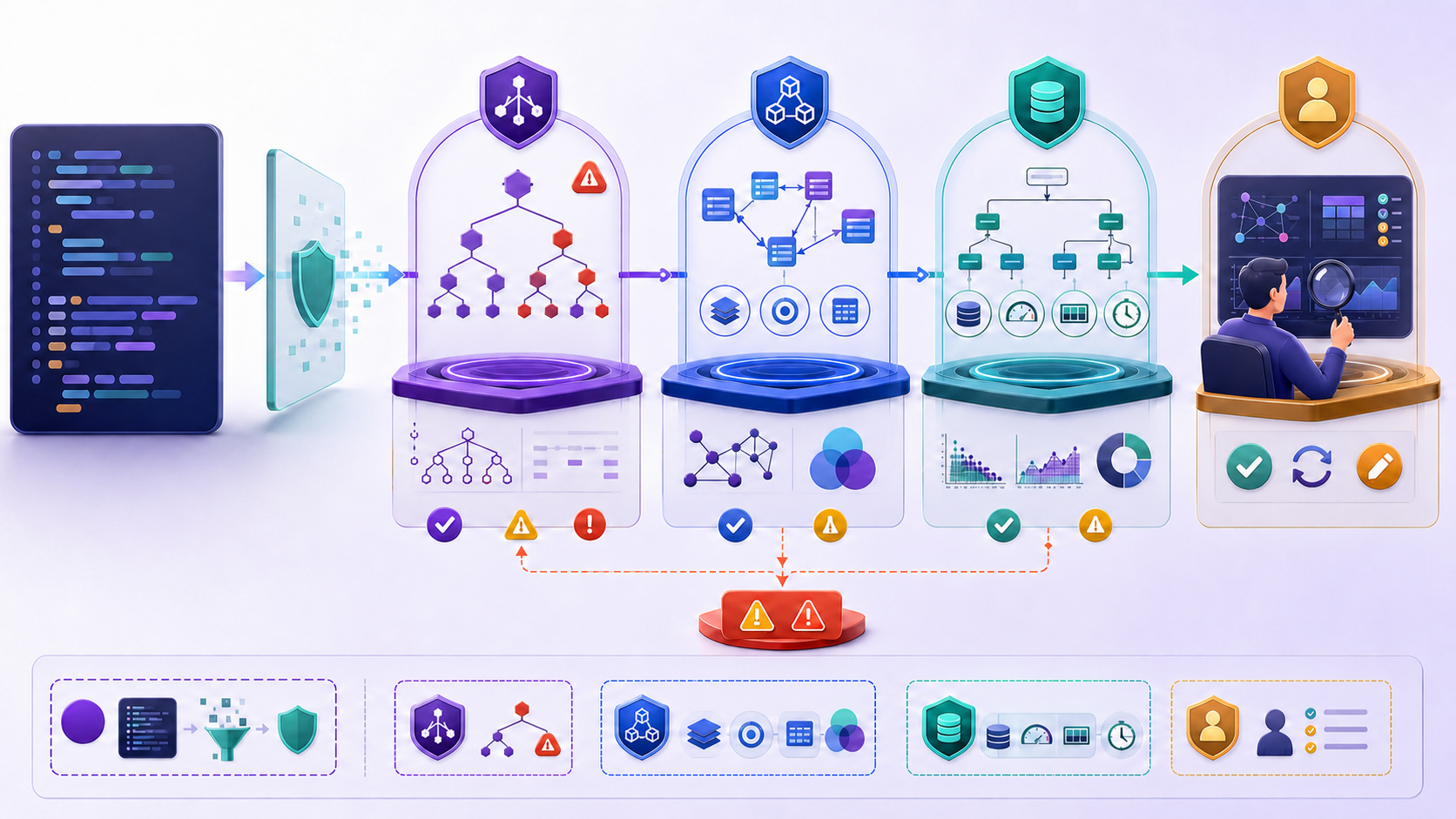
An SQL checker can validate one or more layers: parse syntax, lint style, inspect structural complexity, or help interpret database execution evidence. No single checker proves business correctness, source quality, permissions, result grain, performance in production, and security.
Choose the tool from the question. “Will this parse in PostgreSQL?” needs a dialect-aware parser. “Why is this hard to maintain?” needs structural review. “Why is it slow on this data?” needs the target database's actual plan. “Is revenue correct?” needs data tests and reconciliation.
Separate syntax, structure, execution, and semantics
| Layer | Can answer | Cannot prove |
|---|---|---|
| Parser/linter | Grammar and selected rules | Correct business result |
| Structural checker | Joins, nesting, windows, repetition | Real optimizer choices |
| EXPLAIN/actual plan | Operators, estimates, runtime evidence | Business meaning |
| Data tests/review | Invariants and edge cases | All future distributions |
A mature workflow connects these layers instead of treating a green parser result as approval. Every finding should state its scope and required next evidence.
Use a dialect-aware parser and schema context
SQL dialects differ in quoting, date literals, limits, functions, QUALIFY, null ordering, aliases, and procedural extensions. Select the exact engine and version where possible. A generic parser may reject valid vendor syntax or accept a construct that the target engine interprets differently.
Parsing without schema cannot confirm tables, columns, types, permissions, overloaded functions, or implicit casts. Use an approved development database or schema-aware validator for those checks. Never treat successful parsing as proof that the query can run safely.
Use structural checks to guide review, not assign guilt
Structural analysis can count joins, nested levels, CTEs, subqueries, window specifications, aggregates, repeated expressions, wide projections, and branching. High counts identify review effort and possible failure mechanisms, but a long query can be correct and efficient while a short query can produce a Cartesian product.
Convert each warning into a question: Does every join have an intended key and cardinality? Does nesting hide repeated work? Do windows share ordering? Is a complex stage named and testable? Complexity scores prioritize inspection; they do not automatically justify rewriting.
Use the target database for optimizer and runtime evidence
Only the target engine knows its catalog statistics, indexes, partitions, constraints, parameter values, memory, parallelism, and physical storage. Estimated EXPLAIN shows planned operators and estimates; an actual plan adds runtime rows, loops, time, spills, and sometimes reads. Running an actual plan can execute side effects, so use safe statements and approved environments.
A checker that never connects to the database cannot know the actual plan. It can still reveal structural questions worth taking to the plan, such as repeated correlated layers, multiple sorts, or many-to-many risks.
Prove business correctness with invariants and edge cases
A syntax-valid query can silently lose unmatched entities, multiply measures, choose nondeterministic rows, confuse NULL with zero, or apply the wrong time basis. Define one-row meaning, preserved population, metric formulas, permitted exclusions, and expected totals. Then test zero, one, and many matches, null keys, duplicates, ties, empty groups, late data, and threshold boundaries.
Compare row-level differences by stable keys plus aggregate controls. Two wrong queries can share the same total, and two correct queries can order rows differently. Match the comparison method to the contract.
Sanitize SQL before using an online checker
Remove credentials, connection strings, tokens, secrets, personal data, customer identifiers, sensitive literal values, proprietary comments, and unnecessary object names. Replace them with consistent placeholders that preserve structure. Confirm the tool's retention, training, access, region, and deletion policies and use only approved services.
Prefer offline or controlled tools for regulated or confidential workloads. An SQL checker does not need production data to review text structure. If execution is required, use a sandbox with least privilege, read-only access where possible, bounded resources, and synthetic or approved test data.
Use a seven-step SQL checking workflow
- Define intent. State output grain, population, and metrics.
- Sanitize. Remove secrets and sensitive literals.
- Parse. Use the correct dialect and version.
- Inspect structure. Review joins, nesting, windows, aggregation, and repetition.
- Validate data. Run edge cases and reconcile results in an approved environment.
- Inspect execution. Read the actual plan and resource evidence.
- Record decisions. Save findings, fixes, limits, owner, and regression tests.
Know what a green result still leaves open
- Confirm exact engine, version, and checker capability.
- Verify SQL has been sanitized and tool use is approved.
- Review every join key, cardinality, group, window, and filter boundary.
- Run schema-aware checks for objects, types, and permissions.
- Test adversarial data and compare stable business keys.
- Use actual plans for real data and representative parameters.
- Record unresolved assumptions rather than treating warnings as proof.
Diagnose a query that passes syntax but doubles revenue
Suppose a checker reports valid syntax, yet a report doubles revenue. Orders were joined to both items and payments, creating item-payment combinations before SUM. A parser cannot know the intended grain. Profile matches per order, compare distinct fact keys, pre-aggregate independent branches, and reconcile to the ledger. The checker succeeded within its scope; the workflow failed by treating scope as completeness.
Review structural complexity safely
Paste a sanitized complete statement into the InfiniSynapse SQL Complexity Checker to review joins, nesting, windows, aggregation, repeated logic, and maintainability. Use your target database and approved data tests for execution and result evidence.
Open SQL Complexity CheckerRemove credentials, secrets, personal data, and sensitive literals.SQL checker frequently asked questions
Capabilities vary across syntax, style, structure, and plan analysis.
No; business semantics and source data require tests and review.
Some do and some do not; verify behavior before submission.
It comes from the target database and shows its chosen execution plan.
Sanitize SQL, use approved tools, and keep execution in controlled environments.
Official SQL validation references
Select and evaluate an SQL checker before trusting it
Begin with a capability matrix rather than a product name. Record supported dialects and versions, offline or hosted operation, whether text is retained, whether code can be used for model training, schema connectivity, execution behavior, rule customization, CI integration, export formats, and administrative controls. A tool suitable for public examples may be unacceptable for confidential warehouse queries, while a strict enterprise linter may be unnecessary for a one-time sanitized structural review.
Evaluate with a controlled test suite. Include valid dialect-specific syntax, deliberate parse errors, missing objects, implicit casts, Cartesian joins, one-to-many metric inflation, nested correlation, repeated windows, nondeterministic ordering, null-sensitive NOT IN, and a syntactically valid but semantically wrong query. Record which findings appear, false positives, false negatives, severity, and remediation quality. This reveals the checker's real scope far better than marketing claims.
Treat auto-fixes cautiously. Formatting and unambiguous mechanical changes can be reviewed easily. Replacing subqueries with joins, moving predicates, adding DISTINCT, changing join types, applying COALESCE, or adding LIMIT can change grain and semantics. Require a diff, explanation, approval, edge-case tests, and result equivalence for every semantic rewrite. Never run generated DDL or destructive statements automatically in production.
Integrate checks by risk. Parsing and selected lint rules can block CI when confidence is high. Structural complexity findings may create a review task rather than fail a build. Actual-plan thresholds should use controlled environments and representative data, not execute arbitrary pull-request SQL against production. Business invariants belong in data tests with owners and documented tolerances. A layered pipeline prevents a low-confidence heuristic from becoming an absolute gate.
Version rules and suppressions. A suppression should identify the exact rule, location, reason, approver, and review date. Broad permanent exclusions hide new defects. When the checker, SQL engine, or rule set upgrades, run the evaluation suite and compare finding changes before enforcing new behavior. Preserve checker version in audit artifacts so an old green result remains interpretable.
Monitor the review system itself: queries checked, failure and warning rates, time to resolution, recurrent rule categories, suppressions, escaped defects, and developer feedback. A high warning count with no action indicates noisy rules, not strong governance. A low count can mean excellent code or weak coverage. Sample passed queries periodically and compare checker findings with production incidents to improve the rule portfolio.
Keep accountable human judgment in the loop
Automated findings need an owner who understands the data domain. Reviewers should classify each finding as defect, accepted risk, false positive, or deferred improvement, with evidence and a date. High-impact queries deserve a second reviewer for grain, privacy, permissions, and metric definitions. Tool output can accelerate attention, but it cannot accept business risk on behalf of a team.
When a checker suggests a rewrite, ask what invariant could fail, what edge case distinguishes the versions, and what execution evidence is still missing. Record the answer beside the accepted change. This habit turns recommendations into testable engineering decisions.
Close every checker gap explicitly
Before approval, list what the selected checker did not evaluate and assign those remaining syntax, schema, execution, security, and semantic checks to named evidence or reviewers.