
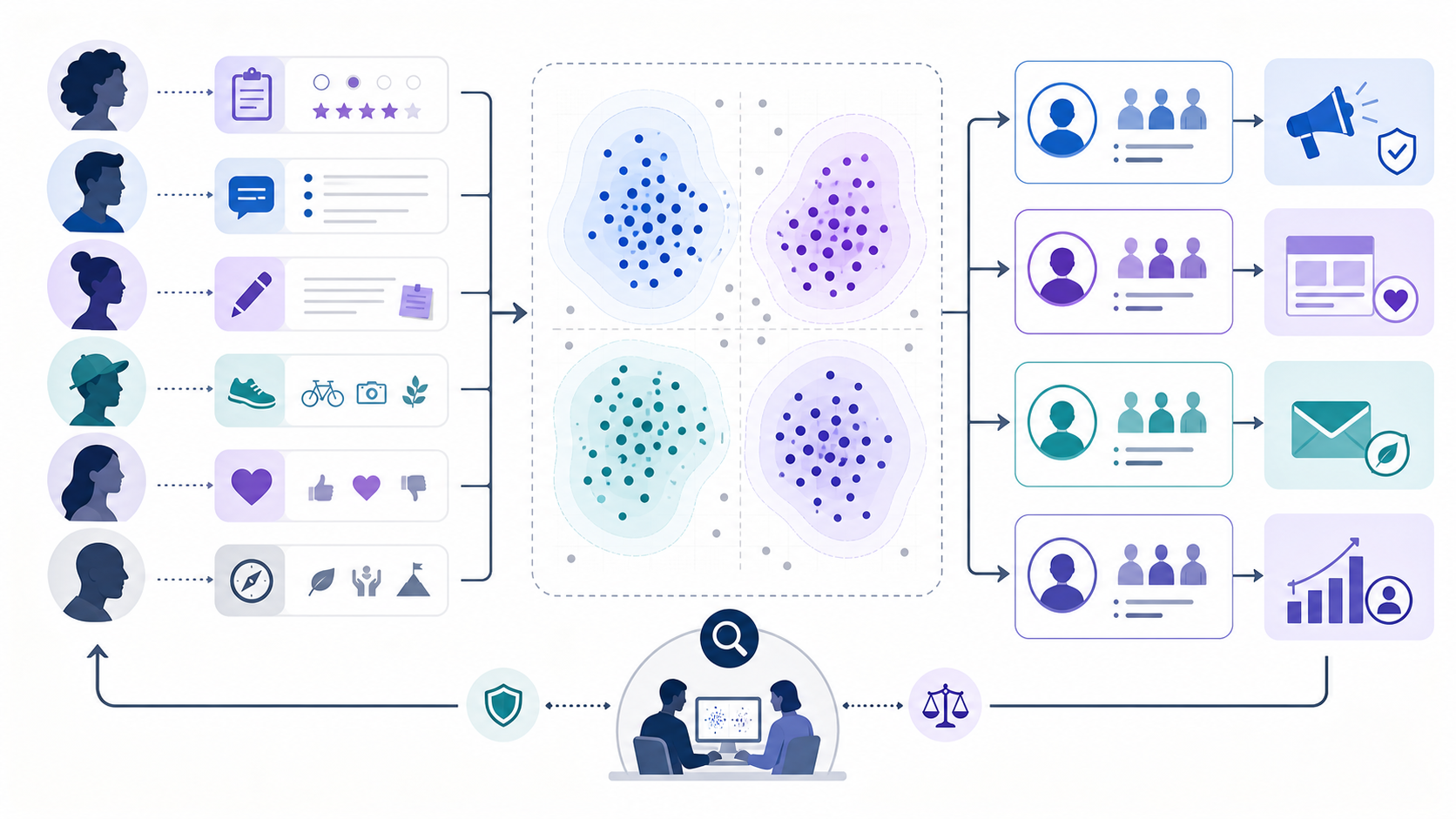
What psychographic segmentation means心理细分是什么
Psychographic segmentation is the practice of dividing an audience into groups whose members share decision-relevant psychological characteristics, such as values, motivations, attitudes, interests, opinions, and lifestyles. It is most useful when a team needs to understand why similar people respond differently and can test a different message, offer, experience, or research hypothesis for each group.
心理细分是依据与决策相关的心理特征——例如价值观、动机、态度、兴趣、观点和生活方式——把受众划分为若干组的做法。当团队需要理解外在相似的人为何反应不同,并能针对不同群组测试消息、方案、体验或研究假设时,它最有价值。
Psychographic data does not reveal a hidden, permanent essence. Responses depend on wording, context, category, timing, culture, and the population sampled. A segment is therefore a model built for a stated purpose, not a diagnosis of an individual. Use it when the groups change a real decision; skip it when a demographic, behavioral, needs-based, or jobs-to-be-done rule answers the question more simply.
心理数据不会揭示某种隐藏且永久不变的本质。回答会受到措辞、情境、品类、时间、文化和抽样人群影响。因此,分群是为明确目的建立的模型,不是对个人的诊断。只有当群组会改变真实决策时才使用;若人口、行为、需求或待办任务规则能更简单地回答问题,就不必强行采用心理细分。
Psychographic segmentation variables and how to measure them心理细分变量及其测量方法
| Variable变量 | Evidence证据 | Possible use可能用途 | Main caution主要注意事项 |
|---|---|---|---|
| Values and beliefs价值观与信念 | Agreement scales, ranking tasks, interviews同意度量表、排序任务、访谈 | Positioning and proof selection定位与证据选择 | Stated values may not predict behavior口头价值观未必预测行为 |
| Motivations and goals动机与目标 | Outcome questions, laddering interviews结果问题、阶梯式访谈 | Benefits, onboarding, offer framing利益点、引导流程、方案表达 | People can have several motives同一人可能有多个动机 |
| Activities, interests, opinions (AIO)活动、兴趣、观点(AIO) | Frequency items, topic choices, open text频率题、主题选择、开放文本 | Content themes and research recruitment内容主题与研究招募 | Interests shift with context and time兴趣随情境与时间变化 |
| Lifestyle and routines生活方式与日常习惯 | Time use, constraints, routines, diary studies时间使用、限制、习惯、日记研究 | Channel, timing, packaging, experience渠道、时机、包装、体验 | Do not turn circumstance into personality不要把处境误当成人格 |
| Attitudes and preferences态度与偏好 | Category-specific scales and trade-offs品类量表与权衡题 | Message tone and feature emphasis消息语气与功能重点 | Measure the relevant object explicitly必须明确测量相关对象 |
Do not copy a generic list of traits into a survey. Begin with qualitative interviews, support conversations, reviews, or open-ended responses to learn the language people use. Convert recurring, decision-relevant themes into balanced statements. Include positive and negative wording carefully, avoid double-barreled items, and pilot for comprehension. A five- or seven-point agreement scale is common, but scale length alone does not create validity.
不要把通用特征列表直接复制进问卷。应先通过定性访谈、客服对话、评论或开放回答了解人们真实使用的语言,再把反复出现且与决策有关的主题转化为平衡陈述。谨慎搭配正反措辞,避免一个题目同时询问两件事,并先做理解度试测。五点或七点同意度量表很常见,但量表长度本身不会自动带来有效性。
Psychographic vs demographic and behavioral segmentation心理细分与人口、行为细分的区别
| Method方法 | Core question核心问题 | Typical data典型数据 | Best use最佳用途 |
|---|---|---|---|
| Demographic人口细分 | Who are they?他们是谁? | Age band, location, role, household, income band年龄段、地区、角色、家庭、收入区间 | Reach, eligibility, access, broad context触达、资格、可访问性、宏观背景 |
| Behavioral行为细分 | What did they do?他们做了什么? | Purchases, events, frequency, recency, journeys购买、事件、频率、近因、旅程 | Lifecycle actions and observed patterns生命周期行动与已观察模式 |
| Needs-based需求细分 | What outcome or constraint matters?什么结果或限制最重要? | Problems, desired outcomes, trade-offs问题、期望结果、权衡 | Product and service design产品与服务设计 |
| Psychographic心理细分 | Why might they prefer one path?他们为何可能偏好某条路径? | Values, motives, attitudes, AIO, lifestyle价值观、动机、态度、AIO、生活方式 | Positioning, creative hypotheses, experience framing定位、创意假设、体验表达 |
The strongest design often joins these lenses after the segments are formed. Use survey variables to create psychographic groups, then profile those groups with demographics and observed outcomes that were not used to construct them. This reduces circular reasoning. A behavioral difference can support usefulness, but it still does not prove the psychological explanation or causality.
更稳健的设计通常在分群形成后再连接这些视角:先用调查变量建立心理群组,再用未参与建模的人口属性和实际结果刻画群组,从而减少循环论证。行为差异可以支持分群的实用性,但仍不能证明心理解释或因果关系。
Prepare psychographic research data before clustering聚类前准备心理研究数据
Name the audience, business decision, available actions, exclusions, owner, timing, and what would make a segment unusable.
写明受众、业务决策、可选行动、排除规则、负责人、时间,以及什么情况会让分群不可用。
Keep question text, response scale, randomization, skip logic, language version, consent language, and pilot notes.
保留题目文本、回答量表、随机顺序、跳题逻辑、语言版本、同意说明与试测记录。
Use one row per respondent, stable pseudonymous keys, coded responses, quality flags, weights, source, and collection time.
每位受访者一行,包含稳定化名键、编码回答、质量标记、权重、来源和采集时间。
Reserve holdout data or a second sample, define stability checks, and choose outcomes or experiments not used to build clusters.
预留留出数据或第二样本,定义稳定性检查,并选择未参与建群的结果或实验。
Sample design matters more than decorative persona names. Define the population and recruitment frame; inspect coverage, nonresponse, duplicate and speed flags; record missing-data rules; and decide whether weights are needed. Do not mix current customers, prospects, and the general population without a reason, because the resulting clusters may describe recruitment sources rather than meaningful psychographic differences.
样本设计比漂亮的画像名称更重要。应定义目标总体与招募框,检查覆盖偏差、未响应、重复回答与异常快速作答,记录缺失值规则,并决定是否加权。不要在没有理由时混合现有客户、潜在客户和一般人群,否则聚类可能只是在区分招募来源,而非有意义的心理差异。
How to do psychographic segmentation step by step如何逐步完成心理细分
- Define the decision and audience.定义决策与受众。Specify what will change—message, offer, channel, onboarding, research recruitment, or product hypothesis. Set ethical exclusions before seeing clusters.明确要改变的是消息、方案、渠道、引导、研究招募还是产品假设,并在查看分群前设定伦理排除项。
- Discover candidate dimensions.发现候选维度。Use interviews and open text to identify motives, constraints, attitudes, language, and contradictions relevant to the category.通过访谈与开放文本识别与品类有关的动机、限制、态度、语言和矛盾。
- Design and pilot the survey.设计并试测问卷。Write neutral single-idea items, choose response scales, test comprehension, measure completion quality, and revise ambiguous questions.编写中性且单一含义的题目,选择回答量表,测试理解度与完成质量,并修改歧义题。
- Clean, code, and document.清洗、编码并记录。Apply preregistered quality rules, inspect missingness and straight-lining, reverse-code carefully, and create a reproducible data dictionary.应用预先规定的质量规则,检查缺失与直线作答,谨慎反向编码,并建立可复现的数据字典。
- Reduce dimensions when justified.在有依据时降维。Inspect correlations and reliability; use exploratory factor or component methods only when assumptions and interpretation fit. Retain meaning, not merely variance.检查相关性与可靠性;只有在假设和解释合适时才使用探索性因子或成分方法,保留意义而不只是方差。
- Compare candidate segment solutions.比较候选分群方案。Run more than one plausible method or cluster count. Compare separation, size, stability, interpretability, and actionability instead of choosing the prettiest chart.运行多个合理方法或群数,比较区分度、规模、稳定性、可解释性与可行动性,不要按最漂亮的图选择。
- Profile without circularity.避免循环式画像。Describe each group with holdout variables, behaviors, outcomes, and verbatim evidence not used in clustering. Name groups neutrally and document uncertainty.用未参与聚类的留出变量、行为、结果和原话描述群组,中性命名并记录不确定性。
- Validate, activate, and monitor.验证、应用并监测。Reproduce the solution on holdout or later data, create a bounded classification rule, test one decision, monitor harm and drift, and retire segments that stop helping.在留出或后续数据上复现,建立有边界的分类规则,测试一个决策,监测伤害与漂移,并淘汰不再有用的分群。
Choose a psychographic segmentation method you can defend选择可辩护的心理细分方法
| Method方法 | When it fits适用情况 | Watch for注意事项 |
|---|---|---|
| Rule-based grouping规则分组 | A small, theory-backed set of explicit thresholds少量、有理论依据的明确阈值 | Arbitrary cutoffs and forced exclusivity任意阈值与强制互斥 |
| Factor analysis then clustering因子分析后聚类 | Many correlated survey items may reflect fewer dimensions大量相关题项可能反映较少潜在维度 | Ordinal scales, rotation choices, unstable factors有序量表、旋转选择、不稳定因子 |
| K-means or hierarchical clusteringK 均值或层次聚类 | Prepared numeric features and exploratory grouping已准备的数值特征与探索性分组 | Scaling, distance assumptions, outliers, forced shapes缩放、距离假设、异常值、强制形状 |
| Latent class analysis潜类分析 | Categorical or ordinal indicators and probabilistic membership分类或有序指标及概率归属 | Local independence, model fit, small classes局部独立、模型拟合、小群体 |
No silhouette score, fit index, or dendrogram is sufficient on its own. A useful solution balances statistical evidence with domain coherence and operational constraints. Compare assignments across resamples, seeds, methods, and time. Report borderline membership when the model provides probabilities; do not hide uncertainty by forcing every person into a vivid persona.
任何轮廓系数、拟合指标或树状图都不能单独决定答案。有用的方案需要平衡统计证据、领域一致性和运营约束。应比较不同重采样、随机种子、方法和时间下的归属;若模型提供概率,应报告边界成员的不确定性,不要用鲜明画像掩盖强制分类。
Hypothetical psychographic segmentation example假设心理细分示例
This example is hypothetical; labels and results are illustrative, not observed InfiniSynapse customer data.
本示例为假设场景;标签与结果仅用于说明,并非 InfiniSynapse 客户数据。
A subscription meal-planning team knows its core customers are busy adults, but demographic targeting does not explain why some respond to low-cost messages while others respond to control or variety. The team interviews 24 consenting participants across customer and prospect groups, then pilots a survey containing category-specific statements about planning effort, budget predictability, food exploration, health confidence, and household coordination. It recruits a broader sample using documented quotas and keeps a holdout portion for validation.
某订阅式膳食规划团队知道核心用户是忙碌成年人,但人口定向无法解释为何有些人响应低价信息,另一些人响应掌控感或多样性。团队在客户与潜客中访谈 24 名已同意的参与者,再试测一份品类专属问卷,涵盖规划精力、预算可预测性、食物探索、健康信心与家庭协作。随后按有记录的配额招募更广样本,并预留一部分用于验证。
The exploratory model suggests three candidate groups: people seeking predictable routines, people seeking confident health choices, and people seeking variety with low planning effort. These names summarize dominant patterns; they do not claim every member has only one motive. The team profiles the groups with holdout meal-selection and renewal data, checks whether assignments reproduce, and finds enough stability to test creative—not enough evidence to redesign pricing or infer health conditions.
探索模型提出三个候选群组:追求可预测日常的人、追求有把握健康选择的人,以及追求多样性但不愿投入太多规划精力的人。这些名称只概括主要模式,并不声称每位成员只有一种动机。团队使用未参与建模的选餐与续订数据刻画群组,检查归属能否复现,认为稳定性足以支持创意测试,但不足以重定价或推断健康状况。
For one campaign, consenting research-panel members are randomly shown one of three message frames. The primary outcome and guardrails are defined before launch. The result would tell the team whether a frame works better for a research-defined group under those conditions; it would not prove a universal personality type, permit covert profiling, or guarantee future performance.
在一次活动中,已同意参与研究的面板成员被随机展示三种消息框架之一。主要结果与护栏指标在上线前确定。结果只能说明某框架在这些条件下是否更适合研究定义的群组;它不能证明普遍人格类型,也不授权隐蔽画像,更不保证未来表现。
Common psychographic segmentation mistakes, limits, and privacy risks心理细分的常见错误、限制与隐私风险
- Starting with catchy personas. Names can conceal weak evidence. Preserve item distributions, cluster profiles, sample sizes, and uncertainty.先想吸睛画像。名称会掩盖薄弱证据;应保留题项分布、群组特征、样本量与不确定性。
- Inferring motivation from behavior alone. The same click or purchase can arise from convenience, price, habit, identity, or constraint.仅凭行为推断动机。同一点击或购买可能来自便利、价格、习惯、身份或限制。
- Overfitting a small or biased sample. Too many variables and clusters create unstable stories that fail outside the recruited panel.对小样本或偏样本过拟合。变量和群数过多会制造离开招募面板就失效的不稳定故事。
- Treating correlation as cause. Segment differences can reflect recruitment, access, life stage, or measurement artifacts.把相关当因果。群组差异可能来自招募、可访问性、人生阶段或测量伪影。
- Using sensitive traits or manipulative targeting. Avoid covert inference, discriminatory exclusion, vulnerability exploitation, and uses people would not reasonably expect.使用敏感特征或操纵性定向。避免隐蔽推断、歧视性排除、利用脆弱性,以及人们无法合理预期的用途。
- Leaving segments unchanged forever. Values, context, markets, and measurement instruments drift. Revalidate and retire stale solutions.永远不更新分群。价值观、情境、市场与测量工具都会漂移;应重新验证并淘汰过时方案。
Privacy and research obligations depend on jurisdiction and context. Apply data minimization, purpose limitation, consent or another valid basis, access controls, retention limits, participant rights, and specialist review where necessary. The UK ICO guide to data-protection principles is one authoritative regulatory reference; it is not universal legal advice.
隐私与研究义务取决于司法辖区和具体情境。应落实数据最小化、目的限制、同意或其他有效依据、访问控制、保留期限、参与者权利,并在必要时接受专业审查。英国 ICO 数据保护原则指南是一项权威监管参考,但不是普遍适用的法律建议。
How to validate a psychographic segmentation model如何验证心理细分模型
| Check检查 | Evidence证据 | Failure signal失败信号 |
|---|---|---|
| Separation and coherence区分度与一致性 | Profiles differ on meaningful construction variables群组在有意义的建模变量上不同 | Nearly identical centers or contradictory themes中心几乎相同或主题互相矛盾 |
| Stability稳定性 | Similar assignments across resamples, seeds, and time重采样、种子与时间变化下归属相似 | Members switch groups under minor changes轻微变化即导致大量换组 |
| External validity外部有效性 | Holdout variables or later data show relevant differences留出变量或后续数据出现相关差异 | Only construction items distinguish groups只有建模题项能区分群组 |
| Actionability and reach可行动性与可触达性 | A lawful intervention differs and can be tested存在合法、不同且可测试的干预 | The groups change no decision or cannot be reached群组不改变决策或无法触达 |
| Fairness and acceptability公平性与可接受性 | Documented review, safeguards, and participant expectations已记录的审查、保护措施与参与者预期 | Disparate harm, surprise use, or sensitive inference差异性伤害、意外用途或敏感推断 |
Write a one-page segment contract: version, target population, source and dates, construction variables, preprocessing, method, cluster count, assignment logic, uncertainty rule, intended uses, prohibited uses, owner, review date, and monitoring measures. This turns a presentation artifact into a reviewable analytical object.
应编写一页分群契约:版本、目标人群、来源与日期、建模变量、预处理、方法、群数、归属逻辑、不确定性规则、允许用途、禁止用途、负责人、复核日期与监测指标。这样才能把演示材料转化为可审核的分析对象。
Analyze prepared psychographic data with InfiniSynapse用 InfiniSynapse 分析已准备的心理数据
Once the research instrument and data are prepared, an analytical workspace can help with data-quality profiling, response distributions, reproducible transformations, factor or cluster comparisons, tables, charts, and validation summaries. Keep the human research team responsible for construct validity, consent, ethical review, segment naming, and activation decisions.
研究工具与数据准备完成后,分析工作区可协助完成数据质量概览、回答分布、可复现转换、因子或聚类比较、表格、图表与验证摘要。构念有效性、同意、伦理审查、分群命名与应用决策仍应由研究团队负责。
Before opening the app, prepare a CSV or spreadsheet with one row per respondent, a data dictionary, survey wording and scales, quality flags, weight fields, a decision question, intended and prohibited uses, and trusted totals for reconciliation. InfiniSynapse can help analyze uploaded or connected data; it does not recruit participants, obtain consent, validate a psychological construct automatically, or authorize targeting.
打开应用前,请准备每位受访者一行的 CSV 或表格、数据字典、问卷措辞与量表、质量标记、权重字段、决策问题、允许与禁止用途,以及用于对账的可信总数。InfiniSynapse 可协助分析上传或已连接数据,但不会招募参与者、取得同意、自动验证心理构念或授权定向。
Open the InfiniSynapse data analysis app打开 InfiniSynapse 数据分析应用A useful first task is a reproducible data audit: list missingness by item, response-time flags, straight-lining checks, scale coding, weighted and unweighted totals, and differences between the modeling and holdout samples. Resolve those issues before asking for personas or campaign recommendations.
第一个有用任务是可复现的数据审计:列出各题缺失率、作答时长标记、直线作答检查、量表编码、加权与未加权总数,以及建模样本与留出样本差异。在要求生成画像或活动建议前,先解决这些问题。
Psychographic segmentation best practices and next steps心理细分最佳实践与下一步
- Start with one decision. Broad “understand our audience” projects collect too much data and produce decorative segments.从一个决策开始。宽泛的“了解受众”项目往往收集过多数据并产出装饰性分群。
- Keep original evidence. Preserve item wording, coding, distributions, interview excerpts, and version history behind every summary label.保留原始证据。在每个摘要标签背后保存题目措辞、编码、分布、访谈原话和版本历史。
- Use neutral, revisable names. Describe a dominant need or orientation without moral judgment, caricature, or claims of permanence.使用中性、可修改的名称。描述主要需求或取向,不作道德评判、漫画化或永久性断言。
- Separate research from activation. A group observable in a survey may not be lawfully or accurately reachable in an advertising platform.区分研究与应用。调查中可观察的群组未必能在广告平台中合法、准确地触达。
- Test the intervention. Segment quality matters only if a differentiated action improves a defined outcome without unacceptable guardrail harm.测试干预。只有差异化行动改善既定结果且未造成不可接受的护栏损害,分群质量才有意义。
- Monitor drift and deletion. Set review dates, reclassification rules, retention limits, and a process for honoring participant rights.监测漂移与删除。设定复核日期、重新分类规则、保留期限,以及履行参与者权利的流程。
The practical next step is to write the decision brief and conduct a small set of interviews before drafting a survey. If the interviews reveal no meaningful variation that could change an action, stop. Avoiding an unnecessary segmentation project is also a valid research outcome.
务实的下一步是在起草问卷前先写决策简报并完成一小组访谈。如果访谈没有发现能够改变行动的有意义差异,就应停止。避免一个不必要的细分项目,同样是有效的研究结果。
Frequently asked questions about psychographic segmentation关于心理细分的常见问题
Psychographic segmentation divides an audience into groups based on shared values, motivations, attitudes, interests, opinions, personality-related tendencies, or lifestyles. It is designed to explain why people may prefer different messages or offers, not merely who they are or what they clicked.
心理细分依据共同的价值观、动机、态度、兴趣、观点、人格相关倾向或生活方式划分受众。它用于解释人们为何可能偏好不同消息或方案,而不只是描述他们是谁或点击了什么。
Common variables include values, motivations, attitudes, beliefs, activities, interests, opinions, lifestyles, aspirations, and decision preferences. Use only variables relevant to a defined decision, and avoid inferring sensitive traits without a lawful, ethical basis.
常见变量包括价值观、动机、态度、信念、活动、兴趣、观点、生活方式、愿望与决策偏好。只使用与既定决策有关的变量,并避免在缺乏合法、合乎伦理依据时推断敏感特征。
Define the decision, collect consented survey and qualitative evidence, clean and code responses, explore latent dimensions, compare candidate clusters, profile them with separate variables, validate stability and usefulness, and test the resulting marketing decisions.
先定义决策,收集经同意的调查与定性证据,清洗并编码回答,探索潜在维度,比较候选聚类,用独立变量刻画群组,验证稳定性与实用性,再测试由此产生的营销决策。
Demographic segmentation groups people by observable attributes such as age, location, household structure, or income band. Psychographic segmentation groups them by motivations, values, attitudes, interests, or lifestyles. Combining both can improve interpretation, but neither proves individual intent.
人口细分按年龄、地区、家庭结构或收入区间等可观察属性分组;心理细分按动机、价值观、态度、兴趣或生活方式分组。组合两者可改善解释,但都不能证明个人意图。
No. Behavior shows recorded actions, not the motivation behind them. Behavioral patterns can help recruit interview participants or test whether a survey-derived segment acts differently, but motivation should not be asserted from clicks alone.
不能。行为只显示已记录动作,不显示其背后动机。行为模式可以帮助招募访谈参与者,或检验调查分群是否表现不同,但不能只凭点击断言动机。
Useful segments are distinct, internally coherent, stable enough to reproduce, large enough to act on, reachable through appropriate channels, and linked to a real decision. Validate them on holdout data and through controlled message or offer tests.
有用的分群应彼此不同、内部一致、稳定到可复现、规模足以行动、可通过合适渠道触达,并关联真实决策。应使用留出数据以及受控消息或方案测试进行验证。
Authoritative sources权威来源
- OpenStax Principles of Marketing: market segmentation — an academic treatment of psychographic variables, including values, lifestyle, personality, and AIO.OpenStax《营销学原理》的市场细分章节——介绍价值观、生活方式、人格与 AIO 等心理变量。
- UK Government Analysis Function questionnaire design guidance — official methodological guidance on requirements, ethics, respondent burden, inclusive design, and qualitative and quantitative testing.英国政府分析职能问卷设计指南——关于需求、伦理、受访者负担、包容性设计以及定性与定量测试的官方方法指导。
- UK ICO guide to data-protection principles — official guidance for one regulatory context.英国 ICO 数据保护原则指南——一种监管语境下的官方指导。