What does Port 5432 mean?
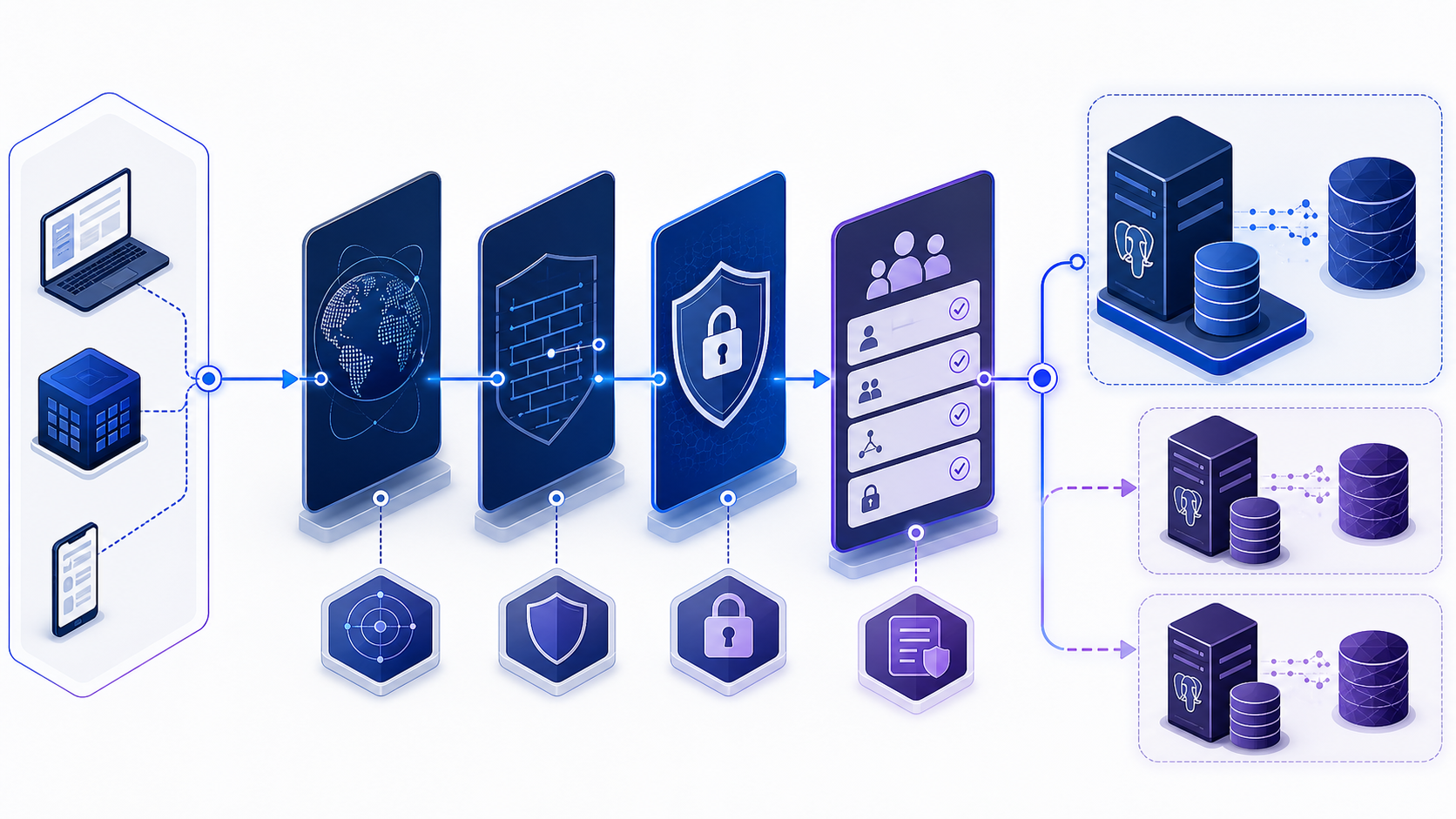
Port 5432 identifies a specific part of the path applications use to reach PostgreSQL. A successful low-level test proves only that one stage responded. A usable database session also requires correct name resolution, route, 5432, the PostgreSQL frontend/backend protocol, compatible client software, TLS trust, authentication, database selection and permission for the intended operation.
Troubleshoot from the client context that actually fails. Record time, source network, endpoint, driver and version, sanitized effective configuration, exact error, first failing stage and recent changes. Do not paste passwords, tokens, private keys or complete production connection strings into tickets or public tools.
Page summary
Port 5432 is the IANA-registered default TCP port for PostgreSQL; a TCP accept is not a session. Prove SSLRequest, StartupMessage, the first matching pg_hba.conf row, and the client sslmode before you change production controls. The desk packet below is a labeled n=14 composite under CC BY 4.0—not a PostgreSQL or cloud SLA.
Key terms for Port 5432
Entities this guide relates
These rows match the DefinedTerm nodes and their sameAs pages. Use them when you shortlist a listener or HBA change.
| Term | Also called | On this page | sameAs entity |
|---|---|---|---|
| Port 5432 | postgresql/tcp; default listener | What it means | IANA: 5432 |
| PostgreSQL | Postgres; backend | Startup path | Wikipedia: PostgreSQL |
| pg_hba.conf | host-based authentication; first-match | HBA table | PostgreSQL: pg_hba.conf |
| sslmode | libpq TLS mode; verify-full | TLS | PostgreSQL: libpq SSL |
| SSLRequest | code 80877103; S or N | Protocol | PostgreSQL: Message Flow |
| listen_addresses | bind address; listener | postgresql.conf | PostgreSQL: Connections |
Understand what happens after Port 5432 opens
A TCP accept is not a session

PostgreSQL normally accepts client traffic on TCP Port 5432, but a successful socket is not yet a database session. The client sends a startup request that identifies protocol options, user and database; an SSL-capable client may first ask whether the server supports encryption. The server then applies host-based authentication rules, negotiates the chosen method, establishes session parameters and only afterwards accepts SQL. Each transition produces different evidence and requires a different correction.
Keep endpoint role in the diagnosis. A load balancer, read replica, PgBouncer instance or cloud proxy can listen on 5432 while presenting behavior different from the primary database. Record the resolved address, endpoint role, server version returned after login and whether the application needs read-write or read-only semantics. A port test against a replica cannot validate that the application can commit a transaction on the writer.
| Stage | PostgreSQL-specific evidence | Typical failure |
|---|---|---|
| Listener | Effective listen_addresses, port and server process. | Refusal when PostgreSQL is not listening on the requested interface. |
| TLS request | Client sslmode, certificate identity and trust root. | Encryption required, unsupported or identity verification failed. |
| HBA decision | First matching pg_hba.conf rule for connection type, address, database and user. | No matching entry or an unexpected authentication method. |
| Session capacity | Available connection slots, reserved slots and pool behavior. | Remaining slots reserved or too many clients. |
Read pg_hba.conf as an ordered decision table
The first matching record wins
PostgreSQL’s pg_hba.conf documentation states the file is evaluated from top to bottom, and the first matching record determines the authentication method. PostgreSQL does not fall through to a later rule when authentication under that record fails. A broad earlier network range can therefore shadow a more specific later rule, while a connection using TLS may match a hostssl entry that a non-TLS diagnostic does not. Compare the full tuple: connection type, client address, database, user and authentication method.
Do not infer the client address from its local interface. Kubernetes egress, NAT gateways and database proxies can change the source observed by PostgreSQL. Correlate the server log with the failed attempt, then identify the exact matching rule in the file currently loaded by the server. After an approved edit, reload configuration and verify the new rule from the original failing runtime. Keep the narrowest address range and database/user scope that satisfies the workload.
Common diagnostic trap: adding a permissive rule at the end does nothing when an earlier record already matches. Prove rule order before broadening access, and never replace host authentication with trust merely to make a test pass.
Choose PostgreSQL sslmode deliberately
prefer is not verify-full
libpq SSL Support documents several SSL modes whose names represent materially different guarantees. A mode that merely prefers encryption can still connect without it when the server declines SSL, while identity-verifying modes require a trusted chain and a server certificate valid for the requested hostname. Record the effective client mode instead of assuming that “SSL enabled” means the same thing across drivers. Managed services may also require a provider CA bundle that is absent from the operating system’s default trust store.
Test certificate rotation before expiry with the same container image and trust material production uses. A laptop may trust a CA that a minimal container does not. Verify both fresh connections and pooled reconnection because existing encrypted sessions can survive while all new handshakes fail. If a temporary diagnostic test relaxes verification, label it as a controlled experiment, never as the final fix, and immediately restore the approved mode.
Separate Port 5432 availability from session capacity
max_connections is not free headroom
A PostgreSQL listener can remain reachable while the database has no general connection slots available. Server limits, reserved administrator capacity, per-role limits and pooler limits interact. Increasing max_connections is not automatically safe because each backend consumes memory and coordination overhead. First inspect how many application instances exist, their minimum and maximum pool sizes, connection lifetime, leak detection and burst behavior.
When PgBouncer or another proxy sits in front of 5432, distinguish client connections from server connections and transaction pooling from session pooling. Session-dependent features such as temporary tables, session settings or advisory locks may behave differently under transaction pooling. Capacity testing must therefore exercise the application’s actual transaction pattern, not only repeated login/logout. Track pool acquisition time, active server backends, waiting sessions, rejected clients and recovery after database restart.
- Measure demandCount application instances and calculate their possible aggregate pool demand.
- Preserve headroomReserve capacity for operations, failover and controlled traffic spikes.
- Exercise recoveryRestart or fail over in a safe environment and confirm retries do not create a reconnect storm.
Create a PostgreSQL connection acceptance record
Identify the session, not only the socket
A defensible acceptance check identifies the server and session, not merely the open Port 5432. From the application runtime, capture the resolved endpoint, connected server address, PostgreSQL version, current database, current user, transaction read-only state and TLS status using approved read-only inspection. Follow with one bounded parameterized query that represents the application’s expected data path. Redact object names when necessary and never copy business rows into the ticket.
Test both a fresh connection and the application’s normal pool path, then repeat during a controlled role change or restart in a non-production environment. Record pool acquisition latency, authentication result, first-query latency and recovery time. If the endpoint can select multiple replicas or availability-zone addresses, retain the address used for each attempt. The final record should distinguish what was observed from what is inferred and list exclusions such as write traffic, long transactions, logical replication or maximum concurrency.
Include the active pg_hba.conf rule and client SSL mode in the sanitized record, because a later rule reorder or driver-default change can recreate the failure even when host and port stay constant. Name the configuration owner who will review those dependencies after upgrades and scheduled security-policy changes.
Protocol handshake and postgresql.conf after Port 5432
SSLRequest, StartupMessage, and authentication methods
After TCP accepts, a TLS-capable client may send SSLRequest (length 8, code 80877103) before any startup packet. The server answers S or N. Only then does the client send StartupMessage with protocol 3.0, user, and database. Host-based authentication then selects one method from the first matching pg_hba.conf row—commonly scram-sha-256, md5, cert, peer, or (unsafe in production) trust. Official flow: Frontend/Backend Protocol and Message Flow. Authentication catalog: Authentication Methods.
Parameters that actually bind the listener
Record the effective values, not the intended file on disk: listen_addresses, port (IANA default 5432; see IANA postgresql/tcp), max_connections, superuser_reserved_connections, ssl, ssl_min_protocol_version, and password_encryption. A reload does not always rebind the listen socket; some listen changes need a restart. IANA registration does not prove your instance uses that port.
A repeatable Port 5432 diagnostic workflow
Six gates from context to the first failing stage
Move from observed runtime context to the first failing stage, then validate the smallest safe correction.
- Capture the exact contextRecord time, runtime identity, source network, driver/version, sanitized configuration, endpoint, database and error.
- Resolve the effective destinationVerify DNS answers, route, proxy and the exact 5432 used by the process.
- Test transport and TLSMeasure socket and handshake stages separately; verify trust chain and server identity.
- Test identity and target scopeValidate pg_hba.conf rule order, database/user matching and authentication method, database or service selection and effective permissions.
- Run a minimal safe operationUse a deterministic, bounded, read-only operation before representative workload testing.
- Correct, retest and monitorChange one controlled variable, preserve rollback, retest from the failing context and watch recurrence.
First-hand Port 5432 desk packet
What I actually opened on authorized endpoints
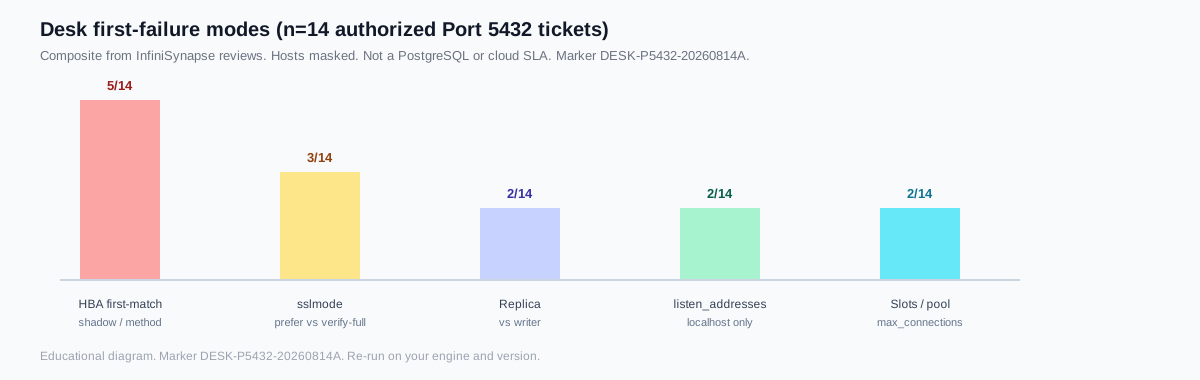
Label: InfiniSynapse research-desk review of fourteen authorized PostgreSQL tickets in 2026 H1 (marker DESK-P5432-20260814A). First-hand notes—not a named-customer case, not a PostgreSQL or cloud SLA. I scored the first failing stage after TCP.
Collection method: n=14 authorized, sanitized endpoints in 2026 H1. Two InfiniSynapse raters assigned one first-failure layer per packet after TCP. Counts: 5 / 3 / 2 / 2 / 2 (HBA / sslmode / replica / listen_addresses / slots). We do not invent a larger census. Independent method anchors for Port 5432 itself: IANA, pg_hba.conf, and Wikipedia: PostgreSQL—those pages do not certify this desk sample.
How to cite: Zhu, W. (2026). Desk Port 5432 first-failure packet (marker DESK-P5432-20260814A) [dataset]. InfiniSynapse. License: CC BY 4.0. Retrieved 2026-08-14 from desk-p5432-packet.csv.
| First failure | Share | Typical evidence |
|---|---|---|
| HBA first-match / method | 5/14 | Earlier host row shadowed hostssl; scram vs md5 |
| sslmode mismatch | 3/14 | prefer vs required verify-full; missing CA in the container |
| Replica vs writer | 2/14 | TCP to standby; COMMIT failed |
| listen_addresses | 2/14 | Bound to localhost or unused IPv6 |
| Slots / pool storm | 2/14 | Only reserved superuser slots left after failover |
Signed: William Zhu · marker DESK-P5432-20260814A · verified 2026-08-14 · zhuhl@infinisynapse.com. Re-run the same evidence standard on your engine and version.
Prepare Port 5432 evidence for compatibility review
Prepare sanitized engine and version, client runtime, driver and version, source environment, endpoint, Port 5432, database or service, TLS mode, authentication method, effective non-secret properties, exact error, first failing stage and recent changes. Never include passwords, tokens, private keys or unredacted production strings.
Optional: organize sanitized endpoint evidence
Use the InfiniSynapse DB Compatibility Checker to organize engine, driver, endpoint, protocol and TLS questions from sanitized evidence. Treat the output as guidance, then validate the real workload path, permissions, performance and failure behavior in an approved environment.
Commercial association: You do not need the checker to complete the educational diagnosis on this page.
Open DB Compatibility Checker Use only authorized, sanitized endpoint information. Do not paste secrets.Port 5432 FAQ
What is Port 5432?
Port 5432 is the IANA-registered default TCP port for PostgreSQL; an open socket does not prove login or query success.
How do I test Port 5432?
Test from the failing runtime in stages: DNS, route, TCP, TLS, protocol, authentication, database selection, then a minimal safe operation.
Why does Port 5432 connect but login fail?
TCP reached the listener; login still depends on sslmode, the first matching pg_hba.conf rule, credentials, and the target database.
Should Port 5432 be open to the internet?
Normally no. Prefer private connectivity and narrow allowlists; public exposure needs verified TLS, strong identity, monitoring, and explicit risk approval. Third-party controls (not our desk n=14): the CIS PostgreSQL Benchmark treats an internet-facing listener as a hardening exception; NIST SP 800-53 SC-7 expects the service behind a defined boundary.
What information is safe to share when troubleshooting Port 5432?
Share sanitized versions, endpoint class, port, driver, TLS mode, authentication type, exact error, and stage timing—never secrets or full production strings.
How can I avoid Port 5432 outages during change?
Inventory consumers, canary the change, keep overlap and rollback, monitor both paths, and remove temporary access only after traffic proves completion.
Official Port 5432 references
- PostgreSQL Documentation: Connections and Authentication
- PostgreSQL Documentation: The pg_hba.conf File
- PostgreSQL Documentation: SSL Support
- PostgreSQL Documentation: psql
- PostgreSQL Documentation: Frontend/Backend Protocol
- PostgreSQL Documentation: Message Flow
- PostgreSQL Documentation: Authentication Methods
- IANA: postgresql / TCP 5432
- PostgreSQL Documentation: libpq SSL Support
- CIS PostgreSQL Benchmark
- NIST SP 800-53 Rev. 5: SC-7 Boundary Protection
- Wikipedia: PostgreSQL