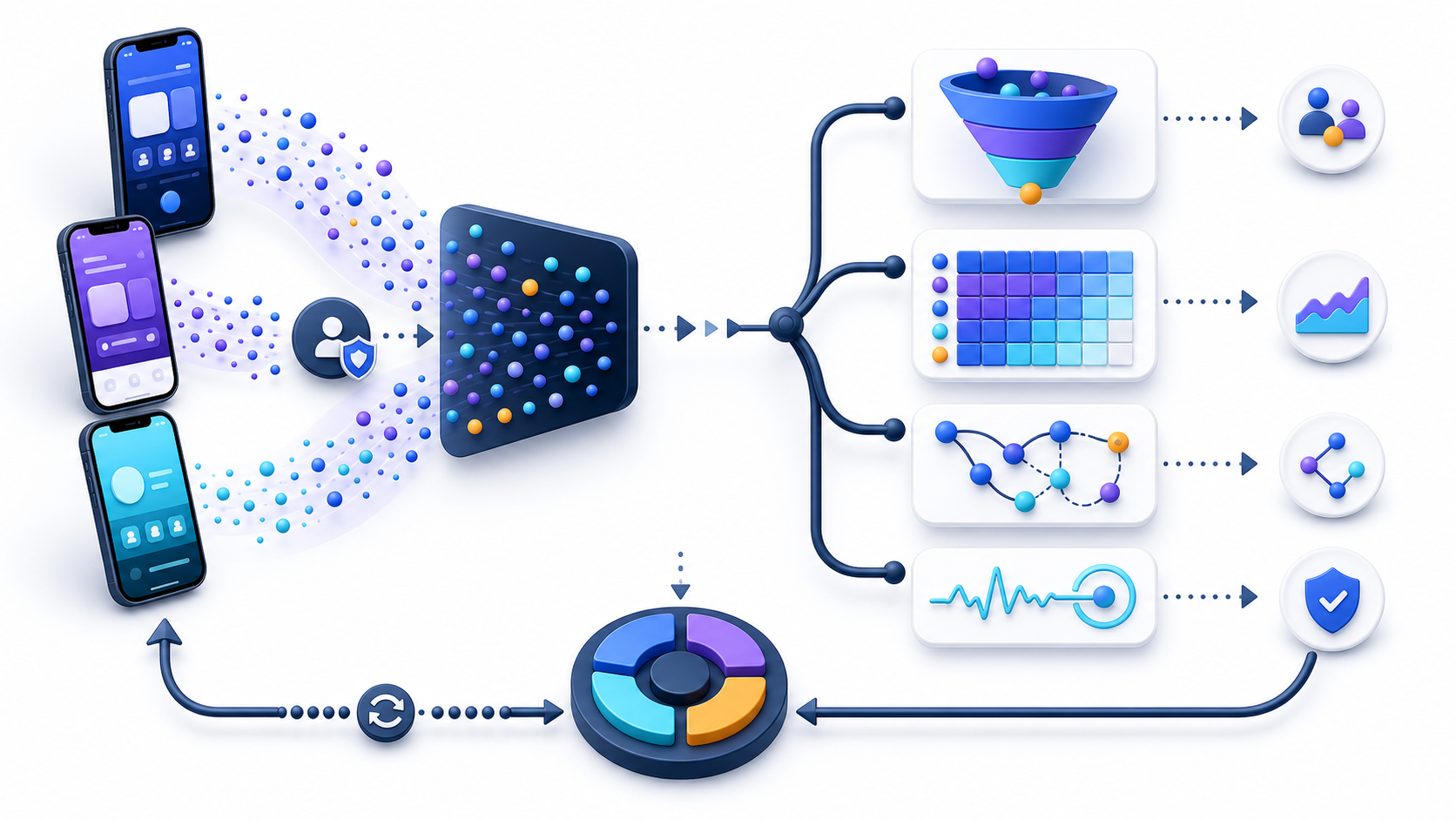
What Is Mobile App Analytics?什么是移动应用分析?
Mobile app analytics is the disciplined collection, validation, and analysis of in-app behavior, acquisition, revenue, and technical-quality data so a team can understand user journeys and make better product decisions. It starts before an SDK is installed: the team defines a decision, specifies the events and properties needed to answer it, verifies that collection is accurate, and only then interprets funnels, cohorts, paths, and app-health signals.
移动应用分析,是对应用内行为、获客、收入与技术质量数据进行有规则的采集、验证和分析,从而理解用户旅程并支持更可靠的产品决策。它并不是安装 SDK 后查看报表;团队应先定义要做的决策,再确定回答问题所需的事件与属性,验证数据采集准确性,之后才解释漏斗、cohort、路径和应用健康信号。
The phrase often covers three related but different jobs. Product analytics explains what people do after opening the app. Acquisition analytics connects campaigns to installs and downstream outcomes. Performance analytics monitors crashes, ANRs, latency, and other failures that can distort behavior. A useful mobile measurement plan connects these layers without pretending that one dashboard proves causation. For the tool split, see the mobile app experience analytics tools comparison.
这个术语通常包含三类相互关联但并不相同的工作:产品分析解释用户打开应用后的行为;获客分析把营销触点与安装及后续结果关联起来;性能分析监控崩溃、ANR、延迟及其他会扭曲用户行为的故障。有效的移动衡量方案会连接三层证据,但不会把单一仪表板当作因果证明。
When Mobile App Analytics Helps—and When It Does Not移动应用分析何时有效,何时无效
Where onboarding loses users; which features correlate with repeat use; how retention differs by app version, source, country, or device; which technical failures precede abandonment; and whether a release changed a defined outcome.
新手引导在哪一步流失;哪些功能与重复使用相关;不同版本、来源、国家或设备的留存有何差异;哪些技术故障发生在放弃之前;一次发布是否改变了预先定义的结果。
Why a person felt confused, whether a correlation is causal, what untracked offline behavior occurred, or what users would prefer before a concept exists. Interviews, usability tests, experiments, and operational records may be better evidence.
用户为何感到困惑、相关关系是否具有因果性、未被采集的线下行为发生了什么,或概念尚不存在时用户会偏好什么。访谈、可用性测试、实验和运营记录可能是更合适的证据。
Analytics also fails when consent is missing, identities are stitched incorrectly, event semantics change without versioning, or teams optimize a proxy that no longer represents the outcome. Treat the tracking plan as a measured system with owners and tests, not as an invisible stream of objective facts.
当用户同意机制缺失、身份拼接错误、事件语义变化却没有版本管理,或团队优化的代理指标已不再代表真实结果时,分析同样会失败。应把埋点方案视为有负责人、有测试的测量系统,而不是天然客观的数据流。
Build the Mobile App Analytics Data Model First先构建移动应用分析数据模型
A durable event model separates the action from its context. An event name states what happened—such as tutorial_complete, search, or purchase—while properties describe the app version, platform, screen, plan, acquisition source, experiment assignment, and other approved context. Google publishes recommended GA4 events and prescribed parameters; using stable conventions makes reports and warehouse queries easier to reconcile.
可持续的事件模型会把动作与上下文分开。事件名称说明发生了什么,例如 tutorial_complete、search 或 purchase;属性则描述应用版本、平台、页面、套餐、获客来源、实验分组及其他经批准的上下文。Google 发布了推荐的 GA4 事件及规定参数;稳定的约定能让报表与数仓查询更容易核对。
| Layer层级 | Minimum fields最少字段 | Validation question验证问题 |
|---|---|---|
| Event事件 | name, timestamp, event ID, session ID名称、时间戳、事件 ID、会话 ID | Can retries create duplicates?重试是否会生成重复记录? |
| User / installation用户 / 安装实例 | approved pseudonymous ID, first seen, consent state经批准的假名 ID、首次出现时间、同意状态 | What changes after login or reinstall?登录或重装后身份如何变化? |
| App context应用上下文 | platform, version, build, device class, locale平台、版本、构建号、设备类型、区域 | Can a release be isolated?能否隔离某个发布版本? |
| Business outcome业务结果 | order or subscription key, value, currency, status订单或订阅键、金额、币种、状态 | Does it reconcile with billing?能否与计费系统核对? |
Privacy boundary: collect only what has a documented purpose, lawful basis, retention period, and access rule. Keep sensitive content out of event properties. Consent changes and deletion requests must propagate to every destination, not only the app SDK.
隐私边界:只采集具有明确用途、合法依据、保留期限和访问规则的数据。敏感内容不应进入事件属性;同意状态变化与删除请求必须传播到所有目的地,而不只是应用 SDK。
Mobile App Analytics Metrics That Support Decisions能支持决策的移动应用分析指标
Choose a compact metric set tied to the app's value exchange. Downloads and total registered users describe reach, but they rarely tell a product team whether people reached value or returned. Define active use as a meaningful event—not simply an app open—and publish the exact inclusion rule, timezone, and identity logic beside each metric.
应围绕应用的价值交换选择一组精简指标。下载量和累计注册用户能描述覆盖范围,却很少说明用户是否获得价值或再次返回。应把“活跃”定义为有意义的行为,而不只是打开应用,并在每个指标旁公布纳入规则、时区和身份逻辑。
| Decision决策 | Metric指标 | Interpretation guardrail解释护栏 |
|---|---|---|
| Activation激活 | Users completing the first-value event ÷ eligible new users完成首次价值事件的用户 ÷ 符合条件的新用户 | Set the window and eligibility before analysis.分析前先定义时间窗口与资格。 |
| Engagement参与度 | Meaningful active users, frequency, depth有意义的活跃用户、频率与深度 | Do not reward empty opens or accidental taps.不要奖励空打开或误触。 |
| Retention留存 | Cohort members returning in day/week N ÷ cohort size第 N 天/周返回的 cohort 用户 ÷ cohort 规模 | Use calendar or rolling retention consistently.固定使用日历留存或滚动留存。 |
| Conversion转化 | Eligible users reaching an outcome ÷ funnel entrants达到结果的合格用户 ÷ 漏斗进入者 | Inspect time-to-convert and repeated attempts.检查转化耗时和重复尝试。 |
| Quality质量 | Crash-free users/sessions, ANR, latency无崩溃用户/会话、ANR、延迟 | Segment by version and device; denominators differ by tool.按版本和设备细分;不同工具的分母可能不同。 |
For Android, Android vitals documents system-measured stability and performance signals and explains why its rates can differ from SDK-based tools. A discrepancy is not automatically an error: first compare population, consent, denominator, time window, and the point at which collection begins.
在 Android 上,Android vitals 记录了系统测量的稳定性和性能信号,也解释了其比率为何可能不同于基于 SDK 的工具。数值不一致不一定代表错误;应先比较样本人群、同意状态、分母、时间窗口以及采集开始的位置。
How to Set Up Mobile App Analytics Step by Step如何逐步搭建移动应用分析
Write the decision brief. Name the user behavior, business outcome, decision owner, decision date, and evidence that would change the choice. This prevents “track everything” plans.
写决策简报。明确用户行为、业务结果、决策负责人、决策日期,以及什么证据会改变选择,避免“全部采集”的方案。
Design the event contract. Specify names, triggers, properties, types, consent requirements, owner, and expected volume. Version semantic changes rather than silently reusing a name.
设计事件契约。规定名称、触发条件、属性、类型、同意要求、负责人和预期量级。语义变化时进行版本管理,不要悄悄复用旧名称。
Implement collection and transport. Add the chosen SDK or server events, deduplicate retries with stable IDs, queue safely offline, and document clock and timezone behavior.
实施采集与传输。接入选定 SDK 或服务端事件,使用稳定 ID 去重重试,安全处理离线队列,并记录时钟与时区行为。
Validate on real devices. Exercise success, failure, cancellation, background, upgrade, offline, and consent-change paths. Compare debug events with the specification before release.
在真实设备上验证。覆盖成功、失败、取消、后台、升级、离线和同意状态变化等路径,发布前把调试事件与规范逐项对照。
Reconcile before interpreting. Compare event totals with application logs, store or billing records, and warehouse row counts. Investigate gaps by version, platform, and arrival delay.
解释前先核对。把事件总量与应用日志、商店或计费记录、数仓行数比较,并按版本、平台和到达延迟调查差异。
Analyze, decide, and annotate. Build the smallest funnel or cohort that answers the brief, record exclusions and caveats, make the decision, then annotate releases and tracking changes for the next review.
分析、决策并记录。构建能回答简报的最小漏斗或 cohort,记录排除条件与注意事项,做出决策,并为下一次复盘标注发布和埋点变更。
Analyze Funnels, Cohorts, Paths, and App Health Together联合分析漏斗、cohort、路径与应用健康
A funnel answers where eligible users fail to progress through an ordered journey. A cohort answers how a defined group behaves over time. Path analysis reveals common sequences but can become noisy without a clear start or end event. Quality analysis tests whether crashes, ANRs, or latency explain a behavioral change. These methods are complements, not interchangeable chart types.
漏斗回答符合条件的用户在有序旅程的哪一步停止前进;cohort 回答一个明确群体随时间如何变化;路径分析揭示常见序列,但没有清晰起点或终点时容易产生噪声;质量分析则检验崩溃、ANR 或延迟是否能解释行为变化。这些方法相互补充,不是可互换的图表。
Hypothetical example: a subscription app sees checkout completion fall after version 8.4. The release funnel shows the drop between payment view and purchase confirmation. Segmentation finds it concentrated on one Android device family. App-health logs show a matching error spike. The team should not claim the new design caused the decline; the combined evidence supports investigating the device-specific payment failure first. All figures would remain labeled as an example until reconciled with billing.
假设示例:某订阅应用在 8.4 版本发布后,结账完成率下降。按版本拆分的漏斗显示流失集中在支付页面与购买确认之间;细分后发现主要来自一个 Android 设备系列;应用健康日志同时出现相匹配的错误峰值。团队不应声称新设计导致下降;组合证据更支持先调查特定设备的支付故障。在与计费系统核对前,所有数字都只能标记为示例。
For retention, fix cohort membership and return criteria before opening the report. Google's GA4 cohort exploration documentation distinguishes inclusion, return criteria, granularity, and calculation mode. A day-7 calendar-retention figure and a rolling seven-day return figure are different measures even when both are labeled “week-one retention.”
分析留存时,应在打开报表前固定 cohort 纳入条件和返回条件。Google 的 GA4 cohort 探索文档区分了纳入条件、返回条件、粒度和计算模式。第 7 天日历留存与七天滚动返回是不同指标,即使两者都被称为“首周留存”。
Choose a Mobile App Analytics Tool Architecture选择移动应用分析工具架构
A mobile app analytics stack usually combines several separate requirements. A collection SDK captures events; a product analytics interface explores behavior; an attribution provider connects acquisition; a crash or performance service diagnoses technical quality; a warehouse preserves joined history; and a BI or analysis layer answers governed cross-source questions. One vendor may cover several layers, but the evaluation should still test each job separately.
移动应用分析体系通常包含多个独立需求:采集 SDK 记录事件;产品分析界面探索行为;归因服务连接获客来源;崩溃或性能服务诊断技术质量;数仓保存可联结的历史数据;BI 或分析层回答受治理的跨源问题。一个厂商可能覆盖多层,但评估时仍应分别测试每项工作。
| Architecture架构 | Best fit适用场景 | Trade-off取舍 |
|---|---|---|
| Integrated suite一体化套件 | Small team needing fast standard reports需要快速标准报表的小团队 | Fast setup; definitions and exports may be constrained.搭建快,但定义与导出可能受限。 |
| Specialist stack专业工具组合 | Teams separating product, attribution, and reliability把产品、归因和可靠性分开的团队 | Depth improves; identity and cost reconciliation become harder.深度更高,但身份与成本核对更难。 |
| Warehouse-centered数仓中心架构 | Cross-platform products with governed business data拥有受治理业务数据的跨平台产品 | Flexible and auditable; needs modeling, quality tests, and ownership.灵活且可审计,但需要建模、质量测试和负责人。 |
Evaluate access controls, consent support, regional processing, identity rules, raw-data export, schema evolution, late events, sampling, retention limits, calculation transparency, SDK performance, offline behavior, and deletion workflows. Run the same test journey through every shortlisted layer and compare raw records before comparing dashboard polish.
评估时应检查访问控制、同意机制、区域处理、身份规则、原始数据导出、Schema 演进、迟到事件、抽样、保留期限、计算透明度、SDK 性能、离线行为和删除流程。先让同一条测试旅程通过所有候选层,并比较原始记录,再比较仪表板外观。
Use InfiniSynapse After Mobile Events Reach Governed Data移动事件进入受治理数据后使用 InfiniSynapse
InfiniSynapse is an analysis layer, not a mobile SDK, attribution network, crash collector, consent manager, or messaging system. Its relevant role begins when validated app events and related business data are available in supported databases or warehouses. Teams can then investigate cross-table questions in natural language and review the generated analysis rather than exporting multiple disconnected reports.
InfiniSynapse 是分析层,不是移动 SDK、归因网络、崩溃采集器、同意管理器或消息系统。它的相关工作从经过验证的应用事件及业务数据进入受支持的数据库或数仓之后开始。团队可用自然语言调查跨表问题并审查生成的分析,而不必导出多个彼此割裂的报表。
Before opening the product, document event definitions, identity keys, timezone, consent exclusions, and the billing or outcome table used for reconciliation. Then use InfiniSynapse to analyze connected data and inspect the result.
打开产品前,请记录事件定义、身份键、时区、同意排除条件,以及用于核对的计费或结果表。之后可使用 InfiniSynapse 分析已连接的数据并检查结果。
Analyze connected data with InfiniSynapse使用 InfiniSynapse 分析已连接数据A useful first question is narrow and verifiable: “For new users acquired in July, compare tutorial completion and four-week retention by app version; exclude users without analytics consent; show cohort sizes and the query logic.” Follow with a device or acquisition-source breakdown only after checking row counts and definitions.
一个合适的首个问题应当狭窄且可验证:“对 7 月获取的新用户,按应用版本比较教程完成率和四周留存;排除未同意分析的用户;展示 cohort 规模和查询逻辑。”只有在核对行数与定义后,再继续按设备或获客来源细分。
Common Mobile App Analytics Mistakes and Validation Checks移动应用分析常见错误与验证检查
A renamed screen or redesigned flow changes the trigger while the event name stays fixed. Version the contract and annotate the release.
页面改名或流程重构改变了触发条件,但事件名称未变。应对契约做版本管理并标注发布。
Guest, logged-in, and reinstalled users are merged or split inconsistently. Test transitions and publish identity rules.
访客、已登录和重装用户被不一致地合并或拆分。应测试状态转换并公布身份规则。
Client time, server time, property timezone, and rolling windows produce different counts. Store UTC and define reporting boundaries.
客户端时间、服务端时间、属性时区和滚动窗口会产生不同计数。应存储 UTC 并定义报表边界。
Power users both adopt a feature and retain more. That does not prove the feature caused retention; use experiments or stronger designs.
高活跃用户既采用某功能又留存更高,并不能证明该功能导致留存;应使用实验或更强的研究设计。
Release gate: confirm expected and observed event sequences; required-property completeness; duplicate-event rate; consent exclusions; platform and version distribution; pipeline delay; SDK-to-warehouse counts; order-to-billing reconciliation; zero and extreme values; and dashboard-to-query agreement. Save the test evidence with the tracking-plan version.
发布门槛:确认预期与实际事件序列、必填属性完整率、重复事件率、同意排除、平台与版本分布、管道延迟、SDK 到数仓计数、订单与计费核对、零值与极端值,以及仪表板与查询结果一致性。测试证据应与埋点计划版本一起保存。
Mobile App Analytics FAQ移动应用分析常见问题
It is the collection, validation, and analysis of app behavior, acquisition, revenue, and technical-quality data so teams can understand user journeys and make product decisions.
它是对应用行为、获客、收入与技术质量数据进行采集、验证和分析,从而理解用户旅程并支持产品决策。
Start with one activation event, meaningful active users, funnel conversion, cohort retention, crash-free usage, and one outcome such as paid conversion. Add metrics only when they support a named decision.
先跟踪一个激活事件、有意义的活跃用户、漏斗转化、cohort 留存、无崩溃使用情况,以及一个付费转化等结果指标。只有在支持明确决策时才增加指标。
Define decisions and events first, document names and properties, implement consent-aware collection, validate on real devices, reconcile counts, and only then build funnels and cohorts.
先定义决策和事件,记录名称与属性,实施感知用户同意状态的采集,在真实设备上验证并核对计数,之后再构建漏斗和 cohort。
No. Attribution connects acquisition touchpoints to installs or outcomes. Product analytics explains behavior after arrival. They overlap at campaign and conversion analysis but use different evidence and controls.
不等同。归因把获客触点与安装或结果关联;产品分析解释用户到达后的行为。二者在营销活动和转化分析上有交集,但使用不同的证据与控制。
No. It analyzes data from connected databases and warehouses; it does not replace the collection layer inside an app. Use it after validated event and business data are available.
不能。它分析来自已连接数据库和数仓的数据,不替代应用内的采集层。应在经过验证的事件和业务数据可用后使用。
Official Sources and Next Steps官方来源与下一步
- Google Analytics recommended eventsGoogle Analytics 推荐事件
- Google Analytics app data-collection setupGoogle Analytics 应用数据采集设置
- Google Analytics cohort explorationGoogle Analytics cohort 探索
- Android vitals documentationAndroid vitals 文档
Next, convert one important product decision into an event contract and a validation checklist. If the data is already in a database or warehouse, use the cross-source analysis workflow as a related pattern for joining product behavior with acquisition and business outcomes.
下一步,把一个重要产品决策转化为事件契约和验证清单。如果数据已进入数据库或数仓,可参考跨源分析工作流,把产品行为与获客及业务结果关联起来。